Category Archives: Education

Uwingu launches its first call for student grant applications

An announcement from Uwingu:

Uwingu Launches Its First Call for Grant Applications
Resulting Grants Will Fund Planetary Science Graduate Student Travel
to Report Research Results at Scientific Meetings During
This Time of Budget Cuts

Space startup Uwingu announced today that it is soliciting applications from planetary science graduate students to support their travel to report research results at scientific meetings in 2014 and early 2015. Applications are due by 30 April 2014 at 11:59 PM PST.

Uwingu expects to make 10-15 awards of travel grants from this solicitation by early June. Any graduate student completing their PhD in 2014 who is studying planetary science and/or exoplanets are eligible. Recipients must use the funds to present their research at a research conference occurring by 30 April 2015. Selections will be made based on material provided by applicants in the form at: http://tinyurl.com/Uwingu-TravelAwards.

Uwingu is a for profit, public engagement space company based in Boulder, CO, led by senior planetary scientists and astronomers (see http://www.uwingu.com/about-us/who-we-are/). Uwingu’s mission is to connect the public to space exploration in new ways and to create a grant fund to support a wide range of space efforts by individual space researchers, educators, and organizations.

Uwingu’s Mars Map Crater Naming Project at www.uwingu.com, which is funding these student grants, allows anyone with a connection to the Internet to help name approximately 590,000 unnamed, scientifically cataloged craters on Mars. The project aims to ultimately raise up to $10M for Uwingu’s grant fund.
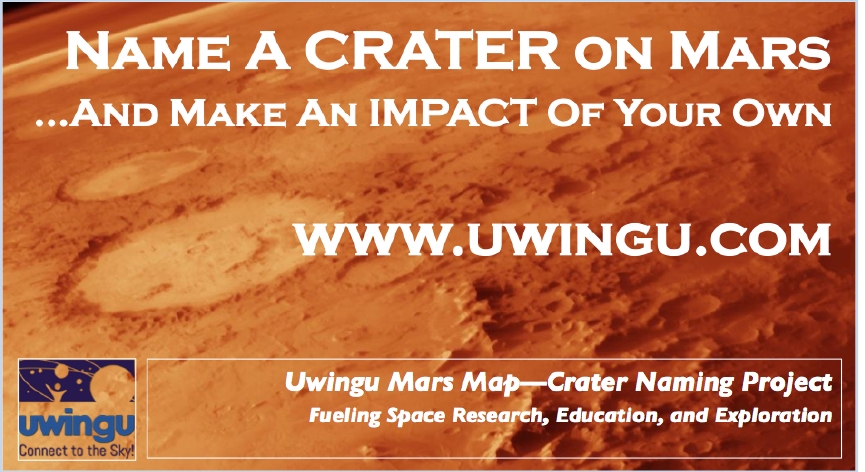
NameACraterOnMars_banner

Uwingu’s Mars map grandfathers in all the already named craters on Mars, opening the remainder up for naming by people around the globe. Prices for naming craters depend on the size of the crater, and begin at $5 dollars. Uwingu makes a shareable Internet link and a naming certificate available to each crater namer for each newly named crater. This public engagement project will culminate with the flight of Uwingufs Mars Map to Mars in 2018 aboard the Mars One 2018 robotic lander, currently in definition phase at aerospace giant Lockheed-Martin

Dr. Alan Stern, Uwingu’s CEO added, “We are excited to begin making grants to students and to supporting their research, and look forward to selecting the best applications we receive for funding. We expect to make more and more grant solicitations as revenues from our Mars Map Crater Naming Project continue to grow.”

Virtual SpaceTV 3D – March/April 2014

Here is the latest episode of The Virtual SpaceTV 3D show with Amanda Bush. The programs are created by BINARY SPACE (www.binary-space.com) with story content from HobbySpace.com.

In this show, Amanda Bush talks about the following topics:
01:27 — 04:05 Satellites assist the Malaysian Airliner Search
04:06 — 06:05 Seeing a Gravity Wave and all around the Milky Way
06:06 — 07:16 Weightless Bikinis and Parabolic Competition
07:17 — 07:59 A new Gulley on Mars
08:00 — 09:32 The first Mars War over naming Craters


Other Virtual SpaceTV 3D shows are available on the  HobbySpace Youtube Channel.

These videos are intended as educational programs and as demonstrations of an experimental technique for generating animated presentations. The show was generated autonomously by software according to a text script. The project is described in the Virtual Producer whitepaper (Release 1.1, Oct.2013, pdf). For further information contact info@binary-space.com.

SpaceUnited – a humanitarian space agency

David Livingston recently interview Adam Brinckerhoff about the SpaceUnited project: Adam Brinckerhoff, Friday, 3-28-14 – Thespaceshow’s Blog

SpaceUnited is described as “your nonprofit humanitarian space agency. Explore for good.” They define a “humanitarian space agency” as follows:

It’s a organization that helps people on Earth and beyond through the use of space technologies. Today, this help comes in the form of satellite imagery, improved housing, life-support systems, and science and education programs. Tomorrow it could mean interstellar Internet access; Mars and Moon aid; or a million other things.

Their primary goals currently appeared to be implementing Humanitarian Space Missions. Here are three current missions –

ExploraLab – Would you like to send something to the stratosphere? ExploraLab is your rocket-shaped experiment payload carrier. Simply create an experiment, put it into an ExploraLab, and drop it in the mail. We’ll make sure that it flies high and then gets delivered back to you!

SHIM-1 – SHIM-1 is a mission about saving lives. We’re working to purchase real-time satellite photos for humanitarian efforts, such as emergency relief organizations and international human rights watchdogs. Discover how you can help.

HOME-1 – HOME stands for Human Optimized Modular Environment. The mission of the HOME program is to improve human life by improving housing. We’re working on building HOMEs for on and off-Earth use. Check out this awesome project.

Two completed missions are BalloonSat-1 and BalloonSat-2.

You can follow their activities and progress at the SpaceUnited Blog. Also, SpaceUnited executives Troy Dunn and Adam Brinckerhoff present Google+ Hangouts every Tuesday at 11:30 AM MT in which they

discuss the humanitarian space exploration topic of the week, interview a guest, and answer your questions live!”

Here is a recent Hangout in which they discussed  “How To Do Space Exploration Yourself” :  SpaceUnited Hangout 3-18-14 – SpaceUnited –

JP Aerospace Kickstarter to fund 2000 student Pongsats for Sept. flight

John Powell of JP Aerospace tells me they had a successful sale of  MiniCubes last month (see JP Aerospace sale on flights of MiniCubes to NearSpace).

Their latest outreach effort is a Kickstarter to fund the flight of 2000 Pongsats in September: 2000 Student Projects to the Edge of Space by John Powell — Kickstarter

This time instead of one thousand PongSats we’re flying two thousand. We have just over 14,000 PongSats flown so far. I think that’s more student payloads then the rest of the world’s space programs combined! The PongSats are getting more and more complex. We now get PongSats with GPS’s and cameras in them and some even made on 3D printers.

(To be clear, Pongsat flights cost nothing to the students or their schools.)

Here’s the Kickstarter video:

Sunspotter – citizen solar science

Sunspotter is a Zooniverse citizen science project in which participants ”

help to organize sunspot images in order of complexity to better understand and predict how the Sun’s magnetic activity affects us on Earth.

The Sunspotter blog includes interesting items such as this Space weather – a short guide and  The Making of a Magnetogram Part I: Lost in a Magnetic Field.

sunspot_size“Sunspots vary in size and tend to range between 1.500 – 50,000 km,
making some larger than Earth.Observed with the Swedish 1-m
Solar Telescope (SST). The SST is operated on the island of La Palma
by the Institute for Solar Physics in the Spanish Observatorio del Roque
de los Muchachos of the Instituto de Astrofísica de Canarias.
Observations: Göran Scharmer and Kai Langhans, ISP.
Image processing: Mats Löfdahl, ISP”

===

See the HobbySpace Sun & Space Weather page here for real time images and data.