Category Archives: Education

Video: Detecting exoplanet systems with microlensing

Here is a SETI Institute seminar on a lesser known way to detect and measure exoplanets: Detecting Exoplanetary Systems with Micolensing – Scott Gaudi (SETI Talks)

From the caption:

Measurements of the demographics of exoplanets over a range of planet and host star properties provide fundamental empirical constraints on theories of planet formation and evolution. Because of its unique sensitivity to low-mass, long-period, and free-floating planets, microlensing is an essential complement to our arsenal of planet detection methods.

Dr. Gaudi will review the microlensing method, and discuss results to date from ground-based microlensing surveys. Also, Dr. Gaudi will motivate a space-based microlensing survey with WFIRST-AFTA, which when combined with the results from Kepler, will yield a nearly complete picture of the demographics of planetary systems throughout the Galaxy.

Space memorabilia auction online to support Astronaut Scholarship Foundation

The 2015 Fall Auction of Astronaut Memorabilia to support the Astronaut Scholarship Foundation is currently underway:

Astronaut Scholarship Foundation to Host
Bi-Annual Online Auction of Space Memorabilia

Money raised from sale of 46 collectibles and astronaut experiences
to help fund STEM scholarships for outstanding college students

KENNEDY SPACE CENTER, Fla. – From unique collectibles and signed memorabilia to one-of-a-kind flown artifacts, the public will have its chance to bid on some of the hottest space keepsakes when the Astronaut Scholarship Foundation (ASF) hosts its fall 2015 online auction beginning Sept. 19. Money raised from the auction will play a key role in funding college scholarships for outstanding science, technology, engineering and math (STEM) students across the United States.

“The Astronaut Scholarship Foundation is very fortunate to have such strong relationships with so many astronauts who are willing to donate their personal space memorabilia in support of our mission,” said Tammy Knowles, ASF’s executive director. “Our bi-annual online auction is filled with collectible items from more than five decades of space travel, all personally donated by astronauts and patrons. These generous gifts help us raise significant dollars to help shape the next generation of science and technology leaders.”

The auction will take place beginning at 9 a.m. Eastern on Saturday, Sept. 19 and run through Friday, Sept. 25 at 10 p.m. Eastern. A special preview of this year’s auction will open on Friday, Sept. 18 at 9 a.m. Eastern. The preview allows the public to register, obtain their bidding numbers and get a sneak peek at the items. This season, there are a total of 46 lots up for bid, including:

  • Official NASA Apollo Earth Orbit Chart signed by 13 Apollo astronauts, including four who walked on the Moon (Edwin “Buzz” Aldrin, Jr., Alan Bean, Eugene “Gene” Cernan and Charles “Charlie” Duke, Jr.). Entitled “Apollo Mission 12, For November 1969 Launch Dates,” this first edition chart measures approximately 13.5 inches by 42 inches.
  • Skylab Astronaut Maneuvering Unit (AMU) checklist cover, which was flown during Skylab 4 and worn on the cuffs of astronauts Gerald “Jerry” Carr, Edward Gibson and William Pogue as they worked in space.
  • Flown Apollo 14 beta cloth patch, silkscreened with the mission insignia and signed by astronaut Edgar Mitchell. The patch is made from the same material used to create fire-resistant space suits.
  • Skylab-Flown, serial-numbered pen and pencil, which were launched with the Skylab workshop in May 1973 and returned to Earth with the final Skylab crew in February 1974.

In addition, the ASF will auction four of its signature “Astronaut Experiences,” which offer bidders the chance to win a one-on-one encounter with a space explorer. This year’s experiences include:

  • A behind-the-scenes, VIP tour for two at the NASA Johnson Space Center in Houston, donated by Jacobs Technology, Inc., the corporate sponsor of ASF’s Workforce Initiative.
  • Two tickets, plus an astronaut special table guest, to the Astronaut Hall of Fame Induction Ceremony in May 2016.
  • Two breathtaking hiking adventures (one of which to take place in Shenandoah National Park).

For a complete listing of items, visit www.astronautscholarship.org/auction on Sept. 18.

While ASF has hosted live and silent auctions during its fundraising events over the past 30 years, the organization branched into online auctions in the early 2000s to appeal to a broader audience.

“Our online auction allows us to reach collectors around the world, who might not be able to attend one of our fundraising events,” Knowles said. “Over the past 10 years, auctions such as this one have helped us raise in excess of $1.5 million for our scholarship program.”

People interested in participating in the fall 2015 online auction must register in advance, beginning Sept. 18. Once the auction opens, participants may submit bids as many times as desired during the bidding period using the forms located on each lot page.

Winning bidders will be notified via email. Items will be shipped at the bidder’s expense. Cash, checks and credit cards will be accepted for payment of items. The full list of rules and regulations will be posted online on Sept. 18.

About the Astronaut Scholarship Foundation: Founded in 1984 by the surviving Mercury 7 astronauts, the Astronaut Scholarship Foundation (ASF) helps the United States retain its world leadership in science and technology. Through the garnered support of astronauts, industry leaders, educational institutions and patrons, ASF awards merit-based scholarships to the best and brightest university students who excel in science, technology, engineering and mathematics (STEM). The prestigious Astronaut Scholarship is known nationwide for being among the highest scholarships awarded to undergraduate STEM students. Since its inception, ASF has awarded in excess of $4 million in scholarships to more than 470 of the nation’s top scholars.
Kerbal Space Program – A visual history of ‘career mode’ from John Walker

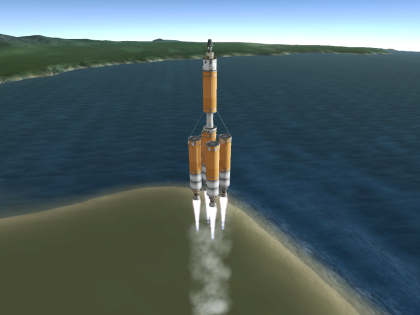
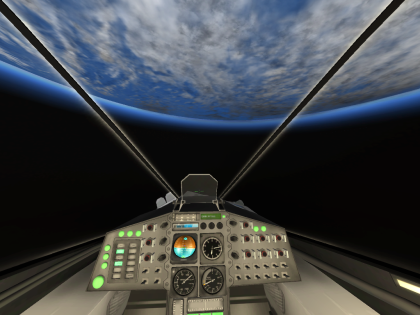
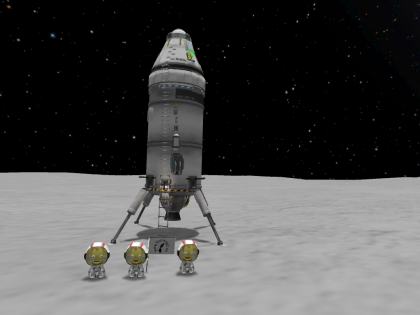
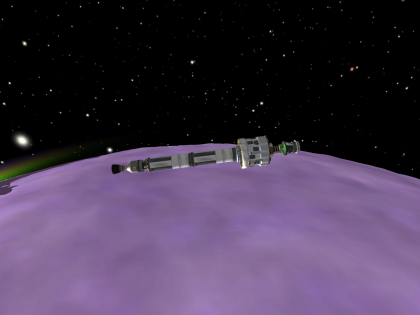
John Walker, founder of Autodesk, Inc. and co-author of AutoCAD, has posted a big Screenshot Gallery obtained from running Kerbal Space Program and learning a whole lot about rockets, orbital mechanics, and other aspects of spaceflight : New: Kerbal Space Program Screenshot Gallery – Fourmilog: None Dare Call It Reason.

The images were

accumulated over a several-months-long play-through in career mode which unlocked the entire technology tree and visited every body in the Kerbol system. An introduction explains the basics of the game to those unacquainted with it. I will add to the archive as adventures continue.

And

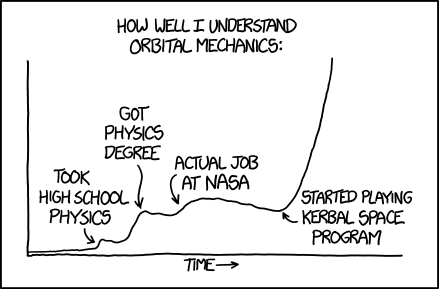
One thing which is certain is that after you’ve spent some time with Kerbal Space Program you will develop an intuition about orbital mechanics which few people, even authors of “hard” science fiction, have. Here is how Randall Munroe, creator of xkcd, described it.

orbital_mechanics[1]

A sample of Walker’s Kerbal screen captures:

screenshot11[1]

screenshot65[1]

screenshot157[1]

screenshot278[1]

Student CanSat competitions underway in US and Europe for 2016

The CanSat Competition involves student teams building soda can sized “satellites” that ride suborbital rockets to a high altitude and perform particular tasks such as atmospheric measurements. The program has been going on for several years in the US and is also now in Europe:

Getting ready for the European CanSat competitions 2016

15 September 2015: The ESA Education team has the pleasure to announce that preparations for the 2016 edition of the European CanSat competition are underway! The launch campaign will take place at the end of June 2016.

This will be the first time ESA assigns a space theme to the competition, which will be announced in the near future.

CanSats_2015_node_full_image_2[1]
Recovered CanSats from the launches
A CanSat is a simulation of a real satellite, integrated within the volume and shape of a soft drink can. The challenge for the students taking part in this competition is to fit all the major subsystems found in a satellite, such as power, sensors and a communication system, into this minimal volume. The CanSat is then launched to an altitude of a few hundred metres by a rocket, or dropped from a platform or captive balloon, where it carries out its scientific experiment and achieves a safe landing.

Before the official European CanSat competition takes place, several national CanSat competitions will be held in various ESA member states*. The winners of the national competitions will be able to participate in the European one. The national organisers are invited to send us the name of their national winning teams before 17 April 2016.

Details about the organisation of the national competitions are available on the CanSat website. Help and advice for the national organisers, the students and teachers, as well as guidelines and timetables will be published soon.

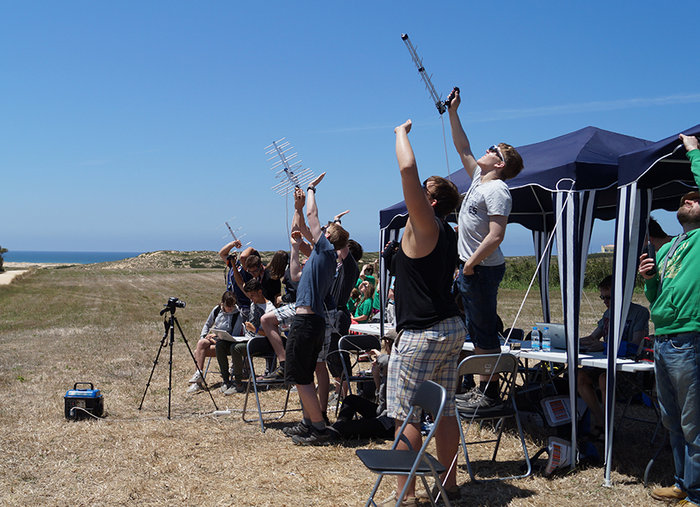
Students_tracking_their_CanSats_during_the_launch_node_full_image_2[1]
Students tracking their CanSats during the launch
The location of the European CanSat competition finals will be announced in the upcoming months. ESA will sponsor the launch and activities of the European finals as well as the accommodation of the teams who will be participating (maximum 4 students and 1 accompanying teacher per team). Travel expenses will have to be paid by the participants themselves. The student teams are requested to speak English, as all documentation and presentations that the students will have to prepare are in this language.

Several conditions have to be met in order to ensure that your team can be accepted for the European competition. One team must be composed of a maximum of four students. Each team needs to be supervised by a teacher or mentor. One teacher can be responsible for a maximum of one team. All students need to be enrolled in a secondary school located in one of ESA’s Member States*. At least 50% of the students included in a team must be of the nationality of the country of the school where they are enrolled, and be aged between 14 and 20. University students will not be accepted for this competition.

If you want more details about the national and European CanSat competitions, or if you wish to organise the national competition in your own country (if it’s not already organised there), then please contact us at cansat @ esa.int. We wish all participants the best of luck for this engaging challenge. Hope to see you at the next European CanSat competition!

Astronaut Scholarship Foundation hosting online auction of space memorabilia

A message from the Astronaut Scholarship Foundation (ASF):

Astronaut Scholarship Foundation to Host
Bi-Annual Online Auction of Space Memorabilia
Money raised from sale of 46 collectibles and astronaut experiences
to help fund STEM scholarships for outstanding college students

KENNEDY SPACE CENTER, Fla. – From unique collectibles and signed memorabilia to one-of-a-kind flown artifacts, the public will have its chance to bid on some of the hottest space keepsakes when the Astronaut Scholarship Foundation (ASF) hosts its fall 2015 online auction beginning Sept. 19. Money raised from the auction will play a key role in funding college scholarships for outstanding science, technology, engineering and math (STEM) students across the United States.

“The Astronaut Scholarship Foundation is very fortunate to have such strong relationships with so many astronauts who are willing to donate their personal space memorabilia in support of our mission,” said Tammy Knowles, ASF’s executive director. “Our bi-annual online auction is filled with collectible items from more than five decades of space travel, all personally donated by astronauts and patrons. These generous gifts help us raise significant dollars to help shape the next generation of science and technology leaders.”

The auction will take place beginning at 9 a.m. Eastern on Saturday, Sept. 19 and run through Friday, Sept. 25 at 10 p.m. Eastern. A special preview of this year’s auction will open on Friday, Sept. 18 at 9 a.m. Eastern. The preview allows the public to register, obtain their bidding numbers and get a sneak peek at the items. This season, there are a total of 46 lots up for bid, including:

  • Official NASA Apollo Earth Orbit Chart signed by 13 Apollo astronauts, including four who walked on the Moon (Edwin “Buzz” Aldrin, Jr., Alan Bean, Eugene “Gene” Cernan and Charles “Charlie” Duke, Jr.). Entitled “Apollo Mission 12, For November 1969 Launch Dates,” this first edition chart measures approximately 13.5 inches by 42 inches.
  • Skylab Astronaut Maneuvering Unit (AMU) checklist cover, which was flown during Skylab 4 and worn on the cuffs of astronauts Gerald “Jerry” Carr, Edward Gibson and William Pogue as they worked in space.
  • Flown Apollo 14 beta cloth patch, silkscreened with the mission insignia and signed by astronaut Edgar Mitchell. The patch is made from the same material used to create fire-resistant space suits.
  • Skylab-Flown, serial-numbered pen and pencil, which were launched with the Skylab workshop in May 1973 and returned to Earth with the final Skylab crew in February 1974.

In addition, the ASF will auction four of its signature “Astronaut Experiences,” which offer bidders the chance to win a one-on-one encounter with a space explorer. This year’s experiences include:

  • A behind-the-scenes, VIP tour for two at the NASA Johnson Space Center in Houston, donated by Jacobs Technology, Inc., the corporate sponsor of ASF’s Workforce Initiative.
  • Two tickets, plus an astronaut special table guest, to the Astronaut Hall of Fame Induction Ceremony in May 2016.
  • Two breathtaking hiking adventures (one of which to take place in Shenandoah National Park).

For a complete listing of items, visit www.astronautscholarship.org/auction on Sept. 18.

While ASF has hosted live and silent auctions during its fundraising events over the past 30 years, the organization branched into online auctions in the early 2000s to appeal to a broader audience.

“Our online auction allows us to reach collectors around the world, who might not be able to attend one of our fundraising events,” Knowles said. “Over the past 10 years, auctions such as this one have helped us raise in excess of $1.5 million for our scholarship program.”

People interested in participating in the fall 2015 online auction must register in advance, beginning Sept. 18. Once the auction opens, participants may submit bids as many times as desired during the bidding period using the forms located on each lot page.

Winning bidders will be notified via email. Items will be shipped at the bidder’s expense. Cash, checks and credit cards will be accepted for payment of items. The full list of rules and regulations will be posted online on Sept. 18.

About the Astronaut Scholarship Foundation: Founded in 1984 by the surviving Mercury 7 astronauts, the Astronaut Scholarship Foundation (ASF) helps the United States retain its world leadership in science and technology. Through the garnered support of astronauts, industry leaders, educational institutions and patrons, ASF awards merit-based scholarships to the best and brightest university students who excel in science, technology, engineering and mathematics (STEM). The prestigious Astronaut Scholarship is known nationwide for being among the highest scholarships awarded to undergraduate STEM students. Since its inception, ASF has awarded in excess of $4 million in scholarships to more than 470 of the nation’s top scholars.