Category Archives: Education

The Breakthrough Junior Challenge offers $250,000 prize for a student with a great science or math idea

The Breakthrough Junior Challenge is

an annual global competition for students to inspire creative thinking about science. Students ages 13 to 18 from countries across the globe are invited to create and submit original videos (3 minutes in length maximum) that bring to life a concept or theory in the life sciences, physics or mathematics. The submissions are judged on the student’s ability to communicate complex scientific ideas in engaging, illuminating, and imaginative ways. The Challenge is organized by the Breakthrough Prize Foundation.

If your video is selected as the winner, you will receive a $250,000 college scholarship, $50,000 prize for your teacher, and $100,000 for your school’s laboratory facilities. In addition, a get a free trip for you and a parent or guardian to receive your award at the live televised Breakthrough Prize Ceremony in November of 2018 (date to be announced).

Here is a video about the competition:

The competition began on April 1, 2018 and will end on July 1, 2018 at 11:59 pm PDT. This video describes the registration process:

Check the Breakthrough Junior Challenge website and FAQ for further details.

$100k in prizes for student rocket contest sponsored by Mars Society & FAR

The Friends of Amateur Rocketry (FAR) and the Mars Society are sponsoring a contest for liquid-fueled bi-propellant powered rockets built by college student teams:

FAR/Mars Society Launch Contest
Student Rocketry Teams Compete for FAR-MARS Prize

MOJAVE, CA – Student-built rockets will streak into the stratosphere in Spring, 2018 as college and university engineering teams from around the world compete for $100,000 in prizes in a contest sponsored jointly by the Mars Society, headquartered in Denver, CO and the California-based Friends of Amateur Rocketry (FAR), officers announced today.

The FAR-MARS Prize will grant $50,000 to the team whose bi-propellant liquid-fueled rocket comes closest to reaching 45,000 feet (13,716 meters). A second $50,000 prize will go to the team that comes closest to hitting that same altitude with a rocket-powered by liquid-methane and liquid-oxygen, announced Robert Zubrin, president of the Mars Society, and Mark Holthaus, director and treasurer of FAR.

“If one team can achieve both goals with the same rocket, they’ll win both prizes totaling $100,000,” Holthaus said.

The contest launch window will commence Saturday, May 5, 2018, the 57th anniversary of the launch of Alan Shepard, America’s first man in space, and continue through Sunday, May 13, according to Holthaus and Zubrin. The goal of being the closest to 45,000 feet, rather than simply reaching the highest altitude, was chosen so teams would have to demonstrate the precise control required to create reusable launch vehicles, Holthaus said.

“We see this as a logical follow-on to the Orteig Prize of the 1920’s that sparked aviation, and the X Prize of the 2000’s that jump-started commercial spaceflight,” said Zubrin, founder of the Mars Society and author of the book The Case For Mars, which proposed the Mars Direct manned missions that radically changed ideas about the feasibility of interplanetary space travel in the 1990’s. “We’re looking to get college and university students fired up about rocketry, which is the key to space travel and making humanity a multi-planetary species.”

Funds for the prize have been provided by an anonymous donor whose goal is to advance Science, Technology, Engineering, and Mathematics (STEM) education in general and human spaceflight specifically, Holthaus and Zubrin said.

The $50,000 for each part of the prize will be presented to the college or university sponsoring the winning team, to be used for scholarships for students in the STEM fields related to rocketry.

Teams will have about 15 months to design, build, and test their rockets before gathering at the FAR rocket launch complex called FAR Site, located North of Edwards Air Force Base, on May 5, 2018.

 “Each competing rocket must loft a 2.2 pound (one-kilogram) payload, containing an altitude tracking device, to the target altitude,” Holthaus said. “The payload will be supplied by FAR, rockets must be recovered by parachute, and these rockets are required to clear 30,000 feet (9,144 meters) as a minimum to qualify.”

The competition will continue over two weekends (May 5-6 and 12-13) if needed, Holthaus noted.

FAR Site is equipped with static engine test stands and rocket launch rails so competing teams can try out their engines and rockets and tweak their performance pre-competition, Holthaus added.

Competing teams must be composed of college or university students, with at least one faculty adviser providing guidance, Holthaus said. Teams from the United States and all other nations are encouraged to enter and compete; two or more institutions can combine students, faculty, and resources for a single entry.

“We see the ability to design, build, and test bi-propellant liquid-fueled rockets as a key career skill in the coming decades, with a host of new, innovative rocket companies such as SpaceX, Blue Origin and Orbital ATK taking spaceflight in entirely new directions,” Zubrin said. “Using methane as a fuel is a critical component for missions to the planet Mars, as it is easy to create liquid-methane out of the resources already available on that world.”

Details on how to enter the contest and the exact rules for the competition will be posted on the Mars Society and FAR websites.

The Mars Society is the world’s largest and most influential space advocacy organization dedicated to the human exploration and settlement of the planet Mars. Established by Dr. Robert Zubrin and others in 1998, the group works to educate the public, the media and government on the benefits of exploring Mars and creating a permanent human presence on the Red Planet.

Friends of Amateur Rocketry, formed in 2003 by amateur rocketry enthusiasts, whose mission is to educate the public in STEM fields through the use of amateur rocketry; and to foster rocket technology by supporting individuals, hobbyists, student groups, businesses, and other like-minded non-profit entities. Both The Mars Society and Friends of Amateur Rocketry are 501(c)(3) non-profit organizations.

Author: David S. Michaels

Middle school students/teachers can register for next Sally Ride EarthKAM session of ISS earth imaging

Mission 60 for the Sally Ride EarthKAM program is set for February 20-26. Sally Ride EarthKAM is a NASA educational outreach program for middle school students who select particular spots on earth for imaging by a dedicated camera on the International Space Station. See the gallery of EarthKAM images taken over the years.

A recent Sally Ride EarthKAM image of Australian coast.

The program “enables students, teachers, and the public to learn about Earth from the unique perspective of space”.

The Activities section explains the details of the program. For example:

How does a Sally Ride EarthKAM mission work?
A teacher starts by signing up for a mission on the Sally Ride EarthKAM website. Students use their class’s Mission Account to pinpoint locations and request images. To figure out where and when to request images, students can track the orbit of the ISS, refer to maps and atlases, and check weather reports to see if clouds are likely to be in the way. 

UCSD undergraduates at the Sally Ride EarthKAM Mission Control Center collect image requests from schools all over the world. NASA representatives at Johnson Space Center in Houston uplink the requests to a computer on the ISS. This computer sends the requests to the digital EarthKAM camera. Then, when the ISS is passing over the exact right spot on Earth, the camera snaps a picture. 

The images are sent back to the ISS computer and downlinked to Johnson Space Center. From there they are transmitted to NASA’s Jet Propulsion Laboratory (JPL) in Pasadena for processing and then sent to the Sally Ride EarthKAM Mission Control Center. Within hours, the Sally Ride EarthKAM team puts the images on the EarthKAM website. Students can investigate the images and make connections to subjects they are studying. 

To participate in the upcoming ISS session, students and teachers can register here.

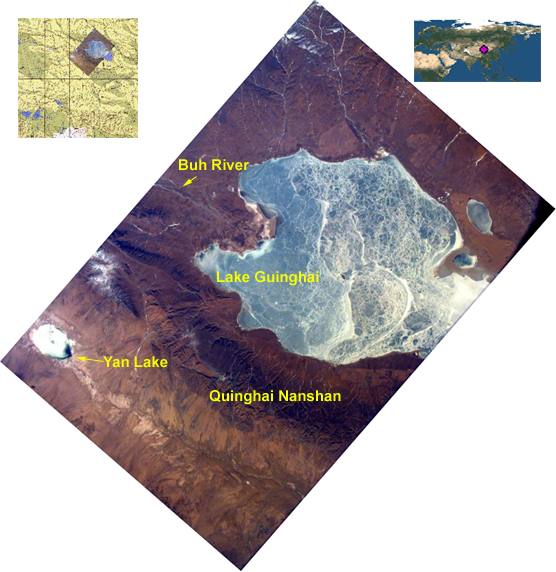
A view of a frozen lake in Qinghai Nanshan, northern China taken with the Sally Ride EarthKAM. An entry in the Favorite EarthKAM images gallery

====

Videos: #AskAbby on The Space and Science Show

Check out the Astronaut Abby YouTube channel where Abigail Harrison, aka Astronaut Abby, hosts The Space and Science Show #AskAbby series in which she answers questions about space travel topics. Here are the first three shows:

Abby founded The Mars Generation, a 501c3 nonprofit “with a mission to excite and educate kids & adults about STEM education & space exploration and the importance of both to humankind“. She is “currently a student at Wellesley College and aspires to be an astronaut & has a goal to be the first person to step on Mars in the 2030’s“.

Here is a video of a talk given by Abby “about the importance of human space exploration in giving hope to an upcoming generation of bright individuals. I’m helping spread the message about how young people’s access to science, technology, engineering, arts, and math (STEAM) education can contribute to the betterment of humankind“:

====

Student satellite projects

It’s becoming increasingly common for students in colleges as well as in grade schools and high schools to built small satellites and see them go into space before they graduate. Here is a story about one such project in Oregon: Student Satellite …. Radio | OPB

The Oregon Small Satellite Project is an ad hoc group of students and educators working on a nano-satellite or “cubesat” to hand off to NASA to launch into space next year. Andrew Greenberg is the faculty advisor for the Portland State Aerospace Society, the group heading up the project. He joins us to talk about the project and its mission.  

===

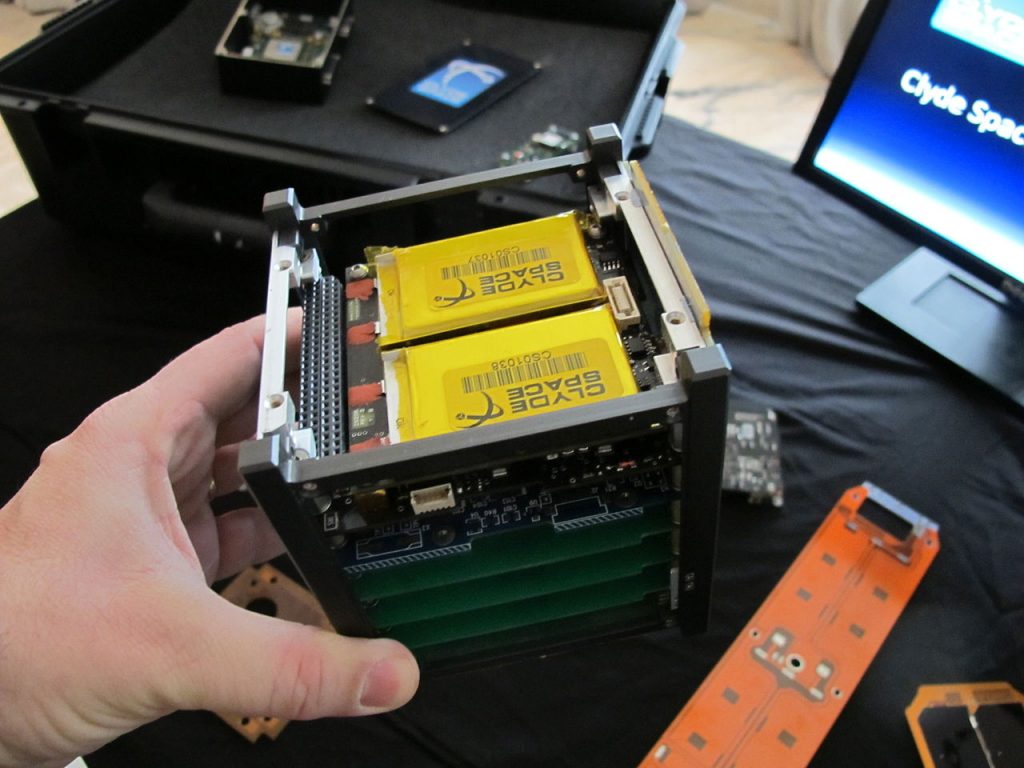
The basic IU CubeSat is 10 cm to a side:

===

Chinese students are also getting involved: China to launch first student satellite for scientific education – Xinhua | English.news.cn

China’s first nano-satellite with primary and middle school students involved in the development and building process will be launched into space Friday.

The satellite, named after late Premier Zhou Enlai, was sent from its production base in Huai’an Youth Comprehensive Development Base in east China’s Jiangsu Province to Jiuquan Satellite Launch Center in northwest China’s Gansu Province Monday, where a CZ-11 solid fuel rocket is scheduled to put it into orbit Friday.

Twenty teenagers who participated in the development project accompanied the transport group to the launch center and will witness the lift-off.

===

A smallsat built and operated by a student team in Colorado helped solve a mystery of the earth’s radiation belts: How A CU Student Satellite Solved A Major Space Mystery | Boulder, CO Patch

The CubeSat mission, called the Colorado Student Space Weather Experiment (CSSWE), houses a small, energetic particle telescope to measure the flux of solar energetic protons and Earth’s radiation belt electrons. Launched in 2012, CSSWE has involved more than 65 CU Boulder students and was operated for more than two years from a ground station they built on the roof of a LASP building on campus.

The instrument on CSSWE, called the Relativistic, Electron and Proton Telescope integrated little experiment (REPTile), is a smaller version of REPT, twin instruments developed by a CU Boulder team led by LASP director and Nature paper co-author Daniel Baker that were launched on NASA’s 2012 Van Allen Probes mission.

“This is really a beautiful result and a big insight derived from a remarkably inexpensive student satellite, illustrating that good things can come in small packages,” said Baker. “It’s a major discovery that has been there all along, a demonstration that Yogi Berra was correct when he remarked ‘You can observe a lot just by looking.'”

“These results reveal, for the first time, how energetic charged particles in the near-Earth space environment are created,” said Irfan Azeem, a program director in the NSF’s Division of Atmospheric and Geospace Sciences.

====

While not as challenging or time consuming as building a real satellite, this lesson plan on making a satellite model is nevertheless quite instructive for students: Build a Satellite Activity | NASA/JPL Edu.

====