Category Archives: Education

ESA Cheops exoplanet space telescope to carry plaques engraved with children’s artwork

The European Space Agency (ESA)

Artwork unveiled on exoplanet satellite 
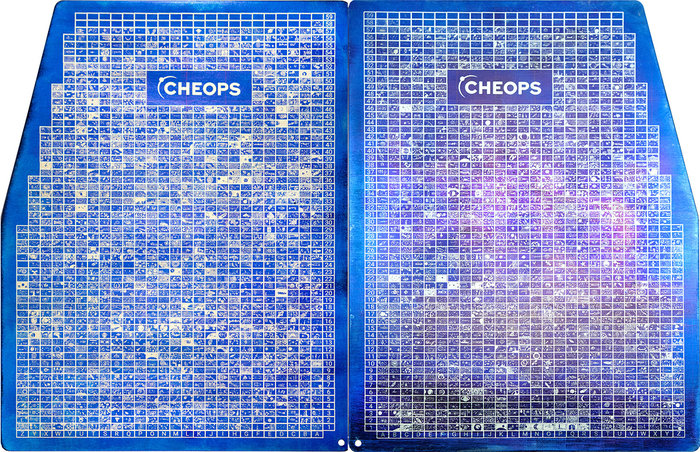
Two titanium plaques etched with thousands of miniaturised drawings made by children have been fixed to the CHaracterizing ExOPlanets Satellite, Cheops. Each plaque measures nearly 18 cm across and 24 cm high. The plaques, prepared by a team at the Bern University of Applied Sciences in Burgdorf, Switzerland, were unveiled in a dedicated ceremony at RUAG on 27 August 2018. Credits : G. Bucher – Bern University of Applied Sciences

27 August 2018: Two plaques etched with thousands of miniaturised drawings made by children have been unveiled in a dedicated ceremony held today in Switzerland.

Three years ago, thousands of children were inspired by the study of planets beyond our Solar System and translated their imagination into beautiful drawings, which feature a variety of planets and other cosmic settings. Out of the many excellent entries, over 2700 were selected to fly on ESA’s Characterising Exoplanet Satellite, Cheops.
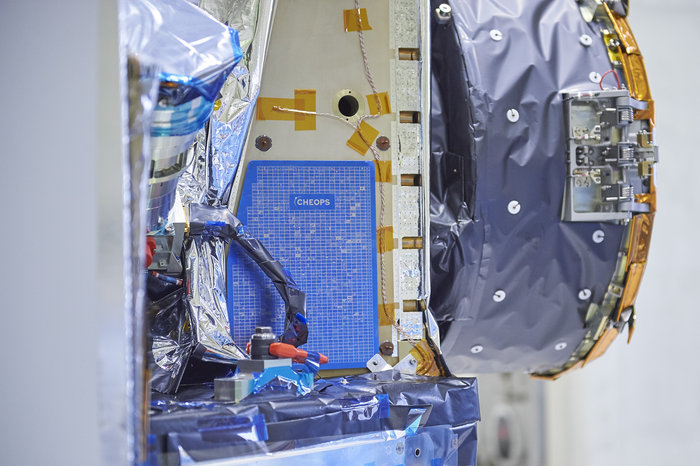
The artwork plates mounted on the Cheops spacecraft.

Cheops will make high-precision measurements of stars, monitoring the small changes in brightness due to the transit of a planet across the star’s disc, in order to determine the planet’s size. Combined with known information about the planet’s mass, Cheops will enable the density of the planet to be calculated, and as such determine if it is a rocky, icy, or even a water-world for example – a first step to characterise exoplanets.

“Cheops is ESA’s first small-class science mission and its task is big. The first step characterisation of the Earth-to-Neptune size planets that Cheops will target is an essential step to piecing together what these planets are made of, and towards the long-term search for habitable worlds beyond our own Solar System,”says Jan Wörner, ESA Director General.

“This unique satellite, the product of European collaboration, has already inspired the young generation, seen in the drawings engraved on the plaques unveiled today as Cheops begins its final stages of preparations before moving to the launch site.”

While the satellite was being assembled earlier this year, a team at the Bern University of Applied Sciences in Burgdorf, Switzerland miniaturized the drawings and engraved them onto two titanium plates. Each plaque measures nearly 18 cm across and 24 cm high.

The spacecraft has recently completed a series of tests at RUAG Space in Zurich, Switzerland, and today was presented to media and invited guests with the two plaques now attached.

Cheops will soon travel to ESA’s technical centre in the Netherlands where the satellite will undergo acoustic and radio-frequency compatibility tests during September, concluding the environmental test campaign. The spacecraft will then return to Airbus Defence and Space, Spain for final tests before shipment to Europe’s Spaceport in Kourou, French Guiana.
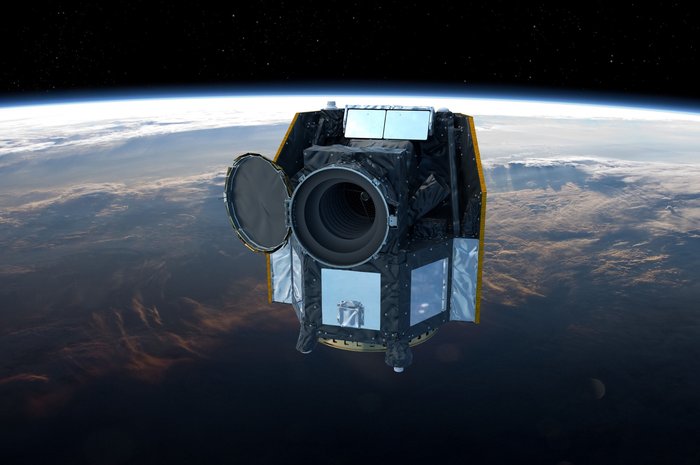
Artist’s impression of Cheops in orbit.

The satellite, which is implemented as a partnership between ESA and Switzerland, is on track to complete all planned test activities by the end of the year.

Once in Earth orbit Cheops will begin to characterise some of the many extrasolar worlds already discovered, many of which are similar to those depicted in the inspired artwork that will fly into space with this exciting mission.

====
EXOS Aerospace to launch student and medical research payloads on suborbital rocket

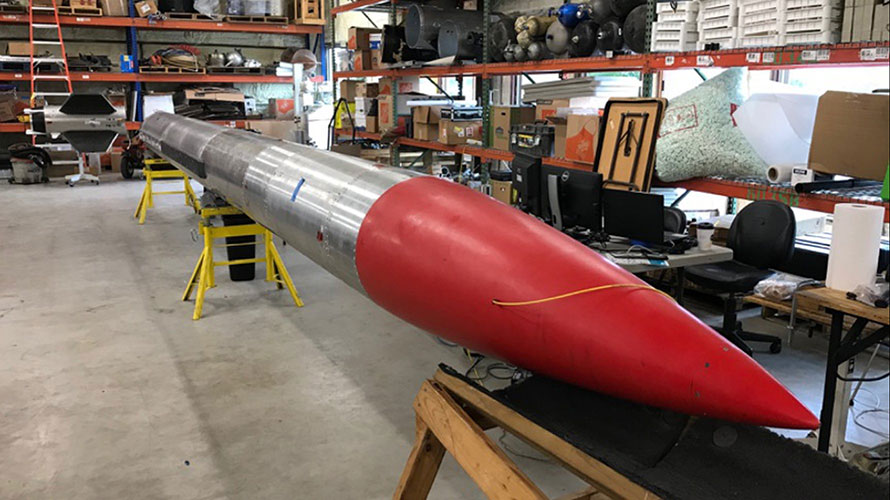
This Saturday at Spaceport America in New Mexico, EXOS Aerospace will attempt the first launch of the company’s reusable suborbital sounding rocket, which has the title SARGE (Suborbital Autonomous Rocket with GuidancE) . The rocket will be carrying payloads for  student projects and medical research experiments:

Reusable Rocket to Carry Student and Medical Research Payloads into Space

Researching science in space has long been a costly endeavor. A rocket launching from New Mexico’s Spaceport America this Saturday may help change that when an EXOS Aerospace SARGE test flight heads into space carrying student and other research experiments.

Tune in to the launch live stream here at the EXOS YouTube channel. It will go active when the live stream begins:

youtube.com/channel/UCh2dmwg4BVRAznfQgdhTm7w/live

Currently, liftoff is planned for 1:00 ET on Saturday (12:00 CT, 11:00 MT, 10:00 PT). The EXOS website (exosaero.com) has a countdown timer.

“Reusable rocket technology makes it possible to cut the launch waiting period for a payload dramatically, while also reducing costs,” said EXOS Co-Founder and Chief Operating Officer John Quinn. “This lowers the barriers for the types of NewSpace education experiments made possible by Enterprise In Space (EIS).”

The EIS student experiments were created at the Grand Center Arts Academy (GCAA) in Saint Louis, Missouri. EIS worked with Andrew Goodin of GCAA and 24 students from his “Building Creative Confidence” class on experiments related to topics such as using the heat of space to melt crayons into space art and determining the effects of the space environment on maple tree seeds that will be grown on Earth when returned from space. To house the experiments, Goodin’s class produced a 3D-printed container that met the criteria of EXOS. In less than two months, they made a 3D-printed cube housing and drop tested it to ensure the object would survive the rocket trip.

Also onboard, the Center for Applied Space Technology (CAST)-sponsored Biological Research in Canister (BRIC) experiment features nine petri dishes containing biological material and is anticipated to have terrestrial and long-duration space flight applications. The BRIC project supports two proof-of-concept projects in collaboration with the Mayo Clinic of Florida Space Medicine program. These projects include an innovative passive flight-crew monitoring system and a cutting-edge organ-on-a-chip experiment.

Enterprise In Space, a nonprofit program of the National Space Society, has led the effort as part of its focus on STEAM (Science Technology Engineering Arts and Math) education and space exploration advocacy. EXOS is hosting the Enterprise In Space and CAST payloads as an in-kind contribution.

“This is the first of many anticipated suborbital research space flights,” said Shawn Case, EIS founder and chairman of the EIS board. “Our goal is to inspire the next generation of future astronauts and space explorers by doing valuable scientific experiments in space. The experiments going up with the SARGE rocket look at some really cutting-edge science, and we’re thrilled to be able to launch the educational payload for Goodin’s class.”

EIS plans to work with EXOS to create an educational K-12 curriculum for the EIS Academy (www.eisacademy.org), as the two partners further develop a long-term relationship.

About Enterprise In Space: Enterprise In Space (EIS) is the world’s first NewSpace education program. EIS provides access to STEAM education to all through the open online EIS Academy. The program’s first Academy-wide project is the design, launch, and retrieval of a 3D-printed spacecraft carrying 100+ active and passive experiments from K-postgrad student teams from all around the world.

About the National Space Society (NSS): NSS is an independent nonprofit educational membership organization dedicated to the creation of a spacefaring civilization. NSS is widely acknowledged as the preeminent citizen’s voice on space, with over 50 chapters in the United States and around the world. The Society publishes Ad Astra magazine, an award-winning periodical chronicling the most important developments in space.

About EXOS Aerospace Systems and Technologies: EXOS is a leading developer of reusable space launch vehicles and is based in Greenville, Texas. EXOS provides affordable, repeatable, and reliable commercial spaceflight with accelerated turnaround.

About the Grand Center Arts Academy: GCAA Grand Center Arts Academy provides the highest level of academic and artistic education for the most talented students in the St. Louis community.

About the Center for Applied Space Technology: The Center for Applied Space Technology (CAST) is a 501(c)(3) corporation based in Florida with offices at the Cape Canaveral Spaceport and Jacksonville, FL. The Center has supported space medicine research in the laboratory and on parabolic, high altitude balloon and suborbital space flight, as well as on board the International Space Station. The EXOS flight will provide the CAST team with another significant opportunity to explore and characterize the behavior of biological systems when in the environment of microgravity.

About Made In Space: Made In Space, Inc. is the world’s most experienced in-space manufacturing company. Established in 2010 and with offices in Florida, California, Alabama and Ohio, Made In Space leverages the unique properties of the space environment to develop manufacturing solutions to commercial, industrial, research and defense challenges.

Additional Media Assets Available:

====


Videos: New Glenn animation + Global rocket race + Space communicators + SpaceX’s Gwynne Shotwell

A selection of space related videos:

** New Glenn: Blue Origin’s Big Reusable Rocket – YouTube – A nice animation of Blue Origin’s New Glenn rocket, including the return and landing of the first stage onto a ship platform at sea.

New Glenn is a 7-meter-diameter (23 ft) two-stage orbital launch vehicle with an optional third stage and a reusable first stage. The first stage will be powered by seven BE-4 methane/oxygen engines—designed and manufactured by Blue Origin—producing 17,000 kN (3,800,000 lbf) of liftoff thrust. Launches of the New Glenn are planned to be made from Spaceport Florida Launch Complex 36 in 2020

** SpaceX Killer – The Great Rocket Race | MUST WATCH – YouTube – A look at rocket projects around the world that are aiming to lower the cost of getting to space.

In this video we look into the Competitors of SpaceX, some of whom have great plans to take on SpaceX , by launching reusable rockets like Jeff Bezos’s Blue origin or by simple efficient and low cost manufacturing process as implemented by India, whose low cost seems to have baffled even the experts.

We look at different countries from Arianne Group (EU) to China and India, and also different companies like Blue origin , ULA , Virgin Orbit , who may give SpaceX the run for the buck in this new era of Space Race.

** Talking Science Communication with @thespacegal, Emily Calandrelli – YouTube

“Emily Calandrelli is here to talk with me all about what it’s like to be the SpaceGal. A full blown science rockstar with e masters degrees from Harvard in Aeronautics and Astronautics, author of “Ada Lace”, a TV producer and host of “Xploration Station” on Fox and corespondent on “Bill Nye Saves the World.””

** SpaceX’s plan to fly you across the globe in 30 minutes | Gwynne Shotwell – YouTube – An on-stage interview with SpaceX President and COO Gwynne Shotwell from last May at a TED conference:

What’s up at SpaceX? Engineer Gwynne Shotwell was employee number seven at Elon Musk’s pioneering aerospace company and is now its president. In conversation with TED curator Chris Anderson, she discusses SpaceX’s race to put people into orbit and the organization’s next big project, the BFR (ask her what it stands for). The new giant rocket is designed to take humanity to Mars — but it has another potential use: space travel for earthlings.

====


Video: Cosmonauts throw student CubeSats into orbit during ISS spacewalk

On Wednesday, Russian flight engineers Oleg Artemyev and Sergey Prokopyev made a spacewalk outside the International Space Station.  Their initial tasks included hurling four student-built smallsats into orbit: Spacewalkers toss nanosatellites into orbit, hook up bird migration monitor – Spaceflight Now

The spacewalkers’ first task was the deployment — by hand — of four CubeSats built by Russian students.

The cosmonauts carried with them two Tanyusha satellites, each about the size of a small toaster oven, built by students at Southwestern State University with demo payloads to study spacecraft autonomy technology and to measure the vacuum of space. Another pair of SiriusSat CubeSats, assembled by Russian schoolchildren and equipped with particle detectors, was also with the cosmonauts.

Prokopyev tossed the four nanosatellites into space by hand just outside the Pirs airlock, using a manual release method used on previous Russian spacewalks.

Here is a video of the hand-tossed orbital deployments plus views of the tiny satellites drifting away from the station:

Most of the rest of the nearly 8 hour long EVA involved installation of an antenna and related equipment for a German project to track animals wearing GPS transmitters:

Then the duo turned their attention to the installation of antennas and cables for a German-developed instrument package to track global animal movements. The equipment was placed outside the station’s Zvezda service module in a multi-step procedure that took a couple of hours longer than originally planned.

Called Icarus, the project aims to reveal changes in migratory routes, animal connections and other animal behavior. The antenna for Icarus was carried aloft in February, and a computer launched on a Russian Progress mission last year to help process the signals coming from tracking units tagged to animals on Earth.

“Icarus is a global collaboration of research scientists that are interested in life on the globe, and once we put together all the information on mobile animals, then we have a different and new understanding of life on Earth,” said Martin Wikelski, lead scientist on the Icarus project, director of the Max Planck Institute of Ornithology, and professor the University of Konstanz in Germany.

The Icarus project will start by tracking small animals, such as birds, bats and flying foxes, according to DLR, the German Aerospace Center. Tags fixed to the animals will transmit information on their migratory behavior — such as their GPS coordinates, acceleration and environmental data — up to a receiver on the space station.

See also

====


Video: Abby Garrett and “Go for Launch” comic books for kids

Check out this Epic Future Space interview with author and artist Abby Garrett who has created a series of terrific comics for youngsters on the theme of rockets:

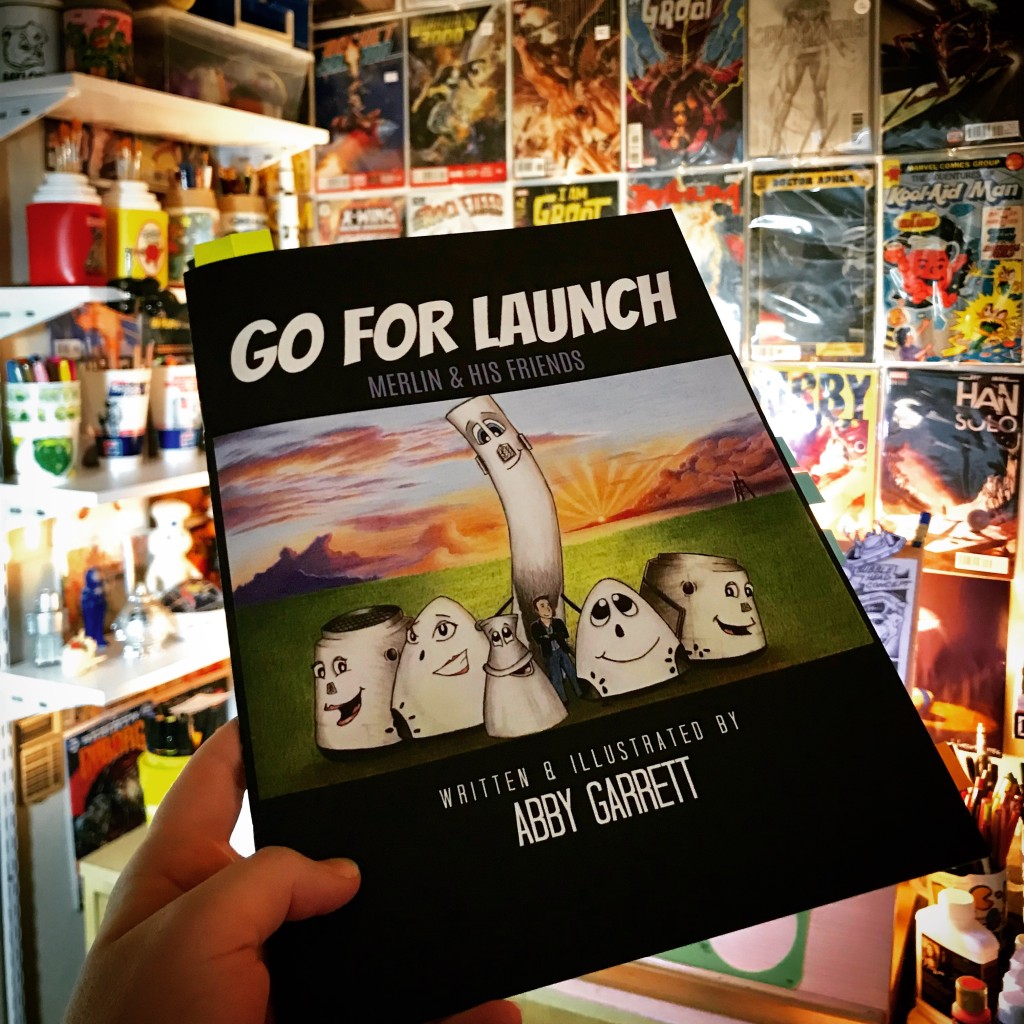
A cover from one of the “Go for Launch: Merlin & His Friends” books, which brings to life the SpaceX rockets:

GO FOR LAUNCH: Merlin & His Friends – children’s books written and illustrated by Abby Garrett

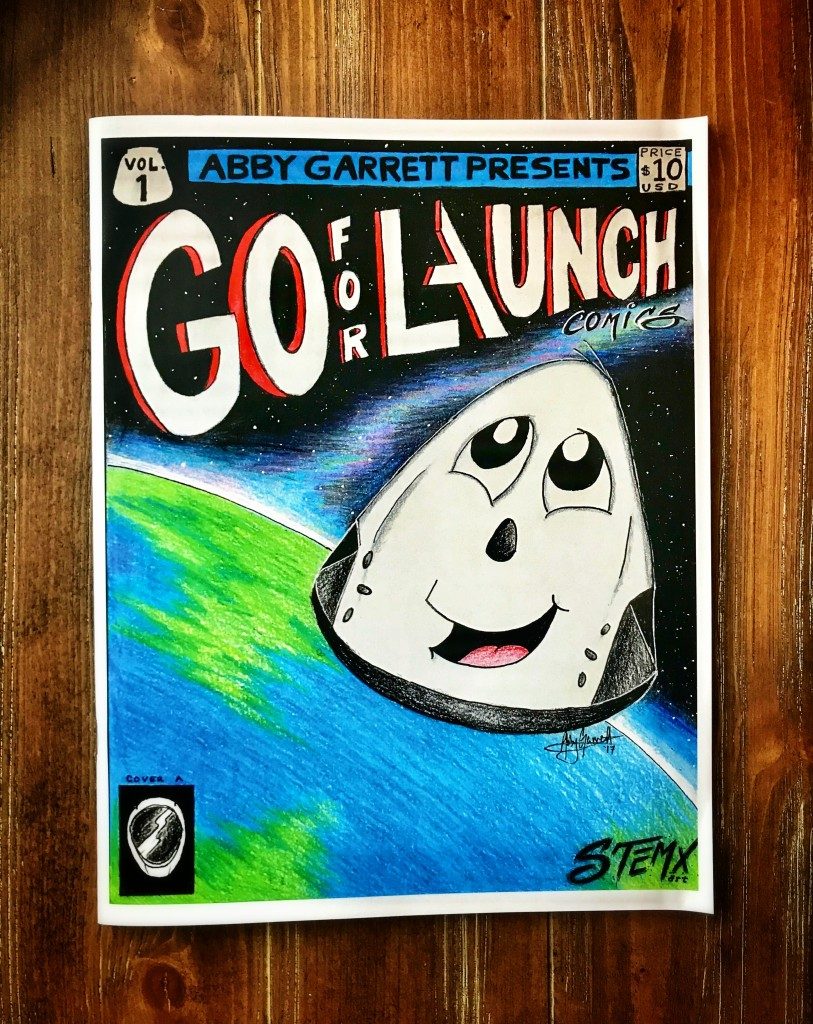
The cover of the first Go For Launch book:

GO FOR LAUNCH COMIC VOL. 1: 32-page Go For Launch Comic Vol. 1.

See some of the pages in the books on her COMICS webpage

====