Category Archives: Education

Student and amateur CubeSat news roundup – Apr.2.2020

A sampling of recent articles, press releases, etc. related to student and amateur CubeSat / SmallSat projects and programs (find previous smallsat roundups here):

** Univ. of Michigan to  lead SunRISE multi-cubesat mission selected by NASA to study solar storms by detecting radio waves that precede coronal mass ejections: ‘Largest radio telescope in space’ to improve solar storm warnings – The Michigan Engineer News Center

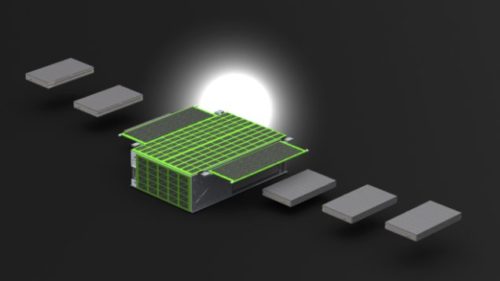
The Sun Radio Interferometer Space Experiment, or SunRISE, consists of miniature satellites called cubesats that form a “virtual telescope” in space to detect and study the radio waves that precede major solar events. The waves can’t be detected on Earth’s surface due to interference from the region of Earth’s upper atmosphere known as the ionosphere. 

SunRISE, expected to launch in 2023, will offer a never-seen-before glimpse at what goes on in the area above the sun’s surface, the sola

The virtual telescope formed by the cubesats is illustrated in this video:

From the caption:

The Sun Radio Interferometer Space Experiment (SunRISE) is expected to launch in 2023. The project is led by University of Michigan climate and space sciences and engineering professor Justin Kasper. The team will deploy miniature satellites, called cubesats, that form a “virtual telescope” in space to detect and study the radio waves that precede major solar events. This is will greatly improve our solar storm warning system. SunRISE is a $62 million project, one of NASA’s Missions of Opportunity. $5 million will go to U-M for its science team and operating costs while the rest will be used for launch. NASA’s Jet Propulsion Laboratory will manage the mission. Space Dynamics Laboratory, a non-profit research corporation, is the other major partner that will build the spacecraft.

See also:

** An update on the Univ. of Washington HuskySat-1 CubeSat in orbit: The first cube satellite made by [UW] students makes it to space – DailyUW.com
HuskySat-1
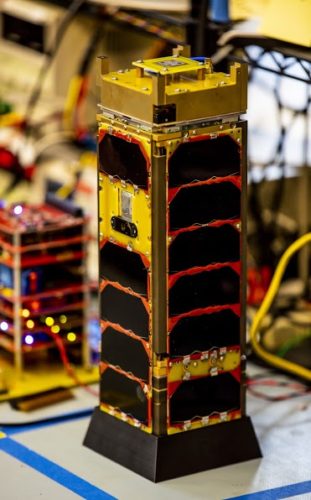
HuskySat-1. Credits: Husky Satellite Lab at the Univ. Washington

Just last November, students worked to launch a loaf of bread into space; that is, a satellite the size of a loaf of bread.

The UW’s Husky Satellite Lab successfully launched the HuskySat-1 (HS-1), a cube satellite, into space Nov. 2, 2019. This initiative was started about four years ago by two graduate students: Paige Northway and Paul Sturmer.

Space development is not anything new to the UW, but HS-1 is the first cube satellite to be launched by a university from Washington state.

The Husky Satellite Lab’s mission was related to demonstrating a pulsed plasma thruster and a high-frequency communications system. Beyond that, Sturmer pointed out the huge success of being able to launch and have a working satellite.

According to Sturmer, the initial project was made up of over 50 students — mostly undergraduate students — who did the actual engineering, prototyping, and testing. Sturmer acted as the technical lead and product manager.

Members of the Husky Satellite Lab have now put their focus on other projects, such as the Miniature Microgravity Electroplating Experiment (MiniMEE) and the Platform for High Altitude Testing 2 (PHAT-2).

Several Roundups have mentioned HuskySat-1.

** AMSAT news on student and amateur CubeSat/smallsat projects: ANS-089 AMSAT News Service Special Bulletin

  • Sean Kutzko, KX9X, Appointed AMSAT Volunteer Coordinator
  • AMSAT Office Closed Until Further Notice
  • First Satellite Contact to be Noted in May QST
  • Amateur Radio Satellite Spreads Fight Coronavirus Message
  • Ham Talk Live! Interviews Frank Bauer, KA3HDO
  • ISS Crew Transition Affected by CoViD-19
  • Upcoming ARISS Contacts
  • Upcoming Satellite Operations
  • Satellite Shorts From All Over

General CubeSat/SmallSat info:

== Amazon Ad ==

Introduction to CubeSat Technology and Subsystem:
Orbit Design, Debris Impact, and Orbital Decay Prediction

“Xtronaut 2.0: The game of solar system exploration” – Xplore sponsors Kickstarter campaign

An announcement from Xtronaut:

Xplore Sponsors Xtronaut’s Kickstarter Campaign,
Donates Space Games to The Boeing Academy
for STEM Learning at The Museum of Flight

Xplore’s Xcraft™ Now Featured in
XTRONAUT 2.0: The Game of Solar System Exploration,
the award-winning space-themed board game

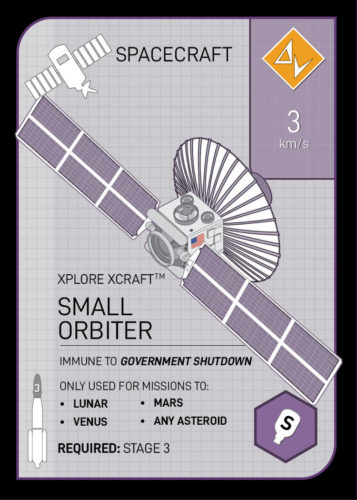
Xplore Xcraft™ playing card in Xtronaut 2.0 Game

Xtronaut 2.0, a fun, multi-player game for players ages eight and up, teaches the real-world challenges of solar system exploration and educates players on how to plan missions to deep space. Xplore’s high-performance spacecraft, the Xcraft™, is a new feature in Xtronaut 2.0, which mirrors real-life space missions. Players can plan exploration missions and send the Xcraft™ to the Moon, Mars, Venus, and asteroids, including Bennu, the target of NASA’s OSIRIS-REx Asteroid Sample Return mission. Spacecraft in the game can launch on SpaceX, ULA, and NASA-SLS rockets. Planetary scientist Dr. Dante Lauretta created Xtronaut with CEO Michael Lyon. Lauretta is a University of Arizona Professor and Principal Investigator for OSIRIS-REx. Lyon, while at Space Adventures, helped orchestrate the private astronaut flights for Dennis Tito and Mark Shuttleworth to the International Space Station.

Xplore founder and Chief Operating Officer Lisa Rich said,

“Xtronaut 2.0 provides valuable education about space missions, builds strategic skills, and inspires players to pursue STEM careers. We are proud to have the Xcraft™ featured in Xtronaut 2.0 and are delighted that our sponsorship enables us to give 120 games to the youth organization of our choice. Xplore selected The Boeing Academy for STEM Learning at The Museum of Flight to receive our gift to support their mission to enhance educational opportunities for young people, particularly students of color, females, and those from low income families and communities to access and pursue STEM pathways.”

Reba Gilman, Vice President of Education for The Museum of Flight said,

“The Boeing Academy for STEM Learning at The Museum of Flight is pleased to accept Xplore’s generous gift of 120 Xtronaut 2.0 games, and we look forward to distributing them among our students. Xplore aligns well with our goal of promoting STEM opportunities. They are a creative company that thinks out-of-the box in terms of how their commercial missions to space will impact the lives of others. While scientists, universities, national space agencies, civilian space agencies, national security space agencies and others will fly with them, our students can also benefit from their missions to space.” She added, “We appreciate the leadership of Xplore’s female founder, Lisa Rich, and are thankful Xplore is giving us this positive stay-at-home activity that students will enjoy during these uncertain times.”

Dr. Dante Lauretta said:

“We are excited to include Xplore as a real-world example of next-generation missions to space. Our original game allows players to fly heritage spacecraft. With Xtronaut 2.0, we have the added feature of flying the Xcraft™ as a small payload with enhanced capability for missions to our solar system. Our players will love this feature as it adds another layer of real-world authenticity to the game.” He added, “We are pleased that our game will support The Museum of Flight. Xtronaut 2.0 is a constructive way for students enrolled in The Boeing Academy for STEM Learning’s programs to expand their knowledge of the aerospace industry and encourage them to be a part of it.”

Xtronaut 2.0 is currently available on Kickstarter. To obtain a copy or sponsor games to give to the youth organization of your choice, visit: https://www.kickstarter.com/projects/xtronaut/xtronaut-2?ref=discovery&term=xtronaut

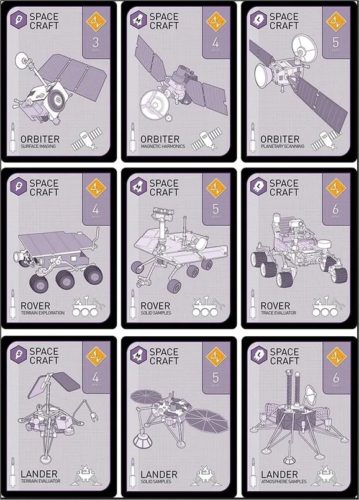
More cards in the Xtronaut game.

About Xplore: Xplore is a Seattle-based commercial deep space company offering Space as a ServiceTM. Xplore provides hosted payloads, communication relay services and exclusive datasets to its customers via a fleet of networked multi-mission spacecraft.

The mission of Xplore is to expand robotic exploration via commercial Xpeditions™ at and beyond Earth, to the Moon, Mars, Venus, Lagrange Points and near-Earth asteroids in the inner solar system. Xplore provides hosted payload services for scientific instruments and technology demonstrations for national space agencies, national security agencies, sovereign space agencies and universities. Visit: https://www.xplore.com

About Xtronaut Enterprises, Inc.: Dante Lauretta and Michael Lyon founded Xtronaut Enterprises to develop innovative educational content associated with space exploration. Dr. Lauretta has spent over 16 years developing and leading the OSIRIS-REx mission. Xtronaut also produces the award-winning game Constellations: The Game of Stargazing and the Night Sky and Downlink: The Game of Planetary Discovery. Visit: https://xtronaut.com/

Kickstarter: https://www.kickstarter.com/projects/xtronaut/xtronaut-the-game-of-solar-system-exploration

====

Here is an interview with Xtronaut CEO Michael Lyon by Jason Kanigan of the Cold Star Project:

Michael Lyon is an attorney, startup accelerator mentor and space tourism pioneer. I’ve interviewed him for the full format Cold Star Project show (link below), and today he’s back to share Xtronaut 2.0. It’s a fun and educational space board game he has co-created that has already achieved 2X its funding target on Kickstarter. Xtronaut 2.0 was co-created by Dante Lauretta of Osiris-REx fame. Bill Nye and the Planetary Society are also involved. I want you to have the chance to hear about it, and maybe pick up some of the cool swag that comes along with backing the idea. Check out the Kickstarter for Xtronaut 2.0 here: https://coldstartech.com/msbxtronaut

=== Amazon Ad ===

Xtronaut: The Game of Solar System Exploration

NASA Langley student space art contest winners

Earlier this month NASA Langley announced the winning entrants in a space art competition: Winners of 2020 NASA Langley Student Art Contest Named | NASA

The winners of NASA’s Langley Research Center’s 2020 Student Art Contest have been selected out of nearly 1,300 entries from 40 states and Puerto Rico.

This year’s contest received a record 1,277 entries from students across the United States. These students, part of the Artemis generation, depicted the theme “We Are Going” with insightful compositions and beautiful creativity. Each piece is wonderfully imaginative, and each student, from kindergarten to 12th grade, used their incredible talents to showcase their interpretation of the theme.

(Finalist # 55) 6th Grade Mehar Kapoor

(Finalist # 55) 6th Grade Mehar Kapoor – 1st Place / 6th Grade

The art contest is intended to illustrate where NASA is going next in the realms of research, development, missions and innovations that highlight NASA’s human exploration activities which touch aspects of our lives here on Earth.

This year’s guest judge was Michael Kagan, an award-winning artist who’s had his artistic talents showcased in solo and group exhibitions all over the world. His most recent exhibition at the Virginia Museum of Contemporary Art, entitled “I Was There When It Happened,” featured Kagan’s lifelong interest in NASA, technology, space and innovation.

(Finalist # 39) 8th Grade Kendra Vincent

Finalist # 39) 8th Grade Kendra Vincent – 2nd Place / 8th Grade

The grand prize winner was announced a few days later: New Jersey Student Takes Grand Prize in NASA Langley 2020 Art Contest | NASA

The simplest of ideas can turn into the grandest of results. One high school student took the simple idea that space is reachable, translated that idea into art, and is now the grand-prize winner of NASA’s Langley Research Center’s 2020 Student Art Contest.

Camila Garcia, a tenth-grader at North Bergen High School in North Bergen, New Jersey, earned the highest honor in the yearly competition.

“Camila Garcia, a tenth-grader at North Bergen High School in North Bergen, New Jersey, was named the grand-prize winner for her entry in the 2020 NASA Langley Student Art Contest.” Credits: NASA Langley Research Center

“My inspiration for my artwork was simply the idea of things being reachable,” she said. “It was a very consistent concept within my thumbnail sketches, especially since they all revolved around people.”

Camila’s winning entry is a woman astronaut gazing out into space and the Moon with the words “We Are Going” at the bottom of her helmet.

“In the case of my artwork in particular, it’s more emotionally centered around the idea of something being reachable as the mere gaze I have (I am the subject of my drawing) towards the Moon is that of amazement at how far I’ve truly come,” she said.

(Finalist # 14) 3rd Grade Daniel Chia

(Finalist # 14) 3rd Grade Daniel Chia – 3rd Place / 3rd Grade

=== Amazon Ad ===

Soviet Space Graphics: Cosmic Visions from the USSR (DESIGN)

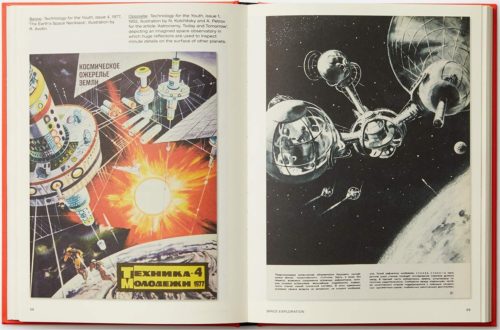
Sample of the artworks displayed in “Soviet Space Graphics: Cosmic Visions from the USSR”

Student and amateur CubeSat news roundup – Mar.18.2020

A sampling of recent articles, press releases, etc. related to student and amateur CubeSat / SmallSat projects and programs (find previous smallsat roundups here):

** The student-led GU Orbit program at the University of Glasgow aims to

bring students into the world of space systems. It will primarily focus on developing micro-satellites with a specific mission in mind and getting them launched into orbit. Students from various disciplines are welcome to become members as we hope to create an interdisciplinary environment and ultimately provide members with an industrial-like setting so that they can get a feel of what it is like to work in the space technology sector.

The program recently arranged for getting their first satellite, Astraeus-01, to orbit via the Responsive Access launch broker: University of Glasgow GU Orbit Team Signs Smallsat Mission Agreement with Responsive Access – Satnews

Responsive Access Ltd. aims to simplify access to space through the use of innovative software and key partner relationships that provide a one-stop-shop for the launch of CubeSats and other small payloads into orbit.

While the search for a suitable rocket gets underway, GU Orbit are focusing on the technical development of their satellite, which is set to become the first ever to be fully built by a Scottish university. The University of Glasgow’s satellite could be set for launch by as early as next year, creating the possibility for it to be one of the first payloads to reach space from a developing UK spaceport.

GU Orbit’s President, Philip Voudouris, explained that thanks to the tremendous effort from the team members, significant progress on the cubesat, Astraeus-01, has been made, finally bringing ideas and ambitions to life as prototypes are manufactured and tested. The University of Glasgow has a strong reputation regarding its involvement in space technology and having opened its first space lab just last year, it has shown that it is prepared to push the boundaries of human presence in space. With Responsive Access helping to plan the mission ahead and selecting a suitable launch vehicle for Astraeus-01, the company is now one large step closer to seeing this satellite reach orbit and subsequently opening an exciting new frontier for students and researchers with a passion in space.

Astraeus-01 is intended “to demonstrate two innovative technologies: a deployable drag sail and a graphics processing unit (GPU)” (ref).  More at GU Orbit on Facebook.

** Environmental monitoring MeznSat cubesat, built by UAE based university teams, will launch on a Soyuz rocket this summer:

MeznSat is a nanosatellite for climate observation, manufactured by Khalifa University of Science and Technology (KUST) in partnership with the American University of Ras Al-Khaimah (AURAK) and funded by the UAE Space Agency. The satellite’s primary payload will be a shortwave infrared (SWIR) spectrometer that makes observations in the 1000-1650 nm wavelength range to derive atmospheric greenhouse gas concentrations.

The secondary payload on MeznSat will consist of a VGA camera for post-processing that brings increased precision and accuracy to the SWIR spectrometer data. The combination of visible and SWIR bands will make MeznSat a unique CubeSat mission, specifically designed to generate a rich dataset for exploring atmospheric correction algorithms.

** Univ. of Iowa Halosat is demonstrating effective astrophysics observations on a cubesat platform: HaloSat Offers Galactic X-Ray Measurements on Shoestring Budget – SPIE

The entire scientific instrument weighs in at less than 3 kg and consumes about 4 W. The control system brings the package up to 12 kg, while the entire satellite is about the size of a thick book.

HaloSat was launched in 2018, and its mission has been extended until mid-2020. So far, it has mapped x-ray emissions from the Milky Way and the Crab Nebula. The simple mapping spectrometer has delivered remarkably clean data, which will enable a few years of analysis and insights.

Live fast, die young

HaloSat will deorbit before the end of 2020 due to drag, so the mission cannot be extended much longer. Such temporal limitation is part of the life of a CubeSat-they are the mayfly of spacecraft. The question is not if the satellite will live longer, but if useful scientific results can be gained from such a short mission. The researchers have proven the affirmative: low-cost, short-lived satellite missions can deliver useful results.

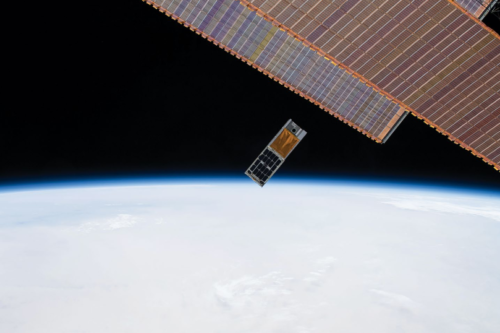
Deployment of HaloSat and RainCube cubesats from the ISS on July 13, 2018. Credits: NASA & Nature Magazine

Here is a technical paper published about the project: Design and construction of the x-ray instrumentation onboard the HaloSat CubeSat, D.M. LaRocca et al, J. or Astronoical Telescopes, Instruments, and Systems – SPIE

HaloSat is the first mission funded by NASA’s Astrophysics Division to use the CubeSat platform. Using three co-aligned silicon drift detectors, the HaloSat observatory measures soft (0.4 to 7 keV) x-ray emission from sources of diffuse emission such as the hot, gaseous halo of the Milky Way. We describe the design and construction of the science payload on HaloSat and the reasoning behind many of the choices. As a direct result of the design choices and adherence to best practices during construction, the HaloSat science payload continues to perform well after more than one year on-orbit.

This NASA video mentions HaloSat:

** AMSAT news on student and amateur CubeSat/smallsat projects: ANS-075 AMSAT News Service Special Bulletin

  • 38th Annual AMSAT Space Symposium and Annual General Meeting Announced
  • Update from the AMSAT President
  • ARISS Video of SpaceX CRS-20 Launch Carrying IORS
  • Minor Update to FoxTelem Released
  • Use the NO-84 PSK31 Transponder Now!
  • ARISS News
  • Hamfests, Conventions, Maker Faires, and Other Events
  • Upcoming Satellite Operations
  • Satellite Shorts from All Over

General CubeSat/SmallSat info:

== Amazon Ad ==

Introduction to CubeSat Technology and Subsystem:
Orbit Design, Debris Impact, and Orbital Decay Prediction

Student and amateur CubeSat news roundup – March.12.2020

A sampling of recent articles, press releases, etc. related to student and amateur CubeSat / SmallSat projects and programs (find previous smallsat roundups here):

** The A&A CubeSat Team at the University of Wisconsin is building SOC-1  or Satellite for Optimal Control and Imaging:

The SOC-i mission will carry an advanced guidance, navigation and control (GNC) payload capable of reorienting the spacecraft while satisfying multiple pointing constraints. SOC-i will also carry an Earth imaging camera, enabling it to take pictures of specified ground locations.

The mission will operate in space for 6 months, and will be supported by a UW ground station being developed in the Aerospace Engineering Research Building. It is a stated goal of the mission to be completely open-source, maintain code on our team’s GitHub page .

See also: Down the rabbit hole of UW’s STEM RSOs – dailyuw.com

Members collaborate throughout the entire design process of the CubeSat, developing different aspects, from its guidance navigation control, electrical power system, physical structure, communications, command and data handling, and imaging configuration.

“Space engineering is such a multifaceted discipline that really, if you show up and just do 10 hours of work, you’re going to learn a hundred new things,” Tormey said. “The thing you get out of it is experience. Even if the work is grueling and hard, knowing that ultimately you’re going to send something up into space is the best motivator ever.”

** The BUSAT (Boston University SATellite) program will see ANDESITE launched on a Rocket Lab Electron rocket. Trisept completes Cubesat integration for NASA ELaNa 32 Andesite Mission – SpaceDaily.com

“Our ANDESITE mission with NASA will demonstrate how CubeSats can play a vital role in providing an unprecedented view into the variations of electrical activity racing through space and its impact on our lives here on earth. GPS services, for example, can be directly affected,” explained Josh Semeter, an electrical engineering professor with Boston University’s Center for Space Physics who first conceptualized the ANDESITE mission.

“If all goes as planned, our CubeSat will release eight small satellite sensors in space to form a first-of-its-kind free-flying mesh network capable of delivering uniquely comprehensive data mapping of magnetic fields and space weather to our smart phones here on campus.”

“TriSept, the University spacecraft team and NASA have completed the initial integration of the ANDESITE mission by installing the CubeSat into the dispenser device and preparing the spacecraft for shipment to Rocket Lab in New Zealand,” said Jason Armstrong, TriSept’s Director of Launch Integration Services.

Illustration of the ANDESITE 6U CubeSat with picosat deployed to study currents in the magnetosphere. Credits: BUSAT

Here is a BUSAT video from 2015 about the ANDESITE project:

** AMSAT news on student and amateur CubeSat/smallsat projects: ANS-068 AMSAT News Service Special Bulletin

  • Welcome Back XW-2D
  • PSAT3 Launch CANCELED [See also Cancellation of PSAT3 Launch Means No DARPA Launch Challenge Winner – ARRL]
  • AMSAT Academy to be Held Prior to Dayton Hamvention
  • The 23cm Satellite Band is Under Scrutiny in Europe
  • Replacing the International Space Station?
  • FO-29 Operational Schedule
  • ARISS News
  • AMSAT Will be at ScienceCity in Tucson, March 14-15
  • Hamfests, Conventions, Maker Faires, and Other Events
  • Upcoming Satellite Operations
  • Satellite Shorts from All Over

General CubeSat/SmallSat info:

** Michael Maloney – Satellite Design For Recovery – Cold Star Project S02E23

Michael Maloney, founder of the advocacy organization Satellite Design for Recovery, is on the Cold Star Project with host Jason Kanigan to talk about the need for including a critical but not-yet-required component to the design of all objects launched into Earth orbit. Satellites and other orbital objects should have mandated design requirements for rendezvous, capture and disposal. The cost of not doing so will be chaos in orbit. Mike is here to tell us about these consequences. Satellite Design for Recovery website: https://satdfr.org/

=== Amazon Ad ===

Introduction to CubeSat Technology and Subsystem:
Orbit Design, Debris Impact, and Orbital Decay Prediction