The first European Rocketry Challenge (EUROC) inter-collegiate student rocketry competition is being held in Ponte de Sor, Portugal this week (October 21-25). EUROC is
the first university rocket launch competition in Europe, which seeks to stimulate engineering students to design, build and launch their own vehicles
A sampling of recent articles, press releases, etc. related to student and amateur CubeSat / SmallSat projects and programs (find previous smallsat roundups here):
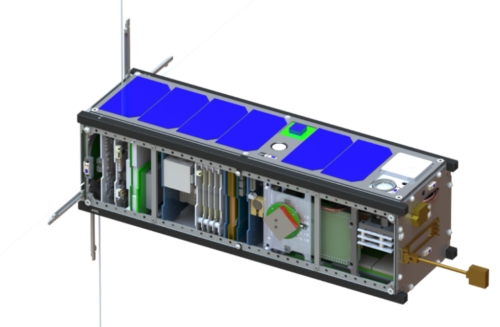
A Northrop Grumman Cygnus cargo vessel berthed to the ISS on October 5th after launching on a Antares rocket from Wallops Island on October 2nd. The Cygnus NG-14 mission carried roughly four tons of cargo, including Neutron-1 and several other smallsats for deployment into orbit from the station. Neutron-1 holds instruments to measure neutrons in space, particularly those coming from the Sun.
Through the 2015 RockSat-X mission, Kauaʻi Community College, Windward Community College, Honolulu Community College and Kapiʻolani Community College were also involved with the development of this mission. The Project IMUA community college collaboration led to the development of a functioning neutron detector, however it was lost during a suborbital test launch from Wallops Flight Facility. This set back the project until Arizona State University (ASU) became a collaborator on this mission by providing the neutron detector in 2018.
“Neutron-1 is a 3U CubeSat [small satellite],” said Amber Imai-Hong, an avionics engineer at HSFL and ground station coordinator for the Neutron-1 mission. “It’s approximately the size of a loaf of bread and the data gathered by the satellite will be used to understand the relationship between the Earth and the Sun by mapping neutrons in the low-earth orbit.”
…
Neutron-1 is launching on a rideshare mission, which includes other satellites, and will be in space for approximately one year. UH delivered the small satellite to NanoRacks, LLC in Houston, Texas on August 20.
are designing, manufacturing and building a cube-shaped, miniaturized satellite, known as a CubeSat, to observe Earth from space to predict and detect fires. The data captured is used to detect areas of risk — to put out fires before a blaze even starts.
“This year’s fire season has been particularly harmful. With the onset of climate change, we need to utilize tools such as satellites to study Earth and try to predict and prevent natural disasters,” said senior Patrick Babb, a mechanical engineering major who is leading the team project.
The 10-member student team is developing a prototype, dubbed “TitanSat,” which incorporates infrared cameras and solar power to monitor Earth’s climate and detect hot and dry zones that pose a wildfire risk.
** Updates on the UAE MeznSat CubeSat recently launched in to orbit on a Russian Soyuz 2.1b rocket along with 18 other smallsats. (See previous posts here, here, here, and here.)
Caution: portions of the audio are difficult to hear
Build a CubeSat – Sierra Nevada Corp. Project Beaver Works Summer Institute will offer students the opportunity to design, build, and test a prototype CubeSat. Students will explore all the major subsystems of a satellite and get hands on experience with mechanical, electrical, and software engineering. The class will use these new skills to demonstrate a real CubeSat science mission in partnership with scientists from Woods Hole Oceanographic Institution.
– Introduction by Jack Fox
– Presentations
Astrobeever
Buzz Lightyear
Team Oddsat
BYJ Cube
Rubble Space Telescope
– Q&A
…
** 84- Microsoft Azure Orbital, Ground Station as a Service, and Dynamic Ground – Constellations Podcast
On this Constellations podcast, the focus will be on Microsoft’s recent announcement of their Ground Station as a Service (GSaaS) offering “Azure Orbital” and what it means for the satellite industry. Azure Orbital is Microsoft’s managed service that is designed to deal with the growing flood of data for Earth Observation and Internet of Things applications. The managed service lets users communicate to, control their satellite, process data and scale operations directly in Microsoft Azure. Microsoft’s GSaaS takes a very different approach compared to traditional ground systems. Azure Orbital leverages key technologies such as virtualization, Software-Defined Networking (SDN), and cloud computing to enable customers to automate and scale operations across the globe. On this podcast Nora Zhan, Product Manager for Microsoft discusses Azure Orbital. She is involved in Azure Space, Satellites and Ground Stations and in bringing this new platform to market to provide satellite connectivity.
Presented by Paul Madle Over the last 25 years, the UK has brought positive disruptions to the space industry. The University of Surrey innovated small spacecraft: leveraging Commercial-Off-The-Shelf components that could compete with larger more traditionally designed spacecraft. In the last 7 years, Scottish CubeSats (very small satellites) have grown from academic projects into commercially viable products performing earth observation and other applications. Both of these innovations have brought down costs and made space more accessible to greater numbers of people. KIPSE Space Systems aspires to be a catalyst for the next step-change to the industry by collaboratively designing a new, capable spacecraft platform that is open source, all design being freely accessible through the internet.
Michael Mackowski of Space in Miniature sent me an announcement of his latest report:
Space In Miniature Tech Report 4 – Energiya Buran Reference Book for Model Builders
The fourth installment in the Space In Miniature (SIM) short-form “Tech Reports” series of reference booklets for spacecraft modelers is now available. The 30-page digital publication, SIM Tech Report #4 – Energiya Buran, describes in detail how the author, Michael Mackowski, built six different model kits of the old Soviet Union’s Energiya Buran heavy lift rocket and orbiter.
The Buran program, with its associated Energiya heavy booster, was the Soviet response to the United States Space Shuttle. The Energiya booster was only launched twice, in 1987 and 1988.
A total of six different kits in two scales are included in this book, which is loaded with over 70 photos of work in progress of the following subjects:
1/288 Energiya Buran (STC Start)
1/288 Energiya Polyus (STC Start)
1/288 Energia Buran (Master Modell)
1/144 Energia Buran (Anigrand)
1/144 Buran (Rho Models)
1/144 Buran (Ark)
The SIM Tech Reports cover topics that are too short or too narrow in subject matter for full length printed books. These are also distributed only as electronic (pdf) copies, which can be printed by the customer. It allows the use of color illustrations, and customers get their books via a simple download. The pdf download sells for $7.00 and is available at spaceinminiature.com.
** What’s Up: October 2020 Skywatching Tips from NASA – NASA JPL
What are some skywatching highlights in October 2020? Not one, but two, full moons; Mars at opposition; and finding the Andromeda galaxy. Additional information about topics covered in this episode of What’s Up, along with still images from the video, and the video transcript, are available at https://solarsystem.nasa.gov/whats-up….
Crisp, clear October nights are full of celestial showpieces. Find Pegasus, the flying horse of Greek myth, to pinpoint dense globular star clusters and galaxies, and keep watching for space-based views of M15, NGC 7331, and the Andromeda Galaxy.
What can you see in the night sky tonight? Astronomers Pete Lawrence and Paul Abel reveal their stargazing tips for October 2020, and show you the best things to see in the night sky this month.
** What’s in the Night Sky October 2020#WITNS | Halloween Moon | Meteor Showers – Alyn Wallace
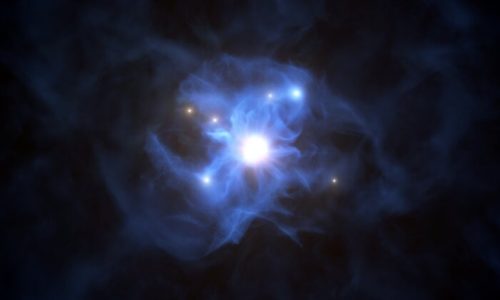
With the help of ESO’s Very Large Telescope (VLT), astronomers have found six galaxies lying around a supermassive black hole, the first time such a close grouping has been seen within the first billion years of the Universe. This artist’s impression shows the central black hole and the galaxies trapped in its gas web. The black hole, which together with the disc around it is known as quasar SDSS J103027.09+052455.0, shines brightly as it engulfs matter around it. Credits ESO.
With the help of ESO’s Very Large Telescope (VLT), astronomers have found six galaxies lying around a supermassive black hole when the Universe was less than a billion years old. This is the first time such a close grouping has been seen so soon after the Big Bang and the finding helps us better understand how supermassive black holes, one of which exists at the centre of our Milky Way, formed and grew to their enormous sizes so quickly. It supports the theory that black holes can grow rapidly within large, web-like structures which contain plenty of gas to fuel them.
“This research was mainly driven by the desire to understand some of the most challenging astronomical objects — supermassive black holes in the early Universe. These are extreme systems and to date we have had no good explanation for their existence,”
said Marco Mignoli, an astronomer at the National Institute for Astrophysics (INAF) in Bologna, Italy, and lead author of the new research published today in Astronomy & Astrophysics.
The new observations with ESO’s VLT revealed several galaxies surrounding a supermassive black hole, all lying in a cosmic “spider’s web” of gas extending to over 300 times the size of the Milky Way.
“The cosmic web filaments are like spider’s web threads,” explains Mignoli. “The galaxies stand and grow where the filaments cross, and streams of gas — available to fuel both the galaxies and the central supermassive black hole — can flow along the filaments.”
The light from this large web-like structure, with its black hole of one billion solar masses, has travelled to us from a time when the Universe was only 0.9 billion years old.
“Our work has placed an important piece in the largely incomplete puzzle that is the formation and growth of such extreme, yet relatively abundant, objects so quickly after the Big Bang,”
says co-author Roberto Gilli, also an astronomer at INAF in Bologna, referring to supermassive black holes.
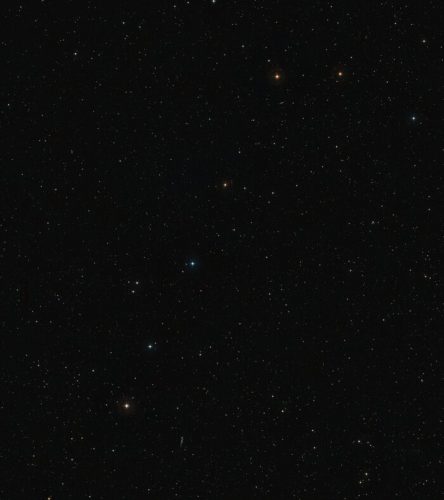
This image shows the sky around SDSS J103027.09+052455.0, a quasar powered by a supermassive black hole surrounded by at least six galaxies. This picture was created from images in the Digitized Sky Survey 2. Credits ESO
The very first black holes, thought to have formed from the collapse of the first stars, must have grown very fast to reach masses of a billion suns within the first 0.9 billion years of the Universe’s life. But astronomers have struggled to explain how sufficiently large amounts of “black hole fuel” could have been available to enable these objects to grow to such enormous sizes in such a short time. The new-found structure offers a likely explanation: the “spider’s web” and the galaxies within it contain enough gas to provide the fuel that the central black hole needs to quickly become a supermassive giant.
But how did such large web-like structures form in the first place? Astronomers think giant halos of mysterious dark matter are key. These large regions of invisible matter are thought to attract huge amounts of gas in the early Universe; together, the gas and the invisible dark matter form the web-like structures where galaxies and black holes can evolve.
“Our finding lends support to the idea that the most distant and massive black holes form and grow within massive dark matter halos in large-scale structures, and that the absence of earlier detections of such structures was likely due to observational limitations,”
says Colin Norman of Johns Hopkins University in Baltimore, US, also a co-author on the study.
The galaxies now detected are some of the faintest that current telescopes can observe. This discovery required observations over several hours using the largest optical telescopes available, including ESO’s VLT. Using the MUSE and FORS2 instruments on the VLT at ESO’s Paranal Observatory in the Chilean Atacama Desert, the team confirmed the link between four of the six galaxies and the black hole.
“We believe we have just seen the tip of the iceberg, and that the few galaxies discovered so far around this supermassive black hole are only the brightest ones,”
said co-author Barbara Balmaverde, an astronomer at INAF in Torino, Italy.
These results contribute to our understanding of how supermassive black holes and large cosmic structures formed and evolved. ESO’s Extremely Large Telescope, currently under construction in Chile, will be able to build on this research by observing many more fainter galaxies around massive black holes in the early Universe using its powerful instruments.