** What’s Up: February 2022 Skywatching Tips from NASA – NASA JPL
What are some skywatching highlights in February 2022? Jupiter is the lone planet lingering in twilight skies after sunset in February. It exits the evening sky this month leaving no bright planets there until August (save for a brief appearance from Mercury in April). Also Venus is at peak brightness for the year in the a.m., and it’s a great time to view the Orion Nebula.
0:00 Intro
0:10 New Moon 0:30 Quadrantid meteors
1:28 Dusk / Dawn Highlights
2:28 Moon Phases
Additional information about topics covered in this episode of What’s Up, along with still images from the video, and the video transcript, are available at https://solarsystem.nasa.gov/skywatch….
In February, the Winter Triangle is your guide to the night sky: The northern hemisphere is treated to views of the stars Procyon, Sirius, and Betelgeuse. Keep watching for the awe-inspiring space-based views of the Orion Nebula, which is sculpted by the stellar winds of central bright stars.
About this Series
“Tonight’s Sky” is a monthly video of constellations you can observe in the night sky. The series is produced by the Space Telescope Science Institute, home of science operations for the Hubble Space Telescope, in partnership with NASA’s Universe of Learning. This is a recurring show, and you can find more episodes—and other astronomy videos—at https://hubblesite.org/resource-galle….
A $47,533 ARRL Foundation grant will fund the initial phase of the Amateur Radio on the International Space Station (ARISS‐USA) *STAR* Keith Pugh Memoriam Project. *STAR*, which stands for Space Telerobotics using Amateur Radio, honors the memory of Keith Pugh, W5IU, a highly respected member of the ARISS team who died in 2019. ARISS arranges live question-and-answer sessions via ham radio between International Space Station (ISS) crew members and students. A long-time and enthusiastic supporter of ARISS, Pugh was a star ARISS technical mentor, assisting schools with ARISS contacts, encouraging interest in ARISS among educators, and visiting schools to teach students about wireless radio technology. One goal of ARISS is to engage students in science, technology, engineering, arts, and mathematics (STEAM) subjects.
The ARISS *STAR* Project, is a new educational initiative that will enable US junior and senior high school groups to remotely control robots via ham radio through digital APRS (Automatic Packet Reporting System) commands. Year 1 will focus on systems development and initial validation of ARISS *STAR*, and year 2 will focus on evaluation and final validation.
Systems development and evaluation will be led by university staff and students who will undertake hands-on wireless and telerobotics lesson development, learn about amateur radio, and support *STAR* engineering hardware and software development.
Next, youth teams will be selected to experiment and critique *STAR* telerobotics scenarios in closed courses. In the process, ARISS will encourage students to prepare for and earn an FCC amateur radio license, enabling them to use ham radio to learn and practice concepts in radio technology and radio communication.
ARISS-USA Executive Director Frank Bauer, KA3HDO, praised the ARRL Foundation for its generosity.
“ARISS team member Keith Pugh, W5IU, poured his energy into inspiring, engaging, and educating youth in space and in amateur radio endeavors,” Bauer said. “What better way to honor Keith than through the ARISS *STAR* initiative. We thank the ARRL Foundation for its vision to move this initiative forward. Maybe someday one of our ARISS *STAR* students will use their telerobotics skills to control scientific rovers on the [m]oon or Mars!”
Over the past 2 decades, more than 1,400 ARISS contacts have connected more than 1 million youth with the ISS using amateur radio, with millions more watching and learning.
The overarching goals for *STAR* are to improve and sustain ARISS STEAM educational outcomes. Robotics is gaining popularity among youth and adults alike, and telerobotics adds a wireless accent to robotic control. This will expand ARISS’s educational dimension to attract the attention of more groups, students, and educators — outreach that promises to attract new audiences.
The ARRL Foundation was established in 1973, to advance the art, science, and social benefits of the Amateur Radio Service by awarding financial grants and scholarships to individuals and organizations that support their charitable, educational, and scientific efforts.
ARISS is a cooperative venture of international amateur radio societies and space agencies that support the ISS. US sponsors include ARRL, the Radio Amateur Satellite Corporation (AMSAT), the ISS National Lab‐Space Station Explorers, and NASA’s Space Communications and Navigation program (SCaN). The primary goal of ARISS is to promote exploration of science, technology, engineering, the arts, and mathematics topics. For more information, visit www.ariss-usa.org and www.ariss.org.
** What’s Up: January 2022 Skywatching Tips from NASA – NASA JPL
What are some skywatching highlights in January 2022? Stargazing is at its best on the nights around the new moon, Jan. 2. Later that night, catch the peak of the Quadrantid meteor shower. Then look for the Moon with Jupiter on Jan. 5, and with Mars and Venus on Jan. 29.
0:00 Intro 0:10 New Moon 0:30 Quadrantid meteors 1:28 Dusk / Dawn Highlights 2:28 Moon Phases
Additional information about topics covered in this episode of What’s Up, along with still images from the video, and the video transcript, are available at https://solarsystem.nasa.gov/skywatch….
In January, the northern hemisphere features beautiful views of Capella, a pair of giant yellow stars; Aldebaran, a red giant star; and two star clusters—the Hyades and the Pleiades. Keep watching for the awe-inspiring space-based views of the Crab Nebula, the remains of a star that exploded as a supernova. About this Series “Tonight’s Sky” is a monthly video of constellations you can observe in the night sky. The series is produced by the Space Telescope Science Institute, home of science operations for the Hubble Space Telescope, in partnership with NASA’s Universe of Learning. This is a recurring show, and you can find more episodes—and other astronomy videos—at https://hubblesite.org/resource-galle....
What can you see in the night sky tonight? Astronomers Pete Lawrence and Paul Abel reveal the best night-sky highlights to observe throughout January 2022.
** What’s in the Night Sky June 2021 #WITNS | Comet Leonard | Quadrantid Meteor Shower – Alyn Wallace
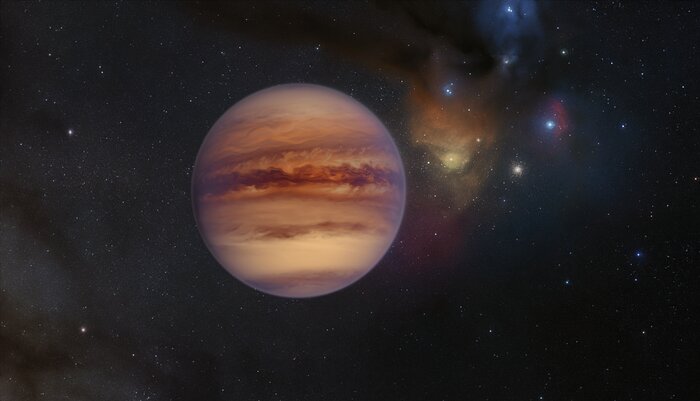
This artist’s impression shows an example of a rogue planet with the Rho Ophiuchi cloud complex visible in the background. Rogue planets have masses comparable to those of the planets in our Solar System but do not orbit a star, instead roaming freely on their own.
Rogue planets are elusive cosmic objects that have masses comparable to those of the planets in our Solar System but do not orbit a star, instead roaming freely on their own. Not many were known until now, but a team of astronomers, using data from several European Southern Observatory (ESO) telescopes and other facilities, have just discovered at least 70 new rogue planets in our galaxy. This is the largest group of rogue planets ever discovered, an important step towards understanding the origins and features of these mysterious galactic nomads.
“We did not know how many to expect and are excited to have found so many,”
says Núria Miret-Roig, an astronomer at the Laboratoire d’Astrophysique de Bordeaux, France and the University of Vienna, Austria, and the first author of the new study published today in Nature Astronomy.
Rogue planets, lurking far away from any star illuminating them, would normally be impossible to image. However, Miret-Roig and her team took advantage of the fact that, in the few million years after their formation, these planets are still hot enough to glow, making them directly detectable by sensitive cameras on large telescopes. They found at least 70 new rogue planets with masses comparable to Jupiter’s in a star-forming region close to our Sun, located within the Scorpius and Ophiuchus constellations [1].
To spot so many rogue planets, the team used data spanning about 20 years from a number of telescopes on the ground and in space.
“We measured the tiny motions, the colours and luminosities of tens of millions of sources in a large area of the sky,” explains Miret-Roig. “These measurements allowed us to securely identify the faintest objects in this region, the rogue planets.”
“The vast majority of our data come from ESO observatories, which were absolutely critical for this study. Their wide field of view and unique sensitivity were keys to our success,” explains Hervé Bouy, an astronomer at the Laboratoire d’Astrophysique de Bordeaux, France, and project leader of the new research. “We used tens of thousands of wide-field images from ESO facilities, corresponding to hundreds of hours of observations, and literally tens of terabytes of data.”
The team also used data from the European Space Agency’s Gaia satellite, marking a huge success for the collaboration of ground- and space-based telescopes in the exploration and understanding of our Universe.
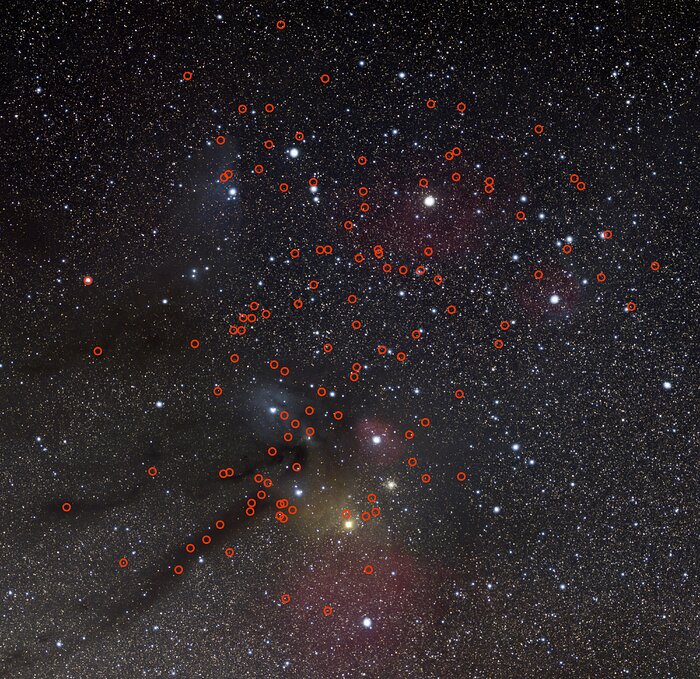
This image shows the locations of 115 potential rogue planets, highlighted with red circles, recently discovered by a team of astronomers in a region of the sky occupied by Upper Scorpius and Ophiucus. Rogue planets have masses comparable to those of the planets in our Solar System, but do not orbit a star and instead roam freely on their own. The exact number of rogue planets found by the team is between 70 and 170, depending on the age assumed for the study region. This image was created assuming an intermediate age, resulting in a number of planet candidates in between the two extremes of the study.
The study suggests there could be many more of these elusive, starless planets that we have yet to discover.
“There could be several billions of these free-floating giant planets roaming freely in the Milky Way without a host star,” Bouy explains.
By studying the newly found rogue planets, astronomers may find clues to how these mysterious objects form. Some scientists believe rogue planets can form from the collapse of a gas cloud that is too small to lead to the formation of a star, or that they could have been kicked out from their parent system. But which mechanism is more likely remains unknown.
Further advances in technology will be key to unlocking the mystery of these nomadic planets. The team hopes to continue to study them in greater detail with ESO’s forthcoming Extremely Large Telescope (ELT), currently under construction in the Chilean Atacama Desert and due to start observations later this decade.
“These objects are extremely faint and little can be done to study them with current facilities,” says Bouy. “The ELT will be absolutely crucial to gathering more information about most of the rogue planets we have found.”
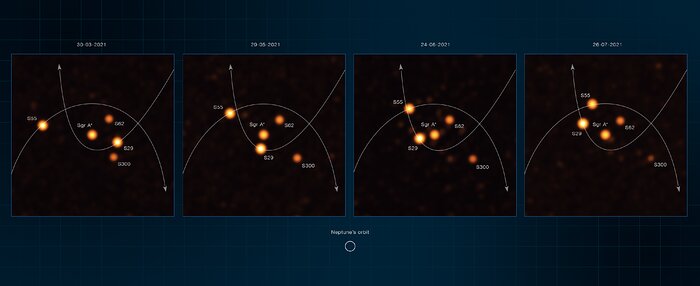
These annotated images, obtained with the GRAVITY instrument on ESO’s Very Large Telescope Interferometer (VLTI) between March and July 2021, show stars orbiting very close to Sgr A*, the supermassive black hole at the heart of the Milky Way. One of these stars, named S29, was observed as it was making its closest approach to the black hole at 13 billion kilometres, just 90 times the distance between the Sun and Earth. Another star, named S300, was detected for the first time in the new VLTI observations. To obtain the new images, the astronomers used a machine-learning technique, called Information Field Theory. They made a model of how the real sources may look, simulated how GRAVITY would see them, and compared this simulation with GRAVITY observations. This allowed them to find and track stars around Sagittarius A* with unparalleled depth and accuracy.
The European Southern Observatory’s Very Large Telescope Interferometer (ESO’s VLTI) has obtained the deepest and sharpest images to date of the region around the supermassive black hole at the centre of our galaxy. The new images zoom in 20 times more than what was possible before the VLTI and have helped astronomers find a never-before-seen star close to the black hole. By tracking the orbits of stars at the centre of our Milky Way, the team has made the most precise measurement yet of the black hole’s mass.
“We want to learn more about the black hole at the centre of the Milky Way, Sagittarius A*: How massive is it exactly? Does it rotate? Do stars around it behave exactly as we expect from Einstein’s general theory of relativity? The best way to answer these questions is to follow stars on orbits close to the supermassive black hole. And here we demonstrate that we can do that to a higher precision than ever before,”
explains Reinhard Genzel, a director at the Max Planck Institute for Extraterrestrial Physics (MPE) in Garching, Germany who was awarded a Nobel Prize in 2020 for Sagittarius A* research. Genzel and his team’s latest results, which expand on their three-decade-long study of stars orbiting the Milky Way’s supermassive black hole, are published today in two papers in Astronomy & Astrophysics.
On a quest to find even more stars close to the black hole, the team, known as the GRAVITY collaboration, developed a new analysis technique that has allowed them to obtain the deepest and sharpest images yet of our Galactic Centre.
“The VLTI gives us this incredible spatial resolution and with the new images we reach deeper than ever before. We are stunned by their amount of detail, and by the action and number of stars they reveal around the black hole,”
explains Julia Stadler, a researcher at the Max Planck Institute for Astrophysics in Garching who led the team’s imaging efforts during her time at MPE. Remarkably, they found a star, called S300, which had not been seen previously, showing how powerful this method is when it comes to spotting very faint objects close to Sagittarius A*.
With their latest observations, conducted between March and July 2021, the team focused on making precise measurements of stars as they approached the black hole. This includes the record-holder star S29, which made its nearest approach to the black hole in late May 2021. It passed it at a distance of just 13 billion kilometres, about 90 times the Sun-Earth distance, at the stunning speed of 8740 kilometres per second. No other star has ever been observed to pass that close to, or travel that fast around, the black hole.
The team’s measurements and images were made possible thanks to GRAVITY, a unique instrument that the collaboration developed for ESO’s VLTI, located in Chile. GRAVITY combines the light of all four 8.2-metre telescopes of ESO’s Very Large Telescope (VLT) using a technique called interferometry. This technique is complex,
“but in the end you arrive at images 20 times sharper than those from the individual VLT telescopes alone, revealing the secrets of the Galactic Centre,”
says Frank Eisenhauer from MPE, principal investigator of GRAVITY.
“Following stars on close orbits around Sagittarius A* allows us to precisely probe the gravitational field around the closest massive black hole to Earth, to test General Relativity, and to determine the properties of the black hole,”
explains Genzel. The new observations, combined with the team’s previous data, confirm that the stars follow paths exactly as predicted by General Relativity for objects moving around a black hole of mass 4.30 million times that of the Sun. This is the most precise estimate of the mass of the Milky Way’s central black hole to date. The researchers also managed to fine-tune the distance to Sagittarius A*, finding it to be 27 000 light-years away.
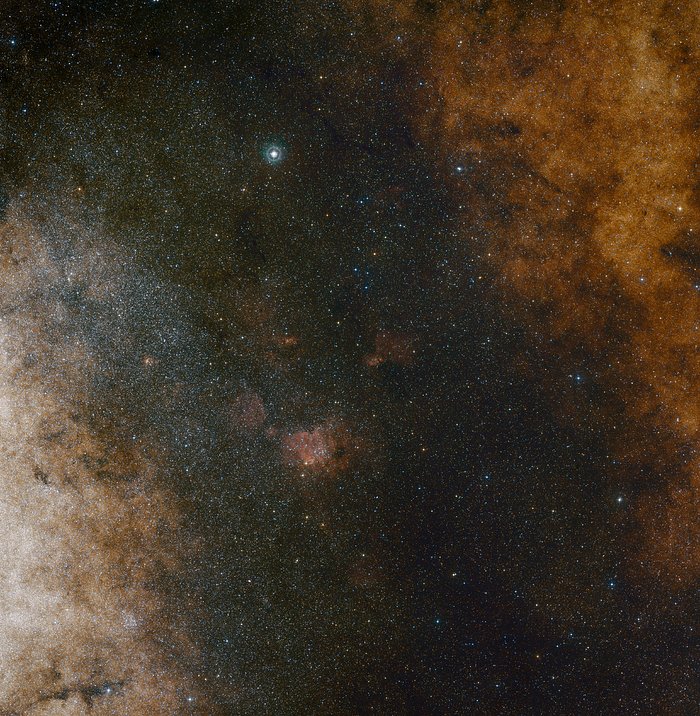
This visible light wide-field view shows the rich star clouds in the constellation of Sagittarius (the Archer) in the direction of the centre of our Milky Way galaxy. The entire image is filled with vast numbers of stars — but far more remain hidden behind clouds of dust and are only revealed in infrared images. This view was created from photographs in red and blue light and forming part of the Digitized Sky Survey 2. The field of view is approximately 3.5 degrees x 3.6 degrees.
To obtain the new images, the astronomers used a machine-learning technique, called Information Field Theory. They made a model of how the real sources may look, simulated how GRAVITY would see them, and compared this simulation with GRAVITY observations. This allowed them to find and track stars around Sagittarius A* with unparalleled depth and accuracy. In addition to the GRAVITY observations, the team also used data from NACO and SINFONI, two former VLT instruments, as well as measurements from the Keck Observatory and NOIRLab’s Gemini Observatory in the US.
GRAVITY will be updated later this decade to GRAVITY+, which will also be installed on ESO’s VLTI and will push the sensitivity further to reveal fainter stars even closer to the black hole. The team aims to eventually find stars so close that their orbits would feel the gravitational effects caused by the black hole’s rotation. ESO’s upcoming Extremely Large Telescope (ELT), under construction in the Chilean Atacama Desert, will further allow the team to measure the velocity of these stars with very high precision.
“With GRAVITY+’s and the ELT’s powers combined, we will be able to find out how fast the black hole spins,” says Eisenhauer. “Nobody has been able to do that so far.”