Category Archives: Space Arts

Space Art: Virginia 7th grader wins NASA Langley art contest + James Vaughan depicts NewSpace ventures

Anna Fox, a seventh grader in Virginia Beach, wins the NASA Langley Student Art Contest for 2018:

Virginia Middle-Schooler Wins Grand Prize at NASA Langley Art Contest
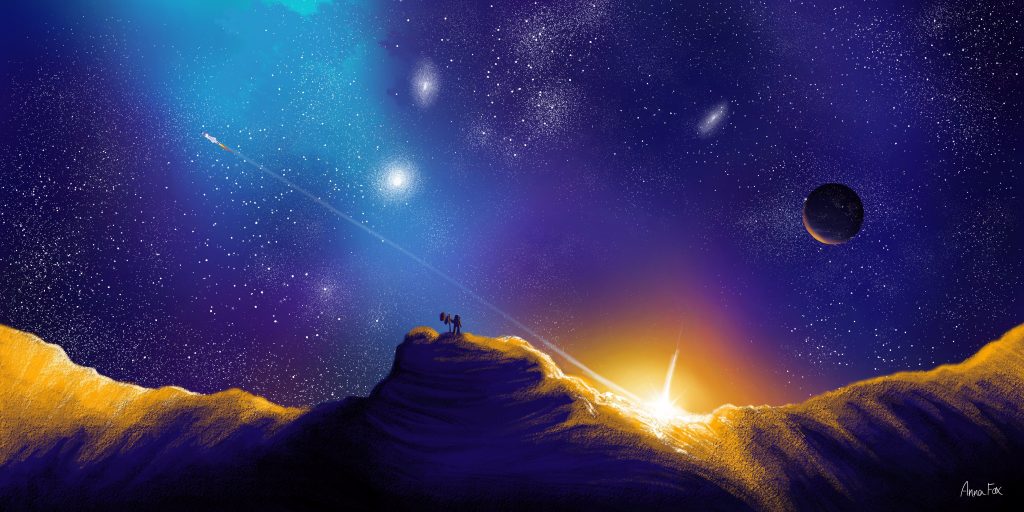
NASA art contest grand prize winner by Anna Fox

Anna Fox, a seventh-grader from Virginia Beach Middle School in Virginia Beach, Virginia, was named as the grand prize winner of Langley Research Center’s Student Art Contest.

“I was very excited when I heard that I won first place for my grade,” Anna said. “But when I heard that I won grand prize, I was speechless.”

A record 831 entries were submitted from hundreds of children in 39 states, the District of Columbia and Puerto Rico, with 13 students earning first-place honors in grade levels K-12 and the opportunity to be considered for the grand prize, said Kristina Cors, Langley Student Art Contest coordinator.

“We hope this contest continues to grow and provide a place for students to explore science and technology through creativity,” she said.

The art contest theme, “The Next 100 Years,” was intended to illustrate how NASA research and innovation propels science to new discoveries.

“This year’s artwork was particularly remarkable, and represented the theme ‘The Next 100 Years’ with imagination and immense talent,” Cors said.

Anna’s winning piece shows a deep-space scene with an astronaut planting a flag on a planet’s mountain while watching a rocket fly off in the distance in a sky populated by stars, galaxies and a moon.

“When I started drawing, I had no idea what to do, so I had looked at a bunch of videos on how to do galaxies for inspiration,” Anna said. “After that I randomly placed colors together until I found something I liked. It all started coming together from there.”

Once she got an idea in motion, Anna did her work using old and new techniques.

“I created my artwork digitally on Photoshop,” Anna said. “I had started with basic colors for the background, including the explosion behind the rocks. Then, on another layer I created the rocks, planet, astronaut and rocket ship taking off. Later I added detail on all the layers to look more realistic. The last step was to add all of the stars and galaxies, which I did with a special brush.”

Anna, who has been an artist for as long as she could pick up a pencil, said she started drawing digitally when she was 11, inspired by her father’s work on a computer.

“I think the best part of creating art is having fun with it and inspiring others to do art as well,” she said.

Anna said she always had an interest in space and the art contest was a perfect vehicle to express that.

“I think that the coolest thing about NASA is that they help so many people achieve their dreams, and send people to do what not a lot of people get to do,” Anna said.

For her grand-prize victory, Anna received a certificate, and a NASA Exploration Package of posters, pens, stickers, patches and lapel pins. Her artwork will be displayed at the Virginia Air & Space Center in Hampton, Virginia.

The 13 grade-level winners were selected by a panel of five judges from the Hampton Roads art community, and the grand champion was picked by Langley employees. Each piece was evaluated on originality, interpretation of subject matter/theme, creative techniques, composition and overall art appearance.

====

Here is a story about James Vaughan and his renderings of NewSpace rockets and spacecraft: Pixels and privatization: An artist’s view of NewSpace – SpaceFlight Insider 

While working in an exciting field that has seen a swell of innovation might seem hectic and stressful, for Vaughan, being able to participate in the NewSpace age has enabled him, in some ways, to live out his dreams. 

“I get to make important and far-reaching dreams take on believable and inspiring sense of reality,” Vaughan said, noting that one’s imagination is almost as important as a degree in aeronautics. “In order to build and advance, we have to be able to imagine. What I do helps to make these possibilities seem attainable.”
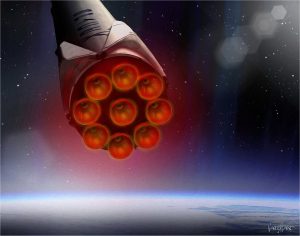
SpaceX Falcon 9 First Stage by James Vaughan

====

The space art of Nikolai M. Kolchitsky

Check out a sampling of the wonderful artworks from Nikolai Kolchitsky (1907-1979) via Artyom Chitailo (@tty72) | Twitter:

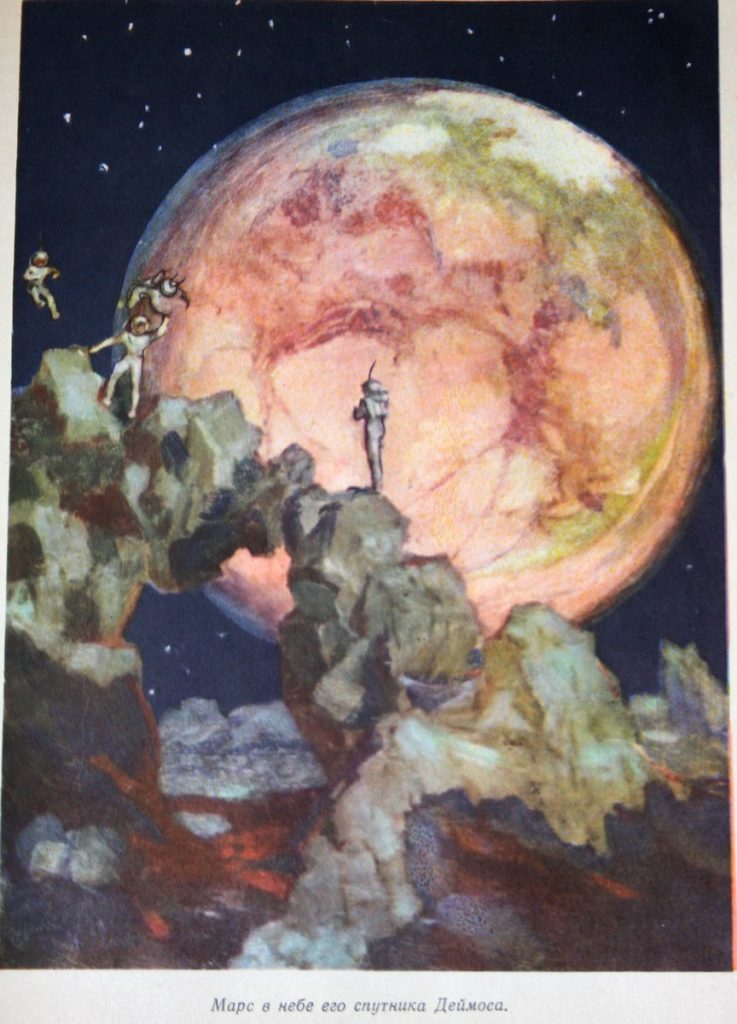
“Mars in the Skies of It’s Moon Deimos” illustration by Nikolai Kolchitsky for the book “The Journey to Distant Worlds” by Karl Gilzin, 1960

More about Kolchitsky:

====

Misc: An Artist Astronaut + Next phase of NASA’s 3-D Printed Habitat Challenge + An assembler of ingredients for life

Some miscellaneous items of interest:

** This Performance Artist Is Also a Candidate for Space Travel – Creators –  Sarah Jane Pell is a “Artist Astronaut” who believes that

 … the artistic and astronautics components of her work have equal weight. In other words, the art isn’t supplementary. “Calling art supplementary is like calling it decoration,” Pell tells Creators.

“The capacity of an artist is deeper, more complex and culturally significant: stemming from a philosophy of aesthetics and poetics from the sublime to the beautiful and grotesque and everything in between. It is an act, action and activism, a way of being in the world that translates curiosities, insights and provocations about our being in time. It can be invention, experimentation, improvisation, expression, and calculated methodical gesture and mark. Art may manifest in music, movement, the material arts and letters. Art knows no bounds, and therein lays the capacity for new discovery.”

** NASA Opens $2 Million Third Phase of 3D-Printed Habitat Competition | NASA – NASA invites participates to enter the 3-D Printed Habitat Challenge competition:

Future missions to the Moon, Mars and beyond will require innovative options to shelter our explorers, and we won’t be able to carry all of the materials with us from Earth. NASA’s 3D-Printed Habitat Challenge, a Centennial Challenges competition, seeks ways to create or develop the technologies needed to create such habitats on-site, and challenges citizen inventors to lead the way. Today, NASA and challenge partner Bradley University of Peoria, Illinois, announce the opening of Phase 3 of the competition for team registration.

“The ideas and technologies this competition has already produced are encouraging, and we are excited to see what this next phase will bring,” said Monsi Roman, program manager of NASA’s Centennial Challenges. “The solutions we seek from our competitions are revolutionary, which by nature makes them extremely difficult. But this only fuels our teams to work harder to innovate and solve.”

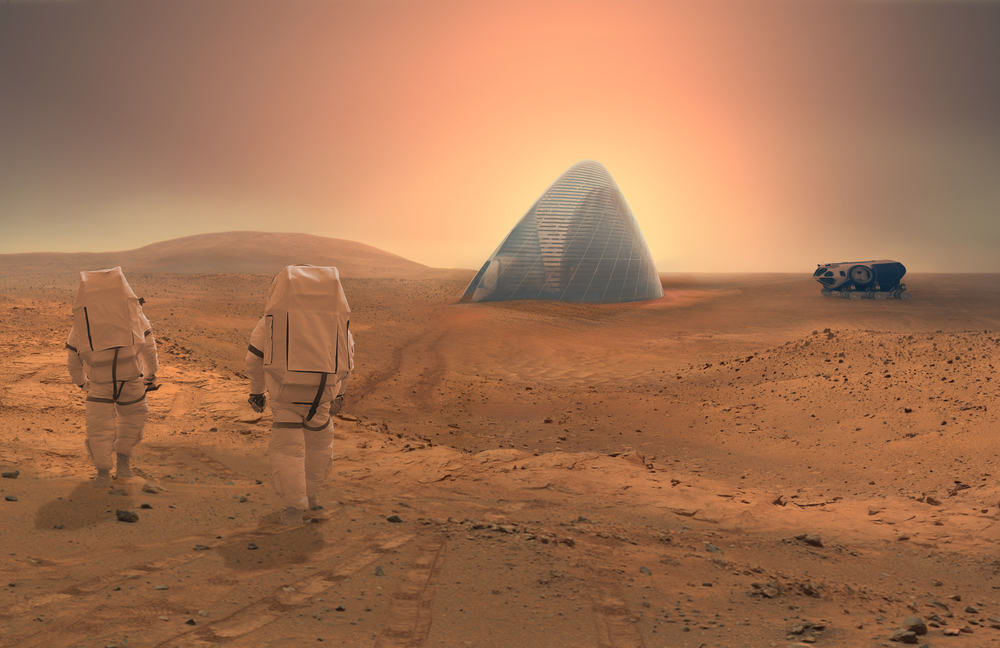
The Ice House

The goal of the 3D-Printed Habitat Challenge is to foster the development of new technologies necessary to additively manufacture a habitat using local indigenous materials with, or without, recyclable materials. The vision is that autonomous machines will someday be deployed to the Moon, Mars or beyond to construct shelters for human habitation. On Earth, these same capabilities could be used to produce affordable housing wherever it is needed or where access to conventional building materials and skills are limited.

Bradley University President Gary Roberts said the school is honored to be the challenge partner once again. “Bradley prides itself on experiential learning and student engagement,” Roberts said. “This challenge isn’t something our students can learn about in a textbook or in a classroom. This is a forward-thinking concept coming to life, and they have a chance to see it firsthand. They will meet the people making it happen and learn about the ideas that are fueling innovation. This could change the way they imagine the future and push their creative limits.”

The 3D-Printed Habitat Challenge is divided into phases. The Phase 1: Design Competition called on participants to develop state-of-the-art architectural concepts and was completed in 2015. The Phase 2: Structural Member Competition focused on manufacturing structural components and was completed in August 2017.

The now-open Phase 3: On-Site Habitat Competition challenges competitors to fabricate sub-scale habitats using indigenous materials with or without mission-generated recyclables, and offers a $2 million total prize purse. Phase 3 has five levels of competition. Interested teams may register through Feb. 15, 2018. Full details, schedule and rules can be found here.

** Scientists find potential ‘missing link’ in chemistry that led to life on earth | EurekAlert! – An interesting finding that could illuminate a key step in bringing together the ingredients that led to the formation of life on earth:

Origins-of-life researchers have hypothesized that a chemical reaction called phosphorylation may have been crucial for the assembly of three key ingredients in early life forms: short strands of nucleotides to store genetic information, short chains of amino acids (peptides) to do the main work of cells, and lipids to form encapsulating structures such as cell walls. Yet, no one has ever found a phosphorylating agent that was plausibly present on early Earth and could have produced these three classes of molecules side-by-side under the same realistic conditions.

TSRI chemists have now identified just such a compound: diamidophosphate (DAP).

====

Space Art: Maciej Rebisz and “Space That Never Was”

Check out the marvelous space inspired art from Maciej Rebisz at Space That Never Was, his project to do more than

… some cool pictures of spaceships, I wanted to do something a bit more original than yet another generic sci-fi. I wanted to do proper research, get science and engineering as correct as possible, then do illustrations along with concept and graphic design.

[]
“ITS landers at Alpha Site, first large scale human colony on Mars. My take on SpaceX Interplanetary Transport System announced by Elon Musk last year.” – Maciej Rebisz

I thought it would be pretty cool to depict how all these planned and never realized missions would look like. Apollo based spacecraft going to Venus, Voyager 3 visiting Jupiter, Saturn and then Pluto. Soviet landing on the Moon. Crewed missions to Mars. Launch of the first interstellar probe. I have started doing research and taking courses about history of spaceflight, where and when it began, where it headed, what space agencies wanted to do and where to go before their funding got cut off. All that research was great inspiration and gave me hundreds of ideas and fueled the development of this alternative history project.

[]
Engine maintenance Art: Maciej Rebisz

Imagine a world where Space Race has not ended. Where space agencies were funded a lot better than military. Where private space companies emerged and accelerated development of space industry. Where people never stopped dreaming big and aiming high.

Find more about Rebisz and his art at: Space That Never Was is an artist’s vision of a never-ending space race – The Verge

[]
“Another artwork in Cosmonaut series. This time it’s cosmonaut on Ganymede, largest moon of Jupiter.” – Maciej Rebisz

Prints of Rebisz’s artworks are available at deviantART.com and society6.com shops.

====

“Debris” – an installation artwork by PLEX NOIR

The PLEX NOIR artists collective in Germany has created an installation piece titled Debris, which is currently on exhibit at the Kunsthaus Troisdorf in Germany.

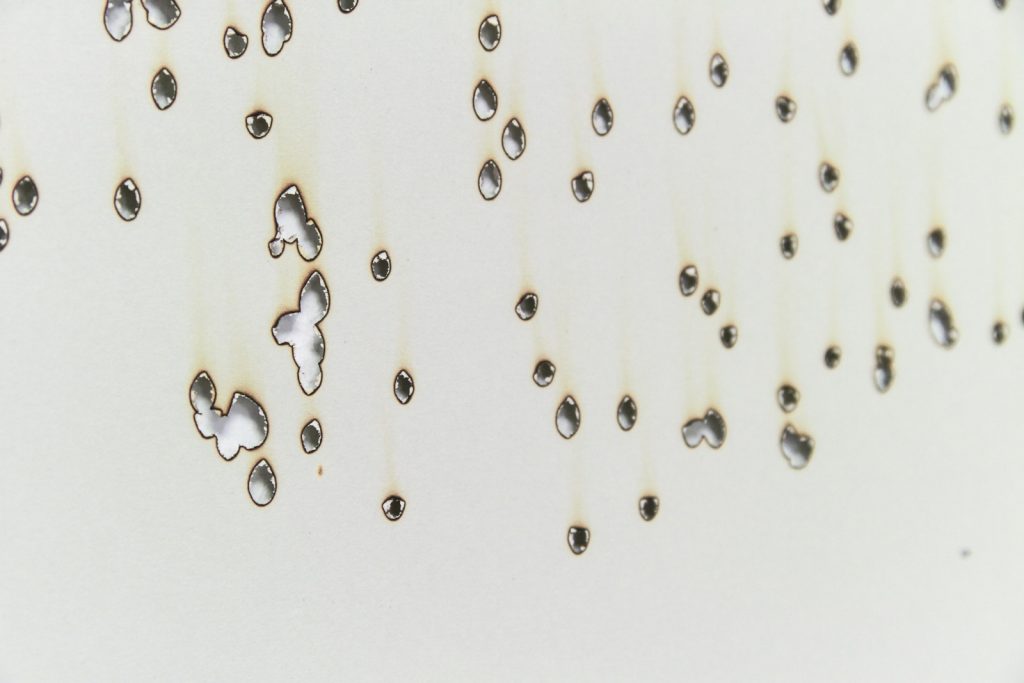
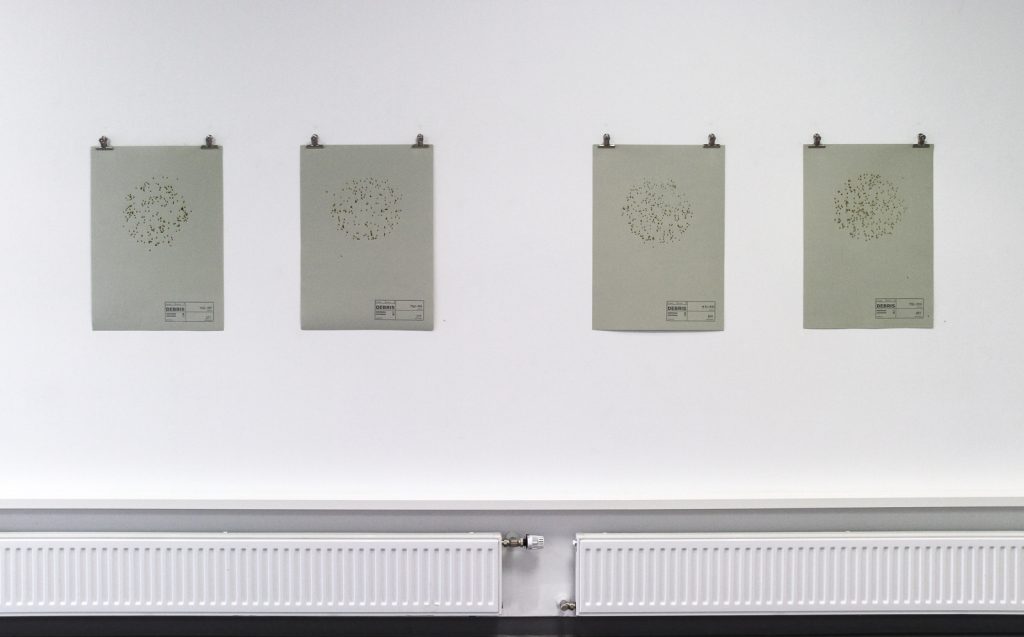
Debris is an installation to illustrate the emergence of space debris through decades of space exploration and commercial space use. The installation utilizes a laser to continuously visualize man-made objects orbiting the earth. The orbits of this debris are analysed and then exposed onto two thick paper sheets as a 2D projection of the northern and southern hemispheres.

From the press release:

DEBRIS – a thoughtful piece of laser art to celebrate Sputnik’s anniversary.

German based artist collective PLEX NOIR celebrates the 60th anniversary of the first satellite to reach earth orbit by picturing remains of space missions via ›laser engravings‹.

DEBRIS is an installation to illustrate the emergence of space debris through decades of space exploration and commercial space use.
The installation utilizes a laser to continuously visualize man-made objects orbiting the earth. The orbits of these debris are analyzed and exposed onto cardboard as a 2D projection.

On October 4th, 1957, Sputnik was the first man-made satellite to be launched into orbit. Since then, the empty space of our universe has become a dangerous place for manned space travel in the immediate vicinity of Earth. Almost all space flights leave parts behind, in different orbits and speed. The majority of them fall back to earth within short time to burn up in the atmosphere. However, especially faster parts remain in orbit for many decades. Scientists warn against cascading effects that will become more likely with each additional object and each collision between these objects.

DEBRIS manifests all catalogued pieces of debris in chronological order as tiny, burned-in marks on cardboard. The cardboard is exchanged when the visualisation of one decade of space debris is completed.

DEBRIS is currently on display at Kunsthaus Troisdorf, Germany. Over the course of the exhibition the laser continuously engraves space debris for each decade since the 1960s.