Category Archives: Contests and Games

NASA’s ‘Take the Plunge’ Challenge: Guess when LADEE hits the Moon

NASA invites you to make a guess as to when the LADEE spacecraft will smack the Moon:

Take the Plunge: LADEE Impact Challenge

 NASA’s Lunar Atmosphere and Dust Environment Explorer (LADEE) spacecraft is gradually lowering its orbital altitude over the moon. LADEE will continue to make important science observations before its planned impact into the lunar surface later this month.

When will it impact the lunar surface? NASA wants to hear your best guess!

Take the Plunge LADEE Impact Challenge

LADEE mission managers expect the spacecraft will impact the moon’s surface on or before April 21. On April 11, ground controllers at NASA’s Ames Research Center in Moffett Field, Calif., will command LADEE to perform its final orbital maintenance maneuver prior to a total lunar eclipse on April 15, when Earth’s shadow passes over the moon. This eclipse, which will last approximately four hours, exposes the spacecraft to conditions just on the edge of what it was designed to survive.

This final maneuver will ensure that LADEE’s trajectory will impact the far side of the moon, which is not in view of Earth and away from any previous lunar mission landings. There are no plans to target a particular impact location on the lunar surface, and the exact date and time depends on several factors.

“The moon’s gravity field is so lumpy, and the terrain is so highly variable with crater ridges and valleys that frequent maneuvers are required or the LADEE spacecraft will impact the moon’s surface,” said Butler Hine, LADEE project manager at Ames. “Even if we perform all maneuvers perfectly, there’s still a chance LADEE could impact the moon sometime before April 21, which is when we expect LADEE’s orbit to naturally decay after using all the fuel onboard.”

Anyone is eligible to enter the “Take the Plunge: LADEE Impact Challenge.” Winners will be announced after impact and will be e-mailed a commemorative, personalized certificate from the LADEE program. The submissions deadline is 3 p.m. PDT Friday, April 11.

For more information about the challenge and to enter, visit: http://socialforms.nasa.gov/ladee

“We want to thank all those that watched LADEE launch and have followed the mission these past months,” said Jim Green, NASA’s Director for Planetary Science at NASA Headquarters in Washington. “Our Moon holds a special place in so many cultures, and because of LADEE, we’ll know more than ever before about our nearest neighbor.”

LADEE’s mission marked several firsts. It was the first demonstration of Optical Laser Communications from space (sent data six times faster than radio), and the first deep space spacecraft designed and built “in house” at NASA’s Ames Research Center.  It was also the first payload to launch on a U.S. Air Force Minotaur V rocket integrated by Orbital Sciences Corp., Va., and was the first deep space mission to launch from NASA’s Goddard Space Flight Center’s Wallops Flight Facility on Wallops Island, Va., when millions watched the night launch on Sept. 6, 2013.

The vending-machine size spacecraft has been orbiting the moon since Oct. 6. On Nov. 10, LADEE began gathering science data, and on Nov. 20, the spacecraft entered its science orbit around the moon’s equator. LADEE has been in extended mission operations following a highly successful 100-day prime science phase.

LADEE’s three science payload instruments have been working to unravel the mysteries of the lunar atmosphere and dust environment acquiring to date more than 700,000 measurements. In its previous orbit, LADEE’s closest approach to the moon’s surface was between 20 and 50 km, and its farthest point was between 75 and 150 km – a unique position that allows the spacecraft to frequently pass from lunar day to lunar night, approximately every two hours. This vantage provides data about the full scope of changes and processes occurring within the moon’s tenuous atmosphere.

Scientists hope to address a long-standing question: Was lunar dust, electrically charged by sunlight, responsible for the pre-sunrise glow detected during several Apollo missions above the lunar horizon? LADEE also is gathering detailed information about the structure and composition of the thin lunar atmosphere.

A thorough understanding of these characteristics of our nearest celestial neighbor will help researchers understand other bodies in the solar system, such as large asteroids, Mercury, and the moons of outer planets.

Z-2 Spacesuit contest: Vote for best cover layer design

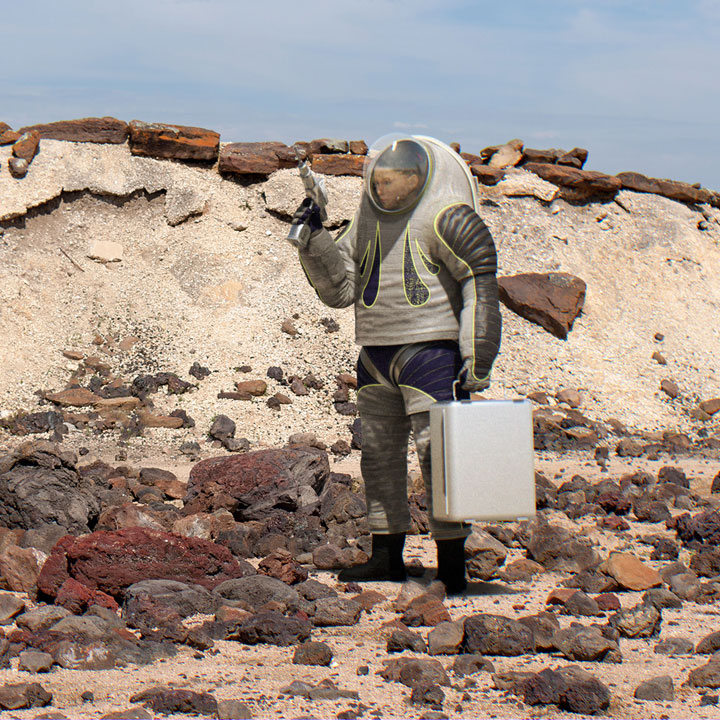
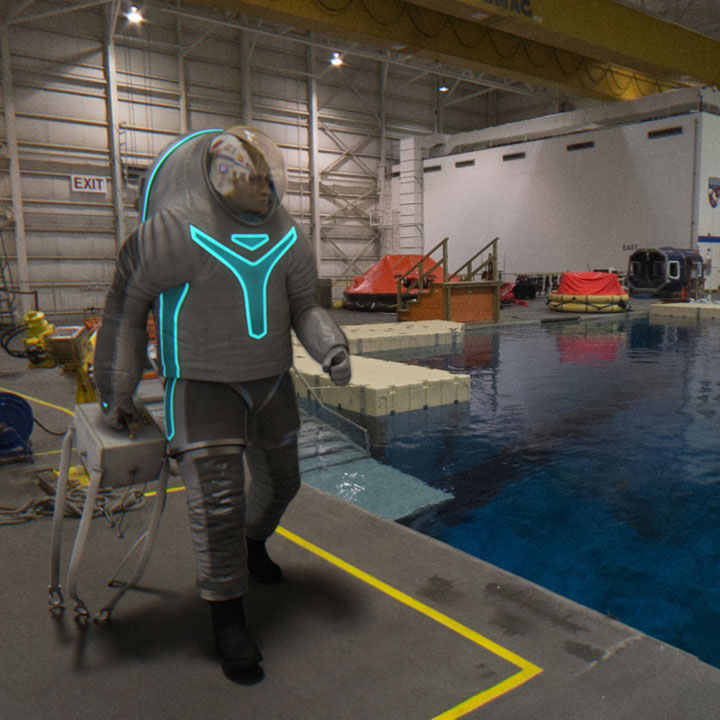
The NASA Z-2 EVA spacesuit development group is asking the public to vote on which of three exterior styles they like best: Z-2 Spacesuit Design Vote – NASA JSC

After the positive response to the Z-1 suit’s visual design we received, we wanted to take the opportunity to provide this new suit with an equally memorable appearance. The cover layer of a prototype suit is important as it serves to protect the suit against abrasion and snags during the rigors of testing. With the Z-2, we’re looking forward to employing cover layer design elements never used in a spacesuit before. The designs shown were produced in collaboration with ILC, the primary suit vendor and Philadelphia University. The designs were created with the intent to protect the suit and to highlight certain mobility features to aid suit testing. To take it a step further, we are leaving it up you, the public, to choose which of three candidates will be built.  

Option A: “Biomimicry”

bio_spaceCenter_scaled

—-

Option B: “Technology”

tech_nbl_scaled

—-

Option C: “Trends in Society”

trend_rocks_scaled

Inspiration Mars student design contest finalists selected

The Mars Society has selected finalists for the  International Student Design Competition for concepts related to the proposed Inspiration Mars Mission: Inspiration Mars Student Design Contest Finalists Announced – The Mars Society

The Mars Society announced today 10 finalists chosen from 38 engineering student teams competing in its International Inspiration Mars Student Design Contest. The requirement of the global competition is to design a two-person Mars flyby mission for 2018 as cheaply, safely and simply as possible. All other design variables are open. 

Each team competing was required to submit a 50-page design report, which provided the basis for a down-select first to 21 semifinalists and then to 10 finalists. The finalist teams will be invited to present and defend their designs before a panel of six judges chosen (two each) by the Mars Society, Inspiration Mars and NASA. The presentations will take place during a public event at NASA Ames Research Center in April 2014.

The finalists and their proposals are shown here. 

Commenting on the designs submitted by the competing teams, Mars Society President Dr. Robert Zubrin said, “I expected an excellent response from the world’s engineering students to this challenge, but even so, I am amazed at the extraordinary strength and quality of the work set forth by these teams. Where some people have said that a low-cost two-person Mars flyby mission can’t be done in 2018, many of these teams have shown very clearly that it can. These designs will be of enormous benefit to Inspiration Mars or anyone else who is willing to step up and take on this challenge. They also show beyond question that around the world a new generation of terrific young engineers is waiting in the wings, ready to pick up and carry forward the banner of human space exploration when the time comes for them to take their turn. I look forward to final face-off between the teams at NASA Ames with great excitement. Let the best ideas win!” 

The first place team will receive a prize of $10,000, an all-expenses paid trip to the 2014 International Mars Society Convention to be held August 4-7 in Houston, Texas and a trophy to be presented by Dennis Tito at that event. Prizes of $5,000, $3,000, $2,000 and $1,000 will also be awarded for second through fifth place.  

Video: Trailer for “Back to the Moon for Good”

The Google Lunar XPRIZE has created a Fulldome Planetarium Show titled, Back To The Moon For Good.

In case you haven’t heard, the Moon is trending again… and in a big way. Like in the glory days of the 1960s and 1970s, our big white space neighbor is enjoying the attention of lunar explorers. Only this time, they’re going back to the moon for good.

The educational 24-minute Google Lunar XPRIZE fulldome planetarium show, Back To The Moon For Good, chronicles teams around the world competing for the largest incentivized prize in history, by landing a robotic spacecraft on the Moon for the first time in more than 40 years.

Here is a trailer:


NASA’s Asteroid Grand Challenge Contest

A message from Planetary Resources:

Be an Asteroid Hunter in NASA’s
First Asteroid Grand Challenge Contest Series

NASA’s Asteroid Data Hunter contest series will offer $35,000 in awards over the next six months to citizen scientists who develop improved algorithms that can be used to identify asteroids.

This contest series is being conducted in partnership with Planetary Resources Inc. of Bellevue, Wash. The first contest in the series will kick off on March 17. Prior to the kick off, competitors can create an account on the contest series website and learn more about the rules and different phases of the contest series by going to: http://bit.ly/AsteroidHunters

Managed by the NASA Tournament Lab, the entire contest series runs through August and is the first contest series contributing to the agency’s Asteroid Grand Challenge.

“For the past three years, NASA has been learning and advancing the ability to leverage distributed algorithm and coding skills through the NASA Tournament Lab to solve tough problems,” said Jason Crusan, NASA Tournament Lab director. “We are now applying our experience with algorithm contests to helping protect the planet from asteroid threats through image analysis.”

The Asteroid Data Hunter contest series challenges participants to develop significantly improved algorithms to identify asteroids in images captured by ground-based telescopes. The winning solution must increase the detection sensitivity, minimize the number of false positives, ignore imperfections in the data, and run effectively on all computer systems.

“Protecting the planet from the threat of asteroid impact means first knowing where they are,” said Jenn Gustetic, Prizes and Challenges Program executive. “By opening up the search for asteroids, we are harnessing the potential of innovators and makers and citizen scientists everywhere to help solve this global challenge.”

Gustetic and Jason Kessler, Grand Challenges Program executive, will host a panel March 10 at the South by Southwest Festival in Austin, Texas titled “Are We Smarter than the Dinosaurs?” to talk about how open innovation can meaningfully engage people in discussions on and research into space exploration and help us solve problems of global importance. They will provide an outline of the Asteroid Data Hunter contest series and other efforts to detect asteroid threats, as well as ideas for mitigating these threats.

“Current asteroid detection initiatives are only tracking one percent of the estimated objects that orbit the Sun. We are excited to partner with NASA in this contest to help increase the quantity and knowledge about asteroids that are potential threats, human destinations, or resource rich.” said Chris Lewicki, President and Chief Engineer of the asteroid mining company Planetary Resources, Inc. “Applying distributed algorithm and coding skills to the extensive NASA-funded Catalina Sky Survey data set will yield important insights into the state of the art in detecting asteroids.”

Through NASA’s asteroid initiative, the agency seeks to enhance its ongoing work in the identification and characterization of near-Earth objects for further scientific investigation. This work includes locating potentially hazardous asteroids and identifying those viable for redirection to a stable lunar orbit for future exploration by astronauts. The Asteroid Grand Challenge, one part of the asteroid initiative, expands the agency’s efforts beyond traditional boundaries and encourages partnerships and collaboration with a variety of organizations.

The algorithm contests are managed and executed by NASA’s Center of Excellence for Collaborative Innovation (CoECI). CoECI was established at the request of the White House Office of Science and Technology Policy to advance NASA open innovation efforts and extend that expertise to other federal agencies. CoECI uses the NASA Tournament Lab (NTL) for its advanced algorithmic and software development contests. Through its contract with Harvard Business School in association with Harvard’s Institute of Quantitative Social Science, NTL uses the topcoder platform to enable a community of more than 600,000 designers, developers and data scientists to create the most innovative, efficient and optimized solutions for specific, real-world challenges faced by NASA.

For more information on NASA’s Center of Excellence for Collaborative Innovation, visit: http://www.nasa.gov/coeci

For more information on Planetary Resources, Inc., visit: http://www.planetaryresources.com

For more information on NASA’s asteroid initiative, visit: http://www.nasa.gov/asteroidinitiative