Check out the night sky this month, September 2023. Here are videos highlighting the top sights to observe.
** What’s Up: September 2023 Skywatching Tips from NASA – NASA JPL
Venus returns to the early morning skies as a bright beacon in the east. The full moon at the end of the month is known as the Harvest Moon. And if you have access to dark skies away from urban light pollution, you might be able to glimpse the faint, glowing pillar of the zodiacal light.
0:00 Intro 0:13 Venus in the morning sky 0:36 Viewing Jupiter and Saturn 1:01 The Harvest Moo 1:37 The Zodiacal Light 2:50 OSIRIS-REx asteroid sample return 3:21 September Moon phases
Additional information about topics covered in this episode of What’s Up, along with still images from the video, and the video transcript, are available at https://solarsystem.nasa.gov/skywatch….
In September, Pegasus becomes increasingly prominent in the southeastern sky, allowing stargazers to locate globular star clusters and a nearby double star, Alpha Capricorni. Keep watching for space-based views of densely packed, spherical collections of ancient stars in visible and X-ray light.
Pete Lawrence and Paul Able guide us through this month’s night-sky highlights, including Mercury emerging as a morning planet, Neptune at opposition, lunar occultation of Botein, Gruithuisen’s Lunar City, the autumn equinox and 2023’s Harvest Moon.
** Sky & Telescope’s Sky Tour Podcast – September 2023 | The Harvest Moon and the Summer Triangle – Sky & Telescope Youtube
Our monthly Sky Tour #astronomy #podcast provides an informative and entertaining 10-minute guided tour of the nighttime sky. Listen to the September episode and celebrate the equinox; stalk the Harvest #Moon; check in with #Saturn, #Jupiter, and #Venus; and explore the #Summer Triangle. Grab your curiosity, and come along on this month’s Sky Tour.
Axiom Space is guided by the vision of a thriving home in space that benefits every human, everywhere. The leader in providing space infrastructure as a service, Axiom offers end-to-end missions to the International Space Station today while privately developing its successor – a permanent commercial destination in Earth’s orbit that will sustain human growth off the planet and bring untold benefits back home. More information about Axiom can be found at www.axiomspace.com.
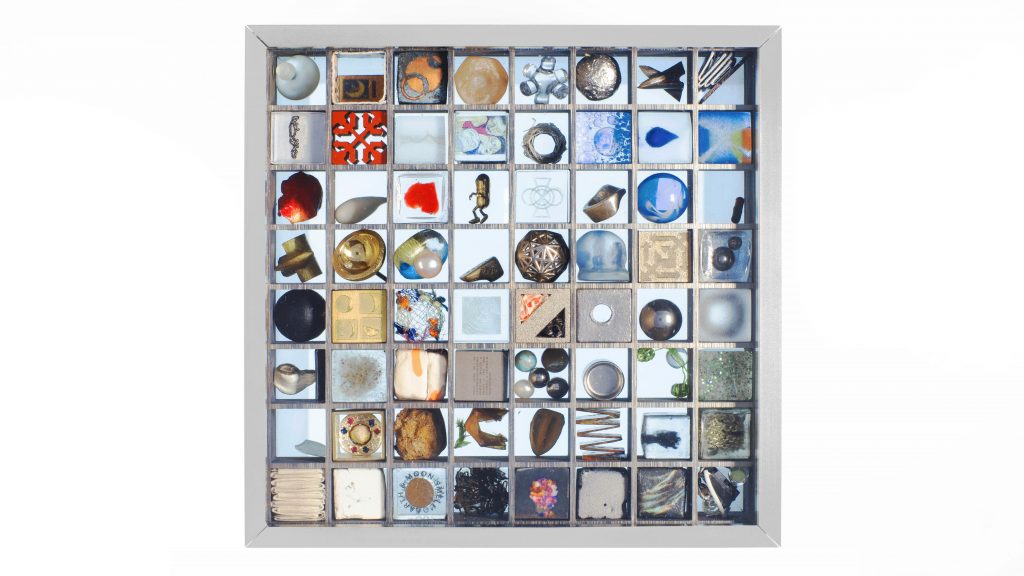
international collaborative artwork and a gallery of ideas worth sending to the Moon. Moon Gallery aims to set up the first permanent museum on the Moon. Moon Gallery will launch 100 artefacts to the Moon within the compact format of 10 x 10 x 1cm plate on a lunar lander exterior panelling as early as 2025. In this Petri-dish-like gallery, we are developing a culture for future interplanetary society. What are the ideas we want to promote into the future? What are the ideas we want to leave behind?
A collection of art pieces were sent to the ISS in February 2022 on the NG-17 mission of the Northrop-Grumman Cygnus cargo spacecraft. For this test mission, the gallery grid featured
… 8×8 cells housing 64 physical artefacts and one engraved AR artwork. Sixty-five art projects featured in the gallery reached the final frontier of human habitation and marked the historical meeting point of the Moon Gallery and the cosmos. Reaching low Earth orbit on our way to the Moon is the first step in extending our cultural dialogue to space.
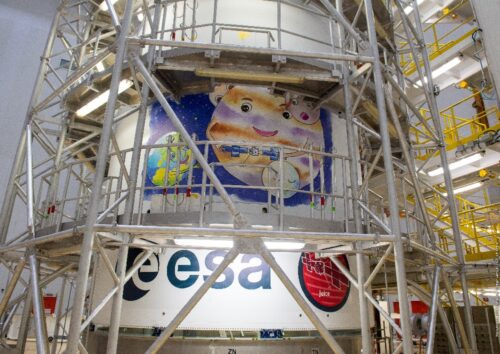
ESA’s Jupiter Icy Moons Explorer (Juice) will launch in April on an Ariane 5 rocket. The nosecone faring has been decorated with the winning artwork in the ‘JUICE Up Your Rocket!’ competition. The artwork came from 9-year-old Yaryna.
Here is a video about the “JUICE Up Your Rocket!” art project:
The Jupiter Icy moons Explorer (Juice) is an ESA planetary exploration mission currently under construction, development and testing at different sites across Europe. This is the seventh episode of a series, in which we take the viewer behind the scenes of the European space industry, space technology and planetary science community around the Juice mission.
In this Episode Manuela Baroni, head of the Juice Project Control Section, presents the idea and results of the ‘JUICE Up Your Rocket!’ competition, which invited children from all over the world to create a work of art related to the mission. The winning artwork will be placed on the nose (fairing) of the rocket that will launch Juice into space!
This episode is part of a film project that will result in a one-hour documentary film to be released before the launch of Juice. Produced for ESA by Lightcurve Films. Original music by William Zeitler. Animations by Rafael Andres (ESA).
… is not limited to creating works such as photographs, videos, movies, and media art from images and footage taken by the space camera.
We will work on various creative activities with many people, including artists and creators, by offering new inspiration from experiences connecting with space through operation of our satellite and content that brings users various forms of “Space perspectives.”
It will have the possibility to bring about inspiration in creativity in all kinds of domains, from creations such as artworks including paintings and sculptures, design in fashion and architecture, animation, games, narratives, and poetry to expressions and performances such as music, theater, and dance. STAR SPHERE will unleash space for artists and creators with the latest technology and entertainment that imparts fresh meanings of space.
** Boldly Going: Planet and The Roddenberry Foundation Collaboration – Planet Labs
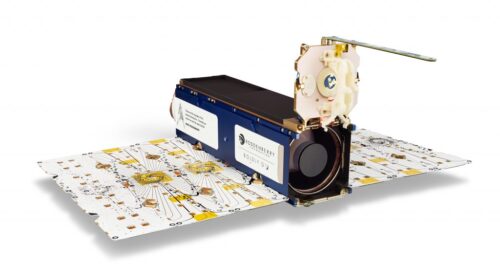
The company Planet Labs has built, launched, and operated hundreds of small satellites in orbit that provide near continuous high resolution images of the entire surface of the Earth. On January of 2022, three dozen Planet satellites were taken into orbit on a SpaceX Falcon 9 rocket. The side panels of ten of the satellites were engraved with artwork and quotes selected from submissions from over 1000 fans of Star Trek and Gene Roddenberry.
We recently launched 36 Planet SuperDove satellites with SpaceX, with a select number of these satellites featuring Star Trek inspired quotes as a part of Planet and Roddenberry Foundation’s shared commitment to make the world a more sustainable and secure place. The Roddenberry Foundation’s Rod Roddenberry, son of Star Trek Creator’s Gene Roddenberry, gets the scoop from our very own VP of Launch Mike Safyan on how sats are reaching the final frontier…of making the world a better place. Watch now!
** Sci-Fi Short Documentary “Artist Depiction by Steve R. Dodd” | DUST
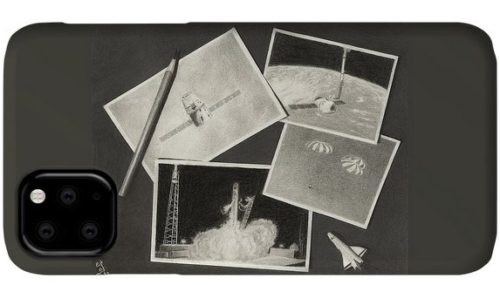
Working at home in Tennessee with no internet or computer, Steve R. Dodd has created hundreds of beautiful ‘spacescapes’ visions of a positive future. Now 69 years old, this is his first on camera interview.
“Artist Depiction by Steve R. Dodd” directed by Brett Ryan Bonowicz
… James Vaughan, aerospace illustrator and primary cover artist for Ad Astra magazine. Ad Astra Editor-in-Chief Rod Pyle sits down to talk with Jim about his stunning work in illustrating the future of spaceflight, his career in Chicago’s advertising and fashion industries, and what makes some of his landmark works stand out in a crowded field–and why everyone from NASA’s Kennedy Space Center to Lockheed Martin, to the NSS have engaged him to communicate their vision. Enjoy this informative and fun space forum with one of the most prominent space artists of today.
** What’s Up: August 2023 Skywatching Tips from NASA – NASA JPL
What are some skywatching highlights in August 2023? Saturn reaches opposition this month, meaning it’s at its biggest and brightest for the year, and visible all night. The “shooting stars” of the annual Perseid meteors are a must-see, overnight on August 12th. And this month brings two full moons – the second of which is a “Super Blue Moon.”
0:00 Intro 0:11 Saturn at opposition 0:40 Pairings of the Moon, stars, and planets 1:05 Perseid meteor shower 2:16 Super Blue Moon 3:46 August Moon phases
Additional information about topics covered in this episode of What’s Up, along with still images from the video, and the video transcript, are available at https://solarsystem.nasa.gov/skywatch….
In August, a flock of star-studded figures soars overhead. Look for the Vega and Lyra constellations, which point to Epsilon Lyrae and the Ring Nebula. You can also spot three bright summer stars: Vega, Deneb, and Altair, which form the Summer Triangle. Keep watching for space-based views of these and other stars and nebulas.
Astronomers Pete Lawrence and Paul Abel reveal the best things to see in the night sky this month, including Mercury and Venus, Saturn at opposition, Comet C/2020 V2 (ZTF), a perigee full Moon and the Perseid meteor shower.
Our monthly Sky Tour #astronomy #podcast provides an informative and entertaining 10-minute guided tour of the nighttime sky. Listen to the August episode and stalk a Blue #moon; peek perchance at some #Perseids; welcome #Saturn to the evening sky; and gaze at the center of the #milkyway.
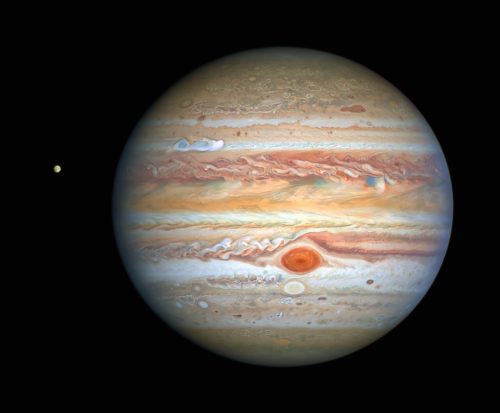
An image of Jupiter, taken by the NASA/ESA Hubble Space Telescope on 25 August 2020, was captured when the planet was 653 million kilometres from Earth. Hubble’s sharp view is giving researchers an updated weather report on the monster planet’s turbulent atmosphere, including a remarkable new storm brewing, and a cousin of the Great Red Spot changing colour — again. The new image also features Jupiter’s icy moon Europa.
Check out the upcoming National Space Society Space Forum with Dr. Doug Plata, President and founder of the Space Development Network. He will talk about the Network’s plan for sustainable space development and focus in particular on The Space Fair and Instabase projects. The presentation on Zoom is set for Thursday, July 13, 2023, 9:00 pm to 10:15 pm EDT.
[ Update July.17.2023: Here is a video of the event:
The Plan for Sustainable Space Development is the plan proposed by the Space Development Network for the initial development of space. It has similarities to the NSS Roadmap, but it is focused on the near term, what is probable, and a specific timetable. Doug’s presentation will focus on two aspects, The Space Fair and Instabase.
The Space Fair is made from the exhibits which were displayed at ISDC 2023 in Frisco, Texas and which filled a conference room, much to the delight and enjoyment of the attendees. The Space Fair is divided into 15 categories and Doug will review the sections as they provide an interesting summary of the plan.
Following that introduction to the plan, Doug will explore their proposed concept for the Initial Permanent Bases on the moon and Mars. This Instabase would be designed to house the very historic, Initial Permanent Crew of eight. Doug will explain why they believe that inflatables make the best sense not only for the Initial Permanent Base but for the initial phase of the International Bases on the Moon and Mars. They could use very large, 100 ton inflatables delivered via Starship. Doug will systematically go through the various modules of the InstaBase and then describe the scenario for the Initial Permanent Crew.
Don’t miss this informative space forum that will feature the innovative concepts for habitation on the Moon proposed by the Space Development Network. Doug will also share more about the Space Development Network and answer all of your questions. …
* * * * * * * * * * * * * * * *
Doug Plata is a physician in Redlands, CA. He is the President and Founder of the Space Development Network, a free-to-join organization of space advocates networked to advance space development projects. Doug has served on multiple committees of different space advocacy organizations. He has made dozens of appearances and presentations at conferences and on the radio. He recently oversaw the completion of a full-scale Moon-Mars base mock-up named the InstaBase which is to be displayed during major Starship launches. His primary interest is the establishment of large, inflatable, and sustainable bases as the initial permanent bases on both the Moon and Mars.
** What’s Up: July 2023 Skywatching Tips from NASA – NASA JPL
What are some skywatching highlights in July 2023?
Mars and Venus start the month close together, but part ways and head lower as July goes on. Mars appears very near Regulus in Leo on the 9th and 10th. Saturn and Jupiter rule the night, along with bright star Fomalhaut. And July is prime time for viewing the Milky Way core from dark sky locations.
0:00 Intro 0:12 Mars & Venus in the evening 0:31 Mars close to Regulus 1:07 Saturn & Jupiter in the morning 1:49 Fomalhaut’s debris disk 2:38 Viewing the Milky Way 3:17 July Moon phases
Additional information about topics covered in this episode of What’s Up, along with still images from the video, and the video transcript, are available at https://solarsystem.nasa.gov/skywatch….
In July, find the Scorpius constellation to identify the reddish supergiant Antares, which will lead you to discover a trio of globular star clusters. Keep watching for space-based views of these densely packed, spherical collections of ancient stars, as well as three nebulas: the Swan Nebula, the Lagoon Nebula, and the Trifid Nebula.
Pete Lawrence and Paul Abel reveal what’s visible in the night sky this month, including Mercury and Venus, a (somewhat) brightening Jupiter, the Perseid meteor shower, minor planet Vesta, and Comet C/2020 V2 (ZTF).
Our monthly Sky Tour #astronomy #podcast provides an informative and entertaining 10-minute guided tour of the nighttime sky. Listen to the July episode and take the measure of #Earth’s orbit; track down #mars, #mercury, and #venus, and take a poke at the celestial scorpion, #scorpious.
Listen and subscribe to this podcast at https://skyandtelescope.org/observing/ and don’t forget to subscribe to S&T’s YouTube channel to get alerts about new videos, including this monthly podcast.