Category Archives: Space participation

Mars One announces round three astronaut candidates – The Mars 100

Mars One reduces their candidate settlers to 100:

The Mars 100: Mars One Announces Round Three Astronaut Candidates

Amersfoort, 16th February 2015 – From the initial 202,586 applicants, only 100 hopefuls have been selected to proceed to the next round of the Mars One Astronaut Selection Process. These candidates are one step closer to becoming the first humans on Mars.

“The large cut in candidates is an important step towards finding out who has the right stuff to go to Mars,” said Bas Lansdorp, Co-founder & CEO of Mars One. “These aspiring martians provide the world with a glimpse into who the modern day explorers will be.”

The Mars 100 Round Three candidates were selected from a pool of 660 candidates after participating in personal online interviews with Norbert Kraft, M.D., Chief Medical Officer. During the interviews the candidates had a chance to show their understanding of the risks involved, team spirit and their motivation to be part of this life changing expedition. “We were impressed with how many strong candidates participated in the interview round, which made it a very difficult selection” said Dr. Norbert Kraft.

Who are the Mars 100 Round Three candidates? There are 50 men and 50 women who successfully passed the second round. The candidates come from all around the world, namely 39 from the Americas, 31 from Europe, 16 from Asia, 7 from Africa, and 7 from Oceania. The complete list of Mars One candidates can be found here: Mars One Round Three Candidates.

What further challenges will these candidates face? The following selection rounds will focus on composing teams that can endure all the hardships of a permanent settlement on Mars. The candidates will receive their first shot at training in the copy of the Mars Outpost on Earth and will demonstrate their suitability to perform well in a team. “Being one of the best individual candidates does not automatically make you the greatest team player, so I look forward to seeing how the candidates progress and work together in the upcoming challenges.” said Dr. Norbert Kraft.

Candidates that were not selected to continue will have a chance to reapply in a new application round that will open in 2015. New application opportunities will follow in order to train candidates that can replace eliminated teams and join the crews of settlers that will leave Earth to live on Mars.

More Information

About Mars One

Mars One is a not-for-profit foundation that will establish permanent human life on Mars. Human settlement on Mars is possible today with existing technologies. Mars One’s mission plan integrates components that are well tested and readily available from industry leaders worldwide. The first footprint on Mars and lives of the crew thereon will captivate and inspire generations. It is this public interest that will help finance this human mission to Mars.
Mars One candidates wait for next down-select

The Mars One will soon reduce its candidate list down to 100. The project may never reach the Red Planet but at least it has proven that there are plenty of people willing to move to there if given the opportunity and even if they can’t come back:

Update: Here is a video about three candidates:

SkyTruth – Using satellites to spot gas flares, deforestation, illegal fishing, and other nasties

SkyTruth uses satellite imagery and measurements to monitor the globe for nefarious activities:

SkyTruth is a nonprofit organization using remote sensing and digital mapping to create stunning images that expose the landscape disruption and habitat degradation caused by mining, oil and gas drilling, deforestation, fishing and other human activities.

Our vision is a world where all people can see and understand the environmental consequences of human activity everywhere on Earth, and are motivated to take action to protect it.

Our mission is to motivate and empower new constituencies for environmental protection through illuminating the issues that impact our planet.

We use scientifically credible satellite images and other visual technologies to create compelling pictures that vividly illustrate environmental impacts, and provide these pictures and supporting data to environmental advocates, policy-makers, the media, and the public. 

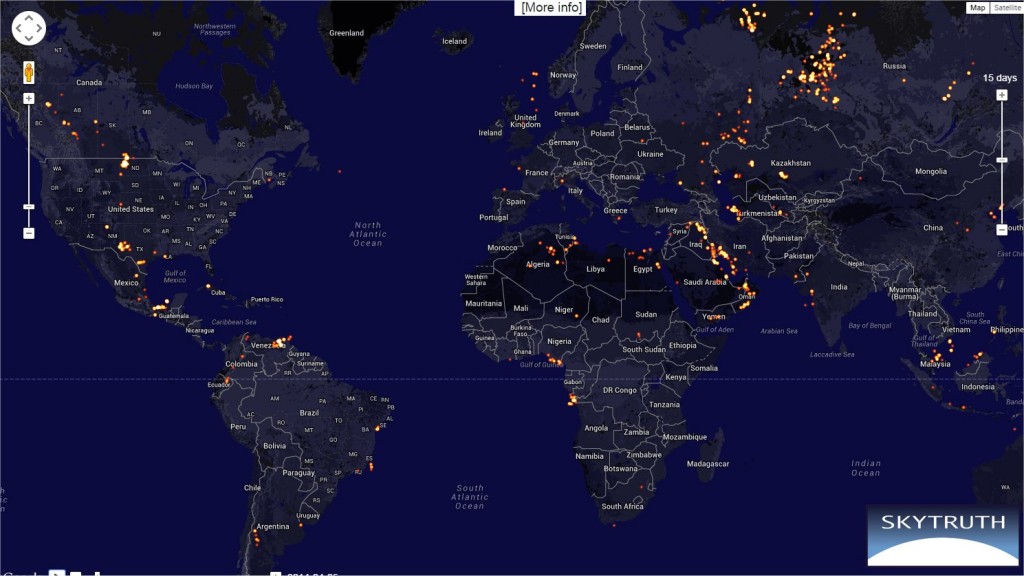
Here, for example, is a graphical display of gas flares around the world: Global Flaring Visualization – SkyTruth

GlobalFlaring

A new program is the Global Fishing Watch:

Global Fishing Watch is the product of a technology partnership between SkyTruth, Oceana, and Google that is designed to show all of the trackable fishing activity in the ocean. This interactive web tool – currently in prototype stage – is being built to enable anyone to visualize the global fishing fleet in space and time. Global Fishing Watch will reveal the intensity of fishing effort around the world, one of the stressors contributing to the precipitous decline of our fisheries.

A visualization of ocean fishing activities was unveiled last fall Global Fishing Watch – SkyTruth. They are taking advantage of satellite tracking of ships via the Automatic Identification System (AIS). The AIS is based on a standardized transmitter on ships intended to help with maritime traffic control. Though the AIS signal is fairly short range and intended originally only terrestrial reception in coastal areas, it was shown a few years ago that it can be picked up by satellites in low earth orbit. Subsequently, several satellite systems now use AIS to provide maritime traffic monitoring. Here are two ship tracking visualization tools available on line for free:

This video lays out the Global Fishing Watch plan:

LEGO Hubble Telescope model misses selection for commercial production

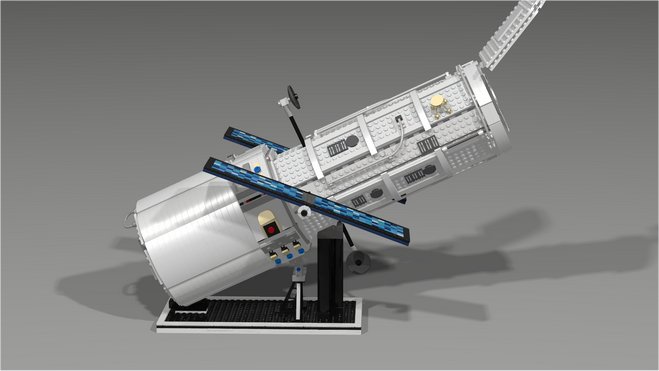
Last summer I wrote about a LEGO scratch model of the Hubble Telescope, which could become an official production model by LEGO if it was popular enough. (See The Hubble observatory in LEGO.)  LEGO allows LEGO modelers to post about their creations on the LEGO Ideas site. Visitors can vote on the models they like best. Those models that exceed 10,000 votes will be considered for commercial production.

Gabriel Russo posted his impressive Hubble Telescope model at the LEGO Ideas site last year:

HubbleTelescopeLego-GRusso

It received the 10000 votes but Robert Pearlman reports that it was nevertheless not selected by LEGO : LEGO passes on fan-voted Hubble Space Telescope model – collectSPACE

LEGO on Wednesday (Feb. 4) revealed the outcome of its most recent review of fan-suggested model kits submitted through its LEGO Ideas website. The Danish toy company passed on making the Hubble telescope, selecting a Pixar animator’s WALL-E robot and a “Doctor Who” set instead.

“We reviewed eight amazing projects that reached 10,000 supporters between June and September,” Signe Lonholdt with the LEGO Ideas team said in a video announcing the results of the evaluation. “Reaching 10,000 supporters is a tremendous accomplishment, but the journey [for the sets] is far from over.”

Here were two previous posts about the HST model:

Copenhagen Suborbitals: Rugged copy writer wanted

The volunteer rocket development group Copenhagen Suborbitals posted this job ad today: CopSub on Twitter:

Are you a copy writer fired up on rocketfuel? Take part in sending the worlds first amateur astronaut into space! 

B9AlzJ4IgAEnaWO[1]