In March, the stars of spring lie eastward: Look for the constellations Gemini and Cancer to spot interesting celestial features like star clusters M35 and the Beehive Cluster, and NGC 3923, an oblong elliptical galaxy with an interesting ripple pattern. Keep watching for space-based views of the galaxies.
an apparent meeting or passing of two or more celestial bodies. The Moon is in conjunction with the Sun at the phase of New Moon, when it moves between the Earth and Sun and the side turned toward the Earth is dark. Inferior planets—those with orbits smaller than the Earth’s (namely, Venus and Mercury)—have two kinds of conjunctions with the Sun. An inferior conjunction occurs when the planet passes approximately between Earth and Sun; if it passes exactly between them, moving across the Sun’s face as seen from Earth, it is said to be in transit. A superior conjunction occurs when Earth and the other planet are on opposite sides of the Sun, but all three bodies are again nearly in a straight line. Superior planets, those having orbits larger than the Earth’s, can have only superior conjunctions with the Sun.
** Superb Stargazing *** Let’s Take a Trip to the Brightest Stars *** March 1-5 2020 – nemesis maturity
Let’s take a trip to the stars, constellations, planets and Moon, and discover the amazing wonders of the night sky. Let the Moon guide you to the brightest stars of the night sky over the next several evenings. Happy New Month and Happy Skywatching!
** [ Update March.2.2020: What’s Up: March 2020 Skywatching Tips from NASA
Looking for astronomy highlights for March 2020? This month, early risers enjoy a planetary grouping of Mars, Jupiter and Saturn in the early morning sky. Plus a closer look at Sirius, the brightest star in the sky, and spot a lovely trio at sunset on March 28. Additional information about topics covered in this episode of What’s Up, along with still images from the video, and the video transcript, are available at https://solarsystem.nasa.gov/whats-up… .
Space Adventures and SpaceX announced today plans to fly four private citizens on a Crew Dragon flight. The Dragon would not go to the ISS but would be a “free flyer” mission in which the citizen astronauts would enjoy microgravity and views of Earth in the spacecraft. The spacecraft would go to 2-3 times the altitude of the ISS. The first launch is aimed for the late 2021 to mid-2022 time frame. The mission would last up to five days.
February 18, 2020 – Vienna, Va. — Building on the success of Crew Dragon’s first demonstration mission to the International Space Station in March 2019 and the recent successful test of the spacecraft’s launch escape system, Space Adventures, Inc. has entered into an agreement with SpaceX to fly private citizens on the first Crew Dragon free-flyer mission. This will provide up to four individuals with the opportunity to break the world altitude record for private citizen spaceflight and see planet Earth the way no one has since the Gemini program.
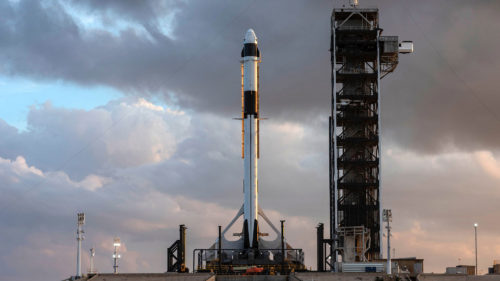
The Crew Dragon atop a Falcon 9 on Pad 39A before the launch on March 2, 2019 of the uncrewed vehicle for a test mission to the ISS.
If interested parties are secured, this mission will be the first orbital space tourism experience provided entirely with American technology. Private citizens will fly aboard SpaceX’s fully autonomous Crew Dragon spacecraft launched by the company’s Falcon 9 rocket, the same spacecraft and launch vehicle that SpaceX will use to transport NASA astronauts to the International Space Station.
“This historic mission will forge a path to making spaceflight possible for all people who dream of it, and we are pleased to work with the Space Adventures’ team on the mission,”
said Gwynne Shotwell, President and Chief Operating Officer, SpaceX.
“Creating unique and previously impossible opportunities for private citizens to experience space is why Space Adventures exists. From 2001-2009 our clients made history by flying over 36 million miles in space on eight separate missions to the ISS. Since its maiden mission in 2010, no engineering achievement has consistently impressed the industry more than the Dragon/Falcon 9 reusable system. Honoring our combined histories, this Dragon mission will be a special experience and a once in a lifetime opportunity – capable of reaching twice the altitude of any prior civilian astronaut mission or space station visitor,”
said Eric Anderson, Chairman, Space Adventures.
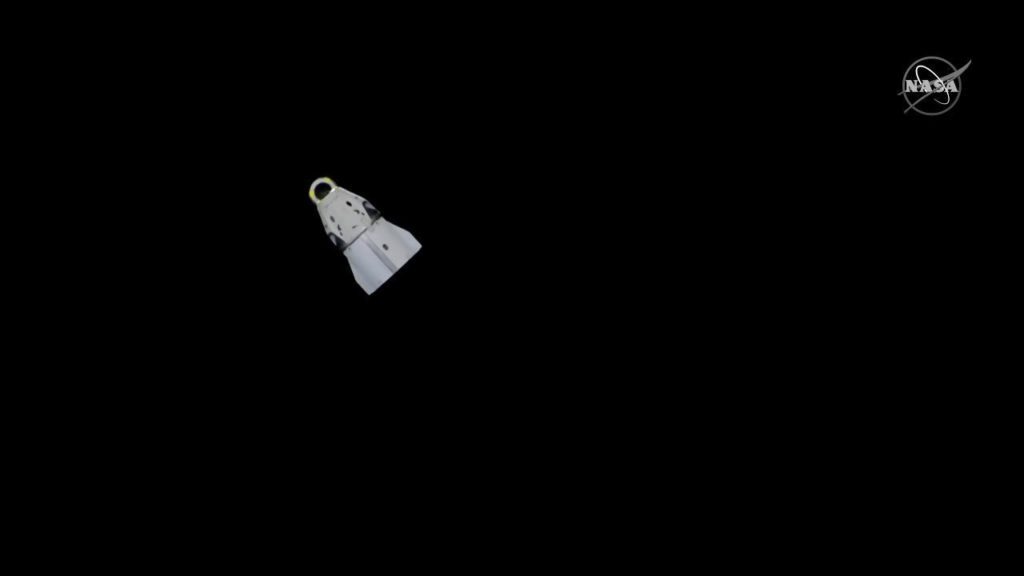
A view of the Crew Dragon during the uncrewed test flight in March 2019. The vehicle here was on it’s way back to earth after departing the ISS. Credits: NASA TV.
About Space Adventures: Space Adventures, the company that organized the flights for the world’s first private space explorers, is headquartered in the Washington, D.C. metro area. It offers a variety of programs available today, including spaceflight missions to the International Space Station, around the Moon, record-breaking orbital missions, and various training and spaceflight qualification programs. The company’s orbital spaceflight clients include Dennis Tito, Mark Shuttleworth, Greg Olsen, Anousheh Ansari, Charles Simonyi, Richard Garriott, and Guy Laliberté. For more information, please visit www.spaceadventures.com.
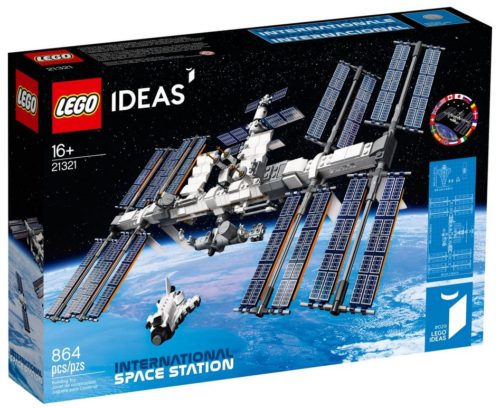
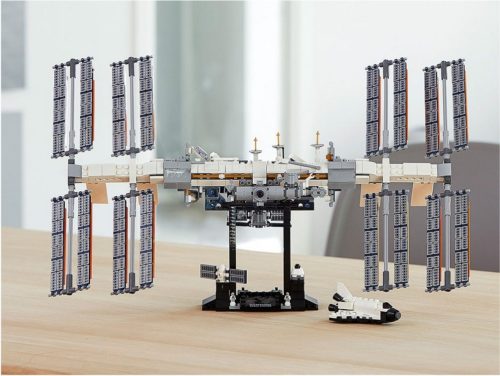
LEGO will release the International Space Station kit on February 1st. The highly elaborate kit (list price $69.99) is in the IDEAS line of models “inspired and voted for by LEGO fans”:
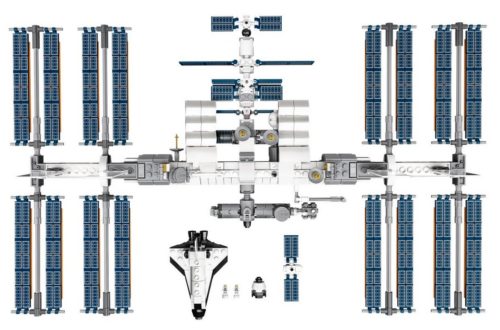
Packed with authentic ISS details, including a posable Canadarm2 and 2 rotating joints that coincide with 8 adjustable ‘solar panels’, this 864-piece set is a wonderful gift idea for space enthusiasts, adult LEGO fans or any experienced builder. Beautiful centerpiece This awesome LEGO spaceship model comes with a display stand, a buildable mini NASA space shuttle and 3 mini cargo spacecrafts, plus 2 astronaut microfigures to create a striking centerpiece in any room. Illustrated instructions are included, plus a 148-page booklet with fascinating ISS facts and information about the LEGO fan who created this space model kit and its LEGO designer [Christophe Ruge].
LEGO first announced that it was producing the International Space Station as a toy set in June 2019, after it won a fan poll in celebration of the 10th anniversary of the LEGO Ideas website. The space station received 45 percent of the more than 22,000 votes cast in a competition against three other possible sets.
The LEGO ISS got its start five years earlier, when Christoph Ruge, a LEGO and space enthusiast from Germany, first submitted his design for the space station brick-built model to the LEGO Ideas website. It qualified for a review by the LEGO team, but was rejected in 2015.
In 2018, Ruge re-entered his space station after scaling it down to match the size of the shuttle included in a winning LEGO Ideas project, the “Women of NASA” set released in 2017. (The orbiter included in the ISS set coming out Feb. 1 is similar to, but not identical to the “Women of NASA” model.) Again, LEGO’s design team did not select Ruge’s ISS to go forward, but then the anniversary vote came about.
The Space Tourism Conference (STC) is an annual event that will be produced with support from the Space Tourism Society (STS), the world’s leading space tourism advocacy organization for over 20 years.
The April 28 conference date was deliberately chosen as the anniversary of Dennis Tito’s lift-off into the history books in 2001 as the world’s first private space tourist. Tito’s flight jump-started the space tourism industry, generating massive consumer awareness as to the possibilities of private space travel and commercialization of space through earth-based experiences.
[Dennis Tito enters the ISS on April 30, 2001.]
A hallmark of the STC is a dynamic mix of executives and cross-section of industries:
space tourism flight providers ✦ private space station developers ✦ space enterprise strategists ✦ space investors ✦ entertainment executives ✦ astronauts ✦ media producers ✦ architects ✦ digital media experts ✦ futurists ✦ scientists ✦ space-themed fashion ✦ lifestyle designers ✦ consumer brands ✦ esports ✦ artists ✦ musicians ✦ high tech leaders
Attendees can expect concrete, actionable information, real-world use cases, and stellar deal-making.
PLUS you’ll have an insider track to the growth areas in space tourism, including earth-based space experiences, such as Zero Gravity aircraft flights.
** The Space Show – Mon, 12/30/2019 – John Spencer of the Space Tourism Society, which is organizing the above conference, talked about “space tourism, The Space Tourism Society, earth tourism analogs, social profits compared to financial profits, space tourism careers and opportunities plus more”:
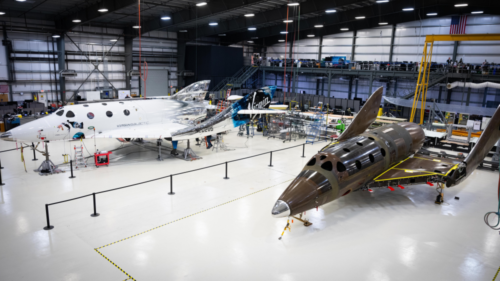
Virgin Galactic Holdings, Inc. (NYSE: SPCE) (“VG” or “the Company”), the world’s first commercial spaceline, announced today that it has reached the “Weight on Wheels” milestone in the build of its second commercial spaceship. In this milestone, all major structural elements of the vehicle were assembled, and the vehicle deployed its main landing gear and carried its own weight for the first time. The milestone signals strong progress in the manufacture of Virgin Galactic’s space vehicle fleet by The Spaceship Company, VGH’s wholly-owned aerospace development subsidiary.
“The Virgin Galactic fleet.” The second SS2 on right is about 80% complete. Credits: Virgin Galactic
This Weight on Wheels milestone has been reached considerably faster than it took to get to this stage with the first spaceship in the Virgin Galactic fleet, VSS Unity, which is currently in flight test. This pace has been achieved through a more efficient, modular assembly process, as well as experience curve benefits.
With the spaceship now capable of bearing its own weight, the assembly team is hard at work connecting the vehicle’s integrated systems, including the flight control systems from fuselage to tail booms, as well as completing the final structural closeouts.
As this work is completed, the spaceship will be positioned in the hangar for the start of integrated vehicle ground testing, which will verify the integrity of all systems. This step is a precursor to the start of its flight test program.
Beyond today’s Weight on Wheels milestone for the second space vehicle, the Virgin Galactic spaceship fleet is already advancing to its third spaceship, also currently under construction in Mojave. Structural and system part fabrication for that third vehicle is now over 50% complete.
George Whitesides, CEO of Virgin Galactic said: “Reaching the Weight on Wheels milestone considerably faster than was achieved for VSS Unity is a huge accomplishment and is a testament to the growing expertise and capabilities of the company. We now have two spaceships that are structurally complete, with our third making good progress. These spaceships are destined to provide thousands of private astronauts with a truly transformative experience by performing regular trips to space.’’
** Virgin Galactic (SPCE) is now a publicly traded company (see last roundup) . Here are some articles about how the stock is doing:
Virgin Galactic has kicked off its Astronaut Readiness Program – the process of preparing Future Astronaut customers for their flights to space. As the first and only private company to have put humans into space in a vehicle built for commercial service, we are now finalizing all elements of the customer experience, including the recently unveiled customer spacesuits, created in partnership with Under Armour, and the interior of our Gateway to Space headquarters at Spaceport America. The next phase in this process is to ensure that Future Astronauts are optimally prepared to fly to space.
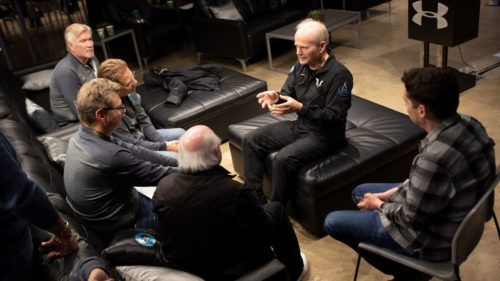
The Astronaut Readiness Program launched [last November] at the Under Armour Global HQ in Baltimore where we were joined by Future Astronauts who will be among the first to fly with Virgin Galactic. Guided and instructed by some of our key team members, they carried out a number of flight preparation activities. Through completing this unique program they are helping us to tailor and perfect the program for those who follow.
Virgin Galactic Chief Pilot Dave Mackay talks with future adventure travelers on SpaceShipTwo rocket planes. Credits: Virgin Galactic
** On December 11th, Blue Origin flew an uncrewed New Shepard again (see the report on the flight here). This was the 6th flight of that vehicle, which had only inspections after each flight rather than major refurbishment. Achieving fast, airliner-like turnarounds is key to lowering the cost of flying rocket powered vehicles.
However, there have been long breaks between New Shepard flights and no explanation for the gaps. Company officials say that they need a few more test flights before they will put people on the vehicles so that might mean many months if they do not speed up the flight rate.
** The sights of earth from space will draw many people to go there, especially after rocket transport ticket prices drop with vehicles like the SpaceX Starship. Most who have gone to space have said it was one of the greatest experiences of their lives and they never tired of watching the ever-changing earthscapes below.
January 9, 2020 – Reston, Va. – The American Institute of Aeronautics and Astronautics (AIAA) and Blue Origin have partnered to create Design/Build/Launch (DBL), a new competition designed to launch experimental payloads to study the effects of short-duration microgravity.
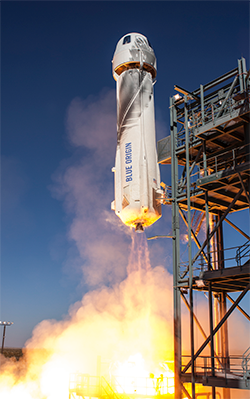
A fully reusable New Shepard rocket lifts off for a suborbital trip to space. Credits: Blue Origin
AIAA and Blue Origin invite high school students to develop creative research proposals in the fields of microgravity science or space technology and pair the experiment with a public outreach plan to share the excitement of space with others. The top proposal will be launched on Blue Origin’s New Shepard rocket and receive a $1,000 grant to prepare and develop the experiment for flight.
“There’s no better way to learn than by doing,” said Dan Dumbacher, AIAA executive director. “These students have an amazing opportunity to contribute to space research while learning how transformative aerospace can be while gaining the skills that will serve them well throughout their careers!”
AIAA and Blue Origin representatives will judge the submitted proposals on the basis of scientific/technical merit, outreach creativity, and feasibility. The winning payload is expected to fly on New Shepard in 2021. Postflight, the students will be recognized and have the opportunity to deliver their final report at ASCEND, an AIAA event dedicated to the space economy.
“Blue Origin is passionate about the future of living and working in space. Through payloads on our reusable New Shepard vehicle and our non-profit, Club for the Future, we are inspiring students to pursue careers in STEM and inviting them to visualize their own possibilities in space,” said Dr. Erika Wagner, payload sales director for Blue Origin.
Timeline:
Proposals Due
3 April 2020
Announcement of Winning Team
22 May 2020
Experiment Flies
2021
Final Report Presentation at ASCEND
November 2021
Who can enter?
All active high school students, between 9th and 12th grade (or equivalent homeschooling levels) at the time of their submission. Multiple students may collaborate on a single proposal, and a lead faculty advisor must be named to receive the payload development award. The competition is open to both U.S. and international students. Please see aiaa.org/dbl for more information.
About Blue Origin: For information on Blue Origin, visit www.blueorigin.com and follow @BlueOrigin on Twitter and Instagram. To learn more about Club for the Future and our space mail program, visit clubforfuture.org and follow @ClubForFuture on Twitter and Instagram.
About AIAA: The American Institute of Aeronautics and Astronautics (AIAA) is the world’s largest aerospace technical society. With nearly 30,000 individual members from 85 countries, and 95 corporate members, AIAA brings together industry, academia, and government to advance engineering and science in aviation, space, and defense. For more information, www.aiaa.org, or follow us on Twitter @AIAA.
About ASCEND: A new event by AIAA, ASCEND is designed to drive the $1 trillion space economy forward, bringing together technical and business leaders to solve problems that affect the entire planet and beyond. The international forum also is convening traditional and nontraditional players to help build the space economy. ASCEND’s inaugural event is 16–18 November 2020 in Las Vegas, Nevada. For more information, please visit https://www.ascend.events/, or follow us on Twitter @ascendspace.