A sampling of recent articles, videos, and images related to commercial human space travel (see also previous space tourism related posts):
** Survey of announced orbital spaceflights involving private individuals:
- Three persons to fly on a SpaceX Crew Dragon to the ISS in 2021 in a flight sponsored by Axiom Space.
- Four persons to fly in a SpaceX Crew Dragon in earth orbit (no ISS docking) in a mission reserved by Space Adventures.
- Two persons to fly on Soyuz to the ISS in 2023 in a flight sponsored by Space Adventures
- One will be the first private person to do a space walk.
- The contract is with Space Adventures, which must find and sign up two customers for the flight.
- Russian space firm signs deal to send two tourists to orbital outpost in 2023 – TASS
- Energia and Space Adventures Sign Contract for Orbital Space Tourist Flight – Space Adventures
- Tom Cruise movie to film on ISS:
- While confirmed by NASA, details of the film ops on the Station are not yet public. E.g. it is not known if Cruise will go himself to the station or how many people will go.
- [ Update July.30.2020: How Tom Cruise Pitched $200 Million Universal Commitment On Space Film – Deadline]
- Everything we know—and don’t—about Tom Cruise’s plans to film a movie in space | Ars Technica
- Tom Cruise’s Outer Space Movie with Elon Musk, NASA Finds Its Director – Variety
- Tom Cruise Plots Movie To Shoot In Space With Elon Musk’s SpaceX – Deadline
- ‘Should Be A Lot Of Fun!’ – Why Tom Cruise Shooting A Movie In Space Is Such A Big Deal – Forbes
- NASA working with Tom Cruise to film movie on the International Space Station – Spaceflight Now
- Yusaku Maezawa to fly in a SpaceX Starship to the Moon.
From Dennis Tito in 2001 to Guy Laliberté in 2009 there were seven private citizens who flew on Soyuz spacecraft to the ISS and spent several days there. (Charles Simonyi flew twice.) These flights were arranged by Space Adventures. The flights stopped with the retirement of the Shuttle because spare seats on the Soyuz were needed by NASA astronauts to reach the Station. With the debut flight of the SpaceX Crew Dragon, private individuals will again be heading to orbit either in a Dragon or a Soyuz, which has seats available once again.
** Suborbital space tourism awaits final tests of Virgin Galactic SpaceShipTwo and Blue Origin New Shepard. Notes on the two leading suborbital human space flight programs:
- VG SS2:
- See the item below on the unveiling on July 28th of the SpaceShipTwo interior design.
- Some details about the plan to reach commercial service were unveiled to BBC by George Whitesides, “Chief Space Officer”: Virgin Galactic set for last key rocket test flights – BBC News
- “Our next flight will be just purely two pilots in the front to do a systems check,” he told BBC News.“And then, once we’ve done that – well, we’re in pretty exciting territory because the plan is to start putting [four of our] people in the back. We haven’t shared exactly how many flights that will be because we’ve got to see how it goes. But it could be a fairly small number.”Commercial service would begin thereafter.
- Reportedly about 600 people currently have tickets for SS2 flights, which take six spaceflight participants and two pilots to about 80-90 km in altitude. This is below the Kármán line of 100 km, but is sufficient to meet the USAF criteria for spaceflight.
- After a lengthy pause, the company resumed taking reservations with $1000 deposits. See announcement below.
- Following the relocation of flight operations from Mojave to Spaceport America in New Mexico, the company carried out two drop-glide tests of the SS2 Unity. Powered test flights should resume soon.
- The company is now publicly traded and so is under an even more intense public spotlight than it was previously. While safety will obviously be a top priority, they will be under stockholder pressure to start flying paying customers as soon as possible.
- With the help of NASA, VG will develop a training program for private astronauts planning to visit the ISS: Virgin Galactic Signs Space Act Agreement with NASA for Private Orbital Spaceflight to the International Space Station (ISS) – Virgin Galactic
- Blue NS:
- Blue is still not taking reservations for flights on the New Shepard. Management has hinted that the prices will be in the same ball park as other companies, i.e. VG. So in the $250k range.
- The test flights so far have had no one on board. There had been indications that flights with company personnel would start by the end of the year following two or three more uncrewed flights. However, this is looking increasingly unlikely.
- The company has never explained why their flight rate is so low. The vehicle is fully reusable and appears to have performed well so far. Yet there are usually several months between flights. There has been no flight since Dec. 11, 2019.
- There apparently was going to be a flight in late spring but some employees balked at working during the Covad-19 crisis and the flight was canceled.
** NASA may buy seats on commercial suborbital vehicles for astronauts. The agency has “has initiated a new effort to enable NASA personnel to fly on future commercial suborbital spaceflights”: NASA Developing a Plan to Fly Personnel on Suborbital Spacecraft | NASA.
Commercial suborbital spaceflight capabilities are anticipated to be more accessible, affordable, and available than missions to the International Space Station and could provide NASA additional commercial human spaceflights to conduct such activities as testing and qualification of spaceflight hardware, human-tended microgravity research, and additional training opportunities for astronauts and other NASA personnel. The agency has developed an intensive, comprehensive training program for astronauts and astronaut candidates, and suborbital crew space transportation services could provide even more training opportunities for NASA astronauts, engineers, scientists, operators, and trainers.
This could provide an additional revenue source for Virgin Galactic and Blue Origin and supplement their suborbital tourism businesses. However, if NASA requires an elaborate certification process as the agency did for the SpaceX Dragon and Boeing Starliner, it could be many years before any NASA astronaut steps into a SS2 or New Shepard for a ride to suborbital space. ASAP To Keep Eye on NASA’s Safety Review of Commercial Suborbital Flights – SpacePolicyOnline.com.
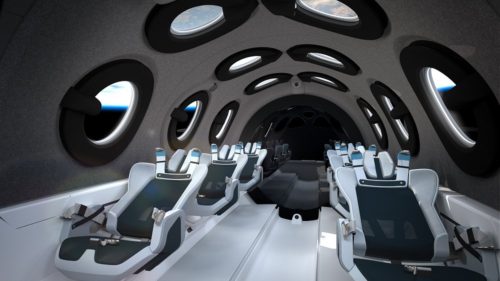
** Virgin Galactic shows off the interior of the SpaceShipTwo: Virgin Galactic Reveals SpaceshipTwo Cabin Interior – Virgin Galactic
One of the defining hallmarks of the Virgin brand over 50 years, has been the use of inspired and bold design to transform the customer experience. It’s an ethos that has been successfully applied across industrial sectors and design disciplines: from aircraft cabins and hotel bedrooms to fitness classes and personal banking.
Virgin Galactic, in collaboration with London design agency, Seymourpowell, has striven to remain faithful to that tradition by developing an elegant but progressive, experience-focused concept for the cabin of its spaceship. While it has been created to integrate seamlessly with every other aspect of the Virgin Galactic astronaut journey – the cabin is also the design centrepiece; providing safety without distraction, quietly absorbing periods of sensory intensity and offering each astronaut a level of intimacy required for personal discovery and transformation.
Here’s the unveiling event:
** Virgin Galactic restarts spaceflight participant reservation registrations: Virgin Galactic Invites Aspiring Astronauts to Take “One Small Step” as Company Experiences Rocketing Global Demand – Virgin Galactic
Virgin Galactic announced today that in preparation for the re-opening of spaceflight sales, it is introducing the One Small Step initiative. The company formally closed its doors to new ticket sales after its history-making first space flight in December 2018.
In addition to more than 600 firm reservations it has already taken from Future Astronaut customers from 60 countries, Virgin Galactic has received a consistently high level of interest from aspiring astronauts. This has resulted in 7957 online reservation registrations in the fourteen months since the first spaceflight and more than double the number the Company last reported in September 2019.
In light of continuing, strong progress towards commercial service, Virgin Galactic is now preparing to release its next tranche of seats for sale to the general public. In the first phase of that process, the Company will be launching its new One Small Step qualification process on Wednesday, February 26th, allowing those who are serious about flying to space, to register now and be front of line for firm seat reservations, once they become available.
To take One Small Step, future flyers will pay a fully refundable deposit of US$1,000 in a simple online registration process at www.virgingalactic.com/smallstep/
** Virgin Galactic gets new leadership: Virgin Galactic Announces Michael Colglazier as Chief Executive Officer in Preparation for Commercial Service – Virgin Galactic
[July 15, 2020] Virgin Galactic Holdings, Inc. (NYSE: SPCE) (“Virgin Galactic”), a vertically integrated aerospace and space travel company, today announced the appointments of Michael Colglazier as Virgin Galactic’s new Chief Executive Officer and George Whitesides as Chief Space Officer, effective July 20, 2020.
Michael assumes the CEO role at an exciting time for Virgin Galactic as the Company progresses through its test flight program and prepares for commercial service. He will also join the Company’s Board of Directors effective July 20, 2020. Michael joins Virgin Galactic following a long and successful career at The Walt Disney Company (NYSE: DIS), bringing over three decades of experience in developing and growing consumer-oriented multi-billion dollar businesses strategically, commercially, and operationally. Most recently Michael was President and Managing Director, Disney Parks International, where he was responsible for operations, strategy, and commercial and experiential development of Disney’s international parks and resorts.
George will assume the role of Chief Space Officer, focused on developing the Company’s future business opportunities, including point-to-point hypersonic travel and orbital space travel. George will also chair the Company’s Space Advisory Board, and in conjunction with his new role will step down from the Company’s Board of Directors. George joined Virgin Galactic in 2010 as its first CEO, after serving as Chief of Staff at NASA. During the past decade, he has built the Company from 30 people to a workforce of over 900 today, and he has successfully guided Virgin Galactic through its human space flight research and development program as well as the progress to date in its flight test program, culminating in two successful space flights. These historic flights saw the first humans launched into space from US soil since the retirement of the Space Shuttle, as well as the first woman to fly on a commercial space vehicle. During the last year, George led the transition of operations from Mojave, California to Spaceport America, New Mexico, and oversaw the Company’s successful public listing —creating the world’s first publicly traded human spaceflight venture.
See also
- Meet Disney’s Michael Colglazier, taking over as Virgin Galactic CEO – CNBC
- Virgin Galactic hires Disney executive as new CEO – SpaceNews
- When the Millennium Falcon’s Hyperdrive Fails, It’s Time to Hop on a Real Spaceship – WSJ
** VG has released a number of videos about various aspects of the SS2 development and its applications. Here is one with Beth Moses talking about her flight:
Learn what it’s like to travel to space from Beth Moses, Virgin Galactic’s Chief Astronaut Trainer, in this special Spacechat for all young people currently studying at home! Beth was the world’s 571st human to look down at Earth from the black sky of space as she became Commercial Astronaut 007. Hear Beth talk about her spaceflight, including highlights such as the rocket ride and floating in zero G! Beth invites you to join her and talk traveling through space in the first part of this series – Spacechat #WithMe!
** The “space experience company” Orbite will provide space flight training for private individuals planning to
- Space hospitality startup to establish training complex – SpaceNews
- Orbite, an ambitious New Space and Hospitality startup, will develop a unique Spaceflight Gateway Complex to serve future space explorers – Orbite
- Orbite (@orbitespace) / Twitter
** Other companies such as KBR are also offering various training services for space flight for private persons:
- In a Space Industry First, NASA Grants KBR the Right to Train Private Astronauts at NASA Facilities | KBR
- Houston company to train private astronauts at NASA facilities – Houston Chronicle
KBR, the Houston company currently training NASA astronauts, will start training their private, deep-pocket counterparts at NASA facilities.
KBR signed a Space Act Agreement with NASA’s Johnson Space Center to train private astronauts in a wide variety of spaceflight tasks, including operating onboard International Space Station systems, integrating into the existing ISS crew, performing routine operational tasks, maintaining health and performance and responding to emergencies. KBR will also provide medical operations and services prior to, during and after spaceflights.
** Space flight is typically described as one of the greatest experiences in the lives of those who have experienced it. For example, see the testimonies in Six NASA Astronauts Describe the Moment in Space When “Everything Changed – getpocket.com”
Nicole Scott
104 Days in Space
All I know is I was stunned in a way that was completely unexpected. It was overwhelmingly impressive — beyond anything I’d heard from my colleagues who’ve flown before. We just can’t describe it, you know? When you go to different places here on Earth and experience things that you never thought you would before, it’s difficult to describe it. I think with a lot of those things, you’re seeing it, but you’re feeling it, too. You feel like it’s just getting in you.
The planet just glows. I remember trying to describe to my son, who was seven at the time, what it was looking like to me. I’m like, “Okay, the simplest way I can think is just, take a lightbulb — the brightest lightbulb that you could ever possibly imagine — and just paint it all the colors that you know Earth to be, and turn it on, and be blinded by it.” Because day, night, sunrise, sunset, it is just glowing in all of those colors.
People go all over the world, often at great expense in both money and time, for no other reason than to see sights of historical significance, beauty, uniqueness, etc. Space travelers like those above come back to earth reporting that space offers stupendously unforgettable sights and mind-bending experiences. Any suggestion that there is no market for space flight is absurd.
** Many private space travelers will want flight insurance if available at a reasonable price: Space Insurance and the New Era of Space Exploration
The private sector has been gearing up outside the public eye for many years now. Soon, Virgin Galactic and Blue Origin may both begin space tourism flights sending guests to the edge of space and back. While SpaceX is the first private company to send humans to the ISS, Boeing’s Starliner will soon follow performing the same mission. Currently scheduled for 2021, the NASA Artemis program, using a new launch vehicle, Space Launch System, and crew capsule, Orion, are scheduled to begin missions that will eventually take humans to deep space destinations such as the Moon and Mars.
Human space flight brings new risks to the companies involved. The ISS will now host guests that are not sponsored by governments but by the private commercial sector. These individuals could be NASA astronauts as with the SpaceX crew, but they could also be employees of the launch company or space tourists. NASA and the FAA are still refining how these new risks are addressed. The space underwriters are working with the private space companies and NASA/FAA to create the insurance product that appropriately addresses the risks facing s the private sector when it comes to human flight. As the space industry evolves so too do the insurance programs that address the hazards.
** Experiencing weightlessness continues to attract customers to ZERO-G, which has been flying parabolas since 2004: Zero-G plans international expansion – SpaceNews.com
At a press conference during the Next-Generation Suborbital Researchers Conference here March 3, Matt Gohd, who became chief executive of [ZERO-G] about three months ago, said global interest in the company’s flights prompted him to examine the possibility of doing flights in other countries.
“One thing that stuck out for me was the amount of people from all over the world who would fly into the various places where a plane would go up for either passenger flights or research experiments,” he said, with customers coming to the U.S. from as far away as the Middle East and New Zealand, often just for the experience.
To tap into that demand, he said Zero-G is planning to conduct flights outside in other countries. He declined to identify what countries the company is considering to conduct such flights, but said more information about this “global initiative” will be released in the coming months.
** Michael Lyon – Space Tourism and Space Startups – Cold Star Project S02E13
Michael Lyon, founder of Xtronaut Enterprises, is a mentor at the Creative Destruction Lab tech accelerator, with a history of work in the space tourism and education fields. He has been an Adjunct Professor at the George Mason University School of Management, and was general counsel with James Cameron on Deep Ocean Expeditions (Titanic, Bismark).
On the Cold Star Project with host Jason Kanigan we discuss:
– the experience of traveling in a submersible to hydrothermal vents 8600 feet beneath the ocean surface
– what Michael has learned as a mentor at the Creative Destruction Lab
– what space and AI company founders need to do before they start looking for seed round funding
– the deadly things startups consistently miss to protect themselves legally as they begin operation
– how Michael’s company, Xtronaut Enterprises, is involved in the NASA OSIRIS-REx mission
– the hurdles to commercial space tourism and how the field may develop.
** High-altitude Near Space balloon travel adventures have been promised for many years but, like suborbital space tourism on rockets, have yet to take off.
Zero2Infinity of Spain was probably the first company to begin serious development of a high altitude (~35 km) system to provide a Near Space travel experience. Several adventurers would ride in a large enclosed gondola capsule below a helium balloon and they would enjoy a multi-hour journey in luxuious comfort before the capsule would detach from the balloon and parachute back to earth. Their Bloon system has yet to lift off as a business, but they have carried out extensive testing.
The Bloon’s experience consists in a four hour trip sitting in a pleasant, intimate environment. Fly up to an altitude of 36 km to enjoy of a spectacular view of our planet and learn about Earth in the most unique way.
World View, founded by Jane Poynter and Taber MacCallum, whose company Paragon Space Development Corp. had advised Zero2Infinity on life support systems, started out planning to offer similar Near Space trips but later became focused on using hi-alt balloon systems as platforms for broadband internet routers, scientific experiments, remote sensing, etc.
Poynter and MacCallum subsequently left World View and have now started a new company called Space Perspective, which returns to a focus on flying people in a hi-alt system: Space Perspective to fly people and payloads to the edge of space | Space Perspective –
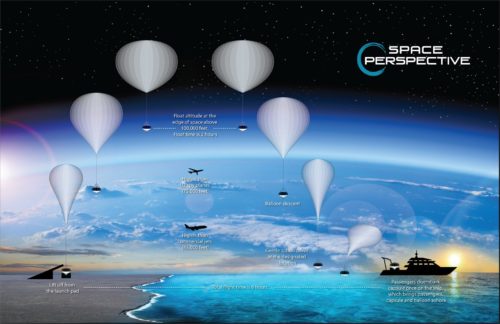
Space Perspective today announced its plans to fly passengers and research payloads to the edge of space with its Spaceship Neptune, a high-performance balloon and pressurized capsule. The human space flight company plans to launch from the iconic Shuttle Landing Facility at NASA’s Kennedy Space Center (KSC) in Florida, with the first un-crewed test flight scheduled in early 2021 that will include a suite of research payloads.
“We’re committed to fundamentally changing the way people have access to space – both to perform much-needed research to benefit life on Earth and to affect how we view and connect with our planet,” said Space Perspective Founder and Co-CEO Jane Poynter. “Today, it is more crucial than ever to see Earth as a planet, a spaceship for all humanity and our global biosphere.”
The company has completed extensive international market research and a new design built on 50+ years of proven technology. Spaceship Neptune was developed from the ground up for maximum safety, accessibility, near zero-emissions and routine operations around the world. The balloon measures the length of a football stadium and the pressurized capsule is comfortable and spacious.
Flown by a pilot, Neptune takes up to eight passengers called “Explorers” on a six-hour journey to the edge of space and safely back, where only 20 people have been before. It will carry people and research payloads on a two-hour gentle ascent above 99% of the Earth’s atmosphere to 100,000 feet, where it cruises above the Earth for up to two hours allowing passengers to share their experience via social media and with their fellow Explorers. Neptune then makes a two-hour descent under the balloon and splashes down, where a ship retrieves the passengers, the capsule, and the balloon. Neptune’s commercial human spaceflight launches are regulated by the FAA Office of Commercial Spaceflight.
See also:
- World View founders launch new stratospheric ballooning venture – SpaceNews.com
- Company plans space tourism flights in high-altitude balloon – CBS News
** The annual Space Tourism Conference will take place April 28, 2021 in Los Angeles. The STC is sponsoring a series of webinars between now and the conference. The first webinar took place on June 25th and is available for viewing: STC Webinar 1: “Space Tourism: A View into the Future” featuring John Spencer, Founder, Space Tourism Society & Jane Poynter, CEO, Space Perspective.
The next webinar is titled “Space Tourism: Follow the Money” and will be held on Thursday, August 6th at 12:00 p.m. PST.
Space tourism is the most profitable commercial space service to date and soon to be the fastest growing and most exciting sector within the space industry. Analysts say that by 2030 outer space travel will represent an annual market of at least $20 billion. Given the advancements, trials and growth already implemented this century, the Space Tourism Society and team behind the Space Tourism Conference foresee the acceleration of this marketplace in the near future, dubbing it the Space Tourism Decade. This session examines how and why the space tourism market is trending waaay up and analyzes the potential profits awaiting investors in this dynamic field.
The event will be hosted by Allison Dollar, CEO of ITV Alliance, and moderated by Robert Jacobson, author of Space is Open for Business, and will include speakers:
- Bonnie Rosen, Program Manager to the Techstars Starburst Space Accelerator.
-
Meagan Crawford, Managing Partner, SpaceFund
- Matthew Kuta, Co-Founder, President, and COO of Voyager Space Holdings
This webinar series is free for Space Tourism Conference ticket holders
=====
=== The Art of C. Sergent Lindsey ===