NASA JPL gives a preview of the night sky for the coming month.: What’s Up For April 2014 – “Mars at opposition, a lunar eclipse and April’s Lyrid meteor shower.”
NASA JPL gives a preview of the night sky for the coming month.: What’s Up For April 2014 – “Mars at opposition, a lunar eclipse and April’s Lyrid meteor shower.”
Ira Flatow interviews astronomer Chad Trujillo about a new dwarf planet that he and his team discovered in the outer reaches of our solar system: Dwarf Planet Found at the Edge of the Solar System – Science Friday
More about the discovery:
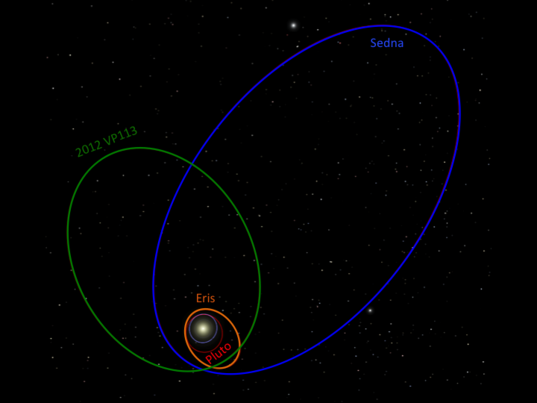 Unmannedspaceflight.com user Lucas, via Planetary Society
This diagram shows the relative sizes of the
orbits of Pluto and the dwarf planets
Eris, Sedna, and 2012 VP113
A surprising find by the European Southern Observatory (ESO):
First Ring System Around Asteroid
Observations at many sites in South America, including ESO’s La Silla Observatory, have made the surprise discovery that the remote asteroid Chariklo is surrounded by two dense and narrow rings. This is the smallest object by far found to have rings and only the fifth body in the Solar System — after the much larger planets Jupiter, Saturn, Uranus and Neptune — to have this feature. The origin of these rings remains a mystery, but they may be the result of a collision that created a disc of debris. The new results are published online in the journal Nature on 26 March 2014.
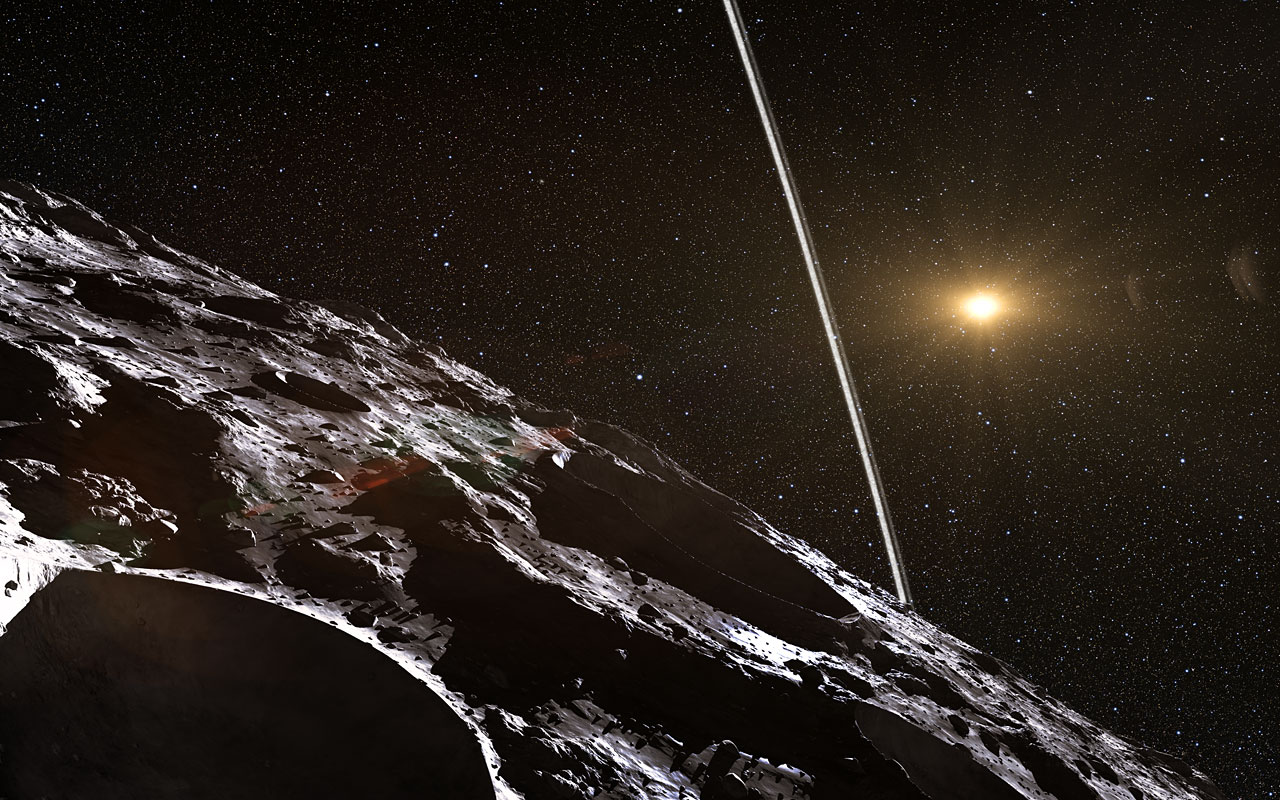
The rings of Saturn are one of the most spectacular sights in the sky, and less prominent rings have also been found around the other giant planets. Despite many careful searches, no rings had been found around smaller objects orbiting the Sun in the Solar System. Now observations of the distant minor planet [1] (10199) Chariklo [2] as it passed in front of a star have shown that this object too is surrounded by two fine rings.
“We weren’t looking for a ring and didn’t think small bodies like Chariklo had them at all, so the discovery — and the amazing amount of detail we saw in the system — came as a complete surprise!” says Felipe Braga-Ribas (Observatório Nacional/MCTI, Rio de Janeiro, Brazil) who planned the observation campaign and is lead author on the new paper.
Chariklo is the largest member of a class known as the Centaurs [3] and it orbits between Saturn and Uranus in the outer Solar System. Predictions had shown that it would pass in front of the star UCAC4 248-108672 on 3 June 2013, as seen from South America [4]. Astronomers using telescopes at seven different locations, including the 1.54-metre Danish and TRAPPIST telescopes at ESO’s La Silla Observatory in Chile [5], were able to watch the star apparently vanish for a few seconds as its light was blocked by Chariklo — an occultation [6].
But they found much more than they were expecting. A few seconds before, and again a few seconds after the main occultation there were two further very short dips in the star’s apparent brightness [7]. Something around Chariklo was blocking the light! By comparing what was seen from different sites the team could reconstruct not only the shape and size of the object itself but also the shape, width, orientation and other properties of the newly discovered rings.
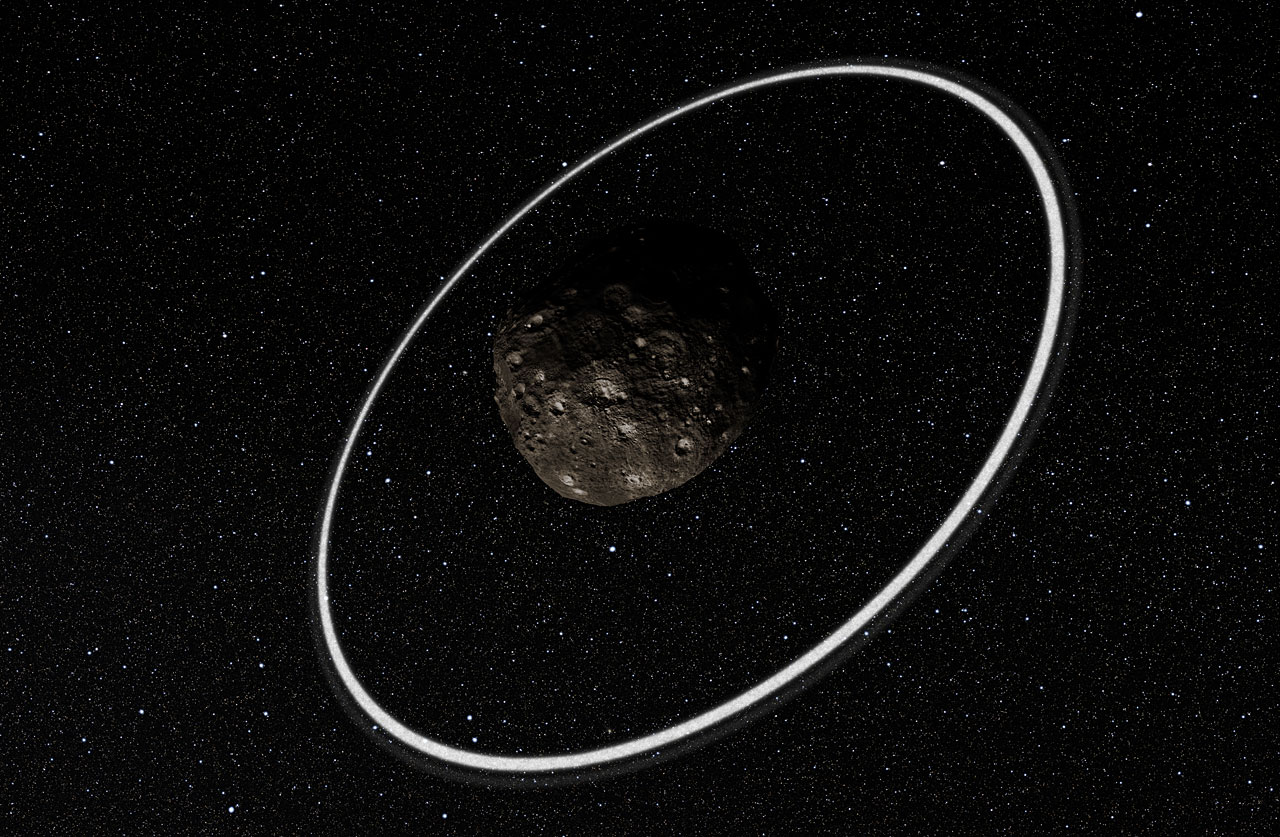
Artist’s sketch of ring around minor planet Chariklo.
Click to Enlarge
The team found that the ring system consists of two sharply confined rings only seven and three kilometres wide, separated by a clear gap of nine kilometres — around a small 250-kilometre diameter object orbiting beyond Saturn.
“For me, it was quite amazing to realise that we were able not only to detect a ring system, but also pinpoint that it consists of two clearly distinct rings,” adds Uffe Gråe Jørgensen (Niels Bohr Institute, University of Copenhagen, Denmark), one of the team. “I try to imagine how it would be to stand on the surface of this icy object — small enough that a fast sports car could reach escape velocity and drive off into space — and stare up at a 20-kilometre wide ring system 1000 times closer than the Moon.” [8]
Although many questions remain unanswered, astronomers think that this sort of ring is likely to be formed from debris left over after a collision. It must be confined into the two narrow rings by the presence of small putative satellites.
“So, as well as the rings, it’s likely that Chariklo has at least one small moon still waiting to be discovered,” adds Felipe Braga Ribas.
The rings may prove to be a phenomenon that might in turn later lead to the formation of a small moon. Such a sequence of events, on a much larger scale, may explain the birth of our own Moon in the early days of the Solar System, as well as the origin of many other satellites around planets and asteroids.
The leaders of this project are provisionally calling the rings by the nicknames Oiapoque and Chuí, two rivers near the northern and southern extremes of Brazil [9].
Masking out the intense bright light a star so that the dim reflected light of its planets, especially small earth-like ones, can be seen is no easy task. As mentioned in an earlier post, a starshade is a specially designed occulter that blocks a star’s light in a way that greatly reduces the diffraction around its edges. A starshade would be placed in space so that a telescope thousands of kilometers from it could observe planets around a distant star.
New Worlds Mission is a starshade project that has done early studies but has not been funded for implementation of an exoplanet observation system. This article provides more details on starshades: Incredible Technology: Giant Starshade Could Help Find an Alien Earth | Space.com
As it stands now, the assumed $1 billion mission would be able to target about 55 bright stars in a three-year span. [Sara Seager], the chair of NASA’s science and technology definition team for the starshade project, thinks it’s possible to find Earth-like planets orbiting 22 of those 55 stars targeted by the mission.
One major advantage to the starshade is that astronomers won’t need to couple it with a large, extremely expensive space telescope. By blocking out the light of a star before that light ever reaches the telescope, the starshade eliminates the need for a huge telescope, Seager said.
“You don’t need a very fancy telescope that’s highly thermally and mechanically stable,” Seager told Space.com. “You can use any old space telescope. We can buy a telescope. That’s what we’re thinking of. … It sounds a little funny, but any telescope will do.”
More at
A press release from ESA/Hubble:
New artwork unveiled at the Science with
the Hubble Space Telescope IV conference
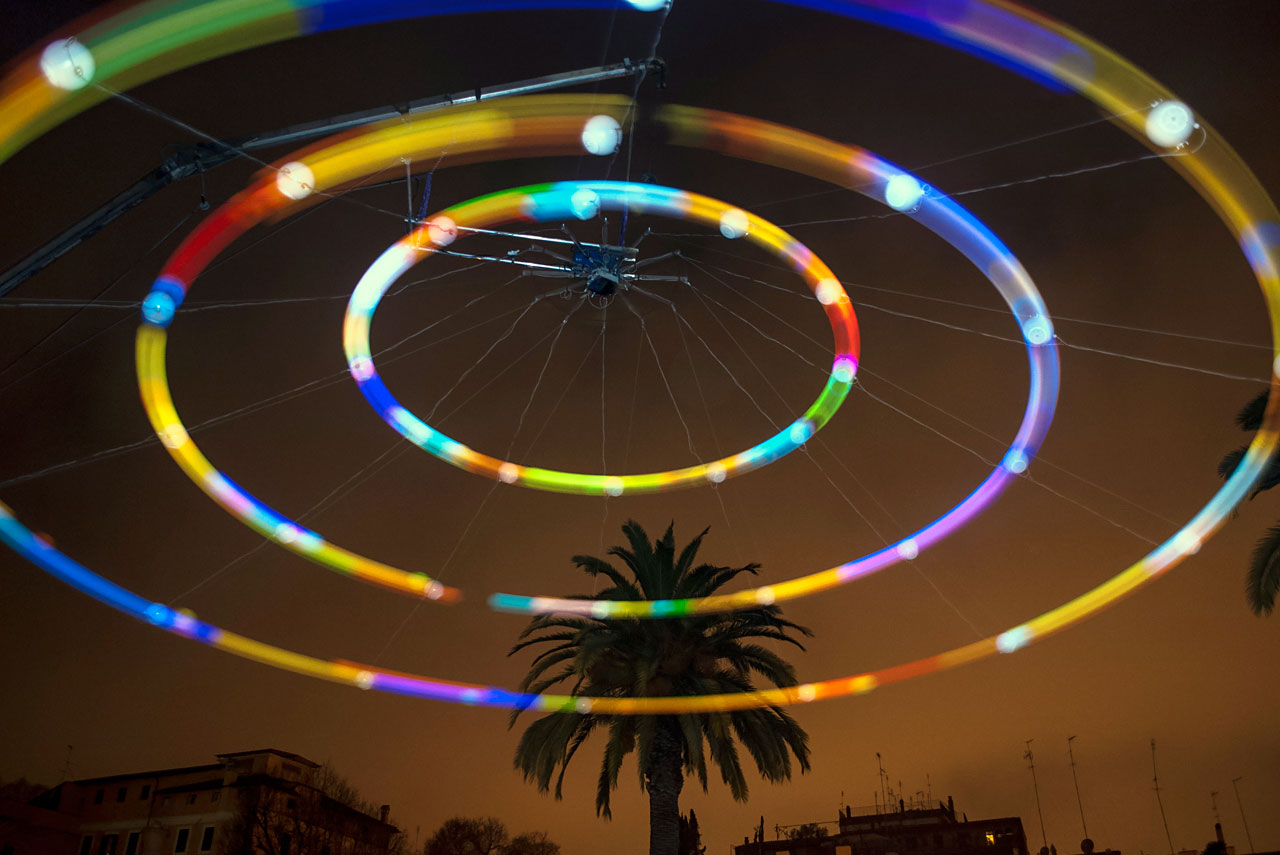
Last week researchers from around the world gathered at the Accademia dei Lincei in Rome for the Science with the Hubble Space Telescope IV conference. The event celebrated the history of Hubble’s extraordinary achievements, and looked to the future at what might yet be achieved and how the James Webb Space Telescope will build on our knowledge of the Universe. As part of this celebration artist Tim Otto Roth revealed a new artwork, Heaven’s Carousel, inspired by Hubble’s work on the accelerating expansion of the Universe.

Click to Enlarge
Credit: NASA, ESA, and Pam Jeffries
The “new astronomy-inspired art installation premiered in Rome at the Science with the Hubble Space Telescope IV conference. The installation, named Heaven’s Carousel, links together the fields of art, music and astronomy. Conceptualised and designed by German artist and composer Tim Otto Roth, the work is inspired by novel work on the accelerating expansion of the Universe by Nobel laureate Adam Riess (STScl), Greek cosmology and Renaissance astronomers. “
The artwork takes the form of a rotating carousel, with 36 illuminated spherical loudspeakers mounted on long strings and illustrates some of Hubble’s key findings and the physical processes that underpin Hubble’s work [1].
“Being inside the installation is like being inside a sound Universe,” says artist Tim Otto Roth. “When you look up at the night sky you see it in black and white, but in reality it is full of colours, colours which are too faint to be perceived by the eye’s colour receptors. It is the most dominant of these colours that I have translated into sound as part of the Heaven’s Carousel.”
In representing the Universe in this way Heaven’s Carousel allows the audience to experience phenomena such as the Doppler effect [2]. This phenomenon has been key to many of the discoveries discussed at the conference as it lets us know just how fast the galaxies observed by Hubble are moving away from or towards us. This can be experienced within the sound installation where at the centre of the installation there is no significant effect, but as the visitor moves outwards the frequencies start to oscillate dramatically and weave into a mesmerising sound tapestry.
During the 25-minute sound performance the other phenomena and processes that inspired the piece become evident. For example the progress from the high pitched and bright blue tones that represent the beginning of the Universe to the deep tones of red and low frequency sounds that illustrate what we observe in the distant Universe with Hubble today.
The premiere on Monday 17 March was very well attended and speeches were given by Tim Otto Roth and Adam Reiss, Nobel Prize winner and advisor to the artist, whose work was crucial to showing that the expansion of the Universe is accelerating.
The immersive installation shows another way that Hubble has inspired new thinking over its 24 years in orbit. It provided the perfect accompaniment to the conference, which involved four days of talks from fields as broad as dark energy, the Hubble Frontier Fields, exoplanet research and Solar System research, to name but a few.
“As we celebrate Hubble’s splendid 24 years in orbit” says ESA Hubble Space Telescope project scientist Antonella Nota. “We are left to marvel at the accomplishments humanity can achieve when there is collaboration between communities. On this occasion, we celebrate the partnership between NASA and ESA which led to the creation of Hubble. A partnership which set the foundation for the James Webb Space Telescope and many more ventures to come.”
Hubble has allowed us to peer into the ancient Universe, to find planets outside the Solar System, to map the dark matter that lurks within galaxy clusters and to say that the expansion of the Universe is accelerating. In the words of John Grunsfeld, NASA Associate Administrator and former astronaut, who has visited Hubble on three occasions:
“Hubble has taken us further than we knew possible towards answering the biggest questions humanity has ever thought to ask: Where did we come from? Where are we going? And, are we alone?”
As part of the conference John Grunsfeld gave a talk on his experience of the Hubble service missions. These missions not only kept Hubble alive, but have also given Hubble a new lease of life through the installation of the wide-field camera, WFC3, on this last mission. This new camera is part of the reason that Hubble is still in constant use and a major theme of the conference was where Hubble will take us next. It is clear that, even with the James Webb Space Telescope on the horizon, Hubble still has a great deal left to offer.