Here is an infographic on lunar eclipses courtesy of astroshop.eu:

Here is an infographic on lunar eclipses courtesy of astroshop.eu:
Rick Boozer on his Astro Maven blog has posted the third installment of his Photometry with AIP4WIN: a Tutorial, which is aimed at astronomers both amateur and professional:
From Part 1:
The science of photometry can be used by both amateur astronomers and professionals for some very advanced scientific work. You can detect the light changes caused by eclipsing binary stars, plot the changes in luminosity of a variable star and even detect an exoplanet orbiting another star. This tutorial will be your step-by-step guide on how to employ the powerful Magnitude Measurement Tool that comes with the renowned astronomical imaging software known as AIP4WIN by Richard Berry and Robert Burnell. Special thanks to Mr. Berry for giving me permission to include screen images and extensive operating details from AIP4WIN.
An announcement from NASA/ESA Hubble Telescope program:
Smallest exoplanet ever found to have water vapour
Astronomers using data from the NASA/ESA Hubble Space Telescope, the Spitzer Space Telescope, and the Kepler Space Telescope have discovered clear skies and steamy water vapour on a planet outside our Solar System. The planet, known as HAT-P-11b, is about the size of Neptune, making it the smallest exoplanet ever on which water vapour has been detected. The results will appear in the online version of the journal Nature on 24 September 2014.
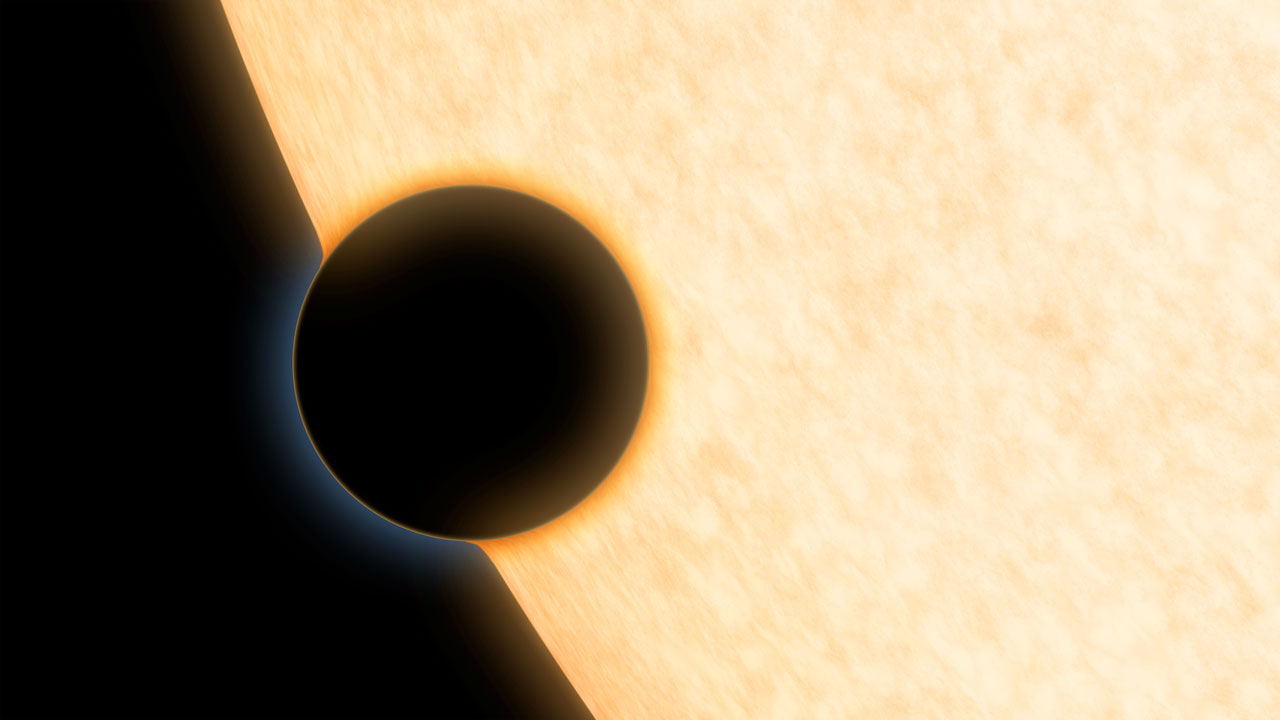
This is an artist’s concept of the silhouette of the extrasolar planet HAT-P-11b
as it passes its parent star. The planet was observed as it crossed in front of its star in order to learn more about its atmosphere.
In this method, known as transmission or absorption spectroscopy, starlight filters through the rim of the planet’s atmosphere and into the telescope. If molecules like water vapour are present, they absorb some of the starlight, leaving distinct signatures in the light that reaches our telescopes. Using this technique, astronomers discovered clear skies and steamy water vapour on the planet.
The discovery is a milestone on the road to eventually finding molecules in the atmospheres of smaller, rocky planets more akin to Earth. Clouds in the atmospheres of planets can block the view of what lies beneath them. The molecular makeup of these lower regions can reveal important information about the composition and history of a planet. Finding clear skies on a Neptune-size planet is a good sign that some smaller planets might also have similarly good visibility.
“When astronomers go observing at night with telescopes, they say ‘clear skies’ to mean good luck,” said Jonathan Fraine of the University of Maryland, USA, lead author of the study. “In this case, we found clear skies on a distant planet. That’s lucky for us because it means clouds didn’t block our view of water molecules.”
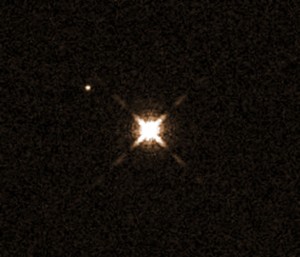
This image, taken with the NASA/ESA Hubble Space Telescope’s Wide Field Camera 3, shows the star HAT-P-11.
Not visible here is a Neptune-sized planet named HAT-P-11b which orbits the star. Astronomers have discovered clear skies and steamy water vapour on the planet. It is the smallest planet ever for which water vapour has been detected.
The small bright object next to the star is not the planet in question; in fact it is not a planet at all, but another star.
The reason for the graininess in this image is that it is a very short exposure. The star itself is so bright that it is saturated, it would otherwise be a small dot like the faint star next to it. The rings and the cross are caused by the diffraction — the bouncing of light — inside the telescope.
HAT-P-11b is a so-called exo-Neptune — a Neptune-sized planet that orbits another star. It is located 120 light-years away in the constellation of Cygnus (The Swan). Unlike Neptune, this planet orbits closer to its star, making one lap roughly every five days. It is a warm world thought to have a rocky core, a mantle of fluid and ice, and a thick gaseous atmosphere. Not much else was known about the composition of the planet, or other exo-Neptunes like it, until now.
Part of the challenge in analysing the atmospheres of planets like this is their size. Larger Jupiter-like planets are easier to observe and researchers have already been able to detect water vapour in the atmospheres of some of these giant planets. Smaller planets are more difficult to probe — and all the smaller ones observed to date have appeared to be cloudy.
The team used Hubble’s Wide Field Camera 3 and a technique called transmission spectroscopy, in which a planet is observed as it crosses in front of its parent star. Starlight filters through the rim of the planet’s atmosphere and into the telescope. If molecules like water vapour are present, they absorb some of the starlight, leaving distinct signatures in the light that reaches our telescopes.
“We set out to look at the atmosphere of HAT-P-11b without knowing if its weather would be cloudy or not,” said Nikku Madhusudhan, from the University of Cambridge, UK, part of the study team. “By using transmission spectroscopy, we could use Hubble to detect water vapour in the planet. This told us that the planet didn’t have thick clouds blocking the view and is a very hopeful sign that we can find and analyse more cloudless, smaller, planets in the future. It is groundbreaking!”
Before the team could celebrate they had to be sure that the water vapour was from the planet and not from cool starspots — “freckles” on the face of stars — on the parent star. Luckily, Kepler had been observing the patch of sky in which HAT-P-11b happens to lie for years. Those visible-light data were combined with targeted infraredSpitzer observations. By comparing the datasets the astronomers could confirm that the starspots were too hot to contain any water vapour, and so the vapour detected must belong to the planet.
The results from all three telescopes demonstrate that HAT-P-11b is blanketed in water vapour, hydrogen gas, and other yet-to-be-identified molecules. So in fact it is not only the smallest planet to have water vapour found in its atmosphere but is also the smallest planet for which molecules of any kind have been directly detected using spectroscopy [1]. Theorists will be drawing up new models to explain the planet’s makeup and origins.
Zoom in on the star:
Although HAT-P-11b is dubbed as an exo-Neptune it is actually quite unlike any planet in our Solar System. It is thought that exo-Neptunes may have diverse compositions that reflect their formation histories. New findings such as this can help astronomers to piece together a theory for the origin of these distant worlds.
“We are working our way down the line, from hot Jupiters to exo-Neptunes,” said Drake Deming, a co-author of the study also from University of Maryland, USA. “We want to expand our knowledge to a diverse range of exoplanets.”
The astronomers plan to examine more exo-Neptunes in the future, and hope to apply the same method to smaller super-Earths — massive, rocky cousins to our home world with up to ten times the mass of Earth. Our Solar System does not contain a super-Earth, but other telescopes are finding them around other stars in droves and the NASA/ESA James Webb Space Telescope, scheduled to launch in 2018, will search super-Earths for signs of water vapour and other molecules. However, finding signs of oceans and potentially habitable worlds is likely a way off.
This work is important for future studies of super-Earths and even smaller planets. It could allow astronomers to pick out in advance the planets with atmospheres clear enough for molecules to be detected. Once again, astronomers will be crossing their fingers for clear skies.
Notes
[1] Molecular hydrogen has been inferred to exist in many planets, including planets smaller than HAT-P-11b, but no molecule has actually been detected, using spectroscopy, in a planet this small, until now.
An announcement from ESA/Hubble:
Hubble snaps what looks like a young galaxy in the local Universe
Astronomers usually have to peer very far into the distance to see back in time, and view the Universe as it was when it was young. This new NASA/ESA Hubble Space Telescope image of galaxy DDO 68, otherwise known as UGC 5340, was thought to offer an exception. This ragged collection of stars and gas clouds looks at first glance like a recently-formed galaxy in our own cosmic neighbourhood. But, is it really as young as it looks?

Astronomers have studied galactic evolution for decades, gradually improving our knowledge of how galaxies have changed over cosmic history. The NASA/ESA Hubble Space Telescope has played a big part in this, allowing astronomers to see further into the distance, and hence further back in time, than any telescope before it — capturing light that has taken billions of years to reach us.
Zooming in on dwarf galaxy DDO 68
Looking further into the very distant past to observe younger and younger galaxies is very valuable, but it is not without its problems for astronomers. All newly-born galaxies lie very far away from us and appear very small and faint in the images. On the contrary, all the galaxies near to us appear to be old ones.
DDO 68, captured here by the NASA/ESA Hubble Space Telescope, was one of the best candidates so far discovered for a newly-formed galaxy in our cosmic neighbourhood. The galaxy lies around 39 million light-years away from us; although this distance may seem huge, it is in fact roughly 50 times closer than the usual distances to such galaxies, which are on the order of several billions of light years.
By studying galaxies of various ages, astronomers have found that those early in their lives are fundamentally different from those that are older. DDO 68 looks to be relatively youthful based on its structure, appearance, and composition. However, without more detailed modelling astronomers cannot be sure and they think it may be older than it lets on.
Elderly galaxies tend to be larger thanks to collisions and mergers with other galaxies that have bulked them out, and are populated with a variety of different types of stars — including old, young, large, and small ones. Their chemical makeup is different too. Newly-formed galaxies have a similar composition to the primordial matter created in the Big Bang (hydrogen, helium and a little lithium), while older galaxies are enriched with heavier elements forged in stellar furnaces over multiple generations of stars.
DDO 68 is the best representation yet of a primordial galaxy in the local Universe as it appears at first glance to be very low in heavier elements — whose presence would be a sign of the existence of previous generations of stars.
Panning across DDO 68
Hubble observations were carried out in order to study the properties of the galaxy’s light, and to confirm whether or not there are any older stars in DDO 68. If there are, which there seem to be, this would disprove the hypothesis that it is entirely made up of young stars. If not, it would confirm the unique nature of this galaxy. More complex modelling is needed before we can know for sure but Hubble’s picture certainly gives us a beautiful view of this unusual object.
The image is made up of exposures in visible and infrared light taken with Hubble’s Advanced Camera for Surveys.
Cosmic sterilization by Galactic Gamma-Ray Bursts (GRB) may explain the Fermi Paradox :
Sounds like a motivation to accelerate mind uploading.