Category Archives: Astronomy

Comet Siding Spring flew by Mars and watched by orbiters and rovers

The orbiters circling Mars survived the fly-by of Comet Siding Spring last Sunday just fine. The NASA JPL site Comets: Siding Spring (C/2013 A1) has lots of images and reports about the event. For example,

NASA Rover Opportunity Views Comet Near Mars
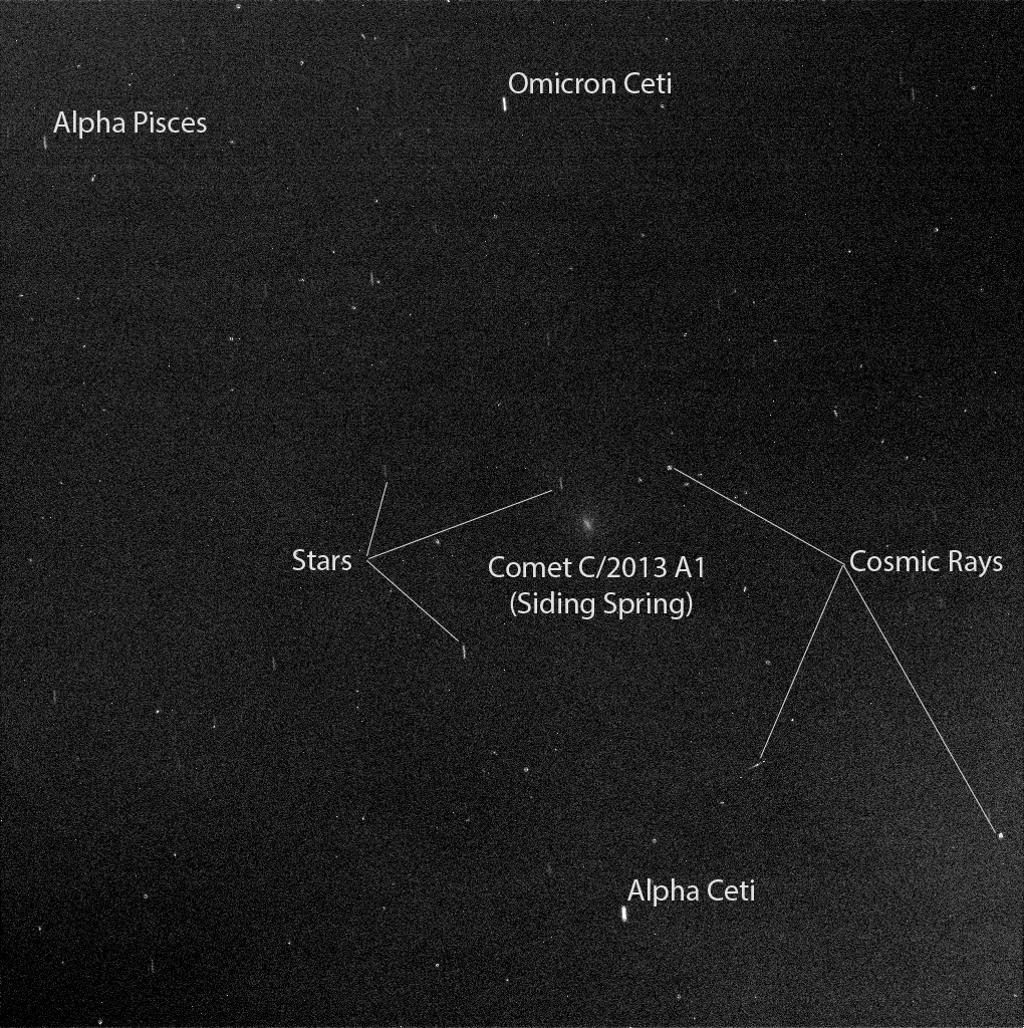
Mars Rover Opportunity's View of Passing CometMars Rover Opportunity’s View of Passing Comet

Researchers used the panoramic camera (Pancam) on NASA’s Mars Exploration Rover Opportunity to capture this view of comet C/2013 A1 Siding Spring as it passed near Mars on Oct. 19, 2014. Credit: NASA/JPL-Caltech/Cornell Univ./ASU/TAMU

NASA’s Mars Exploration Rover Opportunity captured images of a comet passing much closer to Mars than any previous known comet flyby of Earth or Mars. The images of comet Siding Spring were taken against a backdrop of the pre-dawn Martian sky on Sunday (Oct. 19).

Images of comet A1 Siding Spring from the rover’s panoramic camera (Pancam) are online at:

Researchers used Opportunity’s Pancam to image at a range of exposure times about two-and-one-half hours before the closest approach of the nucleus of comet Siding Spring to Mars. By the time of closest approach at about 87,000 miles (139,500 kilometers), dawn had lit the sky above Opportunity.

“It’s excitingly fortunate that this comet came so close to Mars to give us a chance to study it with the instruments we’re using to study Mars,” said Opportunity science team member Mark Lemmon of Texas A&M University, who coordinated the camera pointing. “The views from Mars rovers, in particular, give us a human perspective, because they are about as sensitive to light as our eyes would be.”

Three NASA Mars orbiters, two Mars rovers and other assets on Earth and in space are studying comet Siding Spring. This comet is making its first visit this close to the sun from the outer solar system’s Oort Cloud, so the concerted campaign of observations may yield fresh clues to our solar system’s earliest days more than 4 billion years ago.

Opportunity has been roving on Mars since January 2004 and has provided evidence about the Red Planet’s ancient wet environments.

For more about Opportunity, visit:

===

The Mars Reconnaissance Orbiter capture images of the comet as well:

Mars Orbiter Image Shows Comet Nucleus is Small
First Resolved Image of a Long-Period Comet's Nucleus

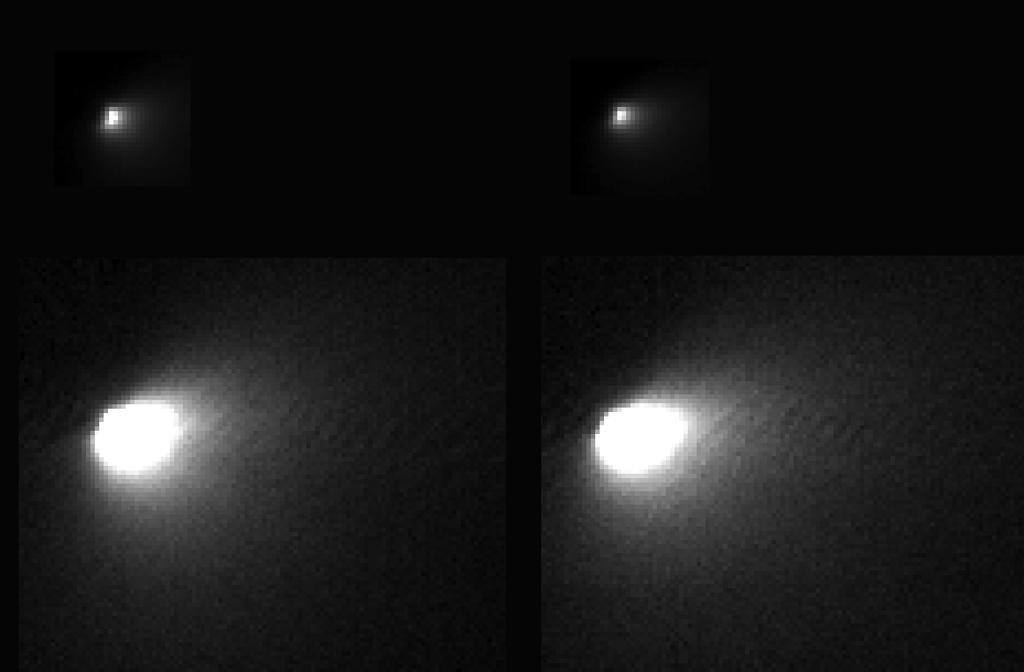
First Resolved Image of a Long-Period Comet’s Nucleus

These images were taken of comet C/2013 A1 Siding Spring by NASA’s Mars Reconnaissance Orbiter on Oct. 19, 2014, during the comet’s close flyby of Mars and the spacecraft. Credit: NASA/JPL-Caltech/University of Arizona

The High Resolution Imaging Science Experiment (HiRISE) camera on NASA’s Mars Reconnaissance Orbiter captured views of comet C/2013 A1 Siding Spring while that visitor sped past Mars on Sunday (Oct. 19), yielding information about its nucleus.

The images are the highest-resolution views ever acquired of a comet coming from the Oort Cloud at the fringes of the solar system. Other spacecraft have approached and studied comets with shorter orbits. This comet’s flyby of Mars provided spacecraft at the Red Planet an opportunity to investigate from close range.

Images of comet Siding Spring from HiRISE are online at: http://mars.nasa.gov/multimedia/images/?ImageID=6682

The highest-resolution of images of the comet’s nucleus, taken from a distance of about 86,000 miles (138,000 kilometers), have a scale of about 150 yards (138 meters) per pixel. Telescopic observers had modeled the size of the nucleus as about half a mile, or one kilometer wide. However, the best HiRISE images show only two to three pixels across the brightest feature, probably the nucleus, suggesting a size smaller than half that estimate.

For more about HiRISE, visit: http://hirise.lpl.arizona.edu

For more about Mars Reconnaissance Orbiter, visit: http://mars.nasa.gov/mro/

===

NASA released a composite image showing the comet and the Red Planet together without under or over-exposing either:

Close Encounters: Comet Siding Spring Seen Next to Mars

comet_springs_0[1]

This composite NASA Hubble Space Telescope Image captures the positions of comet Siding Spring and Mars in a never-before-seen close passage of a comet by the Red Planet, which happened at 2:28 p.m. EDT October 19, 2014. [Larger image]

This composite NASA Hubble Space Telescope Image captures the positions of comet Siding Spring and Mars in a never-before-seen close passage of a comet by the Red Planet, which happened at 2:28 p.m. EDT October 19, 2014. The comet passed by Mars at approximately 87,000 miles (about one-third of the distance between Earth and the Moon). At that time, the comet and Mars were approximately 149 million miles from Earth.

The comet image shown here is a composite of Hubble exposures taken between Oct. 18, 8:06 a.m. EDT to Oct. 19, 11:17 p.m. EDT. Hubble took a separate photograph of Mars at 10:37 p.m. EDT on Oct. 18.

The Mars and comet images have been added together to create a single picture to illustrate the angular separation, or distance, between the comet and Mars at closest approach. The separation is approximately 1.5 arc minutes, or one-twentieth of the angular diameter of the full Moon. The background starfield in this composite image is synthesized from ground-based telescope data provided by the Palomar Digital Sky Survey, which has been reprocessed to approximate Hubble’s resolution. The solid icy comet nucleus is too small to be resolved in the Hubble picture. The comet’s bright coma, a diffuse cloud of dust enshrouding the nucleus, and a dusty tail, are clearly visible.

This is a composite image because a single exposure of the stellar background, comet Siding Spring, and Mars would be problematic. Mars is actually 10,000 times brighter than the comet, and so could not be properly exposed to show detail in the Red Planet. The comet and Mars were also moving with respect to each other and so could not be imaged simultaneously in one exposure without one of the objects being motion blurred. Hubble had to be programmed to track on the comet and Mars separately in two different observations.

The images were taken with Hubble’s Wide Field Camera 3.

Two families of comets detected around another star

An announcement from the European Southern Observatory (ESO):

Two Families of Comets Found Around Nearby Star
Biggest census ever of exocomets around Beta Pictoris

The HARPS instrument at ESO’s La Silla Observatory in Chile has been used to make the most complete census of comets around another star ever created. A French team of astronomers has studied nearly 500 individual comets orbiting the star Beta Pictoris and has discovered that they belong to two distinct families of exocomets: old exocomets that have made multiple passages near the star, and younger exocomets that probably came from the recent breakup of one or more larger objects. The new results will appear in the journal Nature on 23 October 2014.

Beta Pictoris is a young star located about 63 light-years from the Sun. It is only about 20 million years old and is surrounded by a huge disc of material — a very active young planetary system where gas and dust are produced by the evaporation of comets and the collisions of asteroids.

Flavien Kiefer (IAP/CNRS/UPMC), lead author of the new study sets the scene: “Beta Pictoris is a very exciting target! The detailed observations of its exocomets give us clues to help understand what processes occur in this kind of young planetary system.”

For almost 30 years astronomers have seen subtle changes in the light from Beta Pictoris that were thought to be caused by the passage of comets in front of the star itself. Comets are small bodies of a few kilometres in size, but they are rich in ices, which evaporate when they approach their star, producing gigantic tails of gas and dust that can absorb some of the light passing through them. The dim light from the exocomets is swamped by the light of the brilliant star so they cannot be imaged directly from Earth.

To study the Beta Pictoris exocomets, the team analysed more than 1000 observations obtained between 2003 and 2011 with the HARPS instrument on the ESO 3.6-metre telescope at the La Silla Observatory in Chile.

The researchers selected a sample of 493 different exocomets. Some exocomets were observed several times and for a few hours. Careful analysis provided measurements of the speed and the size of the gas clouds. Some of the orbital properties of each of these exocomets, such as the shape and the orientation of the orbit and the distance to the star, could also be deduced.

This analysis of several hundreds of exocomets in a single exo-planetary system is unique. It revealed the presence of two distinct families of exocomets: one family of old exocomets whose orbits are controlled by a massive planet [1], and another family, probably arising from the recent breakdown of one or a few bigger objects. Different families of comets also exist in the Solar System.

The exocomets of the first family have a variety of orbits and show a rather weak activity with low production rates of gas and dust. This suggests that these comets have exhausted their supplies of ices during their multiple passages close to Beta Pictoris [2].

The exocomets of the second family are much more active and are also on nearly identical orbits [3]. This suggests that the members of the second family all arise from the same origin: probably the breakdown of a larger object whose fragments are on an orbit grazing the star Beta Pictoris.

Flavien Kiefer concludes: “For the first time a statistical study has determined the physics and orbits for a large number of exocomets. This work provides a remarkable look at the mechanisms that were at work in the Solar System just after its formation 4.5 billion years ago.”

Beta Pictoris as Seen in Infrared Light

This composite image represents the close environment of Beta Pictoris as seen in near infrared light. This very faint environment is revealed after a very careful subtraction of the much brighter stellar halo. The outer part of the image shows the reflected light on the dust disc, as observed in 1996 with the ADONIS instrument on ESO’s 3.6 m telescope; the inner part is the innermost part of the system, as seen at 3.6 microns with NACO on the Very Large Telescope. The newly detected source is more than 1000 times fainter than Beta Pictoris, aligned with the disc, at a projected distance of 8 times the Earth-Sun distance. This corresponds to 0.44 arcsecond on the sky, or the angle sustained by a one Euro coin seen at a distance of about 10 kilometres. Because the planet is still very young, it is still very hot, with a temperature around 1200 degrees Celsius. Both parts of the image were obtained on ESO telescopes equipped with adaptive optics.

Credit: ESO/A.-M. Lagrange et al

Comet Siding Spring passing close by Mars

The comet Siding Spring is just about to reach its closest approach to Mars. Below are links to various sites with info and imagery:

Comet Siding Spring (C/2013 A1) 
Comet Siding Spring (C/2013 A1) is racing toward Mars
for a close encounter on October 19, 2014.

* Latest NASA news and images:

On Sunday, Oct. 19, Comet C/2013 A1, also known as comet Siding Spring, will pass within about 87,000 miles (139,500 kilometers) of the Red Planet — less than half the distance between Earth and our moon and less than one-tenth the distance of any known comet flyby of Earth. Siding Spring’s nucleus will come closest to Mars around 11:27 a.m. PDT (2:27 p.m. EDT), hurtling at about 126,000 mph (56 kilometers per second).

Hubble Image of Comet Siding Spring 
The images above show — before and after filtering — comet C/2013 A1,
also known as Siding Spring, as captured by Wide Field Camera 3 on NASA’s

* ESA live webcast: European Space Agency – live streaming video powered by Livestream

* Live webcast from the SLOOH online observatory: live.slooh.com – Comet Siding Spring Swings by on a Close Approach to Mars

* Display of the current position of the comet in the sky: Comet C/2013 A1 (Siding Spring) Live Position and Finder Chart – TheSkyLive

* An animation of NASA’s Mars Odyssey  orbiter maneuvering to image Comet Siding Spring:


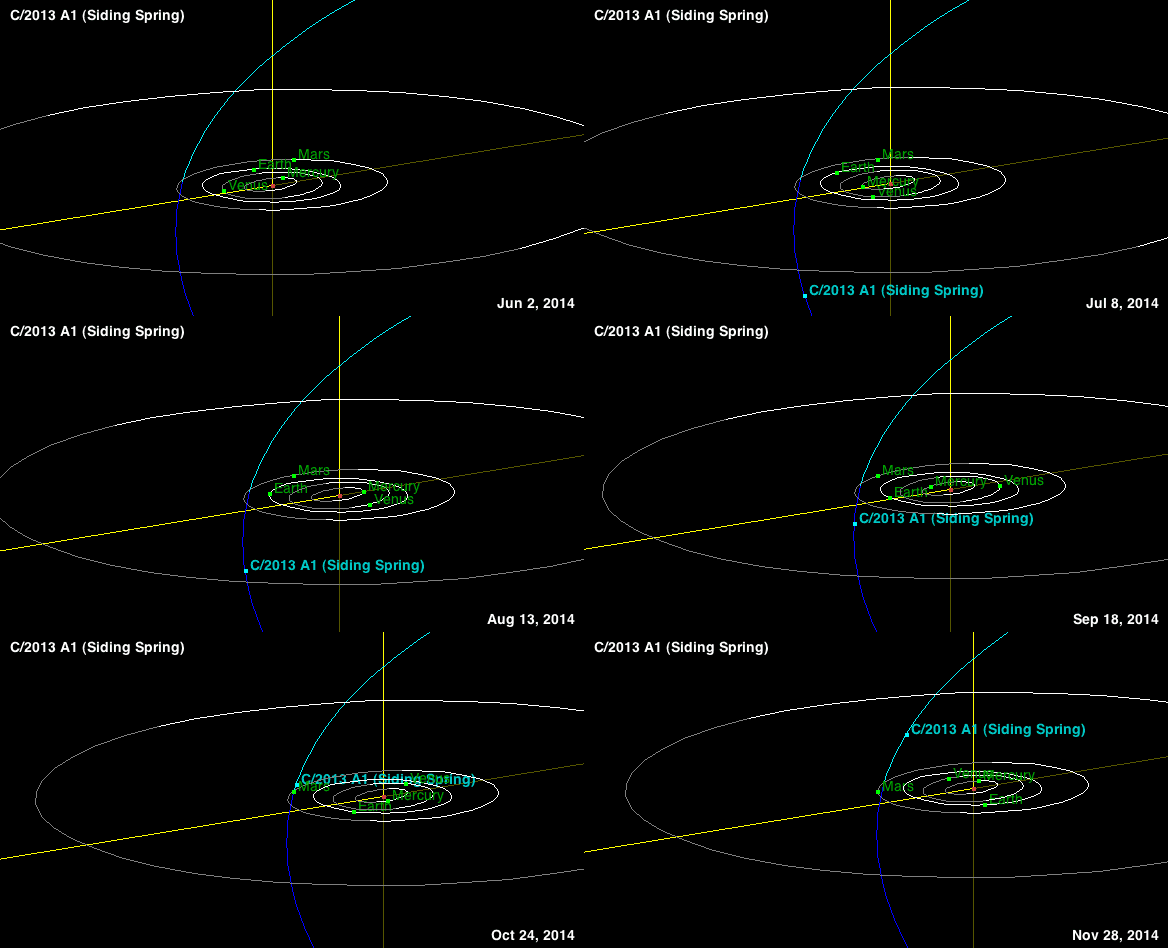
Path of the comet:

Simulation of the Comet Siding SpringBrought to you by the Near-Earth Object (NEO) office
at NASA’s Jet Propulsion Laboratory
.

‘Hunting for an exoplanet using stellar photometry’ – talk by Rick Boozer at Roper Mountain Center

Rick Boozer, the Astro Maven, tells me that on Thursday, Oct. 16th at 7:30 pm he will give a presentation at Roper Mountain Science Center  in Greenville, South Carolina. The title of his talk is Hunting for an Exoplanet Using Stellar Photometry.

Rick has been posting a series of tutorials on his blog explaining the science of photometry and how the astronomical imaging software known as AIP4WIN can be used “by both amateur astronomers and professionals for some very advanced scientific work”.

ESO: Construction secrents of a galactic metropolis

The latest news from the European Southern Observatory (ESO)

Construction Secrets of a Galactic Metropolis

Astronomers have used the APEX telescope to probe a huge galaxy cluster that is forming in the early Universe and revealed that much of the star formation taking place is not only hidden by dust, but also occurring in unexpected places. This is the first time that a full census of the star formation in such an object has been possible.

eso1431c_600x353

This image, taken by the NASA/ESA Hubble Space Telescope, shows the full
ACS overview of the region around the Spiderweb Galaxy (just to the right of the center).
The galaxy is sitting at the centre of an emergent galaxy cluster, surrounded
by hundreds of other galaxies from the cluster.

Galaxy clusters are the largest objects in the Universe held together by gravity but their formation is not well understood. The Spiderweb Galaxy (formally known as MRC 1138-262 [1]) and its surroundings have been studied for twenty years, using ESO and other telescopes [2], and is thought to be one of the best examples of a protocluster in the process of assembly, more than ten billion years ago.

But Helmut Dannerbauer (University of Vienna, Austria) and his team strongly suspected that the story was far from complete. They wanted to probe the dark side of star formation and find out how much of the star formation taking place in the Spiderweb Galaxy cluster was hidden from view behind dust.

The team used the LABOCA camera on the APEX telescope in Chile to make 40 hours of observations of the Spiderweb Cluster at millimetre wavelengths — wavelengths of light that are long enough to peer right through most of the thick dust clouds. LABOCA has a wide field and is the perfect instrument for this survey.

eso1431b_600x600

The APEX view in sub-millimetre light of the region around the
Spiderweb Galaxy a protocluster of galaxies in the early Universe
surrounding a radio galaxy containing a supermassive black hole.
Some of the blobs in this image correspond to dusty star-forming
galaxies in the protocluster that cannot be seen in visible light due
to absorption by dust. The fainter features here are artifacts
of the difficult APEX image processing.

Carlos De Breuck (APEX project scientist at ESO, and a co-author of the new study) emphasises: “This is one of the deepest observations ever made with APEX and pushes the technology to its limits — as well as the endurance of the staff working at the high-altitude APEX site, 5050 metres above sea level.”

The APEX observations revealed that there were about four times as many sources detected in the area of the Spiderweb compared to the surrounding sky. And by carefully comparing the new data with complementary observations made at different wavelengths they were able to confirm that many of these sources were at the same distance as the galaxy cluster itself and must be parts of the forming cluster.

Helmut Dannerbauer explains: “The new APEX observations add the final piece needed to create a complete census of all inhabitants of this mega star city. These galaxies are in the process of formation so, rather like a construction site on Earth, they are very dusty.”

But a surprise awaited the team when they looked at where the newly detected star formation was taking place. They were expecting to find this star formation region on the large filaments connecting galaxies. Instead, they found it concentrated mostly in a single region, and that region is not even centred on the central Spiderweb Galaxy in the protocluster [3].

Helmut Dannerbauer concludes: “We aimed to find the hidden star formation in the Spiderweb cluster — and succeeded — but we unearthed a new mystery in the process; it was not where we expected! The mega city is developing asymmetrically.”

To continue the story further observations are needed — and ALMA will be the perfect instrument to take the next steps and study these dusty regions in far greater detail.

—

Loading player…

This video shows an artist’s impression of the formation of a galaxy cluster in the early Universe. The galaxies are vigorously forming new stars and interacting with each other. Such a scene closely resembles the Spiderweb Galaxy (formally known as MRC 1138-262) and its surroundings, which is one of the best-studied protoclusters. Credit: ESO/M. Kornmesser