Category Archives: Astronomy

Trifid Nebula in infrared reveals new variable stars beyond it

The European Southern Observatory (ESO) releases the latest observation highlight:

VISTA Stares Right Through the Milky Way
New infrared view of the Trifid Nebula reveals
new variable stars far beyond
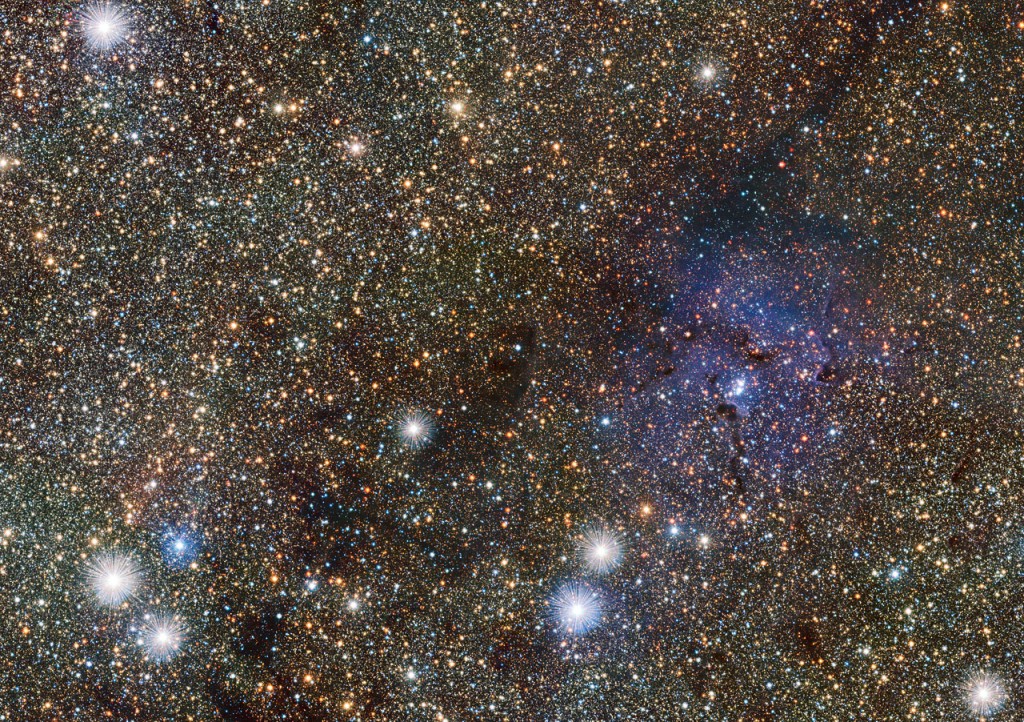
VISTA views the Trifid Nebula and reveals hidden variable stars

A new image taken with ESO’s VISTA survey telescope reveals the famous Trifid Nebula in a new and ghostly light. By observing in infrared light, astronomers can see right through the dust-filled central parts of the Milky Way and spot many previously hidden objects. In just this tiny part of one of the VISTA surveys, astronomers have discovered two unknown and very distant Cepheid variable stars that lie almost directly behind the Trifid. They are the first such stars found that lie in the central plane of the Milky Way beyond its central bulge.

As one of its major surveys of the southern sky, the VISTA telescope at ESO’s Paranal Observatory in Chile is mapping the central regions of the Milky Way in infrared light to search for new and hidden objects. This VVV survey (standing for VISTA Variables in the Via Lactea) is also returning to the same parts of the sky again and again to spot objects that vary in brightness as time passes.

A tiny fraction of this huge VVV dataset has been used to create this striking new picture of a famous object, the star formation region Messier 20, usually called the Trifid Nebula, because of the ghostly dark lanes that divide it into three parts when seen through a telescope.
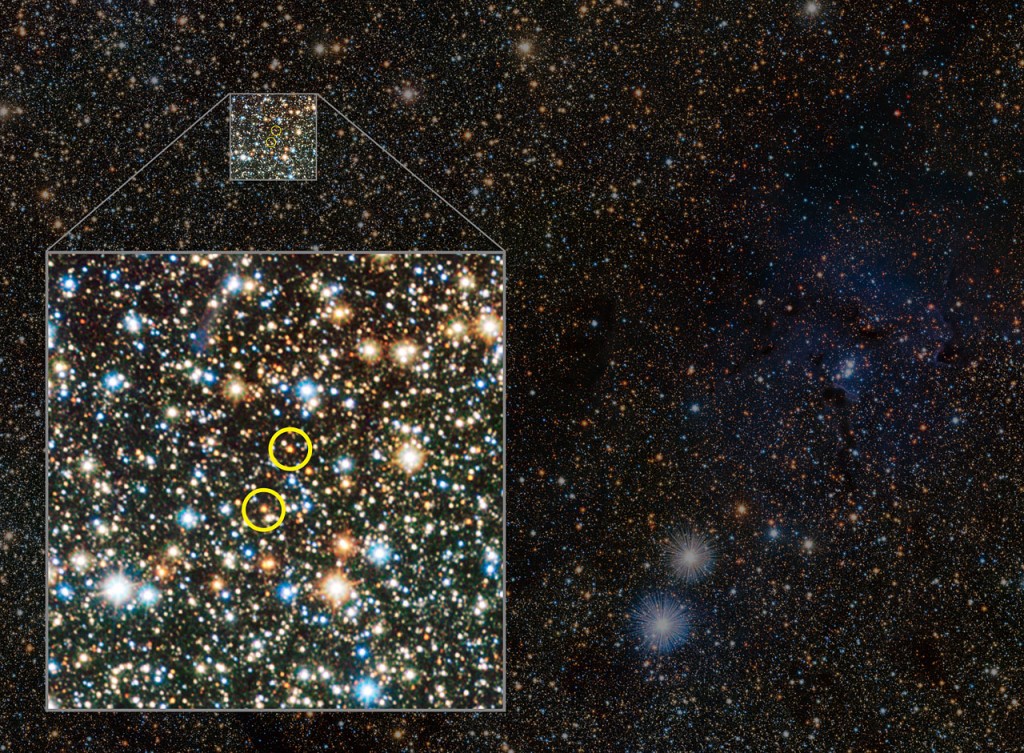
VISTA views the Trifid Nebula and reveals hidden variable stars

The familiar pictures of the Trifid show it in visible light, where it glows brightly in both the pink emission from ionised hydrogen and the blue haze of scattered light from hot young stars. Huge clouds of light-absorbing dust are also prominent. But the view in the VISTA infrared picture is very different. The nebula is just a ghost of its usual visible-light self. The dust clouds are far less prominent and the bright glow from the hydrogen clouds is barely visible at all. The three-part structure is almost invisible.

In the new image, as if to compensate for the fading of the nebula, a spectacular new panorama comes into view. The thick dust clouds in the disc of our galaxy that absorb visible light allow through most of the infrared light that VISTA can see. Rather than the view being blocked, VISTA can see far beyond the Trifid and detect objects on the other side of the galaxy that have never been seen before.

By chance this picture shows a perfect example of the surprises that can be revealed when imaging in the infrared. Apparently close to the Trifid in the sky, but in reality about seven times more distant [1], a newly discovered pair of variable stars has been found in the VISTA data. These are Cepheid variables, a type of bright star that is unstable and slowly brightens and then fades with time. This pair of stars, which the astronomers think are the brightest members of a cluster of stars, are the only Cepheid variables detected so far that are close to the central plane, but on the far side of the galaxy. They brighten and fade over a period of eleven days.

—

A video comparing views of the Trifid Nebula in visible and infrared light:

Check out also this Slider comparison of the Trifid Nebula in visible and infrared light.
ESO: The Mouth of the Beast

The ESO (European Southern Observatory) posts the latest finding:

 The Mouth of the Beast

VLT image of the cometary globule CG4

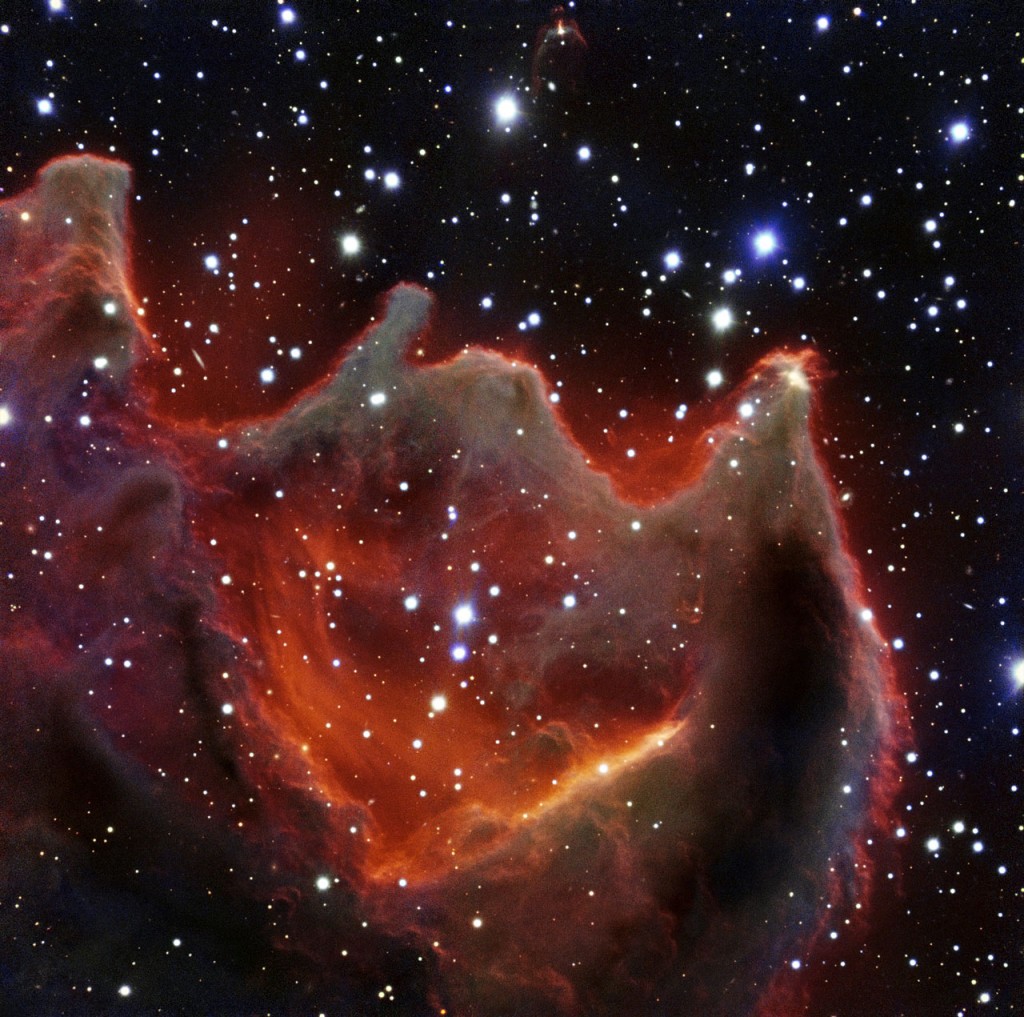
Like the gaping mouth of a gigantic celestial creature, the cometary globule CG4 glows menacingly in this image from ESO’s Very Large Telescope. Although it looks huge and bright in this image it is actually a faint nebula and not easy to observe. The exact nature of CG4 remains a mystery.  Credit: ESO

Like the gaping mouth of a gigantic celestial creature, the cometary globule CG4 glows menacingly in this new image from ESO’s Very Large Telescope. Although it appears to be big and bright in this picture, this is actually a faint nebula, which makes it very hard for amateur astronomers to spot. The exact nature of CG4 remains a mystery.

In 1976 several elongated comet-like objects were discovered on pictures taken with the UK Schmidt Telescope in Australia. Because of their appearance, they became known as cometary globules even though they have nothing in common with comets. They were all located in a huge patch of glowing gas called the Gum Nebula. They had dense, dark, dusty heads and long, faint tails, which were generally pointing away from the Vela supernova remnant located at the centre of the Gum Nebula. Although these objects are relatively close by, it took astronomers a long time to find them as they glow very dimly and are therefore hard to detect.

The object shown in this new picture, CG4, which is also sometimes referred to as God’s Hand, is one of these cometary globules. It is located about 1300 light-years from Earth in the constellation of Puppis (The Poop, or Stern).

This zoom video sequence goes from a wide view of the southern Milky Way deep into the constellation of Puppis close to the site of the Vela supernova remnant. The final view shows a new close-up view of the cometary globule CG4. It glows menacingly, like the gaping mouth of a gigantic celestial creature, in this this new image from ESO’s Very Large Telescope. What looks huge and bright in this image is actually a faint nebula and not easy to observe The exact nature of CG4 remains a mystery. Credit: ESO/J.Perez/Digitized Sky Survey 2/N. Risinger (skysurvey.org). Music: movetwo

The head of CG4, which is the part visible on this image and resembles the head of the gigantic beast, has a diameter of 1.5 light-years. The tail of the globule — which extends downwards and is not visible in the image — is about eight light-years long. By astronomical standards this makes it a comparatively small cloud.

The relatively small size is a general feature of cometary globules. All of the cometary globules found so far are isolated, relatively small clouds of neutral gas and dust within the Milky Way, which are surrounded by hot ionised material.

The head part of CG4 is a thick cloud of gas and dust, which is only visible because it is illuminated by the light from nearby stars. The radiation emitted by these stars is gradually destroying the head of the globule and eroding away the tiny particles that scatter the starlight. However, the dusty cloud of CG4 still contains enough gas to make several Sun-sized stars and indeed, CG4 is actively forming new stars, perhaps triggered as radiation from the stars powering the Gum Nebula reached CG4.

eso1503c_500x523

This wide-field image shows a rich region of the sky in the constellation of Puppis (The Poop). At the centre lies the strange cometary globule CG4. Other interesting objects are also seen, including several much more distant spiral galaxies. This colour view was produced from images forming part of the Digitized Sky Survey 2. Credit: ESO and Digitized Sky Survey 2

Why CG4 and other cometary globules have their distinct form is still a matter of debate among astronomers and two theories have developed. Cometary globules, and therefore also CG4, could originally have been spherical nebulae, which were disrupted and acquired their new, unusual form because of the effects of a nearby supernova explosion. Other astronomers suggest, that cometary globules are shaped by stellar winds and ionising radiation from hot, massive OB stars. These effects could first lead to the bizarrely (but appropriately!) named formations known as elephant trunks and then eventually cometary globules.

To find out more, astronomers need to find out the mass, density, temperature, and velocities of the material in the globules. These can be determined by the measurements of molecular spectral lines which are most easily accessible at millimetre wavelengths — wavelengths at which telescopes like the Atacama Large Millimeter/submillimeter Array (ALMA) operate.

This picture comes from the ESO Cosmic Gems programme, an outreach initiative to produce images of interesting, intriguing or visually attractive objects using ESO telescopes, for the purposes of education and public outreach. The programme makes use of telescope time that cannot be used for science observations. All data collected may also be suitable for scientific purposes, and are made available to astronomers through ESO’s science archive.

Asteroid to pass near Earth-Moon system on January 26th

An asteroid half a kilometer in diameter will pass near earth on Monday: Giant asteroid is about to give Earth a close call – Sen.com

Here is the original NASA JPL story:

Asteroid to Fly By Earth Safely on January 26 

Asteroid2004BL86-16(See GIF animation clip)
This graphic depicts the passage of asteroid 2004 BL86, which will come
no closer than about three times the distance from Earth to the moon
on Jan. 26, 2015. Due to its orbit around the sun, the asteroid is
currently only visible by astronomers with large telescopes who are
located in the southern hemisphere. But by Jan. 26, the space rock’s
changing position will make it visible to those in the northern hemisphere.
Image credit: NASA/JPL-Caltech

An asteroid, designated 2004 BL86, will safely pass about three times the distance of Earth to the moon on January 26. From its reflected brightness, astronomers estimate that the asteroid is about a third of a mile (0.5 kilometers) in size. The flyby of 2004 BL86 will be the closest by any known space rock this large until asteroid 1999 AN10 flies past Earth in 2027.

At the time of its closest approach on January 26, the asteroid will be approximately 745,000 miles (1.2 million kilometers) from Earth.

“Monday, January 26 will be the closest asteroid 2004 BL86 will get to Earth for at least the next 200 years,” said Don Yeomans, who is retiring as manager of NASA’s Near Earth Object Program Office at the Jet Propulsion Laboratory in Pasadena, California, after 16 years in the position. “And while it poses no threat to Earth for the foreseeable future, it’s a relatively close approach by a relatively large asteroid, so it provides us a unique opportunity to observe and learn more.”

One way NASA scientists plan to learn more about 2004 BL86 is to observe it with microwaves (http://www.jpl.nasa.gov/news/news.php?release=2006-00a ). NASA’s Deep Space Network antenna at Goldstone, California, and the Arecibo Observatory in Puerto Rico will attempt to acquire science data and radar-generated images of the asteroid during the days surrounding its closest approach to Earth.

“When we get our radar data back the day after the flyby, we will have the first detailed images,” said radar astronomer Lance Benner of JPL, the principal investigator for the Goldstone radar observations of the asteroid. “At present, we know almost nothing about the asteroid, so there are bound to be surprises.”

Asteroid 2004 BL86 was initially discovered on Jan. 30, 2004 by a telescope of the Lincoln Near-Earth Asteroid Research (LINEAR) survey in White Sands, New Mexico.

The asteroid is expected to be observable to amateur astronomers with small telescopes and strong binoculars.

“I may grab my favorite binoculars and give it a shot myself,” said Yeomans. “Asteroids are something special. Not only did asteroids provide Earth with the building blocks of life and much of its water, but in the future, they will become valuable resources for mineral ores and other vital natural resources. They will also become the fueling stops for humanity as we continue to explore our solar system. There is something about asteroids that makes me want to look up.”

NASA’s Near-Earth Object Program Office is experiencing its first transition in leadership since it was formed almost 17 years ago. On Jan. 9, after a 39-year-long career at JPL, Yeomans retired. Paul Chodas, a long-time member of Yeomans’ team at JPL, has been designated as the new manager.

NASA detects, tracks and characterizes asteroids and comets using both ground- and space-based telescopes. Elements of the Near-Earth Object Program, often referred to as “Spaceguard,” discover these objects, characterize a subset of them and identify their close approaches to determine if any could be potentially hazardous to our planet.

JPL manages the Near-Earth Object Program Office for NASA’s Science Mission Directorate in Washington. JPL is a division of the California Institute of Technology in Pasadena.

More information about asteroids and near-Earth objects is at: www.jpl.nasa.gov/asteroidwatch.

To get updates on passing space rocks, follow: twitter.com/asteroidwatch

Space music: An ensemble with pulsars

The late composer Gérard Grisey created the work Le Noir de l’étoile based around pulsars : Sounds of the cosmos, as muse and metronome – The Boston Globe –

But for all of our skyward magniloquence over the years, the universe has rarely answered back. One notable exception however came in 1985, when the French spectralist composer Gérard Grisey first heard the sounds of the Vela pulsar as captured by radio telescopes. He was transfixed. In their charismatic rhythmic beating Grisey found a kind of primordial music, a celestial metronome, and a link to an event dating to the most distant reaches of human history. The Vela was created by a supernova that exploded some 12,000 years ago — a sight, we are told, that may have been visible to primitive man in broad daylight.

Grisey knew at once that these sounds must find a place in his own music. He ultimately took the sampled beating of two pulsars — the Vela, and a second pulsar referred to only by its coordinates, 0359-54 — and placed them at the center of a large-scale work for six percussionists and electronics titled “Le Noir de l’Étoile.” Completed in 1990, “Le Noir” is still rarely tackled given its fierce technical demands, but each time constitutes a genuine event. For its performance on Friday night, the ambitious ensemble Sound Icon took over Somerville’s Center for the Arts at the Armory.

Here’s a different performance of the work given on Nov. 19, 2011

at Rowan University by Dean Witten with an Alumni All-Star Ensemble. The musicians were Matthew Witten, percussion 2; Anthony DiBartolo, percussion 3; Brittany Hoffman, percussion 4; AJ Lustig, percussion 5 and Mika Godbole, percussion 6.


Video: Zooming-in on Andromeda

I recently posted about a super-high resolution image obtained by the Hubble telescope of the the Andromeda Galaxy. Here is another zoom-in video that gives a sense of the enormity of this one galaxy, which is one member of a universe packed with galaxies: