All posts by TopSpacer

ESO: Third planet found at Proxima Centauri, the star nearest our Sun

A new report from the European Southern Observatory (ESO):

New planet detected around star closest to the Sun

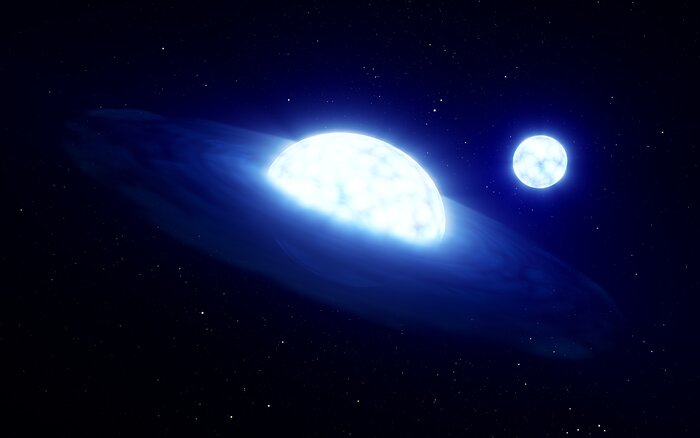
This artist’s impression shows a close-up view of Proxima d, a planet candidate recently found orbiting the red dwarf star Proxima Centauri, the closest star to the Solar System. The planet is believed to be rocky and to have a mass about a quarter that of Earth. Two other planets known to orbit Proxima Centauri are visible in the image too: Proxima b, a planet with about the same mass as Earth that orbits the star every 11 days and is within the habitable zone, and candidate Proxima c, which is on a longer five-year orbit around the star.

A team of astronomers using the European Southern Observatory’s Very Large Telescope (ESO’s VLT) in Chile have found evidence of another planet orbiting Proxima Centauri, the closest star to our Solar System. This candidate planet is the third detected in the system and the lightest yet discovered orbiting this star. At just a quarter of Earth’s mass, the planet is also one of the lightest exoplanets ever found.

The discovery shows that our closest stellar neighbour seems to be packed with interesting new worlds, within reach of further study and future exploration,”

explains João Faria, a researcher at the Instituto de Astrofísica e Ciências do Espaço, Portugal and lead author of the study published today in Astronomy & Astrophysics. Proxima Centauri is the closest star to the Sun, lying just over four light-years away.

The newly discovered planet, named Proxima d, orbits Proxima Centauri at a distance of about four million kilometres, less than a tenth of Mercury’s distance from the Sun. It orbits between the star and the habitable zone — the area around a star where liquid water can exist at the surface of a planet — and takes just five days to complete one orbit around Proxima Centauri.

The star is already known to host two other planets: Proxima b, a planet with a mass comparable to that of Earth that orbits the star every 11 days and is within the habitable zone, and candidate Proxima c, which is on a longer five-year orbit around the star.

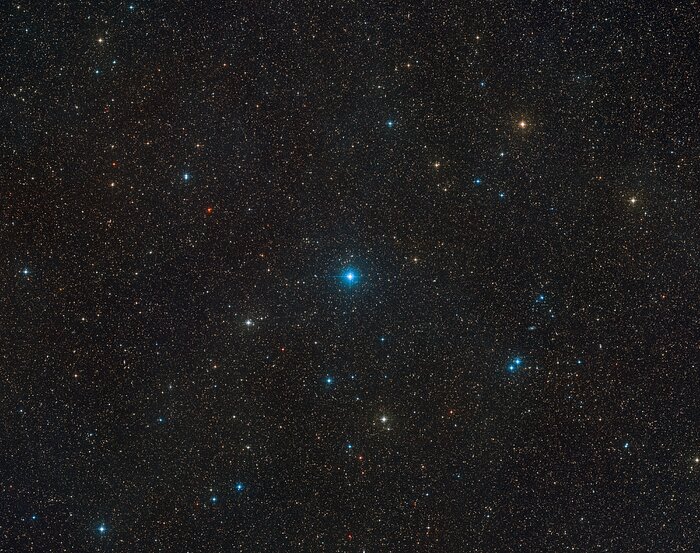
This image of the sky around the bright star Alpha Centauri AB also shows the much fainter red dwarf star, Proxima Centauri, the closest star to the Solar System. The picture was created from pictures forming part of the Digitized Sky Survey 2. The blue halo around Alpha Centauri AB is an artifact of the photographic process, the star is really pale yellow in colour like the Sun.

Proxima b was discovered a few years ago using the HARPS instrument on ESO’s 3.6-metre telescope. The discovery was confirmed in 2020 when scientists observed the Proxima system with a new instrument on ESO’s VLT that had greater precision, the Echelle SPectrograph for Rocky Exoplanets and Stable Spectroscopic Observations (ESPRESSO). It was during these more recent VLT observations that astronomers spotted the first hints of a signal corresponding to an object with a five-day orbit. As the signal was so weak, the team had to conduct follow-up observations with ESPRESSO to confirm that it was due to a planet, and not simply a result of changes in the star itself.

After obtaining new observations, we were able to confirm this signal as a new planet candidate,” Faria says. “I was excited by the challenge of detecting such a small signal and, by doing so, discovering an exoplanet so close to Earth.

At just a quarter of the mass of Earth, Proxima d is the lightest exoplanet ever measured using the radial velocity technique, surpassing a planet recently discovered in the L 98-59 planetary system. The technique works by picking up tiny wobbles in the motion of a star created by an orbiting planet’s gravitational pull. The effect of Proxima d’s gravity is so small that it only causes Proxima Centauri to move back and forth at around 40 centimetres per second (1.44 kilometres per hour).

This achievement is extremely important,” says Pedro Figueira, ESPRESSO instrument scientist at ESO in Chile. “It shows that the radial velocity technique has the potential to unveil a population of light planets, like our own, that are expected to be the most abundant in our galaxy and that can potentially host life as we know it.

This result clearly shows what ESPRESSO is capable of and makes me wonder about what it will be able to find in the future,” Faria adds.

ESPRESSO’s search for other worlds will be complemented by ESO’s Extremely Large Telescope (ELT), currently under construction in the Atacama Desert, which will be crucial to discovering and studying many more planets around nearby stars.

Links

=== Amazon Ads ===

Extraterrestrial:
The First Sign of Intelligent Life Beyond Earth

===

Envisioning Exoplanets:
Searching for Life in the Galaxy

The Space Show this week – Feb.7.2022

The guests and topics of discussion on The Space Show this week:

1. Tuesday, Feb.8, 2022; 7 pm PST (9 pm CST, 10 pm EST): Douglas Messier of Parabolic Arc returns with all that is happening in space news to date in 2022.

2. Wednesday, Feb. 9, 2022; 1:00 pm PST (3:00 pm CST, 4:00 pm EST): No Hotel Mars this week.

3. Friday, Feb.11, 2022; 9:30-11 am PST (11:30 am-1 pm CST, 12:30-2 pm EST): Brett Hoffstadt with Steve Tanaka are guests regarding their new children’s book [Goodnight Moon Base (Amazon commission link)] and lunar development effort. See book URL and info on the upcoming menu on our home page.

4. Sunday, Feb.13, 2022; 12-1:30 pm PST (2-3:30 pm CST, 3-4:30 pm EST): Joe Carroll is back with his ideas and solutions for solving our space debris issues and problems.

Some recent shows: (There were no live shows in the previous week.)

** Wednesday, Jan.26.2022 – Hotel MarsTom Roeder spoke with John Batchelor and Dr. David Livingston about “U.S. Space Force protection of Cislunar space and assets“.

** Tuesday, Jan.25.2022Dennis Wingo discussed “Starship, returning to the Moon, commercial space and space mining economics and challenges, much needed in-space vehicles, Mars, returning to the Moon, U.S.-Russia space relationship and much more“.

** Sunday, Jan.23.2022Dr. Thomas Matula and Dr. Darryl Mitry discussed

their new book, Beyond the Covid Shock: The Great Economic Transition“. We applied much of the economics from the book and the discussion to both the public and commercial space industry. Listeners and callers also asked lots of general economic questions given the state of today’s economy and how the pandemic is impacting it.

**Hotel Mars – Wednesday, Jan. 19.2022 Dr. David Grinspoon spoke with John Batchelor and Dr. David Livingston about “the recent findings on Mars of a unique carbon signature that might suggest ancient molecular life for Mars“.

** Tuesday, Jan.18.2022Robert Zimmerman talked about “[a]nnual launch rates and predictions, China’s Long March 5B, Mars rovers, ancient molecular life on Mars, light carbon atoms, life in the solar system, Carbon-12, UV light, Musk and Starship, Georgia’s preliminary spaceport approval, exploring the lunar poles and more“.

** See also:
* The Space Show Archives
* The Space Show Newsletter
* The Space Show Shop

The Space Show is a project of the One Giant Leap Foundation.

The Space Show - David Livingston
The Space Show – Dr. David Livingston

=== Amazon Ads ===

Becoming Off-Worldly:
Learning from Astronauts to Prepare
for Your Spaceflight Journey
 ===

Envisioning Exoplanets:
Searching for Life in the Galaxy

Videos: “Space to Ground” & other space habitat reports – Feb.4.2022

Here is the latest episode in NASA’s Space to Ground weekly report on activities related to the International Space Station:

** STEMonstrations: Vestibular System NASA Johnson

NASA Astronauts Mark Vande Hei and Shane Kimbrough demonstrate the effects of the weightless-simulated environment on their perception of motion, spatial orientation, and balance aboard the International Space Station. Watch as NASA astronaut Megan McArthur and JAXA astronaut Aki Hoshide discuss the vestibular system and learn how the human body relies on external cues to provide us with important information about our environment. Be sure to check out https://www.nasa.gov/stemonstrations for more videos like this, along with their corresponding Classroom Connection lesson plans.

** Media Briefing: NASA, SpaceX to Provide Update on Crew-4 Space Station MissionNASA Video

** Expedition 66 Space Station Astronauts Answer Wisconsin Student Questions – Feb. 3, 2022NASA Video

Aboard the International Space Station, NASA Expedition 66 Flight Engineers Tom Marshburn and Kayla Barron of NASA answered pre-recorded questions about life and work as astronauts on the orbital laboratory during an in-flight event Feb. 3 with students attending the Random Lake School in Random Lake, Wisconsin. Marshburn and Barron are in the midst of long duration missions living and working aboard the microgravity laboratory to advance scientific knowledge and demonstrate new technologies for future human and robotic exploration missions as part of NASA’s Moon and Mars exploration approach, including lunar missions through NASA’s Artemis program.

** China’s space station decorated for lunar new year by crewVideoFromSpace

China’s Shenzhou-13 crew Zhai Zhigang, Wang Yaping and Ye Guangfu decorated the Tiangon space station to celebrate lunar new year. Credit: Space.com | footage courtesy: China Central Television | produced & edited by Steve Spaleta

** Hello and goodbye in 360° | Cosmic KissEuropean Space Agency, ESA on Youtube

Spaceflight participants Yusaku Maezawa and Yozo Hirano and Russian cosmonaut Alexander Misurkin were welcomed to the International Space Station on 8 December 2021 for a 12 day stay in space. Experience their arrival and farewell in 360° as captured by ESA astronaut Matthias Maurer from within the Russian segment. Also seen in this video are Expedition 66 Commander Anton Shkaplerov, @Roscosmos Mediacosmonaut Pyotr Dubrov and @NASA astronauts Mark Vande Hei, Raja Chari, Tom Marshburn, and Kayla Barron. Matthias was launched to the International Space Station for his six-month ESA mission known as Cosmic Kiss on 11 November 2021. During his time on board, he will support around 35 European and many more international experiments in orbit. Follow Matthias: https://bit.ly/ESACosmicKiss

** Watch SpaceX’s Starbase from the Space Station Camera. space googlevesaire

The Nasa ISS is broadcasting live from the International Space Station as it circles the earth at the edge of space in low earth orbit, 240 miles (405 km) above the planet.

** ISS Live video stream – IBM/ISS HD Earth Viewing Experiment

Currently, live views from the ISS are streaming from an external camera mounted on the ISS module called Node 2. Node 2 is located on the forward part of the ISS. The camera is looking forward at an angle so that the International Docking Adapter 2 (IDA2) is visible. If the Node 2 camera is not available due to operational considerations for a longer period of time, a continuous loop of recorded HDEV imagery will be displayed. The loop will have “Previously Recorded” on the image to distinguish it from the live stream from the Node 2 camera. After HDEV stopped sending any data on July 18, 2019, it was declared, on August 22, 2019, to have reached its end of life. Thank You to all who shared in experiencing and using the HDEV views of Earth from the ISS to make HDEV so much more than a Technology Demonstration Payload!

====

=== Amazon Ads ===

LEGO Ideas International Space Station Building Kit,
Adult Set for Display,
Makes a Great Birthday Present
(864 Pieces)

====

Outpost in Orbit:
A Pictorial & Verbal History of the Space Station

Night sky highlights for February 2022

** What’s Up: February 2022 Skywatching Tips from NASA – NASA JPL

What are some skywatching highlights in February 2022? Jupiter is the lone planet lingering in twilight skies after sunset in February. It exits the evening sky this month leaving no bright planets there until August (save for a brief appearance from Mercury in April). Also Venus is at peak brightness for the year in the a.m., and it’s a great time to view the Orion Nebula.

0:00 Intro
0:10 New Moon
0:30 Quadrantid meteors
1:28 Dusk / Dawn Highlights
2:28 Moon Phases

Additional information about topics covered in this episode of What’s Up, along with still images from the video, and the video transcript, are available at https://solarsystem.nasa.gov/skywatch….

See also NASA Night Sky Notes Monthly Article | Night Sky Network

** Tonight’s Sky: February Space Telescope Science InstituteTonight’s Sky

In February, the Winter Triangle is your guide to the night sky: The northern hemisphere is treated to views of the stars Procyon, Sirius, and Betelgeuse. Keep watching for the awe-inspiring space-based views of the Orion Nebula, which is sculpted by the stellar winds of central bright stars.

About this Series
“Tonight’s Sky” is a monthly video of constellations you can observe in the night sky. The series is produced by the Space Telescope Science Institute, home of science operations for the Hubble Space Telescope, in partnership with NASA’s Universe of Learning. This is a recurring show, and you can find more episodes—and other astronomy videos—at
https://hubblesite.org/resource-galle….

** What to see in the night sky: February 2022BBC Sky at Night Magazine

What can you see in the night sky tonight? Pete Lawrence and Paul Abel reveal the night-sky highlights coming up this month.

** What’s in the Night Sky February 2022 #WITNS | Alpha Centaurid Meteor Shower | Snow Moon Alyn Wallace

00:00 Intro
00:31 Northern Hemisphere Night Sky
06:18 Southern Hemisphere Night Sky
09:45 Star Tracker Target
10:49 Moon
11:01 Alpha Centaurids
12:39 Zodiacal Light
11:23 Quadrantid Meteor Shower
14:32 #WITNS Winners

** Night Sky Notebook February 2022Peter Detterline

** See also:

=== Amazon Ad ===

Stellaris: People of the Stars

===

Envisioning Exoplanets:
Searching for Life in the Galaxy

The Space Show this week – Jan.31.2022

The guests and topics of discussion on The Space Show this week:

1. Tuesday, Feb. 1, 2022; 7 pm PST (9 pm CST, 10 pm EST): No Show Today but see the suggested Golden Oldie on the website archive-program summary page.

2. Hotel Mars – Wednesday, Feb. 2, 2022; 1:00 pm PST (3:00 pm CST, 4:00 pm EST): TBD. Check the Upcoming Show Menu at www.thespaceshow.com for updates on scheduling.

3. Friday, Feb.4, 2022; 9:30-11 am PST (11:30 am-1 pm CST, 12:30-2 pm EST): No Show Today but see the suggested Golden Oldie on the website archive-program summary page.

4. Sunday, Feb.6, 2022; 12-1:30 pm PST (2-3:30 pm CST, 3-4:30 pm EST): No Show Today but see the suggested Golden Oldie on the website archive-program summary page.

Some recent shows:

** Wednesday, Jan.26.2022 – Hotel MarsTom Roeder spoke with John Batchelor and Dr. David Livingston about “U.S. Space Force protection of Cislunar space and assets“.

** Tuesday, Jan.25.2022Dennis Wingo discussed “Starship, returning to the Moon, commercial space and space mining economics and challenges, much needed in-space vehicles, Mars, returning to the Moon, U.S.-Russia space relationship and much more“.

** Sunday, Jan.23.2022 – Dr. Thomas Matula and Dr. Darryl Mitry discussed

their new book, Beyond the Covid Shock: The Great Economic Transition“. We applied much of the economics from the book and the discussion to both the public and commercial space industry. Listeners and callers also asked lots of general economic questions given the state of today’s economy and how the pandemic is impacting it.

**Hotel Mars – Wednesday, Jan. 19.2022 Dr. David Grinspoon spoke with John Batchelor and Dr. David Livingston about “the recent findings on Mars of a unique carbon signature that might suggest ancient molecular life for Mars“.

** Tuesday, Jan.18.2022Robert Zimmerman talked about “[a]nnual launch rates and predictions, China’s Long March 5B, Mars rovers, ancient molecular life on Mars, light carbon atoms, life in the solar system, Carbon-12, UV light, Musk and Starship, Georgia’s preliminary spaceport approval, exploring the lunar poles and more“.

** See also:
* The Space Show Archives
* The Space Show Newsletter
* The Space Show Shop

The Space Show is a project of the One Giant Leap Foundation.

The Space Show - David Livingston
The Space Show – Dr. David Livingston

=== Amazon Ads ===

Conscious Choice:
The Origins of Slavery in America and
Why it Matters Today and
for Our Future in Outer Space

===

Envisioning Exoplanets:
Searching for Life in the Galaxy