In August, a flock of star-studded figures soars overhead. Look for the Vega and Lyra constellations, which point to Epsilon Lyrae and the Ring Nebula. You can also spot three bright summer stars: Vega, Deneb, and Altair, which form the Summer Triangle. Keep watching for space-based views of these and other stars and nebulas.
What can you see this month? In the August sky, look for the “shooting stars” of the annual Perseid meteor shower for some stargazing delights, but be warned — the bright Moon will overwhelm the fainter meteors this year. Plus, the Moon’s evening visits to Jupiter and Saturn. Additional information about topics covered in this episode of What’s Up, along with still images from the video, and the video transcript, are available at https://go.nasa.gov/2KijnRU
** Alyn Wallace – What’s in the Night Sky August 2019
A sampling of recent articles, videos, and images from space-related science news items:
** Comets & Asteroids
*** the Comet is a terrific short film created by Christian Stangl who used a good fraction of the thousands of images taken by ESA’s Rosetta mission of the comet Churyumov-Gerasimenko (67p). The music for the soundtrack was composed by Wolfgang Stangl.
*** A sizable asteroid, previously unknown, flew quite close to earth on July 25th:
This asteroid wasn’t one that scientists had long been tracking, and it had seemingly appeared from “out of nowhere,” Michael Brown, a Melbourne-based observational astronomer, told The Washington Post. According to data from NASA, the craggy rock was large, an estimated 57 to 130 meters wide (187 to 427 feet), and moving fast along a path that brought it within about 73,000 kilometers (45,000 miles) of Earth. That’s less than one-fifth of the distance to the moon and what Duffy considers “uncomfortably close.”
Not a country destroyer but it could damage a city if it reached close to the ground:
In 2013, a significantly smaller meteor — about 20 meters (65 feet) across, or the size of a six-story building — broke up over the Russian city of Chelyabinsk and unleashed an intense shock wave that collapsed roofs, shattered windows and left about 1,200 people injured. The last space rock to strike Earth similar in size to Asteroid 2019 OK was more than a century ago, Brown said. That asteroid, known as the Tunguska event, caused an explosion that leveled 2,000 square kilometers (770 square miles) of forest land in Siberia.
When a lightning detector on a NOAA weather satellite detected something that wasn’t lightning last Saturday, a scientist at the Center for Near Earth Object Studies at NASA’s Jet Propulsion Laboratory in Pasadena, California, did some detective work.
Could a tiny, harmless object that broke up in the atmosphere in a bright flash be connected to a just-received automated alert of a potential near-Earth asteroid discovery? Although far below the size that NASA is tasked to detect and track, the event presented an ideal opportunity for NASA planetary defense teams to test their parts of the alert system.
The outcome? The flow of alert data works, and the culprit was identified: It was an asteroid. Now designated 2019 MO, the asteroid was only about 16 feet (5 meters) in size and was detected at 9:45 UTC (2:45 a.m. PDT, 5:45 a.m. EDT) on Saturday, June 22, by the University of Hawaii’s ATLAS survey telescope on Maunaloa in Hawaii.
NASA’s Transiting Exoplanet Survey Satellite (TESS) has discovered 21 planets outside our solar system and captured data on other interesting events occurring in the southern sky during its first year of science. TESS has now turned its attention to the Northern Hemisphere to complete the most comprehensive planet-hunting expedition ever undertaken.
TESS began hunting for exoplanets (or worlds orbiting distant stars) in the southern sky in July of 2018, while also collecting data on supernovae, black holes and other phenomena in its line of sight. Along with the planets TESS has discovered, the mission has identified over 850 candidate exoplanets that are waiting for confirmation by ground-based telescopes.
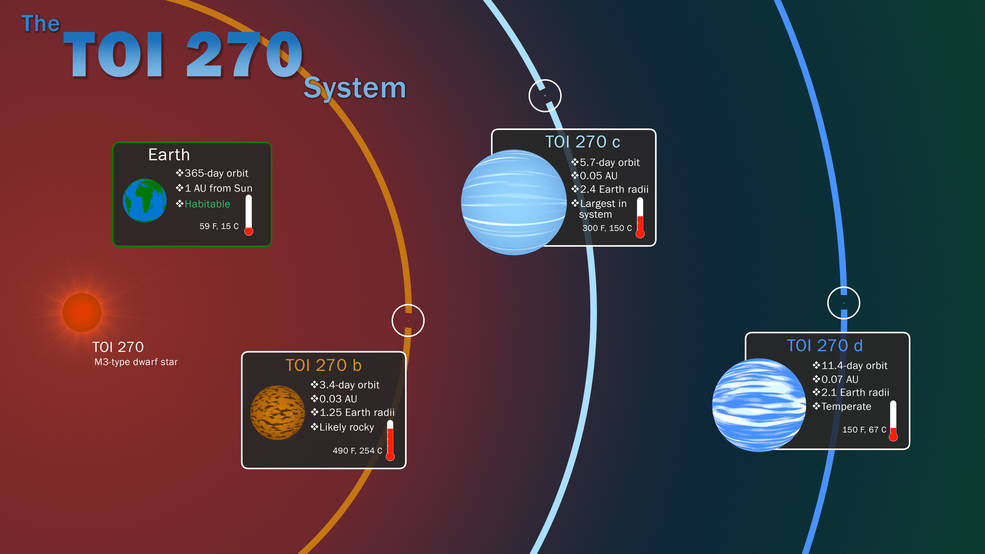
*** TESS spots 3 exoplanets on the small end of the mass spectrum. One is a rocky world a bit bigger than the earth while the other two are about twice as big as earth and classified as gaseous “Mini-Neptunes”. All are in orbits very close to their star: NASA’s TESS Mission Scores ‘Hat Trick’ With 3 New Worlds | NASA
NASA’s newest planet hunter, the Transiting Exoplanet Survey Satellite (TESS), has discovered three new worlds — one slightly larger than Earth and two of a type not found in our solar system — orbiting a nearby star. The planets straddle an observed gap in the sizes of known planets and promise to be among the most curious targets for future studies.
TESS Object of Interest (TOI) 270 is a faint, cool star more commonly identified by its catalog name: UCAC4 191-004642. The M-type dwarf star is about 40% smaller than the Sun in both size and mass, and it has a surface temperature about one-third cooler than the Sun’s. The planetary system lies about 73 light-years away in the southern constellation of Pictor.
“This infographic illustrates key features of the TOI 270 system, located about 73 light-years away in the southern constellation Pictor. The three known planets were discovered by NASA’s Transiting Exoplanet Survey Satellite through periodic dips in starlight caused by each orbiting world. Insets show information about the planets, including their relative sizes, and how they compare to Earth. Temperatures given for TOI 270’s planets are equilibrium temperatures, calculated without the warming effects of any possible atmospheres. Credits: NASA’s Goddard Space Flight Center/Scott Wiessinger”. Find more TESS TOI 270 graphics here.
Tour the GJ 357 system, located 31 light-years away in the constellation Hydra. Astronomers confirming a planet candidate identified by NASA’s Transiting Exoplanet Survey Satellite subsequently found two additional worlds orbiting the star. The outermost planet, GJ 357 d, is especially intriguing to scientists because it receives as much energy from its star as Mars does from the Sun.
“GJ 357 d is located within the outer edge of its star’s habitable zone, where it receives about the same amount of stellar energy from its star as Mars does from the Sun,” said co-author Diana Kossakowski at the Max Planck Institute for Astronomy in Heidelberg, Germany. “If the planet has a dense atmosphere, which will take future studies to determine, it could trap enough heat to warm the planet and allow liquid water on its surface.”
Without an atmosphere, it has an equilibrium temperature of -64 F (-53 C), which would make the planet seem more glacial than habitable. The planet weighs at least 6.1 times Earth’s mass, and orbits the star every 55.7 days at a range about 20% of Earth’s distance from the Sun. The planet’s size and composition are unknown, but a rocky world with this mass would range from about one to two times Earth’s size.
July 20, 2019 is the 50th anniversary of humanity’s first steps on the surface of the moon. In that time, the Apollo missions, a fleet of robotic probes and observations from Earth have taught us a lot about Earth’s surprising satellite. In this nontechnical talk, Andrew Fraknoi, who is sometimes called the Bay Area’s public astronomer, will look at the past, present and future of the moon, including its violent origins, the mystery of the frozen water we have found at its poles and its long-term future as it moves farther and farther away from us. Illustrated with beautiful images taken from orbit and on the surface, his talk will make the moon come alive as an eerie world next door, as a changing object in our skies, and as a possible future destination for humanity and its ambitions. Come find out how the achievements of the Apollo program fit into the bigger picture of our involvement with our only natural satellite.
Unlike Earth, with its plush atmosphere, the Moon has no atmosphere to protect its surface. So when the Sun sprays charged particles known as the solar wind into the solar system, some of them bombard the Moon’s surface and kick up water molecules that bounce around to new locations.
Likewise, wayward meteoroids constantly smash into the surface and uproot soil mingled with frozen bits of water. Meteoroids can hurtle these soil particles — which are many times smaller than the width of a human hair — as far as 19 miles (30 kilometers) away from the impact site, depending on the size of the meteoroid. The particles can travel so far because the Moon has low gravity and no air to slow things down: “So every time you have one of these impacts, a very thin layer of ice grains is spread across the surface, exposed to the heat of the Sun and to the space environment, and eventually sublimated or lost to other environmental processes,” said Dana Hurley, a planetary scientist at the Johns Hopkins University Applied Physics Laboratory in Laurel, Maryland.
While it’s important to consider that even in the shadowed craters water is slowly seeping out, it’s possible that water is being added, too, the paper authors note. Icy comets that crash into the Moon, plus the solar wind, could be replenishing it as part of a global water cycle; that’s something scientists are trying to figure out. Additionally, it’s not clear how much water there is. Is it sitting only in the top layer of the Moon’s surface or does it extend deep into the Moon’s crust, scientists wonder?
Either way, the topmost layer of polar crater floors is getting reworked over thousands of years, according to calculations by Farrell, Hurley, and their team. Therefore, the faint patches of frost that scientists have detected at the poles using instruments such as LRO’s Lyman Alpha Mapping Project (LAMP) instrument could be just 2,000 years old, instead of millions or billions of years old as some might expect, Farrell’s team estimated. “We can’t think of these craters as icy dead spots,” he noted.
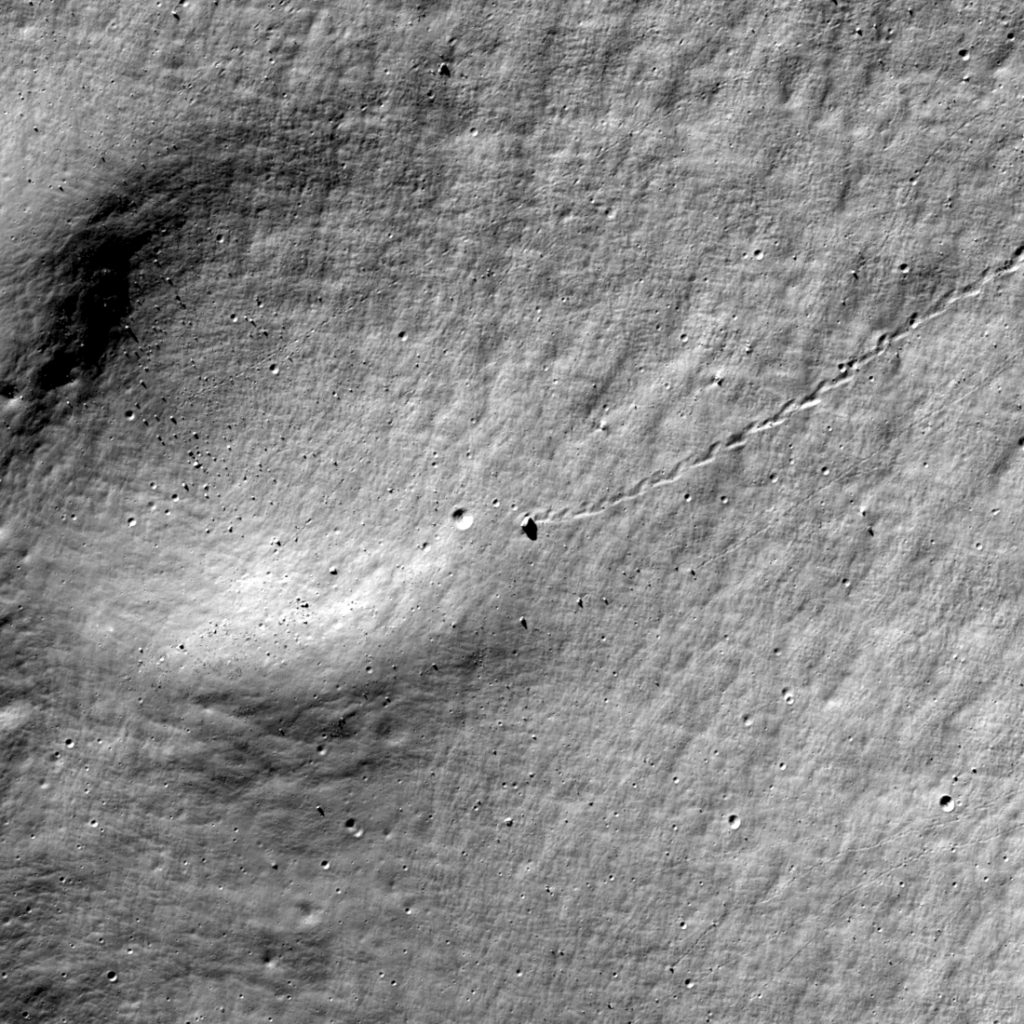
*** Big boulders leave trails on side of Antoniadi crater on the Moon’s far side:
The most prominent trail shows the boulder coming to a halt near a small crater:
Had it rolled just 75 meters more, the boulder might have plopped neatly into a 30-meter-diameter young impact crater on the floor of the partially erased crater. As Apollo 14 golfer Alan Shepard might have expressed it: the boulder narrowly missed scoring a hole-in-one.
This LRO image shows the trail of a boulder “bigger than a bus” on the side of the Antoniadi crater on the Moon’s far side. Credits: NASA/GSFC/Arizona State University.
Bob Zimmerman notices also
… two more less obvious boulder tracks. If you click on the full resolution image and zoom in you can also see another series of impressions in the middle of the photograph that look like a dotted line, suggesting they were left by a boulder bouncing down the slope.
The scattered of boulders in the floor of the small crater all likely came from the top of the big crater’s rim, …
Time lapse video of robotic arm on NASA’s Mars 2020 rover handily maneuvers 88-pounds (40 kilograms) worth of sensor-laden turret as it moves from a deployed to stowed configuration. For more information about the turret and the Mars 2020 mission, visit https://mars.nasa.gov/mars2020
[NASA JPL planetary geologist Vivian Sun] adds that there were no bedrock exposures available for contact science activities in Curiosity’s immediate workspace, so attention has now shifted to identify a drill site area, with the rover driving to that spot.
Check out this cool map showing Curiosity’s route since it landed on August 5, 2012:
Curiosity has now driven 13.10 miles (21.08 kilometers) since landing on Mars in August 2012.
A newly released Curiosity traverse map through Sol 2480 shows the route driven by the robot through the 2480 Martian day, or sol.
Map of Curiosity’s movements as of Sol 2480. Credit: NASA/JPL-Caltech/Univ. of Arizona. Click for larger image.
For the future colonists of Mars, the question of finding water will not be that much of a problem. Not only have planetary geologists mapped out the existence of extensive water-ice in the Martian poles, they have found that the planet apparently has widespread glacier deposits in two mid-latitude belts from 30 to 60 degrees latitude.
The question will be whether those Martian settlers will be able to easily access this water. The data so far suggests that much of the Martian underground water at high latitudes is likely mixed with dust and debris. Extracting it might not be straightforward. There are hints that the ice table at latitudes about 55 degrees might be more pure, but could be somewhat deep below ground, requiring the settlers to become miners to obtain their water. Moreover, all these high latitude locations are in environments that are more hostile, and therefore more difficult to establish a colony.
A sampling of links to recent space policy, politics, and government (US and international) related space news and resource items that I found of interest:
1. Monday, July 29, 2019; 7-8:30 pm PDT (9-10:30 pm CDT,; 10-11:30 pm EDT: No show on Monday which is now reserved for special programming.
2. Tuesday, July 30, 2019;: 7-8:30 pm PDT (9-10:30 pm CDT, 10-11:30 pm EDT): We welcome back Robert Zimmerman (Behind The Black) for space news and policy updates.
3. Wednesday, Wednesday, July 31, 2019: Hotel Mars. See Upcoming Show Menu and the website newsletter for details. Hotel Mars is pre-recorded by John Batchelor. It is archived on The Space Show site after John posts it on his website.
5. Sunday, August 4, 2019; 12-1:30 pm PDT (3-4:30 pm EDT, 2-3:30 pm CDT): We welcome back Joel Sercel of Momentus Space, which is developing space tugs.
Some recent shows:
** Fri, 07/26/2019 – Brad Blair talked about “space mining, lunar development, economics and commercial issues for space mining and more”.
** Tue, 07/23/2019 – Michelle Evans, President of the Orange County Space Society, discussed “Apollo program & Moon landing memories, observations and lessons learned, our future space and Moon plans and our emerging private sector”.