A sampling of recent articles, videos, and images from space-related science news items (find previous roundups here):
Exoplanets
** TESS (Transiting Exoplanet Survey Satellite) has found 29 exoplanets so far in a survey of southern sky: NASA’s TESS Presents Panorama of Southern Sky | NASA
… Constructed from 208 TESS images taken during the mission’s first year of science operations, completed on July 18, the southern panorama reveals both the beauty of the cosmic landscape and the reach of TESS’s cameras.
“Analysis of TESS data focuses on individual stars and planets one at a time, but I wanted to step back and highlight everything at once, really emphasizing the spectacular view TESS gives us of the entire sky,” said Ethan Kruse, a NASA Postdoctoral Program Fellow who assembled the mosaic at NASA’s Goddard Space Flight Center in Greenbelt, Maryland.
Within this scene, TESS has discovered 29 exoplanets, or worlds beyond our solar system, and more than 1,000 candidate planets astronomers are now investigating.
TESS divided the southern sky into 13 sectors and imaged each one of them for nearly a month using four cameras, which carry a total of 16 charge-coupled devices (CCDs). Remarkably, the TESS cameras capture a full sector of the sky every 30 minutes as part of its search for exoplanet transits. Transits occur when a planet passes in front of its host star from our perspective, briefly and regularly dimming its light. During the satellite’s first year of operations, each of its CCDs captured 15,347 30-minute science images. These images are just a part of more than 20 terabytes of southern sky data TESS has returned, comparable to streaming nearly 6,000 high-definition movies.
Solar system
** “Encounter with Ultima Thule: The Most Distant Object Humanity Has Ever Explored”
After encountering Pluto, the New Horizons spacecraft, for the first time flew by a member of the Kuiper Belt of icy objects beyond Neptune. This particular object, informally named “Ultimate Thule” (meaning the farthest place beyond the known world,) turned out to be a “contact binary” – two smaller icy worlds stuck together. Dr. Moore shares an insider’s view (with great images) of how the mission got there and what we learned at Ultima Thule.
Asteroids
** “ESO Telescope Reveals What Could be the Smallest Dwarf Planet Yet in the Solar System” | ESO
Astronomers using ESO’s SPHERE instrument at the Very Large Telescope (VLT) have revealed that the asteroid Hygiea could be classified as a dwarf planet. The object is the fourth largest in the asteroid belt after Ceres, Vesta and Pallas. For the first time, astronomers have observed Hygiea in sufficiently high resolution to study its surface and determine its shape and size. They found that Hygiea is spherical, potentially taking the crown from Ceres as the smallest dwarf planet in the Solar System.
As an object in the main asteroid belt, Hygiea satisfies right away three of the four requirements to be classified as a dwarf planet: it orbits around the Sun, it is not a moon and, unlike a planet, it has not cleared the neighbourhood around its orbit. The final requirement is that it has enough mass for its own gravity to pull it into a roughly spherical shape. This is what VLT observations have now revealed about Hygiea.
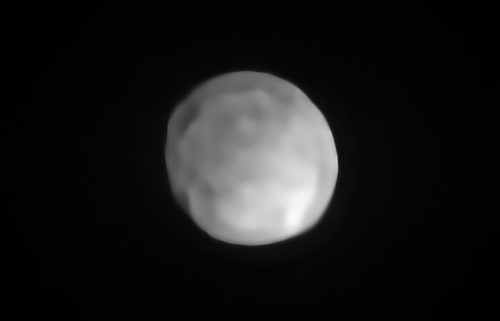
The making of a dwarf planet:
Computational simulation of the fragmentation and reassembly that led to the formation of Hygiea and its family of asteroids, following an impact with a large object. While changes in the shape of Hygiea occur after the impact, the dwarf-planet candidate eventually acquires a round shape.
** The story of Professor Amy Mainzer and the NEOCam space asteroid observatory: One scientist’s 15-year (and counting) quest to save Earth from asteroid impacts – The Space Review
NEOCam is a 50-centimeter telescope that will discover and characterize a large fraction of the asteroids and comets in the inner part of the solar system. It was supported based on its fundamental science, but the data that it will produce also serves planetary defense, which can be considered applied science. NASA administrator Jim Bridenstine has been called “passionate” about planetary defense and the American public agrees: in a recent AP-NORC poll of US priorities in space, monitoring asteroids was considered top priority by 68 percent of those polled, higher than any other category (59 percent prioritized scientific research and exploration; 23 percent and 27 percent prioritized human exploration of the Moon and Mars, respectively; and 19 percent prioritized a US military presence in space.) Imagine how much any presidential candidate would like to poll at 68 percent!
Sun
** The sun remains nearly spotless: Sunspot update October 2019: Sunspot activity continues to flatline | Behind The Black
Even though the previous 2008-2009 solar minimum was one of the deepest and longest ever recorded, the lack of sunspots in the past five months has significantly beaten it for inactivity, as shown on the first graph above. That previous minimum never had a period of even two months with so few sunspots. Furthermore, the Sun has now been blank 74% of the time in 2019, a record of blankness that beats the yearly record of either 2008 or 2009. If the Sun continues to be as blank as it has been for the next two months, 2019 will easily set the record for the year with the fewest sunspots ever recorded.
The big question remains: Are we heading for a grand minimum with no sunspots for decades? We still do not know. Even these unprecedented trends prove nothing, as we really do not yet have a clear understanding of why the Sun undergoes these various cycles of sunspot activity/inactivity. The Sun could still come back to life in the coming years. We can only wait and see.
Astronomy
** The captivating beauty of a galactic smashup: Hubble Captures Cosmic Face | ESA/Hubble
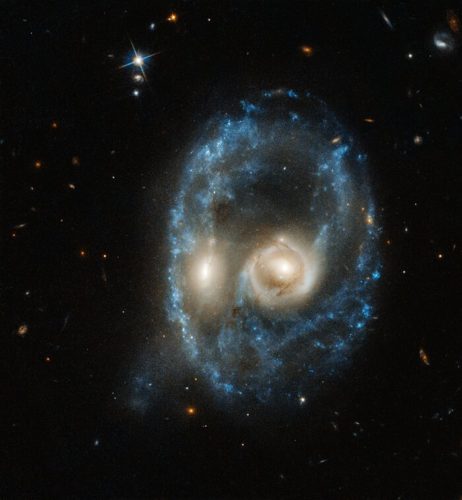
Although galaxy collisions are common — especially in the early universe — most are not head-on impacts like the collision that likely created this Arp-Madore system 704 million light-years from Earth. This violent encounter gives the system an arresting ring structure, but only for a short amount of time. The crash has pulled and stretched the galaxies’ discs of gas, dust, and stars outward, forming the ring of intense star formation that shapes the “nose” and “face” features of the system.
Ring galaxies are rare, and only a few hundred of them reside in our larger cosmic neighbourhood. The galaxies have to collide at just the right orientation so that they interact to create the ring, and before long they will have merged completely, hiding their messy past.
** Heavy element production seen at site of a neutron star collision that was spotted with gravitational wave detection: First identification of a heavy element born from neutron star collision | ESO
For the first time, a freshly made heavy element, strontium, has been detected in space, in the aftermath of a merger of two neutron stars. This finding was observed by ESO’s X-shooter spectrograph on the Very Large Telescope (VLT) and is published today in Nature. The detection confirms that the heavier elements in the Universe can form in neutron star mergers, providing a missing piece of the puzzle of chemical element formation.
In 2017, following the detection of gravitational waves passing the Earth, ESO pointed its telescopes in Chile, including the VLT, to the source: a neutron star merger named GW170817. Astronomers suspected that, if heavier elements did form in neutron star collisions, signatures of those elements could be detected in kilonovae, the explosive aftermaths of these mergers. This is what a team of European researchers has now done, using data from the X-shooter instrument on ESO’s VLT.
The Moon
** China’s lunar far-side exploration mission continues. Both the Yutu-2 rover and Chang’e-4 lander are demonstrating impressive resilience after multiple exposures to the deep cold of the 2 week long lunar nights. (Each uses a radioisotope heater unit to stay warm.) China’s lunar rover travels over 300 meters on moon’s far side – Xinhua
China’s lunar rover Yutu-2 has driven 318.62 meters on the far side of the moon to conduct scientific exploration of the virgin territory.
Both the lander and the rover of the Chang’e-4 probe have ended their work for the 11th lunar day, and switched to dormant mode for the lunar night on Monday (Beijing time), according to the Lunar Exploration and Space Program Center of the China National Space Administration.
The rover is now located 218.11 meters northwest of the lander.
…
The scientific tasks of the Chang’e-4 mission include conducting low-frequency radio astronomical observation, surveying the terrain and landforms, detecting the mineral composition and shallow lunar surface structure and measuring neutron radiation and neutral atoms.
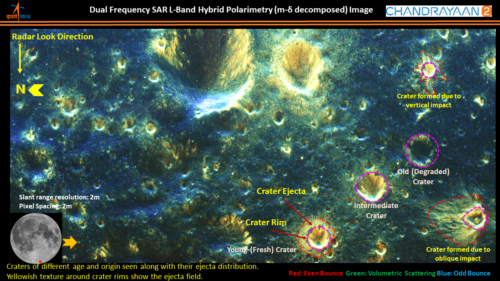
** India’s Chandrayaan-2 orbiter starting to produce data from the 8 instruments aboard the spacecraft. The first findings include the detection of Argon-40 in the tenuous lunar atmosphere using a mass spectrometer and images with the Dual-Frequency Synthetic Aperture Radar (DF-SAR) that highlight the structures of image craters.
- India’s Moon Orbiter: Scientific Sleuthing – Leonard David
- Detection of Argon-40 in the lunar exosphere – ISRO
- Initial imaging and observations by Chandrayaan-2 Dual-Frequency Synthetic Aperture Radar (DF-SAR) – ISRO
- Chandrayaan-2 begins spectroscopic studies of lunar surface – ISRO
More about the orbiter:
- Chandrayaan2 Home – ISRO
- Chandrayaan-2 Mission Gallery – ISRO
- Chandrayaan-2 | The Planetary Society
- Chandrayaan-2 gallery – The Bruce Murray Space Image Library | The Planetary Society
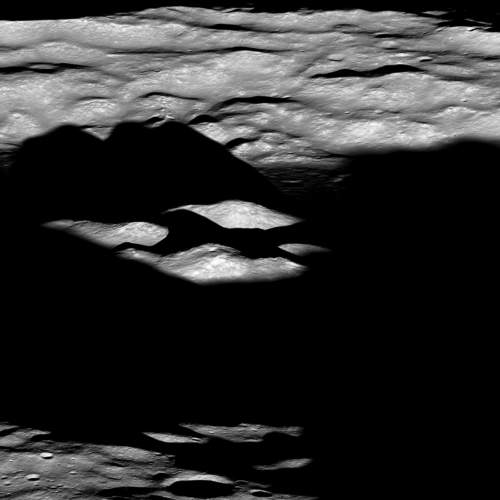
** The LROC imager on the Lunar Reconnaissance Orbiter captures dramatic views of the Bhabha crater, which lies within the South Pole–Aitken (SPA) basin on the Moon’s farside: Dawn Over Bhabha Crater | Lunar Reconnaissance Orbiter Camera
** Research on reusable suborbital rocket vehicles will be the focus of the 2020 Next-Generation Suborbital Researchers Conference (NSRC) in Broomfield, Colorado, March 2-4, 2020: Southwest Research Institute, Commercial Spaceflight Federation announce suborbital space researchers, educators conference – SwRI
The conference will provide an in-depth forum for attendees to learn more about funding and conducting research and public outreach aboard new commercial suborbital spaceflight systems — fortuitous byproducts of space tourism. Representatives from NASA, the Federal Aviation Administration, spaceports, and commercial suborbital and orbital vehicle operators will attend.
“A new era of routine access to suborbital space for researchers and educators is fast approaching,” said SwRI Associate Vice President Dr. Alan Stern, the NSRC program chair. “The 2020 conference will explore the many revolutionary ways this will affect space research and education.”
Organized by SwRI and the Commercial Spaceflight Federation (CSF), NSRC-2020 will feature dozens of keynote and invited presentations, panel discussions, workshops, aerospace tours, presentations, posters and networking opportunities.
“As a growing number of commercial space companies provide low-cost and frequent access to suborbital space for humans and research payloads, 2020 is the time to fully utilize this game-changing capability,” added Eric Stallmer, president of CSF. “NSRC-2020 will be the epicenter for researchers, educators, companies, students and entrepreneurs to connect and take part in this new era.”
NSRC is the premier conference for the suborbital space research and education community. The 2020 conference follows six previous, highly successful meetings since 2010. The program, sponsors, registration, logistics and other conference details are available at http://nsrc.swri.org.
Mars
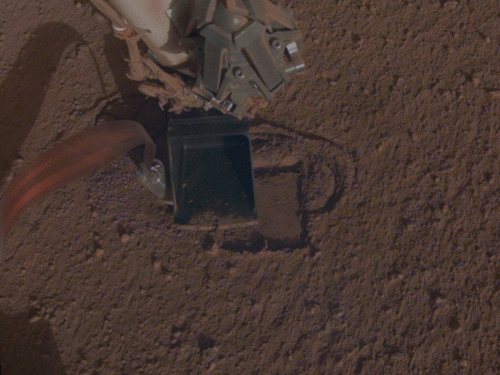
** Insight‘s heat probe digger dug again and appeared to be doing well by getting traction from pressure put on its side by Insight’s robotic arm: Mole Digging on Mars: Breakthrough! – Leonard David – Oct.24.2019
“We have made important progress in our attempts to get the mole digging again…in fact, we got it digging again!”
That’s the word from Tilman Spohn of the German Aerospace Center’s (DLR) Institute of Planetary Research in Berlin. He’s the experiment leader on the Heat Flow and Physical Properties Package (HP3), the self-hammering “mole” designed to dig down as much as 16 feet (5 meters) and take Mars’ temperature.
but then it went into reverse:
- Mars InSight’s Mole Has Partially Backed Out of Its Hole – NASA’s InSight Mars Lander – Oct.27.2019
- InSight heat flow probe suffers setback – SpaceNews.com
- Ground teams studying setback with InSight’s subsurface heat probe – Spaceflight Now
NASA/JPL:
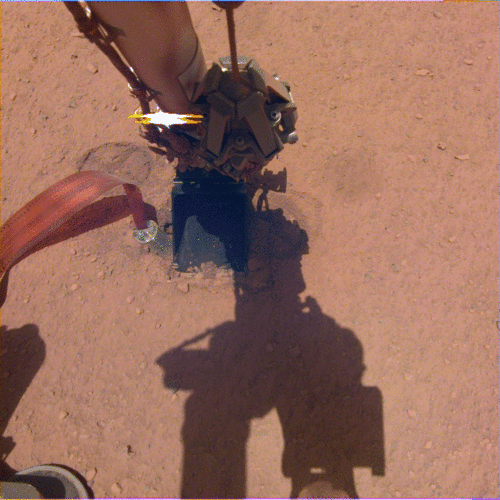
After making progress over the past several weeks digging into the surface of Mars, InSight’s mole has backed about halfway out of its hole this past weekend. Preliminary assessments point to unusual soil conditions on the Red Planet. The international mission team is developing the next steps to get it buried again.
A scoop on the end of the arm has been used in recent weeks to “pin” the mole against the wall of its hole, providing friction it needs to dig. The next step is determining how safe it is to move InSight’s robotic arm away from the mole to better assess the situation. The team continues to look at the data and will formulate a plan in the next few days.
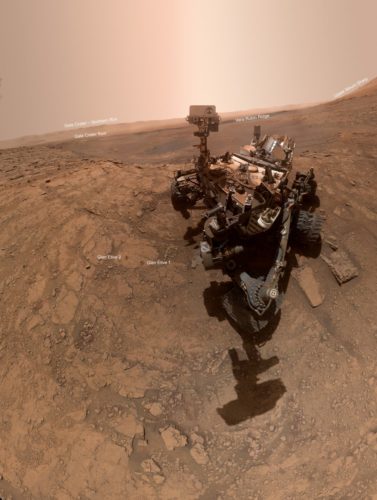
** Latest on Curiosity’s travels:
- Rover update: October 28, 2019 | Behind The Black
- Curiosity takes selfie next to two of its most important drill holes | Behind The Black
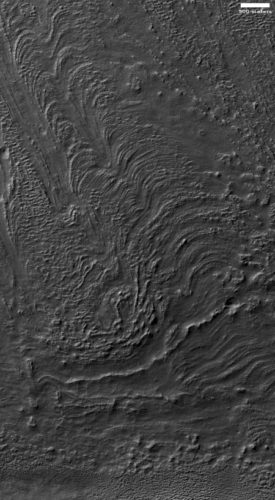
** Glacier movements over the eons create striking structures at Euripus Mons: Ancient glacier flows on Mars | Behind The Black
You can see that this large apron is the result of repeated flows down from the mountain, with each new flow not quite traveling as far, creating a terraced slope extending many miles.
== Amazon Ad ==
Moon: An Illustrated History:
From Ancient Myths to the Colonies of Tomorrow)

 .
.