A sampling of links to recent space policy, politics, and government (US and international) related space news and resource items that I found of interest (find previous space policy roundups here):
** The Space Show – Fri, 11/08/2019 – Dr. Ella Atkins ( Professor in the University of Michigan’s Aerospace Engineering Department where she directs the Autonomous Aerospace Systems (A2SYS) Lab and is Associate Director of the Robotics Institute) talked about “IEEE Robotics & Automation, leveraging tech for space for the future, autonomous terrestrial, air & space vehicles, regulatory oversight, public perceptions/concerns, human spaceflight and more”.
A sampling of recent articles, videos, and images dealing with space transport (find previous roundups here):
** SpaceX Falcon 9 set to launch 60 Starlink satellites on Monday at 9:56 am EST, 14:56 UTC.
[ Update: The launch was a success. The booster landed right on target and the satellites were deployed as planned. Apparently the sea was quite rough, though, and so the ships returned without any attempt to capture the fairings.
This will be the first booster to fly four times. It will also be the first time that a recovered fairing will be re-flown. SpaceX will attempt to catch both fairings from this flight with two ships outfitted with large nets.
Team is go for launch of 60 Starlink sats tomorrow—heaviest payload to date, first re-flight of a fairing, and first Falcon 9 to fly a fourth mission. Watching 1 sat that may not orbit raise; if not, 100% of its components will quickly burn up in Earth’s atmosphere pic.twitter.com/OrI8L0ntFK
Boeing said Nov. 7 that a misplaced pin prevented a parachute from deploying during a pad abort test of its CST-100 Starliner vehicle three days earlier, the only flaw in a key test of that commercial crew vehicle.
In a call with reporters, John Mulholland, vice president and program manager for commercial crew at Boeing, said an investigation after the Nov. 4 test at White Sands Missile Range in New Mexico led the company to conclude that a “lack of secure connection” between a pilot parachute and the main parachute prevented that main parachute, one of three, from deploying.
The United Launch Alliance (ULA) Atlas V rocket set to launch Boeing’s CST-100 Starliner on its maiden voyage to the International Space Station for NASA’s Commercial Crew Program is ready for the mating of Starliner to the top of the launch vehicle.
On Monday, Nov. 4, the Atlas V’s first stage was lifted to the vertical position inside the Vertical Integration Facility at Space Launch Complex 41 at Cape Canaveral Air Force Station in Florida, followed by the mating of two solid rocket boosters to the booster. ULA teams then attached the Centaur upper stage and launch vehicle adapter atop the Atlas V first stage.
** The history of Japan’s reusable suborbital rocket projects are described in this set of tweets:
The history of Japanese reusable rocket R&D came up in my interview on @tmro last weekend. It’s a subject that’s pretty unknown (even within Japan), so it might be worth a bit more of a deep dive. Still a twitter rookie, so I’ll take the thread function for a test drive! (1/14) pic.twitter.com/az2EItlqzl
** Video tour of Rocket Lab‘s New Zealand launch facility:
Join Amanda Stiles, Director of Mission Management and Integration, as we take you on a tour of Rocket Lab’s Launch Complex 1. Located on the Mahia Peninsula on New Zealand’s East Coast, LC-1 is the best spot in the world to launch more frequently than anywhere else on the planet.
** “What are Hypergolic Rocket Fuels? (Other than Explosive, Corrosive, Toxic, Carcinogenic and Orange)” – Scott Manley answers the question, ”
Hypergolic fuels are a core technology in rocket science, propellents that will spontaneously combust when mixed together. This makes them attractive for rocket designers, who generally aren’t the people who have to get in a the protective gear to load the stuff. So, what are they made of, and why do designers pick one option over another?
Adding all of this up, the true cost of a Space Launch System mission with Orion on top in the 2020s, including the rocket’s development but excluding ground systems and Orion development costs, appears to be in the ballpark of $5 billion per flight. Let’s hope the astronauts are served more than just pretzels after takeoff.
I’ve always been amazed and angered that NASA for decades has gotten away with using theoretical marginal cost numbers (i.e. count only the cost of fuel, metals, operators salaries, etc. to do one additional flight) when asked for the cost of a Saturn V, Shuttle or SLS mission. This is clearly a grossly misleading way to answer the question of how much taxpayer money it took for a flight to take place. I’m quite disappointed that Hale defends the practice and I posted a comment on his post but he hasn’t approve it. So [Now approved.] here is what I said (with some typos fixed):
So the cost of the James Webb ST is not $10B, like those knuckle-headed bloggers claim, but is actually ~$500M because that’s about how much it would cost to build a second one?
Marginal (i.e. incremental) cost is an interesting number after making a million widgets and you want to know how much the next widget costs. The fixed cost contribution vanishes. Marginal cost is an irrelevant number when only making, or launching, a 100 or so widgets. The fixed cost contribution doesn’t vanish – and no magical accounting or browbeating by a highly respected Flight Director can make it do so.
It’s definitely relevant to know who is doing the calculation but it’s also good to know if the calculation answers the question being asked. In this case, the question from taxpayers is simply how much did it cost to make those [135] Shuttle flights happen? If only $105B instead of $210B (in 2010 dollars) had been allocated, would [135] launches still have taken place? No, of course not. It is irrelevant if NASA used a substantial portion of the money for items like roofs and non-essential civil servant salaries. That’s what govt organizations do with their budgets. If half the total Shuttle expenditure had instead been allocated to NASA, half [i.e. 67] or fewer flights would have happened.
Yes, who calculates what number is a factor. We can be sure NASA in the next few years will calculate $500M as the cost of a SLS flight. And the $3B+ that it will cost to make each flight happen will be [accurately] calculated by knuckle-headed bloggers.
*** Video: Elon Musk discusses SpaceX and the importance of fully reusable rockets at a US Air Force event last week:
Opening day of Air Force Space Pitch Day. The two-day event was hosted by the U.S. Air Force to demonstrate the Air Force’s willingness and ability to work with non-traditional startups. The “Fireside Chat” features Lt. Gen. John F. Thompson, Space and Missile Systems Center Commander, and Elon Musk, Space X Chief Engineer. The chat covers the future of space, space industry, how to find talent, and various other topics.
The technical viability and utility of beaming high speed, low-latency broadband internet directly into the cockpits of military aircraft is being tested under a program called Global Lightning. SpaceX has engaged the initiative and was awarded $29M to pursue development and testing, far more than any other contract recipient. In October 2019, SpaceX and the USAF began publicly discussing the latest results of that effort to test Starlink’s capabilities in the realm of in-flight connectivity. As reported by SpaceNews, SpaceX COO Gwynne Shotwell revealed that Starlink had successfully demonstrated a data link to the cockpit of a military aircraft with a bandwidth of 610 megabits per second (Mbps), equivalent to a gigabyte ever ~13 seconds.
*** Views of recent Starship construction activity at Boca Chica Beach:
*** And a fly-around of the Mk2 Starship construction activity in Florida:
Aerial Flyby, Quiet Sunday. Working on new ring on top of the engine section. Hints of 6 Raptor engines to be included on MK2. Lot of sheets of steel getting stored in the “On Deck” area. These sheets can be used to construct domes and nosecones.
At the same time as SpaceX’s Boca Chica, Texas team is working around the clock to prepare Starship Mk1 for several major tests, the company is building a second dedicated Starship launch complex at Pad 39A and as of November 4th, that construction effort has reached a symbolic milestone.
The Starship pad at 39A is officially going vertical! You can see just how close the new launch mount is to the ramp and operational pad. Things are about to get really exciting around here. 🏗🚀 #Starship#MK2@SpaceXpic.twitter.com/KlLUqJ059S
Here is the latest episode in NASA’s Space to Ground weekly report on activities related to the International Space Station:
** Students Supporting Spacewalks
Did you know undergrad students are contributing to NASA missions? Check out the MicrogNExT Lone Star College-Cy Fair team’s contribution to International Space Station spacewalks! Learn how you – the Artemis generation — can contribute to NASA’s mission by visiting stem.nasa.gov/artemis
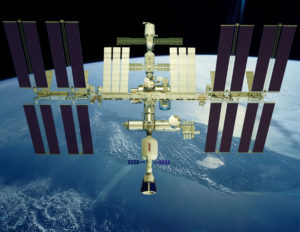
The next crew that will launch to the International Space Station held a news conference Nov. 7 at the Johnson Space Center, Houston to discuss their upcoming mission. NASA astronaut Chris Cassidy and Roscosmos cosmonauts Nikolai Tikhonov and Andrei Babkin are scheduled to launch next April in the Soyuz MS-16 spacecraft from the Baikonur Cosmodrome in Kazakhstan for a planned six-month mission.
Spaceflight has arranged a Rocket Lab Electron launch for the Sky Canvas spacecraft owned by the Japanese company ALE Co., Ltd. Sky Canvas will create “Shooting stars. On demand”.
Seattle – Nov. 5, 2019 — Spaceflight, the leading satellite rideshare and mission management provider, today announced it has arranged for Tokyo-based ALE to launch its entertainment and science satellite on Rocket Lab’s next Electron launch. The mission, called “Running Out of Fingers” by Rocket Lab to signify its tenth mission, represents Spaceflight’s third launch with Rocket Lab this year. It follows the launch of seven spacecraft on its inaugural “Make it Rain” mission in June and three on the “Look Ma No Hands” mission in August.
https://vimeo.com/231032391
Like the previous missions, Spaceflight managed the launch capacity procurement, integration, and mission management services for the rideshare spacecraft. The Electron, carrying the ALE satellite, will lift-off from Rocket Lab’s Launch Complex 1 at the southern tip of Mahia Peninsula, on the east coast of New Zealand’s North Island. The launch window opens on 25th November NZDT.
“Our experience offering end-to-end launch services across multiple launch vehicles continues to be highly valued by organizations — regardless if they’re a newer customer like ALE, or an experienced constellation developer,” said Curt Blake, CEO and president of Spaceflight. “Our expertise and long-standing relationships provide reliability, flexibility, and the confidence that we’ll get customers to space as efficiently as possible. We’re really looking forward to taking ALE on our third Electron launch this year.”
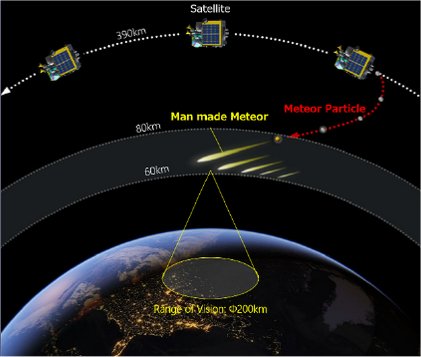
ALE’s Sky Canvas, the world’s first man-made shooting star project, will deploy to a 400km circular Sun Synchronous orbit, which is beneath the International Space Station. The company’s satellite will create man-made shooting stars by safely releasing particles, precisely controlling the reentry location, date, and timing. When the particles re-enter the Earth’s atmosphere, they fully burn up, creating the appearance of shooting stars on the ground.
In addition to the entertainment factor, the Sky Canvas project will also study the path and mechanics of shooting star particles during re-entry from the upper atmosphere. The data collected in the mesosphere will be helpful in the aerospace industry to help predict the path of satellites and artificial objects as well as contributing to scientific understanding in several technology fields including meteorology and the study of climate change.
“This launch gets us much closer to realizing the world’s first man-made shooting star,” said Lena Okajima, CEO of ALE. “We really appreciate Spaceflight`s support and attention to our mission and we’re honored to take this big step with them.”
Following this launch, Spaceflight will have launched 11 spacecraft on the Electron and has plans to continue partnering with the launch vehicle provider in 2020. Spaceflight has completed five missions already this year, with another five planned in 2019. Other noteworthy missions from the last year include Spaceflight’s GTO-1, which deployed the first commercial lunar lander aboard a SpaceX Falcon 9, and SSO-A, the company’s historic dedicated rideshare mission, successfully launched 64 unique smallsats, making it the single largest deployment of satellites from a U.S.-based launch vehicle.
About Spaceflight: Spaceflight is revolutionizing the business of spaceflight by delivering a new model for accessing space. A comprehensive launch services and mission management provider, the company provides a straightforward and cost-effective suite of products and services including state-of-the-art satellite infrastructure and rideshare launch offerings that enable commercial and government entities to achieve their mission goals on time and on budget. A service offering of Spaceflight Industries in Seattle, Wash., Spaceflight provides its services through a global network of partners and launch vehicle providers. For more information, visit http://www.spaceflight.com.
This mission took years of analysis and rigorous review. Josh Rodenbaugh, ALE’s launch campaign manager, worked closely with the Spaceflight team as a mission of this type had never been done before. ALE had already worked through the Japanese Space Agency who had conducted a rigorous review for the launch of ALE-1 earlier this year. ALE also met with other countries’ space agencies and even astronomers to work through any concerns around this unique mission. Spaceflight helped the company get the necessary permits through the New Zealand Space Agency, and worked with Rocket Lab to ensure a smooth integration process (which will begin in the next week or so). We are always happy to advocate for our customers and support new uses for satellites – opening up access to space for new business models is part of our corporate mission.
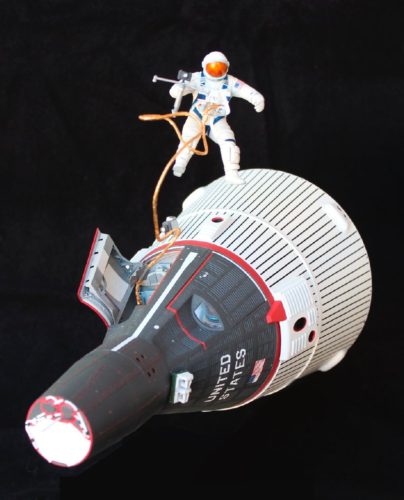
Space in Miniature (SIM) is Michael Mackowski’s website devoted to space modeling. He includes a series of books and reports in which he “covers various topics in the area of building scale models of real spacecraft”. He has just released a new book about modeling Gemini spacecraft:
Building Gemini Reference Book for Model Builders is Published
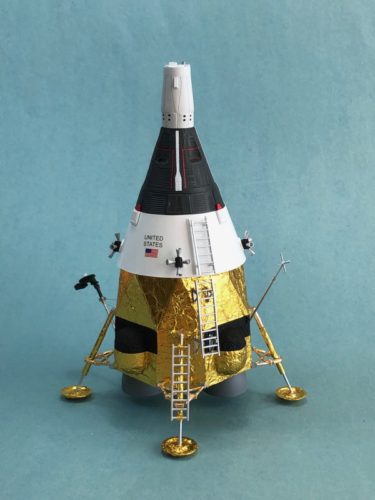
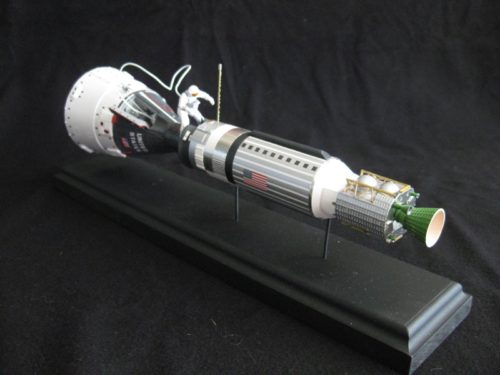
The ninth installment of the Space In Miniature (SIM) series of reference booklets for spacecraft modelers is now available. This 72-page soft-cover booklet describes in detail how the author, Michael Mackowski, built nine different models of the Gemini two-person spacecraft. These include some standard NASA versions as well as some proposed Gemini variants that never made it off the drawing board.
While there already is a Gemini book in the Space in Miniature series, SIM #2, that volume did not have any detailed how-to articles. The new book is loaded with over 200 photos of work in progress of the following model projects:
Gemini IV
Gemini VII
Gemini XI with Agena
Rogallo Wing Capsule
Manned Orbiting Lab (MOL)
Big G
Winged Gemini
Lunar Rescue Gemini
Gemini to Mars
All are in 1/48th scale except for a 1/24th scale Gemini IV and a 1/72nd scale Mars mission concept and use a variety of kits and scratch-building. This book documents those builds, including how to correct the old Revell kits, and presents a bit of background on the “lost Gemini” projects that were never built. The result is the largest SIM book to date, covering a unique collection of nine historical and theoretical Gemini models built over a span of four years.
This book is printed in black and white on coated paper, and is available both as a hard copy book as well as a full-color pdf file. This guidebook will be a unique resource for the serious space modeler. A hard copy of SIM #9 – Building Gemini sells for $12 plus shipping, while a pdf download costs $10. A combination package of both the hard copy and digital version is available for only $15 plus shipping. To order, see www.spaceinminiature.com or send an email to mike@spaceinminiature.com. The other titles in the SIM series are still available.



So the cost of the James Webb ST is not $10B, like those knuckle-headed bloggers claim, but is actually ~$500M because that’s about how much it would cost to build a second one?
Marginal (i.e. incremental) cost is an interesting number after making a million widgets and you want to know how much the next widget costs. The fixed cost contribution vanishes. Marginal cost is an irrelevant number when only making, or launching, a 100 or so widgets. The fixed cost contribution doesn’t vanish – and no magical accounting or browbeating by a highly respected Flight Director can make it do so.
It’s definitely relevant to know who is doing the calculation but it’s also good to know if the calculation answers the question being asked. In this case, the question from taxpayers is simply how much did it cost to make those [135] Shuttle flights happen? If only $105B instead of $210B (in 2010 dollars) had been allocated, would [135] launches still have taken place? No, of course not. It is irrelevant if NASA used a substantial portion of the money for items like roofs and non-essential civil servant salaries. That’s what govt organizations do with their budgets. If half the total Shuttle expenditure had instead been allocated to NASA, half [i.e. 67] or fewer flights would have happened.
Yes, who calculates what number is a factor. We can be sure NASA in the next few years will calculate $500M as the cost of a SLS flight. And the $3B+ that it will cost to make each flight happen will be [accurately] calculated by knuckle-headed bloggers.