Astronomers have found water vapour in a disc around a young star exactly where planets may be forming. In this image, the new observations from the Atacama Large Millimeter/submillimeter Array (ALMA), in which ESO is a partner, show the water vapour in shades of blue. Near the centre of the disc, where the young star lives, the environment is hotter and the gas brighter. The red-hued rings are previous ALMA observations showing the distribution of dust around the star.
Researchers have found water vapour in the disc around a young star exactly where planets may be forming. Water is a key ingredient for life on Earth, and is also thought to play a significant role in planet formation. Yet, until now, we had never been able to map how water is distributed in a stable, cool disc — the type of disc that offers the most favourable conditions for planets to form around stars. The new findings were made possible thanks to the Atacama Large Millimeter/submillimeter Array (ALMA), in which the European Southern Observatory (ESO) is a partner.
“I had never imagined that we could capture an image of oceans of water vapour in the same region where a planet is likely forming,”
says Stefano Facchini, an astronomer at the University of Milan, Italy, who led the study published today in Nature Astronomy. The observations reveal at least three times as much water as in all of Earth’s oceans in the inner disc of the young Sun-like star HL Tauri, located 450 light-years away from Earth in the constellation Taurus.
“It is truly remarkable that we can not only detect but also capture detailed images and spatially resolve water vapour at a distance of 450 light-years from us ,”
adds co-author Leonardo Testi, an astronomer at the University of Bologna, Italy. The ‘spatially resolved’ observations with ALMA allow astronomers to determine the distribution of water in different regions of the disc.
“Taking part in such an important discovery in the iconic HL Tauri disc was beyond what I had ever expected for my first research experience in astronomy,”
adds Mathieu Vander Donckt from the University of Liège, Belgium, who was a master’s student when he participated in the research.
A significant amount of water was found in the region where a known gap in the HL Tauri disc exists. Ring-shaped gaps are carved out in gas- and dust-rich discs by orbiting young planet-like bodies as they gather up material and grow.
Our recent images reveal a substantial quantity of water vapour at a range of distances from the star that include a gap where a planet could potentially be forming at the present time,”
says Facchini. This suggests that this water vapour could affect the chemical composition of planets forming in those regions.
This is the sharpest image ever taken by ALMA — sharper than is routinely achieved in visible light with the NASA/ESA Hubble Space Telescope. It shows the protoplanetary disc surrounding the young star HL Tauri. These new ALMA observations reveal substructures within the disc that have never been seen before and even show the possible positions of planets forming in the dark patches within the system.
Observing water with a ground-based telescope is no mean feat as the abundant water vapour in Earth’s atmosphere degrades the astronomical signals. ALMA, operated by ESO together with its international partners, is an array of telescopes in the Chilean Atacama Desert at about 5000 metres elevation that was built in a high and dry environment specifically to minimise this degradation, providing exceptional observing conditions.
“To date, ALMA is the only facility able to spatially resolve water in a cool planet-forming disc,”
says co-author Wouter Vlemmings, a professor at the Chalmers University of Technology in Sweden [1].
“It is truly exciting to directly witness, in a picture, water molecules being released from icy dust particles,”
says Elizabeth Humphreys, an astronomer at ESO who also participated in the study. The dust grains that make up a disc are the seeds of planet formation, colliding and clumping into ever larger bodies orbiting the star. Astronomers believe that where it is cold enough for water to freeze onto dust particles, things stick together more efficiently — an ideal spot for planet formation.
“Our results show how the presence of water may influence the development of a planetary system, just like it did some 4.5 billion years ago in our own Solar System,”
Facchini adds.
With upgrades happening at ALMA and ESO’s Extremely Large Telescope (ELT) coming online within the decade, planet formation and the role water plays in it will become clearer than ever. In particular METIS, the Mid-infrared ELT Imager and Spectrograph, will give astronomers unrivalled views of the inner regions of planet-forming discs, where planets like Earth form.
Notes
[1] The new observations used the Band 5 and Band 7 receivers on ALMA. Bands 5 and 7 were European developments, at Chalmers/NOVA (Netherlands Research School for Astronomy) and IRAM (Institut de radioastronomie millimétrique), respectively, with involvement of ESO. Band 5 expanded ALMA into a new frequency range specifically for detecting and imaging water in the local Universe. In this study, the team observed three spectral lines of water across the two receiver frequency ranges to map gas at different temperatures within the disc.
Here is this week’s selection of videos and news items about space habitats, living in space, and space settlement. Starts with NASA’s latest Space to Ground report for the International Space Station:
** Expedition 70 Astronaut Andreas Mogensen Talks with Technical University of Denmark – Feb. 23, 2024 –NASA Video
Aboard the International Space Station, Expedition 70 commander Andy Mogensen of ESA (European Space Agency) discussed living and working in space with the Danish Technical University and Danish TV2 on Feb. 23. Mogensen is in the midst of a long-duration mission on the microgravity laboratory to advance scientific knowledge and demonstrate new technologies for future human and robotic exploration missions.
** NASA’s SpaceX Crew-8 astronauts and cosmonaut arrive in Florida ahead of launch – VideoFromSpace
Commander Matthew Dominick, pilot Michael Barratt, mission specialists Jeanette Epps and Aleksandr Grebenkin arrived at the Kennedy Space Center in Florida on Feb. 25, 2024. They are scheduled to launch to the International Space Station on March 1.
** Expedition 70 71 Interviews With Flight Engineer Tracy Dyson 240226 – NASA Video
NASA astronaut Tracy C. Dyson participated in live virtual interviews on Monday, Feb. 26, ahead of her launch to the International Space Station. Dyson is scheduled to launch aboard the Soyuz MS-25 spacecraft Thursday, March 21, and will spend approximately six months aboard the space station. She will travel to the station with Roscosmos cosmonaut Oleg Novitskiy and spaceflight participant Marina Vasilevskaya of Belarus, both of whom will spend approximately 12 days aboard the orbital complex. During her expedition, Dyson will conduct scientific investigations and technology demonstrations that help prepare humans for future space missions and benefit people on Earth. Among some of the hundreds of experiments ongoing during her mission, Dyson will continue to study how fire spreads and behaves in space with the Combustion Integrated Rack, as well as contribute to the long-running Crew Earth Observations study by photographing Earth to better understand how our planet is changing over time. After completing her expedition, Dyson will return to Earth this fall with Roscosmos cosmonauts Oleg Kononenko and Nikolai Chub on the Soyuz MS-25 spacecraft.
A new fuel system called Smart Tanks for Space (SMARTTS) is set to be tested on the International Space Station! Developed by Hampshire-based firm Atout Process, this technology aims to solve the challenges of accurately measuring fuel in propellant tanks in zero gravity.… pic.twitter.com/s22xyJP1MU
Phil McAlister, director of our Commercial Spaceflight Division, recently visited @SierraSpaceCo to see work on the Large Integrated Flexible Environment (LIFE) habitat. Sierra Space is collaborating with @NASA as part of the Collaborations for Commercial Space Capabilities-2… pic.twitter.com/ClGWat3JtV
** China Names Its Manned Lunar Exploration Vehicles Mengzhou, Lanyue –CCTV Video News Agency
The China Manned Space Engineering Office (CMSEO) on Feb. 24 unveiled the official names of the new vehicles for its future manned lunar exploration missions.
** China’s First Home-grown Ground Simulation Space StationPpasses Acceptance Review –CCTV Video News Agency
China’s first “ground space station,” the home-grown Space Environment Simulation and Research Infrastructure (SESRI), passed its acceptance review on Tuesday in Harbin, the capital of northeast China’s Heilongjiang Province.
** Highlight: Las Cruses NM / El Paso TX / Juarez Mexico – Feb 23, 2024 – 13:44 CST – ISS Above
NASA EHDC6 Live views of the Earth from the International Space Station
** Highlight: Egypt – Cairo – Feb 26, 2024 07:40 UTC – ISS Above
** Photographing the International Space Station (ISS) – My First Ever Attempt! – Matt Burns
Follow along as I try to use my telescope to capture a transit of ISS across the Sun. This was several months of waiting for a clear sky with a transit viewable near where I live. I spent several hours the day before doing research to make sure I had the exact time and location correct and doing a dry-run to refine my script so I didn’t miss anything during the event.
** Live Video from the International Space Station (Official NASA Stream) – NASA
Watch live video from the International Space Station, including inside views when the crew aboard the space station is on duty. Views of Earth are also streamed from an external camera located outside of the space station. During periods of signal loss due to handover between communications satellites, a blue screen is displayed.
The space station orbits Earth about 250 miles (425 kilometers) above the surface. An international partnership of five space agencies from 15 countries operates the station, and it has been continuously occupied since November 2000. It’s a microgravity laboratory where science, research, and human innovation make way for new technologies and research breakthroughs not possible on Earth. More: https://go.nasa.gov/3CkVtC8
Did you know you can spot the station without a telescope? It looks like a fast-moving star, but you have to know when to look up. Sign up for text messages or email alerts to let you know when (and where) to spot the station and wave to the crew: https://spotthestation.nasa.gov
Find here the latest news and updates on reusable rocket powered vehicles in operation and in development. (See also the previous Roundup from November 2023.) Such technology should eventually lead to space transports with aircraft-like operation. That is, orbital flight and return followed by rapid reflight with minimal preparation. Vehicles should fly thousands of times with only occasional refurbishment and, most importantly, spacefare should fall to levels similar to long distance airfare.
In the decades following the launch of Sputnik 1, missile derived expendable launchers dominated and progress towards reusable transports moved at a slow crawl. The one major attempt at reusablity, the Space Shuttle, was a major disappointment, providing no reduction in space transport costs due to the lengthy refurbishment and component replacements after each flight. However, progress sped up considerably in the past decade with the arrival of the SpaceX Falcon 9, whose boosters have achieved 248 reflights and 277 landings as of Feb.26.2024.
Reusable rocket powered vehicle designs fall roughly into the following five categories:
Below are reports on several projects and programs that fall into at least one of these categories.
** SpaceX Starship – Third orbital flight test expected in March.
Recent remarks from Elon Musk indicate that the third test flight could happen by mid-March. The test will launch the combo of Starship 28 and Super Heavy Booster 10, which have been undergoing preparations for the flight for several months including repeated trips to and from the orbital launch site for cryogenic pressure tests, engine firings, etc. In mid-February the stages were stacked atop the launch mount and twice an attempt at a wet dress rehearsal was made but each time the propellant filling was stopped prematurely and the rehearsal ended. Subsequently, the Starship was de-stacked and moved to the nearby suborbital test area for engine testing, starting with a spin prime test on Feb.26th (spin prime refers to a test of the engine turbopumps). Booster 10 was moved back to the production site.
[ Update: Just after posting this item, the FAA announced that the mishap investigation with SpaceX has been completed. Presumably, they will soon issue a permit for the next flight test.
The FAA has closed the mishap investigation into the second Starship test flight. pic.twitter.com/jZe8z8VULu
SpaceX must implement 17 corrective actions. Seven on the boosters and ten on the Starship upper stage.
SpaceX also has an update describing the second test flight and reasons for the loss of the two stages. For the booster:
Following stage separation, Super Heavy initiated its boostback burn, which sends commands to 13 of the vehicle’s 33 Raptor engines to propel the rocket toward its intended landing location. During this burn, several engines began shutting down before one engine failed energetically, quickly cascading to a rapid unscheduled disassembly (RUD) of the booster. The vehicle breakup occurred more than three and a half minutes into the flight at an altitude of ~90 km over the Gulf of Mexico.
The most likely root cause for the booster RUD was determined to be filter blockage where liquid oxygen is supplied to the engines, leading to a loss of inlet pressure in engine oxidizer turbopumps that eventually resulted in one engine failing in a way that resulted in loss of the vehicle. SpaceX has since implemented hardware changes inside future booster oxidizer tanks to improve propellant filtration capabilities and refined operations to increase reliability.
For the Starship stage:
At vehicle separation, Starship’s upper stage successfully lit all six Raptor engines and flew a normal ascent until approximately seven minutes into the flight, when a planned vent of excess liquid oxygen propellant began. Additional propellant had been loaded on the spacecraft before launch in order to gather data representative of future payload deploy missions and needed to be disposed of prior to reentry to meet required propellant mass targets at splashdown.
A leak in the aft section of the spacecraft that developed when the liquid oxygen vent was initiated resulted in a combustion event and subsequent fires that led to a loss of communication between the spacecraft’s flight computers. This resulted in a commanded shut down of all six engines prior to completion of the ascent burn, followed by the Autonomous Flight Safety System detecting a mission rule violation and activating the flight termination system, leading to vehicle breakup. The flight test’s conclusion came when the spacecraft was as at an altitude of ~150 km and a velocity of ~24,000 km/h, becoming the first Starship to reach outer space.
SpaceX has implemented hardware changes on upcoming Starship vehicles to improve leak reduction, fire protection, and refined operations associated with the propellant vent to increase reliability. The previously planned move from a hydraulic steering system for the vehicle’s Raptor engines to an entirely electric system also removes potential sources of flammability.
The update goes on to say the measures to protect the launch pad worked well and few fixes were required after the test.
The next test flight will implement various
performance upgrades, including the debut of a new electronic Thrust Vector Control system for Starship’s upper stage Raptor engines and improving the speed of propellant loading operations prior to launch.
]
The company is preparing for up to nine test flights in 2024. The rate of production of vehicles should be sufficient for such a test program as indicated by this recent image of four Super Heavy boosters inside the Megabay 1 at Starbase:
Super Heavy boosters for the next three flights, with a fourth ready to stack, in the Starbase Megabay pic.twitter.com/0GLwlDvjNu
New permanent buildings are replacing the tent-like structures used for production of major components, particularly the steel ring segments that make up the structure of each stage.
Construction of the second Megabay is nearing completion.
These bays are used for the stacking of the steel ring segments, engine installation, and other final assembly operations on the Starship stages.
Construction of an office building and parking garage has begun.
Massey’s site: The former gun club site has become more than just a storage site.
New vehicle stages undergo initial cryogenic and stress testing here.
Similar testing for new structure designs
An engine test facility is under construction.
This video from RGV Aerial Photography gives a sky view of Starbase along with a narration of recent changes. (Note that they divide the Production Site is divided into two sections: the Sanchez open yard area and the Build site.)
And here is a summary of recent SpaceX activities at Starbase and in Florida:
—- SpaceX has now revealed where it would like to put the second launch tower at Starbase:
SpaceX is asking the US Army Corps of Engineers for permission to fill 0.16 acres of wetlands to build a second orbital launchpad, replacing the current suborbital launch pad and test stand at Boca Chica Beach
—- Starship activity at Cape Canaveral and the Kennedy Space Center is becoming more visible again after a long period when not much was happening in public view. In 2022 SpaceX built a Starship launch tower adjacent to the Pad-39A complex used for Falcon 9/Heavy launches and Crew Dragon missions. Several sections for a second tower were assembled at the company’s facility on Roberts Road. However, work on the Pad-39A tower and the second tower were suspended without any public explanation.
The Pad-39A Starship facility work was perhaps stopped due to concerns at NASA that a Starship accident could damage the nearby Falcon launch facility and leave the agency without a domestic means of sending crews to the ISS. A new service tower at SLC-40 is nearly complete and it will enable Crew Dragon flights from there. Perhaps, after SpaceX has demonstrated a crew launch from SLC-40, work on the Pad-39A tower and launch mount will resume.
Recently, most of those tower sections at Roberts Road have been sent via barges to Starbase in Boca Chica for the second tower there (see above item). However, a second tower at the Cape remains very much a priority. Recently, it was revealed that an environmental impact study is underway for a second Starship launch facility: Proposed Action – Space Force Starship EIS.
The study will consider two possible locations:
Space Launch Complex 37, from which the final Delta-4 Heavy rocket will lift off in March.
A new SLC-50 site within the Cape Canaveral Air Station site between SLC-37 and SLC-40.
Starlab Space LLC (Starlab Space), the transatlantic joint venture between Voyager Space and Airbus, today announced the selection of SpaceX to launch the Starlab commercial space station to low-Earth orbit (LEO). Starship, SpaceX’s fully reusable transportation system designed to carry both crew and cargo to Earth orbit, the Moon, Mars and beyond, will launch Starlab in a single mission prior to the decommissioning of the International Space Station.
“SpaceX’s history of success and reliability led our team to select Starship to orbit Starlab,” said Dylan Taylor, Chairman and CEO, Voyager Space. “SpaceX is the unmatched leader for high-cadence launches and we are proud Starlab will be launched to orbit in a single flight by Starship.”
—- Elon Musk gave a talk on January 8th to Starbase employees about the status and future of the Starship program. His presentation was quite informative but one could easily have missed some important items during his lengthy discourse. This video has edited out everything but his key statements and packs them into about 10 minutes:
—- More Starship related articles, reports, and other web resources.
For background on Starship see the SpaceX Starship report, which is published by NewSpace Global and for which I was the primary author. The initial version came out in March 2023 and then we updated it in May to include coverage of the first flight test.
==================
Check out the The Lurio Report
for news and analysis of key developments in NewSpace
The latest issue: Starlink’s Progress, Vulcan, Moon Landing Attempts
Vol. 19, No. 1, February 2, 2024
Space Frontier Foundation Award for NewSpace Journalism
The Falcon program continues to be extremely active as shown by the accumulation of 313 launches so far. The company hopes to do as many as 150 Falcon launches this year. The majority of these will carry Starlink satellites to low earth orbit but there will be many other commercial and government payloads as well.
Reusability plays a major role in Falcon operations and is key to the affordability of the Starlink constellation. There have been 248 reflights and 277 landings as of Feb. 25th. Some boosters have flown 19 times and the company now believes they can fly up to 40 times. An engine has flow 22 times:
Main engine cutoff and stage separation. One of the nine Merlin engines powering tonight’s first stage is our flight leader, powering its 22nd mission to Earth orbit pic.twitter.com/xkTrPdOdsW
—- Polaris Dawn – First EVA from Dragon could happen this summer.
Polaris Dawn is a private Crew Dragon mission sponsored by Jared Isaacman. Currently, the mission is targeted for launch sometime in the summer of 2024. The goals of the mission include:
“… flying higher than any Dragon mission to date and endeavoring to reach the highest Earth orbit ever flown [by a crewed vehicle].“
“Orbiting through portions of the Van Allen radiation belt, Polaris Dawn will conduct research with the aim of better understanding the effects of spaceflight and space radiation on human health.“
“… the crew will conduct scientific research designed to advance both human health on Earth and our understanding of human health during future long-duration spaceflights“
“…first crew to test Starlink laser-based communications in space, providing valuable data for future space communications system necessary for missions to the Moon, Mars and beyond.“
“At approximately 700 kilometers above the Earth, the crew will attempt the first-ever commercial extravehicular activity (EVA) with SpaceX-designed extravehicular activity (EVA) spacesuits, upgraded from the current intravehicular (IVA) suit.“
—- X-37 launches on Falcon Heavy – A high apogee orbit for USAF spaceplane
A Falcon Heavy rocket put one of the two reusable X-37 spaceplanes into orbit on December 28, 2023. The vehicle will carry out a classified mission for the US Air Force. Previous missions have lasted as long as two years before the winged vehicles returned for landings either in California or at Cape Canaveral, Florida.
This mission differs from previous ones in going to a much higher orbit. The spaceplane has been tracked by civilian observers:
Amateur observations of the spaceplane indicate it is flying in a highly elliptical orbit ranging between 201 and 24,133 miles in altitude (323 and 38,838 kilometers). The orbit is inclined 59.1 degrees to the equator.
An interesting video report from the Wall Street Journal about the X-37 and its Chinese counterpart of similar design and size:
Both the U.S. and China launched secretive space missions using high-tech space planes right before the new year. The U.S. blasted its autonomous X-37B plane up in a SpaceX Falcon Heavy rocket just weeks after China dispatched its own Shenlong spacecraft, sparking lots of speculation about where the planes are going and whether they could be used as space weapons.
I take a look at what the U.S.’s Boeing-made X-37B space plane is capable of doing, and how these launches underscore the intensifying space race between superpowers.
0:00 X-37B secret mission 0:39 X-37B features 1:21 Potential space applications 3:24 New mission to deep space? 4:55 The U.S.-China space race
** Blue Origin New Glenn – BE-4 Methalox engines drive Vulcan to orbit & New Glenn 1st stage rolls out
Blue Origin activity has ramped considerably in the past few months at the Cape. The company appears to be making good progress towards the first launch of the New Glenn heavy lift rocket later this year. They aim to launch twice by the end of the year.
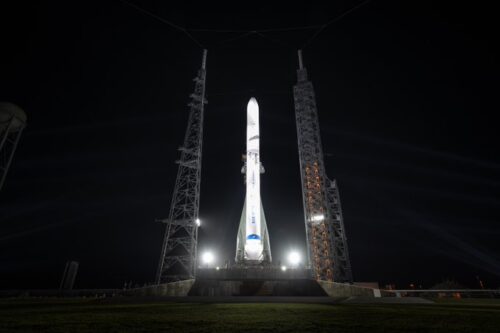
Our New Glenn vehicle successfully rolled out and upended today for the first time on the pad at Launch Complex 36 (LC-36). This milestone represents the first view of the advanced heavy-lift vehicle, which will support a multitude of customer missions and Blue Origin programs, including returning to the Moon as part of NASA’s Artemis program.
Everything on the pad is real New Glenn hardware. The upending is one in a series of major manufacturing and integrated test milestones in preparation for New Glenn’s first launch later this year. The test campaign enables our teams to practice, validate, and increase proficiency in vehicle integration, transport, ground support, and launch operations. These tests do not require engines, which are hotfiring at the historic 4670 Test Stand in Huntsville and Launch Site One in West Texas.
A view of the first fully stacked New Glenn vehicle raised at Launch Complex 36. It will undergo a series of tanking and mechanical system tests. Credits: Blue Origin
The announcement goes on to say:
The tests will demonstrate cryogenic fluid loading, pressure control, and the venting system
The launch pad and ground systems are complete and will be activated for the first time
The reusable first stage is designed for a minimum of 25 missions
The stage will land on a sea-based platform located about 620 miles (1,000 km) downrange.
More about preparations underway for getting New Glenn off the ground.
—- Testing of the BE-4 engines for the New Glenn rocket:
A louder rumble in Rocket City! We just completed our first BE-4 engine hotfire test at the historic Test Stand 4670 in Huntsville. We also continue to test BE-4 engines at our Texas facility. The BE-4 engine produces 550,000 pounds of thrust and is our most powerful engine yet. pic.twitter.com/iyLb3p67PE
“12 docking ports, each able to accommodate payloads weighing up to 500 kilograms“
Can hold “payloads weighing up to two and a half tons“
“offers 3,000 meters per second of delta V, or change in velocity, to maneuver to different orbits“
Can deliver payloads to particular orbits and can also host a payload, providing it with services such as power, communications, etc.
Can act as a refueling depot since it is re-fuelable and can also refuel other spacecraft
** Sierra Space – Vulcan launch of Tenacity, first Dream Chaser cargo vehicle, expected by summer
The successful launch of the first ULA Vulcan expendable rocket on January 8th sets up the countdown to the first launch of the reusable Dream Chaser lifting-body vehicle by late spring or early summer of this year. The Dream Chaser won a NASA contract for seven flights of cargo to the ISS. As with the SpaceX Dragon, Dream Chasers can also return cargo to the ground, unlike the single-use Northrop Grumman Cygnus cargo carrier that burns up on reentry.
The Dream Chaser is currently in preparation for tests to insure it can survive the vibrations of launch:
A video about the testing: Sierra Space’s Dream Chaser Spaceplane at NASA’s Armstrong Test Facility in Ohio –Sierra Space
The stage is set for the reveal of Dream Chaser in full launch configuration atop the world’s largest vibration table at NASA’s Armstrong Test Facility in Ohio. More to come.
Rocket Lab’s recent launch of an Electron two stage rocket included the successful recovery of the first stage. The stage returned via parachute to a soft landing onto the ocean where it floated until lifted into a recovery vessel. The company has recovered first stages on some previous missions but has not yet reused a stage. However, an engine has flown twice.
The ‘Four Of A Kind’ mission for Spire’s customer NorthStar successfully launched from Rocket Lab Launch Complex 1 in New Zealand at 19:34 NZDT / 06:34 UTC. Rocket Lab’s Electron rocket deployed four Space Situational Awareness (SSA) satellites to a 530km circular Earth orbit where the satellites, built and operated by Spire, will monitor near-Earth objects from space to provide timely and precise information for space object detection, tracking, orbit determination, collision avoidance, navigation, and proximity alerts. The mission was Rocket Lab’s 43rd Electron launch overall, bringing the Company’s record of successfully deployed satellites to 176. The mission was the first of a busy launch year for Rocket Lab, with the Company scheduled to launch more in 2024 than any previous year since the Company began missions in 2017.
The mission also resulted in the successful return of the rocket’s first stage after launch as part of Rocket Lab’s plan to evolve Electron into a reusable rocket. After launch and stage separation, Electron’s booster made its way back to Earth under a parachute and splashed down in the Pacific Ocean at approximately 17 minutes post lift-off. Rocket Lab’s recovery operations are currently underway to retrieve the stage and bring it back to the Company’s production complex for a post-launch review and analysis before proceeding to one of the program’s final tasks: reusing a previously-launched first stage on a future mission.
Note that the small first stage for the Electron does not use propulsive braking on its return. Surviving the fall from high altitude relies instead on a layer of thermal protection as it heats up from the air drag. The drag slows the fall to the point it can release the parachute. See the Reusable Rockets section at Rocket Lab for more details.
The first stage also tested a thermal protection panel that the company plans to use on the reusable Neutron mid-sized launcher:
Spot the difference: On our recent recovery mission, we added a sample Neutron thermal protection system (TPS) panel to Electron to see how well Neutron’s structural materials hold up on the return journey from space. Durability and reusability are critical aspects of Neutron’s… pic.twitter.com/hG7qASbz9l
The Neutron booster stage will be too large for parachute return but will have sufficient scale to enable propulsive braking similar to the SpaceX Falcon 9.
** Stoke Space – Update on development of a fully reusable vehicle.
The previous Roundup include a lengthy section on Stoke Space’s unique design of a two stage fully reusable rocket. Stoke CEO Andy Lapsa adds lots of interesting additional details in this interview with NASASpaceflight:
In this episode of NSF Live, Das will talk with Andy Lapsa, CEO of Stoke Space. Topics will include Aerospike Engines, the path to flight, the next testing milestones, and much more.
Component testing for our MethaLox Full-Flow Staged Combustion stage 1 engine is in full swing. Here, we are testing the fuel pre-burner, which powers the fuel leg of the engine. The flame is expected since it’s burning a… pic.twitter.com/eeuYnr1et6
We’ve got another big year ahead of us at Relativity. Here’s a preview of what you can expect to see in the months ahead:
Propulsion progress: Block upgrades to the design of our Aeon R engines to unlock power and performance. We’ll be testing lots of different component configurations and doing hot fires at various power levels throughout the year.
Vehicle architecture: Progressing from preliminary design review (PDR) to critical design review (CDR), getting us significantly closer to our flight-ready vehicle.
Manufacturing: How our production teams drive rapid iteration cycles. And, how we are building out our HQ to meet the production demands of Terran R at scale.
Testing: Expand our testing campaigns to dive into data collection for many of Terran R’s core elements. And yes, lots and lots more hot fire coming your way with engine testing!
Infrastructure: Continue the build-out of engine and stage test stands at NASA Stennis in Mississippi, the development of our new and improved larger launch pad at, LC-16 in Cape Canaveral, and our headquarters in Long Beach to ramp up manufacturing.
—- Two videos about engine development: Relatively Speaking: How Engines are Manufactured at Relativity
Our teams wholeheartedly embrace iteration, leveraging additive techniques for rapid engine component development. This approach accelerates our design process, leading to improved performance and unprecedented testing speed. In less than 2 years, we progressed from sizing Aeon R to completing a successful mission duty cycle, conducting over 1,000 component and subsystem tests along the way. This rapid data accumulation culminated in this month’s successful MDC.
Check out this behind the scenes look at our iterative approach to engine design from blank sheet sketches to fire breathing engines.
0:00 – 0:20 Intro: How Engines are Manufactured at Relativity 0:21– 00:44 The Benefits of Powder Bed Fusion Printing 00:43 –1:20 Unlocking Rapid Iteration 1:20 – 2:08 How Powder Bed Fusion Works 2:09 – 2:42 Powder Bed Fusion in Practice: Gas Generator Injector 2:43 – 3:33 Part Assembly Line Journey to Full Assembly 3:34 – 4:19 End: The Power of Iterative Design
Learn more about Aeon R: https://bit.ly/aeonr
—- Relatively Speaking: Aeon R Engine Explained
Taking it back chalkboard style, we’re breaking down our Aeon R engine 101 style, explaining how our Aeon R engine systems work together to create thrust. We’ll cover how each subsystem collaborates to produce blue fire.
Aeon R Engine, By the Numbers: ✔️13x engines powering Terran R ✔️258,000 lbf each, for a combined liftoff thrust of 3,354,000 lbf ✔️ High-pressure gas generator cycle ✔️ LOX/Methane propellants
0:00 – 0:34: Introduction: What is a Rocket Engine. 0:35 – 0:56: The Purpose of a Rocket: Understanding the Principle of Conservation of Momentum. 0:57 – 1:34: Understanding the Functionality of a Thrust Chamber Assembly. 1:35 – 2:31: Insight into the Operations of a Gas Generator. 2:32 – 2:55: The Crucial Role of Valves.
=== Hypersonic rocket vehicles– Long distance point-to-point
** POLARIS– Flying demonstrator Mira with aerospike engine
Polaris is a German company developing a long distance spaceplane they call AURORA. They have built a series of sub-scale demonstrators “of increasing size, mass and complexity“. So far the demonstrators have used turbojets for propulsion but the current Mira prototype also includes an aerospike rocket engine:
MIRA is a dedicated validation vehicle for in flight-demonstration and testing of linear aerospike rocket engines. Linear aerospikes form a novel class or rocket engines that offer large performance increases compared to conventional rocket engines. Flight-testing including engine in-flight ignition and operation will be conducted under a Bundeswehr/BAAINBw study contract awarded in April 2023. The first flight under turbine power was successfully conducted on 26th of October, 2023 at Peenemünde Airport. Flights under rocket-power will follow soon. Similar to ATHENA, MIRA is licensed for BVLOS operation with a telemetry range of 20 km. MIRA is also equipped with a redundant flight termination system (FTS). MIRA is the largest and most complex vehicle built and flown by POLARIS so far. The total development time from begin of vehicle design from scratch until first flight was just six and a half months.
NOVA will be the final demonstrator before the spaceplane. The main purpose is the demonstration of safe and repeatable rocket-powered supersonic flight capability at high altitudes, while fulfilling the full regulatory framework required for airport-based operation. The first flight is planned for 2024.
NOVA will be nearly 7 meters long and include four kerosene fueled jet turbines and one aerospike engine.
The Boosters for European Space Transportation (BEST!) initiative is being managed by ESA’s Space Transportation Directorate under its Future Launcher Preparatory Programme (FLPP). According to the initiative’s call, the aim of BEST! is to allow the development of new launcher architectures or the improvement of existing launch systems. That second element is an interesting addition as it goes on to state that concept studies should focus on a liquid reusable booster or a reusable first stage.
The management of Europe’s primary launch system provider, Arianespace, disputed the need for reusability when selecting the design for Ariane 6, the successor to its Ariane 5 workhorse expendable rocket. However, the success of Falcon 9 in lowering space access costs and attracting most of the available payload market has forced Arianespace to begin several projects involving development of reusable rockets (e.g., see next item about MaiaSpace). The BEST! initiative looks to be another source of funding for Arianespace’s reusability program:
The phrasing of “liquid reusable booster” and the fact that the programme will potentially be aimed at existing launch systems suggests that this may be part of an Ariane 6 evolution. If this is not one of the direct aims of the initiative, ArianeGroup will certainly be in a position to utilize BEST! as a means to fund, at least partially, the transfer of the knowledge gained during the ongoing development of the reusable booster demonstrator Themis to an evolved Ariane 6 variant.
** MaiaSpace– Developing a partially reusable microlauncher
ArianeSpace created the subsidiary MaiaSpace to develop a low cost launcher with a reusable first stage that can deliver up to 3 tonnes to low earth orbit. The first stage will be powered by the Prometheus® engine, an ESA and ArianeGroup engine that uses liquid Methane and LOX propellants. The booster will land on a sea platform similar to the Falcon 9.
The goal is to fly the first orbital mission by the end of 2025.
** PLD Space– Gains in funding for MIURA 5 medium lifter
PLD Space had a successful first launch last year of the MIURA 1 suborbital rocket. The lessons learned from this test will apply to development of MIURA 5, an orbital two stage rocket whose first stage will return via parachute for recovery and reuse. They aim for an initial launch of MIURA 5 in 2025.
The contract signed today by ESA and PLD Space supports the Miura 5 launch service development by co-funding to the value of €1.3 million to develop a modular, customisable, payload accommodation system. Designed to release all types of satellites with as much flexibility as possible, the payload system – called MOSPA for Modular Solution for Payload Adapter – will allow PLD Space to offer its customers a wider range of missions and services, including accommodation of CubeSats, nanosatellites and microsatellites. The development of the modular payload adapter will be done in partnership with OCCAM Space.
The European Space Agency (ESA) started a project in 2023 to sponsor commercial development and operation of a craft to take and return cargo to the ISS and other future space stations in low earth orbit. The program is clearly inspired by the success of NASA’s commercial cargo program, which includes vehicles operated by SpaceX, Northrop Grumman, and Sierra Space.
Proposals will be submitted this month. The goal is for a demonstration mission by 2028.
The reusable Nyx spacecraft from the Exploration Company is one design that meets the requirement to take a minimum of 4000 kilograms to LEO and bring 2000 kilograms back to earth.
BOOM: Chinese Zhuque-3 rocket challenges SpaceX with successful hop test – PointOrView
BIG BREAKING: Here comes another Chinese private firm challenging SpaceX with successful hop test to achieve reusability of rockets. China’s Landspace conducts first vertical takeoff, vertical landing (VTVL) test for reusable stainless steel rocket. Chinese launch startup Landspace executed a first vertical takeoff, vertical landing with a test article Friday at a launch and recovery site at Jiuquan spaceport.
The Zhuque-3 VTVL-1 reusable vertical take-off and landing recovery verification rocket lifted off from Landspace facilities at Jiuquan Satellite Launch Center at 3:00 a.m. Eastern (0800 UTC), Jan. 19.
The methane-liquid oxygen test article reached an altitude of around 350 meters during its roughly 60-second flight before setting down in a designated landing area. The landing had an accuracy of about 2.4m and a landing speed of about 0.75m/second, according to Landspace.
The test is part of the development of the stainless steel Zhuque-3 rocket first announced in November 2023. The company is aiming for the first flight of Zhuque-3 in 2025. The company earlier planned to execute this first VTVL test last month.
The funds will be used for research and development of its first liquid propellant rocket. The 60-meter-tall, 4.2-meter-diameter Gravity-2 will use nine 100-ton-thrust Yuanli-85 gas generator, variable thrust kerosene engines for the first stage and be supported by solid boosters. The first stage is planned to be reusable.
On January 31, Tianhui Aerospace successfully completed the first complete ignition test of its independently developed 85-ton staged combustion pumping cycle liquid oxygen kerosene engine ‘Qiaolong No. 1’ at the Tongchuan test base. “
On January 31, the 85-ton staged combustion pumping cycle liquid oxygen kerosene engine “Qiaolong No. 1” independently developed by Tianhui Aerospace successfully completed the complete engine ignition test at the Tongchuan test base. This ignition verified the correctness of the ignition and shutdown timing of the entire engine system. It also verified the advantages of the new staged combustion extraction cycle engine using structural fusion design…
The engines would be provided for the rockets of other companies as well as Space Circling’s own reusable vehicles:
The Huilong-1 would have a length of 38 meters, a 3.35-meter-diameter core stage and 2.25-meter-diameter boosters. It is to be capable of lifting five metric tons to sun-synchronous orbit.
The larger Huilong-2 would be capable of carrying nine tons to geosynchronous transfer orbit or 25 tons to LEO.
** Other Chinese reusable rocket developers:
CASC (China Aerospace Science and Technology Corp) – China’s primary space agency
=== Reusable suborbital rocket vehicles for tourism, science & technology
** Suborbital is worth the effort…
Back in 1990s and early 2000s, many advocates for entrepreneurial commercial space development promoted a step-by-step approach that could provide a viable path to low cost orbital space transports. This would require less capital to start with and the revenue generated along the way would sustain the startups as they developed increasingly capable vehicles.
In particular, we hailed the development of reusable suborbital rockets (e.g. see my Space Review article from 2003) and the introduction of prizes like the $10M Ansari X PRIZE, won in 2003 by the Burt Rutan’s SpaceShipOne project, and NASA’s Centennial Challenges.
SpaceX became a success despite skipping the suborbital spaceflight option (except for the Grasshopper test flights) and prize competitions. Elon and NASA supplied sufficient capital to enable SpaceX to go a more direct route to orbit. However, these approaches did benefit other NewSpace participants.
Blue Origin is using the lessons learned from their reusable suborbital New Shepard (see next item) for development of the New Glenn booster :
Building on experience operating its reusable New Shepard suborbital launch system, Blue plans to land its New Glenn rockets beginning with the first flight. “That sounds aggressive, but it’s not,” Jones said. “Think about how many times we’ve landed New Shepard right on the dime. All of the avionics systems, flight systems and everything that we’ve learned, we’ve transferred over—even the people have all come to work for New Glenn—and so I feel pretty confident.” – Aviation Week
Note also that the New Glenn upper stage uses a vacuum version of the BE-3 engine that powers the New Shepard. The multiple test flights of New Shepard will no doubt contribute to making the New Glenn propulsion system more reliable.
A New Shepard rocket booster failed during an uncrewed flight on Sept. 12, 2022. The capsule fired its emergency abort motor and successfully separated from the booster and landed with its science and technology payloads undamaged. The investigation found
the direct cause of the mishap to be a structural fatigue failure of the BE-3PM engine nozzle during powered flight. The structural fatigue was caused by operational temperatures that exceeded the expected and analyzed values of the nozzle material.
Blue Origin implemented
corrective actions, including design changes to the combustion chamber and operating parameters, which have reduced engine nozzle bulk and hot-streak temperatures. Additional design changes to the nozzle have improved structural performance under thermal and dynamic loads.
The flight carried 33 payloads from NASA, academia, research institutions, and commercial companies, bringing the number of payloads flown on New Shepard to more than 150. Club for the Future, Blue Origin’s nonprofit, flew 38,000 postcards as part of its Postcards to Space program.
The long delay before resuming flights led to some speculation that Blue might end its suborbital program so as to focus more resources on development of its New Glenn orbital rocket (see above). However, company management express support for New Shepard following the successful NS-24 flight:
Demand for New Shepard flights continues to grow and we’re looking forward to increasing our flight cadence in 2024.
On January 26th, Virgin Galactic successfully flew the VSS Unity spacecraft on
its first spaceflight of 2024 and 11th mission to date. Today’s ‘Galactic 06’ flight marked the first time all four seats aboard VSS Unity were occupied by private astronauts.
Following the flight, Virgin Galactic discovered that a pin used in the attachment of the SpaceShipTwo to the carrier aircraft had fallen out at some point after the spacecraft had detached. This had no affect on the rocket plane, which successfully completed its mission:
Assuming no major delay from this problem, the company’s next mission is planned for the second quarter of 2024 and “will include both a researcher and private astronauts“.
In November of 2023 the company announced that it would reduce flights from monthly to quarterly in 2024. This would release additional funding for the development of the Delta class ships. (See Q3 2023 Earnings presentation – Nov.8.2023 (pdf).)
The next-gen Delta vehicles will be more robust than the current VSS Unity model. Deltas will fly up to two times per week versus once per month for Unity. The Deltas will fly with 6 customers versus the current maximum of 4. At the expected prices of $450k per person or $600k per seat for research flights, monthly revenues could reach close to $30M, which is more that 10 times the current max income.
The goal is to begin testing the Delta ships in 2025 and then start commercial flights in 2026. A new carrier mothership would be built after the ramp up of the Delta fleet.
=== Other reusable rocket and space vehicle related news:
This artist’s impression shows the magnetic white dwarf WD 0816-310, where astronomers have found a scar imprinted on its surface as a result of having ingested planetary debris. When objects like planets or asteroids approach the white dwarf they get disrupted, forming a debris disc around the dead star. Some of this material can be devoured by the dwarf, leaving traces of certain chemical elements on its surface. Using ESO’s Very Large Telescope, astronomers found that the signature of these chemical elements changed periodically as the star rotated, as did the magnetic field. This indicates that the magnetic fields funneled these elements onto the star, concentrating them at the magnetic poles and forming the scar seen here.
When a star like our Sun reaches the end of its life, it can ingest the surrounding planets and asteroids that were born with it. Now, using the European Southern Observatory’s Very Large Telescope (ESO’s VLT) in Chile, researchers have found a unique signature of this process for the first time — a scar imprinted on the surface of a white dwarf star. The results are published today in The Astrophysical Journal Letters.
“It is well known that some white dwarfs — slowly cooling embers of stars like our Sun — are cannibalising pieces of their planetary systems. Now we have discovered that the star’s magnetic field plays a key role in this process, resulting in a scar on the white dwarf’s surface,”
says Stefano Bagnulo, an astronomer at Armagh Observatory and Planetarium in Northern Ireland, UK, and lead author of the study.
The scar the team observed is a concentration of metals imprinted on the surface of the white dwarf WD 0816-310, the Earth-sized remnant of a star similar to, but somewhat larger than, our Sun.
“We have demonstrated that these metals originate from a planetary fragment as large as or possibly larger than Vesta, which is about 500 kilometres across and the second-largest asteroid in the Solar System,”
says Jay Farihi, a professor at University College London, UK, and co-author on the study.
The observations also provided clues to how the star got its metal scar. The team noticed that the strength of the metal detection changed as the star rotated, suggesting that the metals are concentrated on a specific area on the white dwarf’s surface, rather than smoothly spread across it. They also found that these changes were synchronised with changes in the white dwarf’s magnetic field, indicating that this metal scar is located on one of its magnetic poles. Put together, these clues indicate that the magnetic field funneled metals onto the star, creating the scar [1].
“Surprisingly, the material was not evenly mixed over the surface of the star, as predicted by theory. Instead, this scar is a concentrated patch of planetary material, held in place by the same magnetic field that has guided the infalling fragments,”
says co-author John Landstreet, a professor at Western University, Canada, who is also affiliated with the Armagh Observatory and Planetarium.
“Nothing like this has been seen before.”
To reach these conclusions, the team used a ‘Swiss-army knife’ instrument on the VLT called FORS2, which allowed them to detect the metal scar and connect it to the star’s magnetic field.
“ESO has the unique combination of capabilities needed to observe faint objects such as white dwarfs, and sensitively measure stellar magnetic fields,”
says Bagnulo. In their study, the team also relied on archival data from the VLT’s X-shooter instrument to confirm their findings.
Harnessing the power of observations like these, astronomers can reveal the bulk composition of exoplanets, planets orbiting other stars outside the Solar System. This unique study also shows how planetary systems can remain dynamically active, even after ‘death’.
Notes
[1] Previously, astronomers have observed numerous white dwarfs polluted by metals that were scattered over the surface of the star. These are known to originate from disrupted planets or asteroids that veer too close to the star, following star-grazing orbits similar to those of comets in our Solar System. However, for WD 0816-310, the team is confident that vaporised material was ionised and guided onto the magnetic poles by the white dwarf’s magnetic field. The process shares similarities to how auroras form on Earth and on Jupiter.
Here is this week’s selection of videos and news items about space habitats, living in space, and space settlement. Starts with NASA’s latest Space to Ground report for the International Space Station:
The Progress MS-26 spacecraft autonomously docked to the aft port of the Zvezda service module, on the International Space Station, on 17 February 2024, at 06:06 UTC (01:06 EST). Progress MS-26 (ISS Progress 87 mission) delivers about three tons of food, fuel and supplies for the Expedition 70 crew aboard the International Space Station. Credit: NASA/Roscosmos Music: “Waltz of the Flowers by Tchaikovsky” courtesy of YouTube Audio Library
** Using a VR headset on space station – Astronaut describes experience –VideoFromSpace
Expedition 70 astronaut Andreas Mogensen describes the experience of using a VR headset while exercising on the International Space Station to Space.com’s Elizabeth Howell.
** Expedition 70 Astronaut Satoshi Furukawa Answers Japanese Media Questions Feb. 20, 2024 –NASA Video
Aboard the International Space Station, Expedition 70 Flight Engineer Satoshi Furukawa of JAXA (Japan Aerospace Exploration Agency) discussed living and working in space with Japanese reporters during an in-flight interview Feb. 20. Furukawa is in the midst of a long-duration mission on the microgravity laboratory to advance scientific knowledge and demonstrate new technologies for future human and robotic exploration missions.
** 2023 Annual Highlights of Results from the International Space Station – NASA Johnson
The International Space Station is a microgravity research lab hosting groundbreaking technology demonstrations and scientific investigations. More than 3,700 investigations conducted to date have generated more than 4,000 research articles published in scientific journals. In 2023, the orbiting lab hosted approximately 500 investigations. See more space station research achievements and findings in the Annual Highlights of Results publication at https://www.nasa.gov/stationresults.
** Axiom Space– Progress on assembly of the first habitat module.
Thales Alenia in Italy is building the structures for the habitat modules that Axiom will initially attach to the ISS and later detach to become a free-flying space station owned and operated by Axiom. Here is a recent item about a milestone in assembly of the first module:
The welding of the forward cone to the cylinder bulkhead marks a significant evolution of the primary structure of Ax- H1, @Axiom_Space‘s first module.
Check out the stunning operations set up by our team in #Turin to prepare for this milestone.#spaceforlife#BuildingForBeyondpic.twitter.com/oHOLVGnEk0
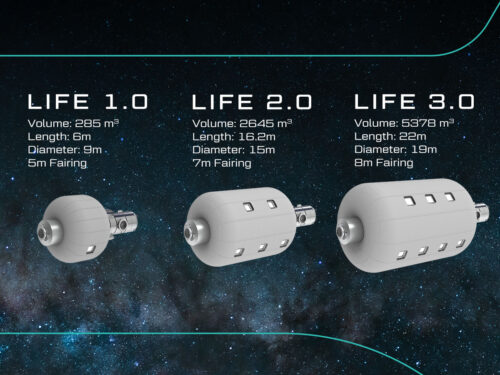
We are developing and testing “game changing softgoods expandable technology” that leverages the ability to “pack and compress” softgoods structures at launch, then deploy to utilize maximum volume for on orbit operations.
2024-20-02: We are developing and testing “game changing softgoods expandable technology” that leverages the ability to “pack and compress” softgoods structures at launch, then deploy to utilize maximum volume for on orbit operations.
These technology advancements provide “low mass to volume ratios” that are unmatched in the industry. Other habitation providers rely on larger and more powerful rockets with increased fairing envelopes to reach our inflated volumes
We can launch packed and deploy to an average 625% volume increase once pressurized in orbit, offering more on orbit capacity at a reduced size and mass.
We look forward to further developing this technology as we build the world’s first commercial space station.
It’s been pointed out that rotating the LIFE 3.0 module, which would fit into the SpaceX Starship at 8 meters before expanding to 19 meters when deployed, around the long axis at a 4-6 times per minute could provide spin gravity at a potentially beneficial fraction (15-35%) of one g.
** VAST – Planning private crew missions to the ISS
Axiom recently completed its third private crew mission to the ISS. These provide the company with revenue as well as technical experience as it prepares to launch its own space habitats in the coming years. VAST, another space habitat company, announced this week that it also aims to sponsor private ISS missions. NASA requires payment for such missions and allows only a limited number per year. So the two companies will need to compete for contracts with the agency.
Vast is excited to announce that we will compete to offer NASA private astronaut missions to the ISS. Diversity of providers will enhance competition and give customers more options. It will also help transfer critical ISS expertise from NASA to more potential commercial LEO… https://t.co/rP9RZbT5rt
** Chinese Astronaut Captures Breathtaking Views of Egypt, Red Sea from Space – CCTV Video News Agency
China Manned Space Agency on Tuesday released a bird’s eye view of Egypt and the Red Sea taken by astronaut Tang Shengjie who is currently on-board China’s space station.
** Highlight: Snow over the Pyrenees across Spain to Barcelona. Feb 20, 2024 11:45 CET – ISS Above
NASA EHDC6 Live views of the Earth from the International Space Station
— Highlight: Dallas TX – Deb 21, 2024 11:46 CST – ISS Above
** Live Video from the International Space Station (Official NASA Stream) – NASA
Watch live video from the International Space Station, including inside views when the crew aboard the space station is on duty. Views of Earth are also streamed from an external camera located outside of the space station. During periods of signal loss due to handover between communications satellites, a blue screen is displayed.
The space station orbits Earth about 250 miles (425 kilometers) above the surface. An international partnership of five space agencies from 15 countries operates the station, and it has been continuously occupied since November 2000. It’s a microgravity laboratory where science, research, and human innovation make way for new technologies and research breakthroughs not possible on Earth. More: https://go.nasa.gov/3CkVtC8
Did you know you can spot the station without a telescope? It looks like a fast-moving star, but you have to know when to look up. Sign up for text messages or email alerts to let you know when (and where) to spot the station and wave to the crew: https://spotthestation.nasa.gov