ESO: Supermassive Black Holes Feed on Cosmic Jellyfish

The lastest report from ESO (European Southern Observatory):

Supermassive Black Holes Feed on Cosmic Jellyfish
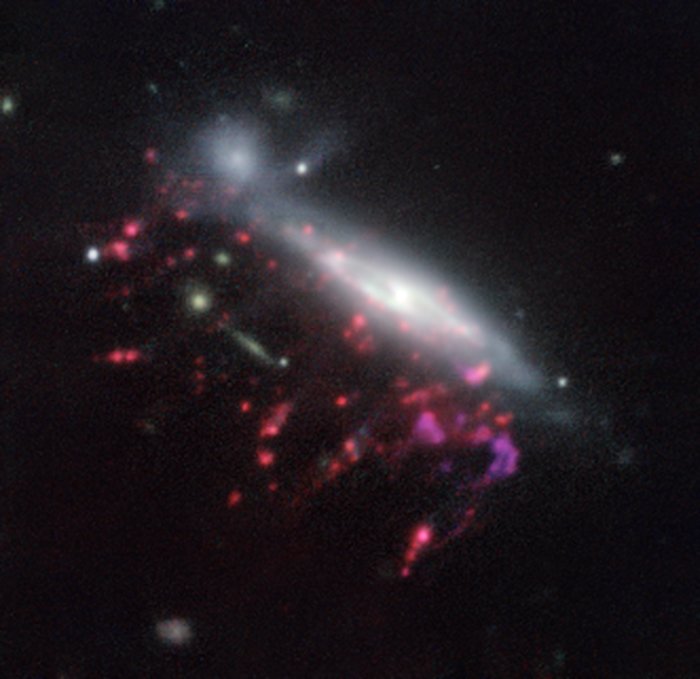
Observations of “Jellyfish galaxies” with ESO’s Very Large Telescope have revealed a previously unknown way to fuel supermassive black holes. It seems the mechanism that produces the tentacles of gas and newborn stars that give these galaxies their nickname also makes it possible for the gas to reach the central regions of the galaxies, feeding the black hole that lurks in each of them and causing it to shine brilliantly. This picture of one of the galaxies, nicknamed JO204, from the MUSE instrument on ESO’s Very Large Telescope in Chile, shows clearly how material is streaming out of the galaxy in long tendrils to the lower-left. Red shows the glow from ionised hydrogen gas and the whiter regions are where most of the stars in the galaxy are located. Some more distant galaxies are also visible. [Larger images]
Observations of “Jellyfish galaxies” with ESO’s Very Large Telescope have revealed a previously unknown way to fuel supermassive black holes. It seems the mechanism that produces the tentacles of gas and newborn stars that give these galaxies their nickname also makes it possible for the gas to reach the central regions of the galaxies, feeding the black hole that lurks in each of them and causing it to shine brilliantly. The results appeared today in the journal Nature.

Observations of “Jellyfish galaxies” with ESO’s Very Large Telescope have revealed a previously unknown way to fuel supermassive black holes. It seems the mechanism that produces the tentacles of gas and newborn stars that give these galaxies their nickname also makes it possible for the gas to reach the central regions of the galaxies, feeding the black hole that lurks in each of them and causing it to shine brilliantly. This quick video explains the main points.

An Italian-led team of astronomers used the MUSE (Multi-Unit Spectroscopic Explorer) instrument on the Very Large Telescope (VLT) at ESO’s Paranal Observatory in Chile to study how gas can be stripped from galaxies. They focused on extreme examples of jellyfish galaxies in nearby galaxy clusters, named after the remarkable long “tentacles” of material that extend for tens of thousands of light-years beyond their galactic discs [1][2].
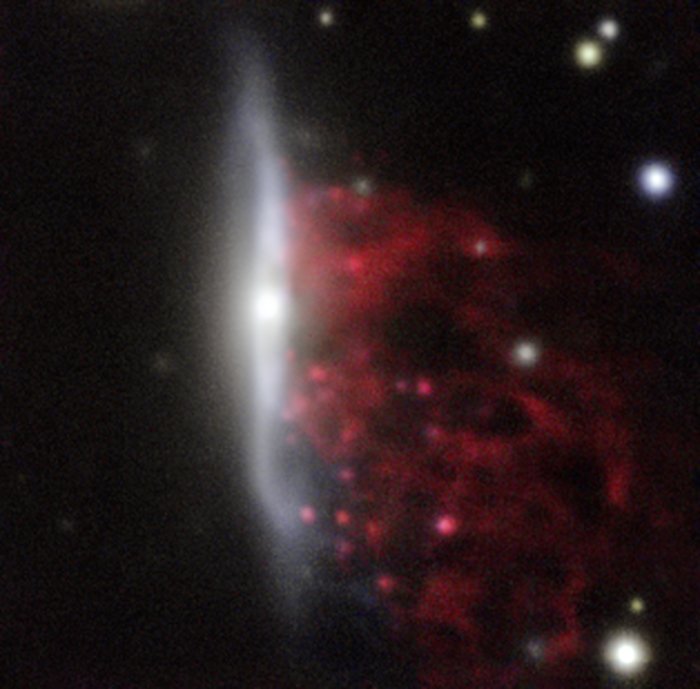
Observations of “Jellyfish galaxies” with ESO’s Very Large Telescope have revealed a previously unknown way to fuel supermassive black holes. It seems the mechanism that produces the tentacles of gas and newborn stars that give these galaxies their nickname also makes it possible for the gas to reach the central regions of the galaxies, feeding the black hole that lurks in each of them and causing it to shine brilliantly.This picture of one of the galaxies, nicknamed JW100, from the MUSE instrument on ESO’s Very Large Telescope in Chile, shows clearly how material is streaming out of the galaxy in long tendrils. Red shows the glow from ionised hydrogen gas and the whiter regions are where most of the stars in the galaxy are located. [Larger images.]
The tentacles of jellyfish galaxies are produced in galaxy clusters by a process called ram pressure stripping. Their mutual gravitational attraction causes galaxies to fall at high speed into galaxy clusters, where they encounter a hot, dense gas which acts like a powerful wind, forcing tails of gas out of the galaxy’s disc and triggering starbursts within it.

This visualisation shows a jellyfish galaxy in the three-dimensional view of the MUSE instrument on ESO’s Very Large Telescope. This combines the normal two-dimensional view with the third dimension of wavelength. This galaxy has undergone jam pressure stripping as it moves rapidly into the hot gas in a galaxy cluster, and streamers of gas and young stars are trailing behind it. These show up as the tentacles extending away from the galaxy as they have different velocities. A 3D interactive view of this galaxy is available. Credit: ESO/Callum Bellhouse and the GASP collaboration
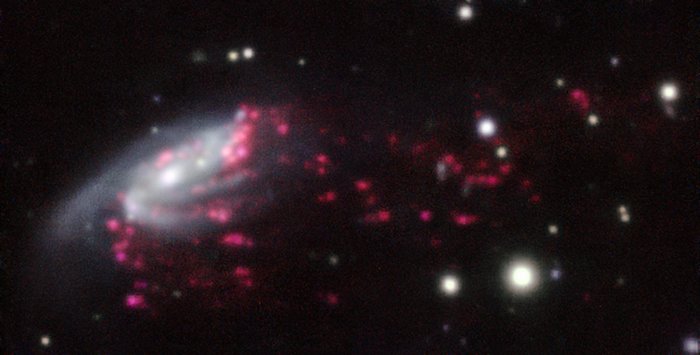
Observations of “Jellyfish galaxies” with ESO’s Very Large Telescope have revealed a previously unknown way to fuel supermassive black holes. It seems the mechanism that produces the tentacles of gas and newborn stars that give these galaxies their nickname also makes it possible for the gas to reach the central regions of the galaxies, feeding the black hole that lurks in each of them and causing it to shine brilliantly.This picture of one of the galaxies, nicknamed JW206, from the MUSE instrument on ESO’s Very Large Telescope in Chile, shows clearly how material is streaming out of the galaxy in long tendrils. Red shows the glow from ionised hydrogen gas and the whiter regions are where most of the stars in the galaxy are located. [Larger images]

Six out of the seven jellyfish galaxies in the study were found to host a supermassive black hole at the centre, feeding on the surrounding gas [3]. This fraction is unexpectedly high — among galaxies in general the fraction is less than one in ten.

This strong link between ram pressure stripping and active black holes was not predicted and has never been reported before,” said team leader Bianca Poggianti from the INAF-Astronomical Observatory of Padova in Italy. “It seems that the central black hole is being fed because some of the gas, rather than being removed, reaches the galaxy centre.” [4]

This artist’s illustration shows a spiral galaxy falling into a galaxy cluster. The galaxy is undergoing a process known as ram pressure stripping, where streaks of bright gas are being dragged out into space by the diffuse hot gas that it is moving through. Credit: NASAESA, and M. Kornmesser Acknowledgements: Ming Sun (UAH) and Serge Meunier

A long-standing question is why only a small fraction of supermassive black holes at the centres of galaxies are active. Supermassive black holes are present in almost all galaxies, so why are only a few accreting matter and shining brightly? These results reveal a previously unknown mechanism by which the black holes can be fed.

Yara Jaffé, an ESO fellow who contributed to the paper explains the significance: “These MUSE observations suggest a novel mechanism for gas to be funnelled towards the black hole’s neighbourhood. This result is important because it provides a new piece in the puzzle of the poorly understood connections between supermassive black holes and their host galaxies.

The current observations are part of a much more extensive study of many more jellyfish galaxies that is currently in progress.

This survey, when completed, will reveal how many, and which, gas-rich galaxies entering clusters go through a period of increased activity at their cores,” concludes Poggianti. “A long-standing puzzle in astronomy has been to understand how galaxies form and change in our expanding and evolving Universe. Jellyfish galaxies are a key to understanding galaxy evolution as they are galaxies caught in the middle of a dramatic transformation.

This visualisation shows a jellyfish galaxy in the three-dimensional view of the MUSE instrument on ESO’s Very Large Telescope. This combines the normal two-dimensional view with the third dimension of wavelength. This galaxy has undergone ram pressure stripping as it moves rapidly into the hot gas in a galaxy cluster, and streamers of gas and young stars are trailing behind it. These show up as the tentacles extending away from the galaxy as they have different velocities. A 3D interactive view of this galaxy is available. Credit: ESO/Callum Bellhouse and the GASP collaboration

Notes

[1] To date, just over 400 candidate jellyfish galaxies have been found.

[2] The results were produced as part of the observational programme known as GASP (GAs Stripping Phenomena in galaxies with MUSE), which is an ESO Large Programme aimed at studying where, how and why gas can be removed from galaxies. GASP is obtaining deep, detailed MUSE data for 114 galaxies in various environments, specifically targeting jellyfish galaxies. Observations are currently in progress.

[3] It is well established that almost every, if not every, galaxy hosts a supermassive black hole at its centre, between a few million and a few billion times as massive as our Sun. When a black hole pulls in matter from its surroundings, it emits electromagnetic energy, giving rise to some of the most energetic of astrophysical phenomena: active galactic nuclei (AGN).

[4] The team also investigated the alternative explanation that the central AGN activity contributes to stripping gas from the galaxies, but considered it less likely. Inside the galaxy cluster, the jellyfish galaxies are located in a zone where the hot, dense gas of the intergalactic medium is particularly likely to create the galaxy’s long tentacles, reducing the possibility that they are created by AGN activity. There is therefore stronger evidence that ram pressure triggers the AGN and not vice versa.

Video: TMRO Orbit.29 – 2017 Solar Eclipse

The latest TMRO.tv live program is now in the archive: 2017 Solar Eclipse – Orbit 10.29 – TMRO

Dr. Madhulika (Lika) Guhathakurta, NASA’s Lead Scientist for the 2017 Solar Eclipse joins us to talk about the upcoming eclipse, the Sun and solar weather. For more information on the eclipse and information on how you can do citizen science head over to NASA’s eclipse website at eclipse2017.nasa.gov

Space news reviewed:

  • New Horizons Next Target, 2014 MU69, Surprises In Study
  • Commercial Crew Updates: One Year Away Edition
  • Most Accurate Measurement Of Dark Matter Distribution Yet
  • Two new Companies to launch rockets from balloons

TMRO is viewer supported:

TMRO:Space is a crowd funded show. If you like this episode consider contributing to help us to continue to improve. Head over to http://www.patreon.com/tmro for information plus our all new goals and reward levels

Videos: SpaceX rocket launches Dragon cargo ship and booster returns for landing

A SpaceX Falcon 9 rocket launched today and put a Dragon cargo spacecraft on track to berth with the International Space Station on Wednesday morning. The first stage booster of the Falcon 9 came down for a successful landing back at Cape Canaveral. Here are a couple of videos showing the launch and the booster return (note the sonic booms just after landing):

SpaceX is reaching a launch rate of about two per month. Plus, United Launch Alliance launches an Atlas V or Delta IV rocket once a month or so as well. So when you scheduled your next Florida vacation trip, you might check a launch schedule to see if you can overlap with an upcoming liftoff.

The Space Show this week – Aug.14.2017

The guests and topics of discussion on The Space Show this week:

1. Monday, August 14, 2017: 2:15 pm -3:30 pm PDT (5:15 pm-6:30 pm EDT, 4:15 pm-5:30 pm CDT): Dr. Franklin Chang Diaz and Dr. Erik Seedhouse talk about Ad Astra Rocket Company, the VASIMR propulsion system, and Erik’s new book, To Mars and Beyond, Fast!: How Plasma Propulsion Will Revolutionize Space Exploration.

2. Tuesday, August 15, 2017: 7-8:30 pm PDT, 10-11:30 pm EDT, 9-10:30 pm CDT: We welcome back Gary Hudson of the Space Studies Institute.

3. Wednesday, August 16, 2016:: Hotel Mars. See Upcoming Show Menu and the website newsletter for details.

4. SPECIAL TIME: Friday, August 18, 2017; 7 pm PDT, (10 pm EDT; 9 pm CDT): OPEN LINES. All space and STEAM calls welcome. First time callers welcome. Let’s see how a Friday evening Open Lines show works on TSS!

5. Sunday, August 20, 2017: 12-1:30 PM DST (3-4:30 pm EDT, 2-3:30 pm CDT): We welcome back noted author Sharon Weinberger to discuss her new book on DARPA, The Imagineers of War: The Untold Story of DARPA, the Pentagon Agency That Changed the World.

See also:
* The Space Show on Vimeo – webinar videos
* The Space Show’s Blog – summaries of interviews.
* The Space Show Classroom Blog – tutorial programs

The Space Show is a project of the One Giant Leap Foundation.

The Space Show - David Livingston
David Livingston

Video: “A World Unveiled: Cassini at Titan”

The Cassini-Huygens mission ends on September 15th when the Cassini spacecraft will plunge into Saturn’s atmosphere. Looking back on the 13 years of exploring the Saturn system, the discoveries about Titan, on which the Huygens probe landed, were among the richest of the whole program: Cassini: The Grand Finale: Cassini Prepares to Say Goodbye to a True Titan

Saturn’s giant, hazy moon Titan has been essential to NASA’s Cassini mission during its 13 thrilling years of exploration there. Cassini and the European Huygens probe have revealed a fascinating world of lakes and seas, great swaths of dunes, and a complex atmosphere with weather – with intriguing similarities to Earth. Titan has also been an engine for the mission, providing gravity assists that propelled the spacecraft on its adventures around the ringed planet. For more about the Cassini-Huygens mission, visit https://saturn.jpl.nasa.gov

Over the course of its 13-year mission at Saturn, Cassini has made 127 close flybys of Titan, with many more-distant observations. Cassini also dropped off the European Space Agency’s Huygens probe, which descended through Titan’s atmosphere to land on the surface in January 2005.

Successes for Cassini during its mission include the revelation that, as researchers had theorized, there were indeed bodies of open liquid hydrocarbons on Titan’s surface. Surprisingly, it turned out Titan’s lakes and seas are confined to the poles, with almost all of the liquid being at northern latitudes in the present epoch. Cassini found that most of Titan has no lakes, with vast stretches of linear dunes closer to the equator similar to those in places like Namibia on Earth. The spacecraft observed giant hydrocarbon clouds hovering over Titan’s poles and bright, feathery ones that drifted across the landscape, dropping methane rain that darkened the surface. There were also indications of an ocean of water beneath the moon’s icy surface.

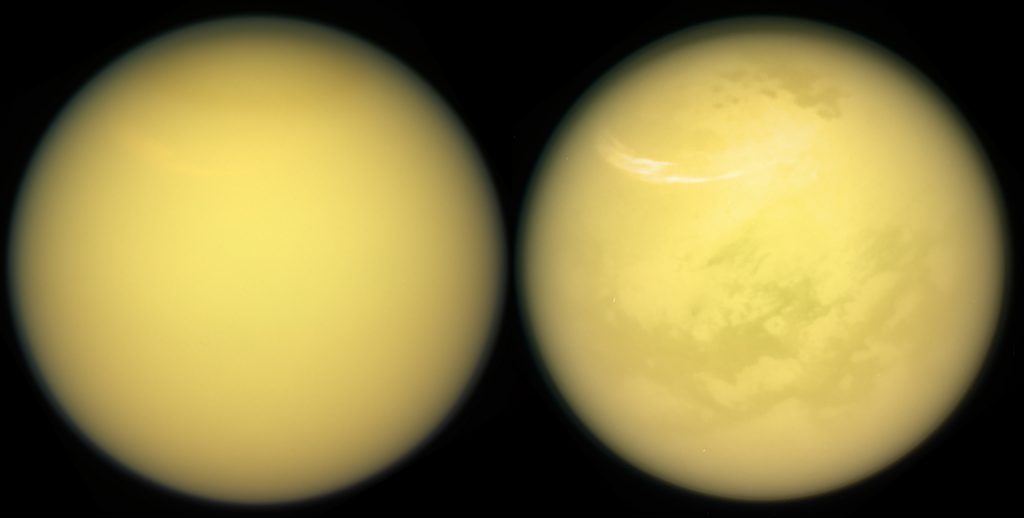
The instruments on Cassini allowed for seeing Titan in different ways: Cassini: The Grand Finale: Two Titans

These views were obtained with the Cassini spacecraft narrow-angle camera on March 21, 2017. Images taken using red, green and blue spectral filters were combined to create the natural-color view at left. The false-color view at right was made by substituting an infrared image (centered at 938 nanometers) for the red color channel.

These two views of Saturn’s moon Titan exemplify how NASA’s Cassini spacecraft has revealed the surface of this fascinating world. > Full image and caption

More about the final days of Cassini: Cassini: The Grand Finale: Cassini to Begin Final Five Orbits Around Saturn.

====