Video: TMRO 9.33 – The beautiful data of rocket launches

The latest TMRO.tv live program is now available on line: The beautiful data of rocket launches – TMRO

We are joined by Declan Murphy of http://www.flightclub.io — Flight club is an innovative and nerdy way to look at rocket launch data to understand where the rocket is and the different characteristics of its flight.

News topics discussed:

* Boeing delays CST-100 by 6 months, consequences loom
* The Universe Contains 10-20 Times The Number of Galaxies We Expected
* Obama support for Mars sparks new incentives for ISS
* Astronomers Are Preparing to Study the Epoch of Reionization
* Boeing says they can beat SpaceX to Mars, here’s How
* The Most Mysterious Star in the Milky Way Gets Even Weirder

TMRO is viewer supported:

TMRO:Space is a crowd funded show. If you like this episode consider contributing to help us to continue to improve. Head over to http://www.patreon.com/tmro for information, goals and reward levels. Don’t forget to check out our SpacePod campaign as well over at http://www.patreon.com/spacepod
Video: Interplanetary Track at the White House Frontiers Conference

Last Thursday, President Obama and the White House held The Frontiers Conference in Pittsburgh, Pennsylvania. The conference was

a national convening co-hosted with the University of Pittsburgh and Carnegie Mellon University to explore the future of innovation here and around the world …

The conference [focused] on building U.S. capacity in science, technology, and innovation, and the new technologies, challenges, and goals that will continue to shape the 21st century and beyond.

Here is a video of the Interplanetary track, in which participants from industry and academia discussed the future of space development and space science exploration:

====

Videos: “SpaceX Look Up”

A couple of inspiring videos:

https://youtu.be/CgBZg74JUyo

https://youtu.be/xB1etfHySQ4


Webcast coverage of the ExoMars arrival at the Red Planet

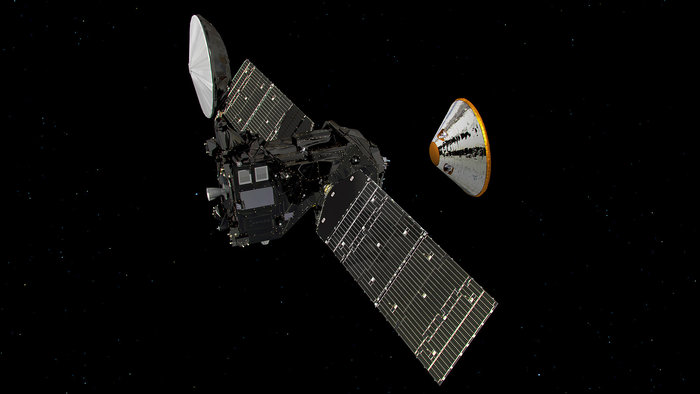
The European/Russian ExoMars mission is nearing the Red Planet. The spacecraft consists of two parts: the Trace Gas Orbiter (TGO) and the Schiaparelli lander. On Sunday, Oct. 16th the two will separate and on Wednesday, Oct. 19th the TGO will go into orbit and Schiaparelli will make its landing.

exomars_2016_separation_node_full_image_21
Artist’s impression visualising the separation of the ExoMars entry, descent and landing demonstrator module, Schiaparelli, from the Trace Gas Orbiter (TGO). The separation is scheduled to occur on 16 October 2016, about seven months after launch. Schiaparelli is set to enter the martian atmosphere on 19 October, while TGO will enter orbit around Mars.

Webcasts reports will cover the events on both days:

The Live coverage overview

16 October – spacecraft separation

In addition to text updates here and via our twitter channels, a short statement confirming the outcome of the separation will be streamed live from the main control room of ESA’s Spacecraft Operations Centre starting at 14:30 GMT / 16:30 CEST.

19 October – landing and arriving at Mars

Live coverage of ExoMars Trace Gas Orbiter arrival and Schiaparelli landing on Mars will begin with our Social TV programme via ESA’s Facebook page and Livestream 13:00–15:15 GMT / 15:00–17:15 CEST on 19 October.

The ESA TV programme will be broadcast on this page in two parts on 19 October:

15:44–16:59 GMT / 17:44–18:59 CEST
18:25–20:03 GMT / 20:25–22:03 CEST

20 October – status report and first images

A press conference is scheduled for 20 October at 08:00 GMT / 10:00 CEST, when a mission status update is expected, along with the first images from the Schiaparelli descent camera. This will also be streamed live via the player above.

For additional mission status text updates starting 14 October, see here.

====

Videos: “Space to Ground” ISS report + ISS view of hurricane Nicole

Here is this week’s episode of NASA’s Space to Ground report on activities related to the Int. Space Station:

And here is a video showing views of hurricane Nicole as seen from the ISS on Thursday:

Here is a report from Kennedy Space Center with a description of  the effects of hurricane Matthew: