ESO: A new image of “A Cosmic Rose with Many Names”

Here’s the latest report from ESO (European Southern Observatory):

A Cosmic Rose With Many Names

This new image of the rose-coloured star forming region Messier 17 was captured by the Wide Field Imager on the MPG/ESO 2.2-metre telescope at ESO’s La Silla Observatory in Chile. It is one of the sharpest images showing the entire nebula and not only reveals its full size but also retains fine detail throughout the cosmic landscape of gas clouds, dust and newborn stars.
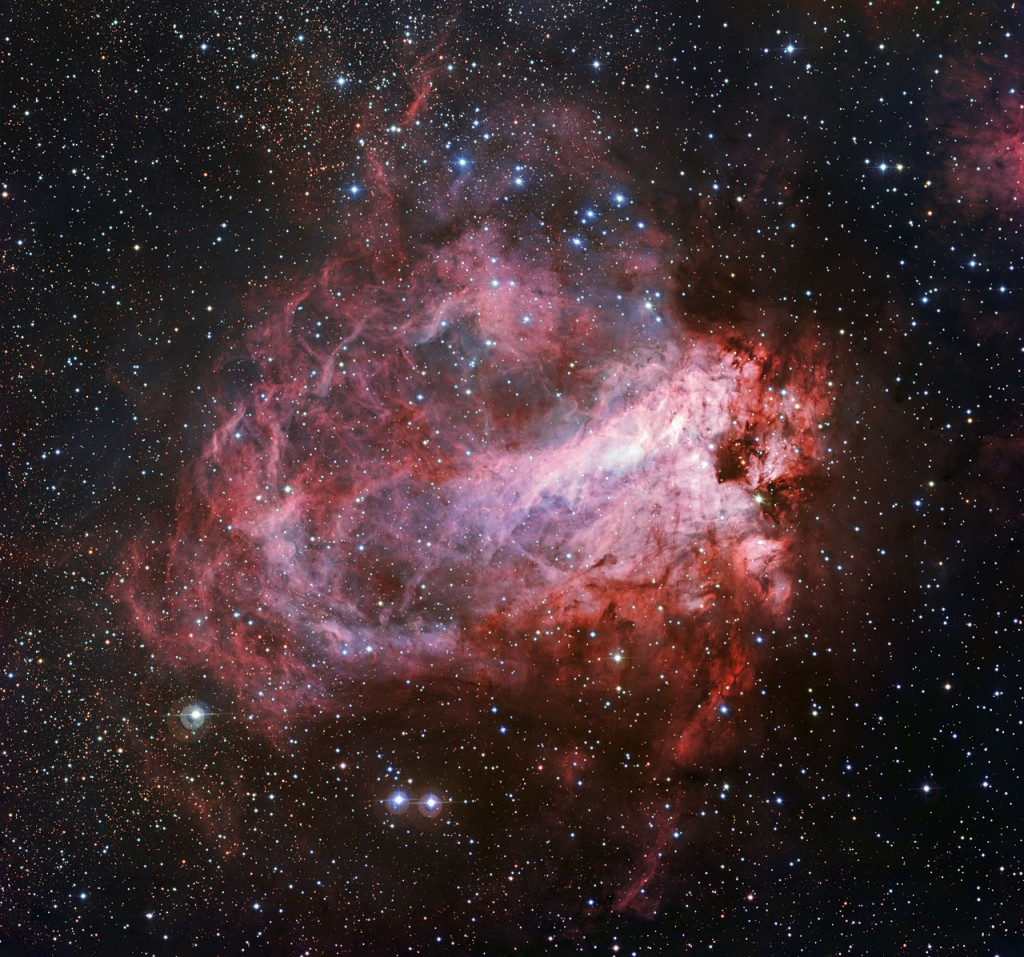
This image of the rose-coloured star forming region Messier 17 was captured by the Wide Field Imager on the MPG/ESO 2.2-metre telescope at ESO’s La Silla Observatory in Chile. It is one of the sharpest images showing the entire nebula and not only reveals its full size but also retains fine detail throughout the cosmic landscape of gas clouds, dust and newborn stars.

The nebula pictured here may have had more names bestowed upon it over the ages than any other object of its kind. Although officially known as Messier 17, its nicknames include: the Omega Nebula, the Swan Nebula, the Checkmark Nebula, the Horseshoe Nebula and — lest those with more of a more marine bent miss out — the Lobster Nebula.

This zoom video sequence takes us from a broad vista of the bright central parts of the Milky Way right into a close-up view of the bright star formation region Messier 17. The final detailed view is from the MPG/ESO 2.2-metre telescope at ESO’s La Silla Observatory in Chile. Credit: ESO, N. Risinger (skysurvey.org), DSS. Music: Johan Monell (www.johanmonell.com)

Messier 17 is located about 5500 light-years from Earth near the plane of the Milky Way and in the constellation of Sagittarius (The Archer). The object spans a big section of the sky — its gas and dust clouds measure about 15 light-years across. This material is fueling the birth of new stars and the wide field of view of the new picture reveals many stars in front of, in, or behind Messier 17.
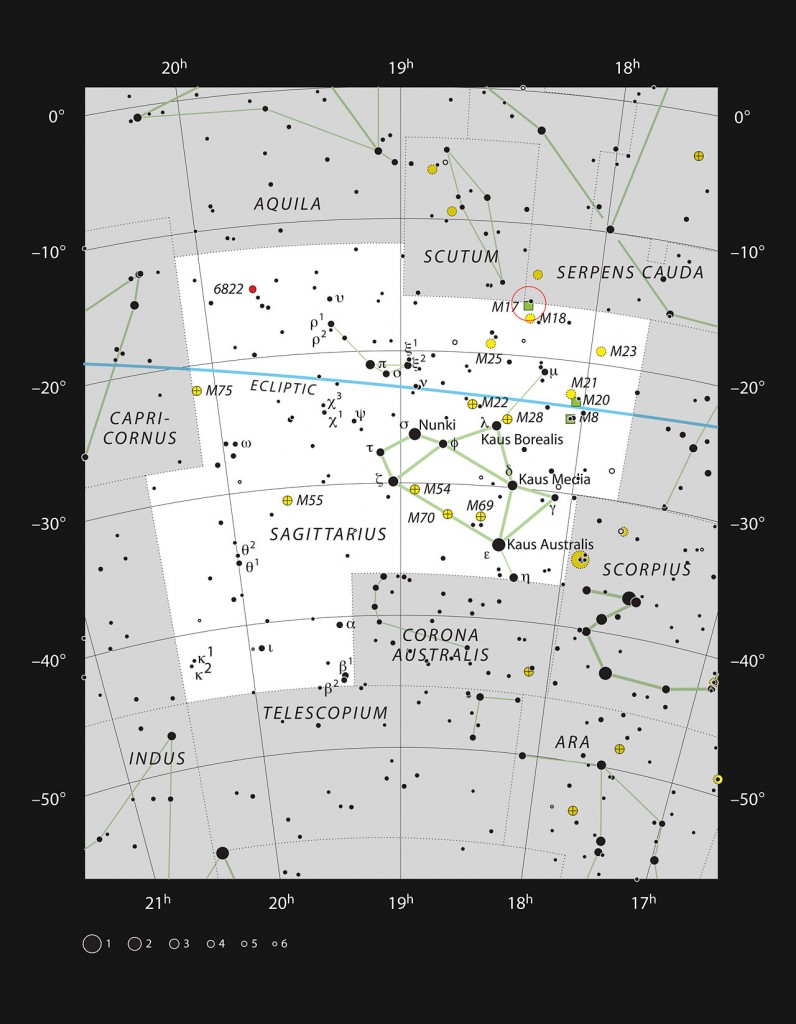
This chart shows the location of the star-forming region Messier 17, also often called the Omega or Swan Nebula, within the constellation of Sagittarius (The Archer). This map shows most of the stars visible to the unaided eye under good conditions, and the cluster itself is marked as a green square within a red circle. Through a moderate-sized amateur telescope this object appears as a bright bar of haze.

The nebula appears as a complex red structure with some graduation to pink. Its colouring is a signature of glowing hydrogen gas. The short-lived blue stars that recently formed in Messier 17 emit enough ultraviolet light to heat up surrounding gas to the extent that it begins to glow brightly. In the central region the colours are lighter, and some parts appear white. This white colour is real — it arises as a result of mixing the light from the hottest gas with the starlight reflected by dust.

This video gives us a close-up view of the rose-coloured star forming region Messier 17. The picture was captured by the Wide Field Imager on the MPG/ESO 2.2-metre telescope at ESO’s La Silla Observatory in Chile. It is one of the sharpest images showing the entire nebula and not only reveals its full size but also retains fine detail throughout the cosmic landscape of gas clouds, dust and newborn stars. Credit: ESO, Music: Johan Monell (www.johanmonell.com)

The gas in the nebula is estimated to have more than 30 000 times the mass of the Sun. Messier 17 also contains an open star cluster of 35 stars, which is known as NGC 6618 [1]. The total number of stars in the nebula, however, is much higher — there are almost 800 stars in the centre with even more forming in its outer regions.
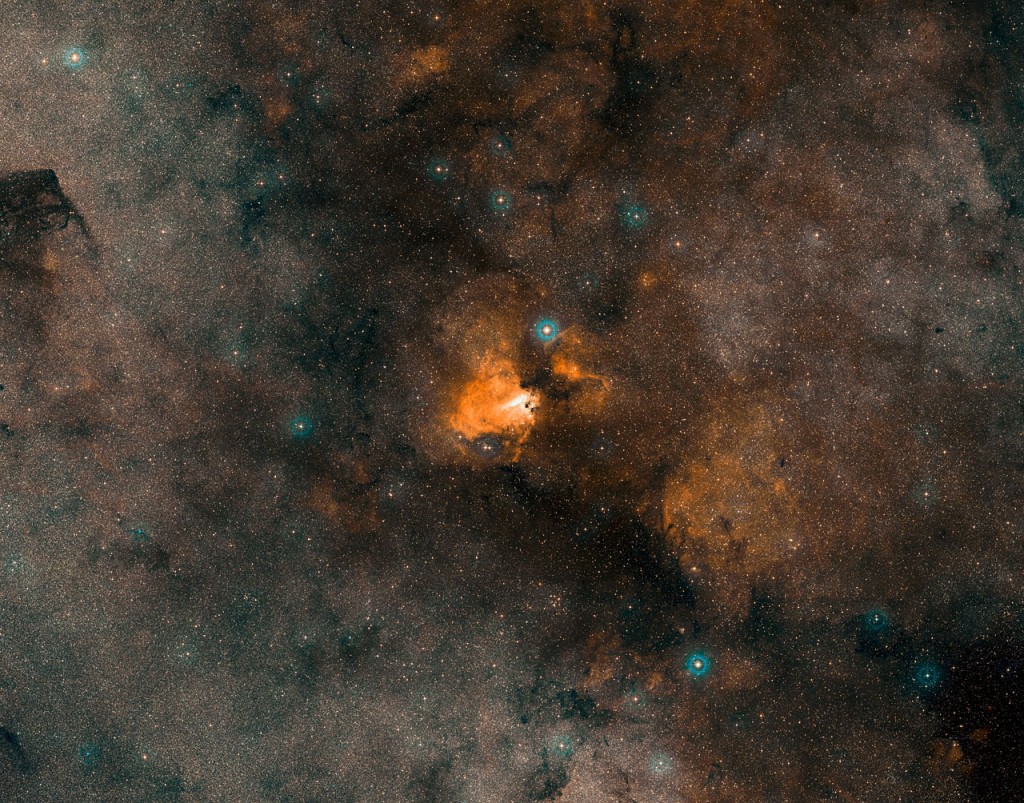
This image is a colour composite of the Omega Nebula (M 17) made from exposures from the Digitized Sky Survey 2 (DSS2). The field of view is approximatelly 4.7 x 3.7 degrees.

Throughout this rosy glow, the nebula shows a web of darker regions of dust that obscure the light. This obscuring material is also glowing and — although these areas are dark in this visible-light image — they look bright when observed using infrared cameras.

The nebula owes its official name to the French comet hunter Charles Messier who included the nebula as the seventeenth object in his famous astronomical catalogue in 1764 [2]. But even with a name as bland as Messier 17, this flowery nebula still looks dazzling.

This picture comes from the ESO Cosmic Gems programme [3].

Notes

[1] This designation is also sometimes used for the entire star formation region.

[2] The astronomer Jean Philippe de Chéseaux discovered the object in 1745, but his discovery did not receive widespread attention. Thus, Messier independently rediscovered and catalogued it almost 20 years later.

[3] The ESO Cosmic Gems programme is an outreach initiative to produce images of interesting, intriguing or visually attractive objects using ESO telescopes, for the purposes of education and public outreach. The programme makes use of telescope time that cannot be used for science observations. All data collected may also be suitable for scientific purposes, and are made available to astronomers through ESO’s science archive.

Space memorabilia auction online to support Astronaut Scholarship Foundation

The 2015 Fall Auction of Astronaut Memorabilia to support the Astronaut Scholarship Foundation is currently underway:

Astronaut Scholarship Foundation to Host
Bi-Annual Online Auction of Space Memorabilia

Money raised from sale of 46 collectibles and astronaut experiences
to help fund STEM scholarships for outstanding college students

KENNEDY SPACE CENTER, Fla. – From unique collectibles and signed memorabilia to one-of-a-kind flown artifacts, the public will have its chance to bid on some of the hottest space keepsakes when the Astronaut Scholarship Foundation (ASF) hosts its fall 2015 online auction beginning Sept. 19. Money raised from the auction will play a key role in funding college scholarships for outstanding science, technology, engineering and math (STEM) students across the United States.

“The Astronaut Scholarship Foundation is very fortunate to have such strong relationships with so many astronauts who are willing to donate their personal space memorabilia in support of our mission,” said Tammy Knowles, ASF’s executive director. “Our bi-annual online auction is filled with collectible items from more than five decades of space travel, all personally donated by astronauts and patrons. These generous gifts help us raise significant dollars to help shape the next generation of science and technology leaders.”

The auction will take place beginning at 9 a.m. Eastern on Saturday, Sept. 19 and run through Friday, Sept. 25 at 10 p.m. Eastern. A special preview of this year’s auction will open on Friday, Sept. 18 at 9 a.m. Eastern. The preview allows the public to register, obtain their bidding numbers and get a sneak peek at the items. This season, there are a total of 46 lots up for bid, including:

  • Official NASA Apollo Earth Orbit Chart signed by 13 Apollo astronauts, including four who walked on the Moon (Edwin “Buzz” Aldrin, Jr., Alan Bean, Eugene “Gene” Cernan and Charles “Charlie” Duke, Jr.). Entitled “Apollo Mission 12, For November 1969 Launch Dates,” this first edition chart measures approximately 13.5 inches by 42 inches.
  • Skylab Astronaut Maneuvering Unit (AMU) checklist cover, which was flown during Skylab 4 and worn on the cuffs of astronauts Gerald “Jerry” Carr, Edward Gibson and William Pogue as they worked in space.
  • Flown Apollo 14 beta cloth patch, silkscreened with the mission insignia and signed by astronaut Edgar Mitchell. The patch is made from the same material used to create fire-resistant space suits.
  • Skylab-Flown, serial-numbered pen and pencil, which were launched with the Skylab workshop in May 1973 and returned to Earth with the final Skylab crew in February 1974.

In addition, the ASF will auction four of its signature “Astronaut Experiences,” which offer bidders the chance to win a one-on-one encounter with a space explorer. This year’s experiences include:

  • A behind-the-scenes, VIP tour for two at the NASA Johnson Space Center in Houston, donated by Jacobs Technology, Inc., the corporate sponsor of ASF’s Workforce Initiative.
  • Two tickets, plus an astronaut special table guest, to the Astronaut Hall of Fame Induction Ceremony in May 2016.
  • Two breathtaking hiking adventures (one of which to take place in Shenandoah National Park).

For a complete listing of items, visit www.astronautscholarship.org/auction on Sept. 18.

While ASF has hosted live and silent auctions during its fundraising events over the past 30 years, the organization branched into online auctions in the early 2000s to appeal to a broader audience.

“Our online auction allows us to reach collectors around the world, who might not be able to attend one of our fundraising events,” Knowles said. “Over the past 10 years, auctions such as this one have helped us raise in excess of $1.5 million for our scholarship program.”

People interested in participating in the fall 2015 online auction must register in advance, beginning Sept. 18. Once the auction opens, participants may submit bids as many times as desired during the bidding period using the forms located on each lot page.

Winning bidders will be notified via email. Items will be shipped at the bidder’s expense. Cash, checks and credit cards will be accepted for payment of items. The full list of rules and regulations will be posted online on Sept. 18.

About the Astronaut Scholarship Foundation: Founded in 1984 by the surviving Mercury 7 astronauts, the Astronaut Scholarship Foundation (ASF) helps the United States retain its world leadership in science and technology. Through the garnered support of astronauts, industry leaders, educational institutions and patrons, ASF awards merit-based scholarships to the best and brightest university students who excel in science, technology, engineering and mathematics (STEM). The prestigious Astronaut Scholarship is known nationwide for being among the highest scholarships awarded to undergraduate STEM students. Since its inception, ASF has awarded in excess of $4 million in scholarships to more than 470 of the nation’s top scholars.

Video: TMRO.tv 8.27 – Space Launch System Past and Future

The latest TMRO.tv live program focused on NASA’s Space Launch System (SLS), “where it came from and where it could be going”: Space Launch System Past and Future – TMRO

For some background info to the SLS:

The space news segment covered:

* Proton Launches with AM8 Communications Satellite
* Two secret launches made by China
* Boeing rejects bid to buy United Launch Alliance
* Blue Origin announces commercial rocket pad in Florida
* NASA Delays crewed flight of Orion to 2023
* Virgin Galactic Announces More Capable LauncherOne

Contribute to the TMRO program:

TMRO Live is a crowd funded show. If you like this episode consider contributing to help us to continue to improve. Head over tohttp://www.patreon.com/tmro for information, goals and reward levels. Don’t forget to check out our Space Pod campaign as well over athttp://www.patreon.com/spacepod

Sci-Tech: Hyperloop development update

Lots of activity on the Hyperloop development front:

* SpaceX is sponsoring a Hyperloop Pod Competition.

* Hyperloop Transportation Technologies (HTT) is building a prototype system in Quay Valley, California: The first full-scale Hyperloop test track may launch in California next year – The Verge

[]

Hyperloop Technologies just hired former Cisco President Rob Lloyd as a new CEO: Hyperloop Technologies taps a new CEO – Sep. 16, 2015.

Lloyd talks about the company here: Hello Hyperloop.

The company is also building a full sized test track: Hyperloop Technologies has a CEO — and plans to open its test track next year – The Verge.

Here’s a report on the project: Pushing the Limits: Hyperloop Technologies – CBS News

Carnival of Space # 424 – PhotosToSpace.com

PhotosToSpace.com hosts the latest Carnival of Space.