ESO: A grand extravaganza of new stars in The Altar

The latest cool astronomical report from the European Southern Observatory (ESO):

A Grand Extravaganza of New Stars
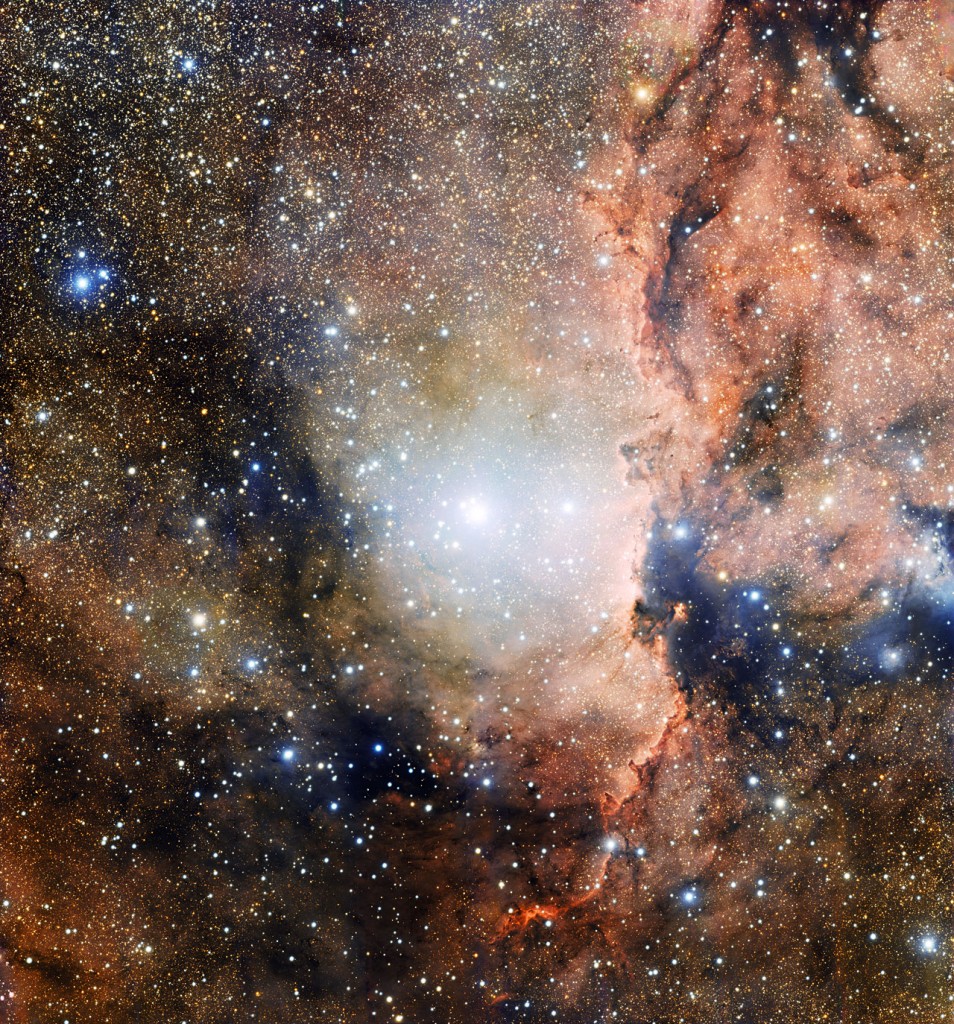
Star cluster NGC 6193 and nebula NGC 6188

This dramatic landscape in the southern constellation of Ara (The Altar) is a treasure trove of celestial objects. Star clusters, emission nebulae and active star-forming regions are just some of the riches observed in this region lying some 4000 light-years from Earth. This beautiful new image is the most detailed view of this part of the sky so far, and was taken using the VLT Survey Telescope at ESO’s Paranal Observatory in Chile.

At the centre of the image is the open star cluster NGC 6193, containing around thirty bright stars and forming the heart of the Ara OB1 association. The two brightest stars are very hot giant stars. Together, they provide the main source of illumination for the nearby emission nebula, the Rim Nebula, or NGC 6188, which is visible to the right of the cluster.

A stellar association is a large grouping of loosely bound stars that have not yet completely drifted away from their initial formation site. OB associations consist largely of very young blue–white stars, which are about 100 000 times brighter than the Sun and between 10 and 50 times more massive.

The Rim Nebula is the prominent wall of dark and bright clouds marking the boundary between an active star-forming region within the molecular cloud, known as RCW 108, and the rest of the association [1]. The area around RCW 108 is made up of mostly hydrogen — the primary ingredient in star formation. Such areas are also known as H II regions.

The ultraviolet radiation and intense stellar wind from the stars of NGC 6193 seem to be driving the next generation of star formation in the surrounding clouds of gas and dust. As cloud fragments collapse they heat up and eventually form new stars.

As the cloud creates new stars, it is simultaneously being eroded by the winds and radiation emitted by previous stars, and by violent supernova explosions. In this way, such star-forming H II regions tend to have a lifespan of just a few million years. Star formation is a very inefficient process, with only around 10% of the available material contributing to the process — the rest is blown off into space.

The Rim Nebula also shows signs of being in the early phase of “pillar formation”, meaning that in the future it could end up looking similar to other well-known star-forming regions, such as the Eagle Nebula (Messier 16, containing the famous Pillars of Creation) and the Cone Nebula (part of NGC 2264).

This single spectacular image was actually created from more than 500 individual pictures taken through four different colour filters with the VLT Survey Telescope. The total exposure time was more than 56 hours. It is the most detailed view of this region yet achieved.

Some recent science/science-fiction film items

Some miscellaneous science/science-fiction film related links:

Keri Kukral, Monday, 3-9-15 – Thespaceshow’s Blog – An interview on The Space Show about Raw Science TV and the Raw Science Film Fest Award Winners -Raw Science

Ground Into Sky: The Topology of Interstellar – The Avery Review – One of the winners of the Raw Science Film Fest awards was Caltech cosmologist Kip Thorne who help develop the story for the film Interstellar.  In this post architect Fred Scharmen writes about a recurring theme in the movie of the large rotating in-space habitat in which the ground rises up in the distance to become the sky overhead.

Bryan Singer Tackling Sci-Fi Classic ‘The Moon Is a Harsh Mistress’ for Fox (Exclusive) – The Hollywood Reporter – One of the great classics of science fiction might finally be made into a movie.

So, the new ‘Tomorrowland’ Trailer. It’s very… Bob Heinlein. – Moe Lane – From the latest trailer, it appears that Disney’s upcoming movie Tomorrowland has some bits with a classic science fiction look to them:

Sci-Tech: Latest on General Fusion

Here’s an update on the General Fusion company in Canada, which I’ve posted about occasionally here, on their quest to develop a unique approach to achieving practical nuclear fusion power at a relatively low cost: Tech firm aims to ‘save the world’ with nuclear reactor – The Globe and Mail.

A General Fusion promotional video:

Where are the stars in in-space made images?

Here’s an excellent mini-tutorial by Bill Dunford on why one seldom sees stars in the dark sky background of images of planets, moons, asteroids, etc. made by scientific probes: A Sky Full of Stars -The Planetary Society

He includes lots of examples such as this counter one:

20130826_PIA10526_f840[1]

 Enceladus among stars
“Extremely unusual circumstances were required to get this shot of Enceladus floating in front of a field of stars. The Cassini spacecraft is flying in space, of course, and regularly captures images of star fields. It also regularly captures images of Enceladus. But Enceladus is so brightly reflective that, under normal circumstances, it is impossible to see both features on Enceladus’ surface and a dense field of stars in the same image. To see Enceladus’ surface, the camera team would select a short exposure setting; to see the stars, they would select a long exposure setting. This photo is possible because Enceladus was actually in Saturn’s shadow when it was taken; the only light reaching its surface (and reflecting from there to Cassini’s camera) is sunlight that has first been reflected off of Saturn or its rings. A long exposure revealed both Enceladus’ surface and the background field of stars.”

Solar cycle update

The number of sunspots decreased significantly in February as the current peak in the solar cycle winds down: Sunspots crash in February – Behind The Black –

ISES Solar Cycle Sunspot Number Progression - NOAA