Space policy roundup – Apr.10.14

A new selection of space policy/politics related links:

Webcasts:

John Batchelor Show Hotel Mars with Marcia Smith, Wednesday, 4-9-14 –  Thespaceshow’s Blog – Marcia Smith of www.spacepolicyonline.com talked about US-Russia space relations and other issues.

Robert (Bob) Zimmerman, Tuesday, 4-8-14 | Thespaceshow’s Blog – Bob (BehindTheBlack.com) and David talk about a wide range of space news and policy issues.

ESA Mars Express: Views of the ancient Osuga Valles flood terrain

The European Space Agency (ESA) posts this article based on images from the Mars Express orbiter:

Beauty from chaos

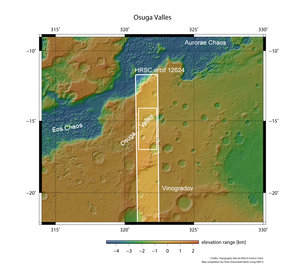
Osuga Valles
Osuga Valles

10 April 2014 Beautiful streamlined islands and narrow gorges were carved by fast-flowing water pounding through a small, plateau region near the southeastern margin of the vast Vallis Marineris canyon system.

Images captured on 7 December 2013 by ESA’s Mars Express show the central portion of Osuga Valles, which has a total length of 164 km. It is some 170 km south of Eos Chaos, which lies in the far eastern section of Valles Marineris.

Osuga Valles in context

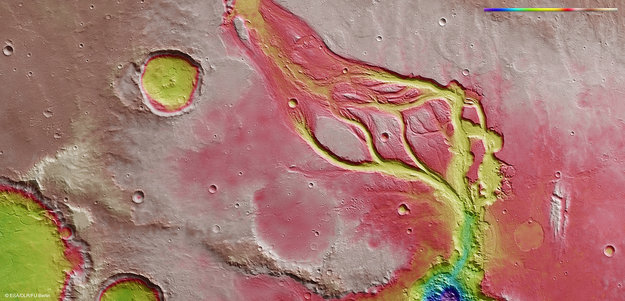
Osuga Valles is an outflow channel that emanates from a region of chaotic terrain at the edge of Eos Chaos to the west (top in the main images). Such landscape is dominated by randomly oriented and heavily eroded blocks of terrain. Another example is seen at the bottom of this scene, filling the 2.5 km-deep depression into which Osuga Valles empties.

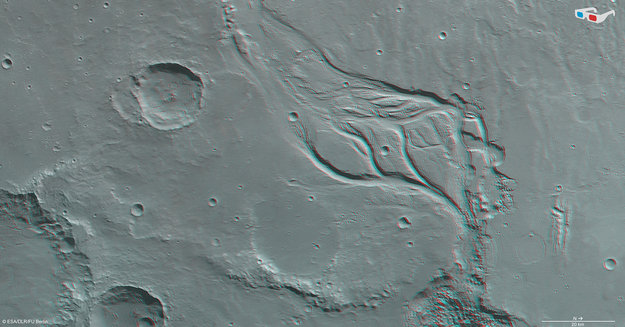
Catastrophic flooding is thought to have created the heavily eroded Osuga Valles and the features within it. Streamlines around the islands in the valley indicate that the direction of flow was towards the northeast (bottom right in the main colour, topographic and 3D images shown here) and sets of parallel, narrow grooves on the floor of the channel suggest that the water was fast flowing.

Osuga Valles topographyOsuga Valles topography

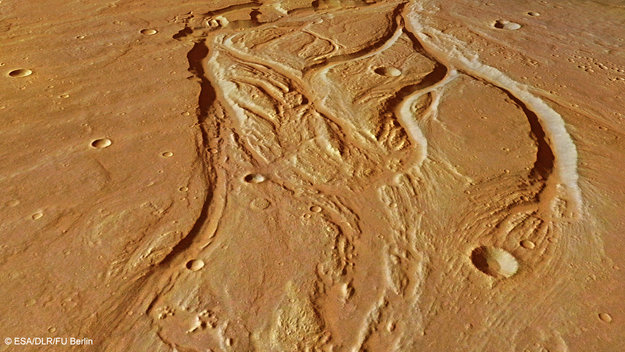
Differences in elevation within the feature, along with the presence and cross-cutting relationships of channels carved onto the islands, suggest that Osuga Valles experienced several episodes of flooding. The perspective view, which is oriented with the direction of the water flow towards the top of the image, shows the details of the grooved valley floor and the channels carved into the islands more clearly.

Close to the northern-most (far right) part of the channel in the main images, two large irregular-shaped blocks appear to have broken away from the surrounding terrain, but do not seem to have experienced as much erosion as the rounded islands.

Perspective view of Osuga VallesPerspective view of Osuga Valles

The floodwater eventually emptied into the deep depression of chaotic terrain at the bottom of the main images, but it is not yet known whether the water drained away into the subsurface or formed a temporary lake.

Osuga Valles in 3DOsuga Valles in 3D

Video: Testing a Mars supersonic parachute is complicated

As part of NASA’s Low-Density Supersonic Decelerator program, an unusual test of a Mars parachute design was carried out that involved creating a  “wind tunnel” with, among other things, a helicopter, a winch, and a rocket sled.

Video: Progress heads for ISS

A Russian Progress cargo craft was launched today on a Soyuz rocket to the International Space Station. It will take a fast route such that it arrives there this afternoon. Here’s a video of the launch:

[ Update: Here is a video of the rendezvous and docking of the Progress freighter with the ISS:

]

Lots of spaceships are coming and going at the ISS:

Crew Gears Up For Spacecraft Traffic at the Station

An express cargo delivery is on its way to the International Space Station. Nearly 3 tons of food, fuel and gear to replenish Expedition 39 launched aboard an ISS Progress 55 resupply craft at 11:26 a.m. EDT from the Baikonur Cosmodrome in Kazakhstan.

The Russian space freighter will orbit Earth just four times before docking to the Pirs docking compartment at 5:20 p.m.

› NASA TV will cover live ISS Progress 55 docking activities

The 55P will occupy the same docking port left open when another Progress, the 54P, departed Monday morning filled with trash after a two-month stay. It is orbiting Earth for several days of orbital engineering tests before finally reentering the atmosphere for a fiery disposal.

› Read about the departure of the ISS Progress 54

There will be four vehicles docked at the orbital laboratory after the 55P arrives. Currently, there are two Soyuz vehicles and an ISS Progress 53 parked at the station. The Soyuz TMA-11M is docked to the Rassvet docking compartment and the Soyuz TMA-12M is docked to the Poisk docking compartment. The 53P space freighter is docked to the aft end of the Zvezda service module.

A fifth cargo vehicle is being readied for its mission to the space station next week. SpaceX will launch its third Dragon commercial cargo craft aboard a Falcon 9 rocket Monday April 14 at 4:58 p.m. from Cape Canaveral Air Force Station in Florida.

› NASA TV will cover live Dragon launch and capture activities

When the Dragon arrives for its rendezvous with the station two days later it will be captured by the station’s robotic arm, Canadarm2, for a berthing to the Harmony node. The Dragon is the first space station resupply vehicle with return capability, safely delivering science research for analysis and gear for inspection, for retrieval off the coast of California.

Orbital Sciences’ Cygnus commercial resupply ship aboard an Antares rocket is lined up to follow the SpaceX Dragon when it leaves in mid-May. Scheduled for a May 6 launch, its approach and rendezvous profile will be similar to the Dragon. It will also be captured by the Canadarm2 for a berthing to Harmony. However, after it’s unberthing and release from the station’s robotic arm it will deorbit over the Pacific Ocean for a destructive reentry just like a Progress spacecraft.

ESO: Chance meeting creates celestial diamond ring

An announcement from European Southern Observatory (ESO):

Chance Meeting Creates Celestial Diamond Ring

Astronomers using ESO’s Very Large Telescope in Chile have captured this eye-catching image of planetary nebula PN A66 33 — usually known as Abell 33. Created when an aging star blew off its outer layers, this beautiful blue bubble is, by chance, aligned with a foreground star, and bears an uncanny resemblance to a diamond engagement ring. This cosmic gem is unusually symmetric, appearing to be almost circular on the sky.

Most stars with masses similar to that of our Sun will end their lives as white dwarfs — small, very dense, and hot bodies that slowly cool down over billions of years. On the way to this final phase of their lives the stars throw their atmospheres out into the space and create planetary nebulae, colourful glowing clouds of gas surrounding the small, bright stellar relics.

This image, captured by ESO’s Very Large Telescope (VLT), shows the remarkably round planetary nebula Abell 33, located roughly 2500 light-years from Earth. Being perfectly round is uncommon for these objects — usually something disturbs the symmetry and causes the planetary nebula to display irregular shapes [1].

Loading player…

This zoom sequence starts with a broad view showing part of the long thin constellation of Hydra (The Female Water Snake). Towards the end a ghostly blue bubble can be seen, with a bright star on its edge, making it look like a diamond ring. This is the planetary nebula Abell 33. ESO/Digitized Sky Survey 2/M. Kornmesser. Music: movetwo


The strikingly bright star located along the rim of the nebula creates a beautiful illusion in this VLT image. This is just a chance alignment — the star, named HD 83535, lies in the foreground of the nebula, between Earth and Abell 33, in just the right place to make this view even more beautiful. Together, HD 83535 and Abell 33 create a sparkling diamond ring.

The remnant of Abell 33’s progenitor star, on its way to becoming a white dwarf, can be seen just slightly off-centre inside the nebula, visible as a tiny white pearl. It is still bright — more luminous than our own Sun — and emits enough ultraviolet radiation to make the bubble of expelled atmosphere glow [2]. Abell 33 is just one of the 86 objects included in astronomer George Abell’s 1966 Abell Catalogue of Planetary Nebulae. Abell also scoured the skies for galaxy clusters, compiling the Abell Catalogue of over 4000 of these clusters in both the northern and southern hemispheres of the sky. This image uses data from the FOcal Reducer and low dispersion Spectrograph (FORS) instrument attached to the VLT, which were acquired as part of the ESO Cosmic Gems programme [3].

Loading player…

This pan video gives a close-up look at an eye-catching new image of planetary nebula Abell 33 taken using ESO’s Very Large Telescope in Chile. Created when an aging star blew off its outer layers, this beautiful blue bubble is, by chance, aligned with a foreground star, and bears an uncanny resemblance to a diamond engagement ring. This cosmic gem is unusually symmetric, appearing to be almost perfectly circular on the sky.

Credit: ESO/Digitized Sky Survey 2. Music: movetwo