ESO: A study in scarlet

This week’s European Southern Observatory (ESO) scientific highlight:

A Study in Scarlet

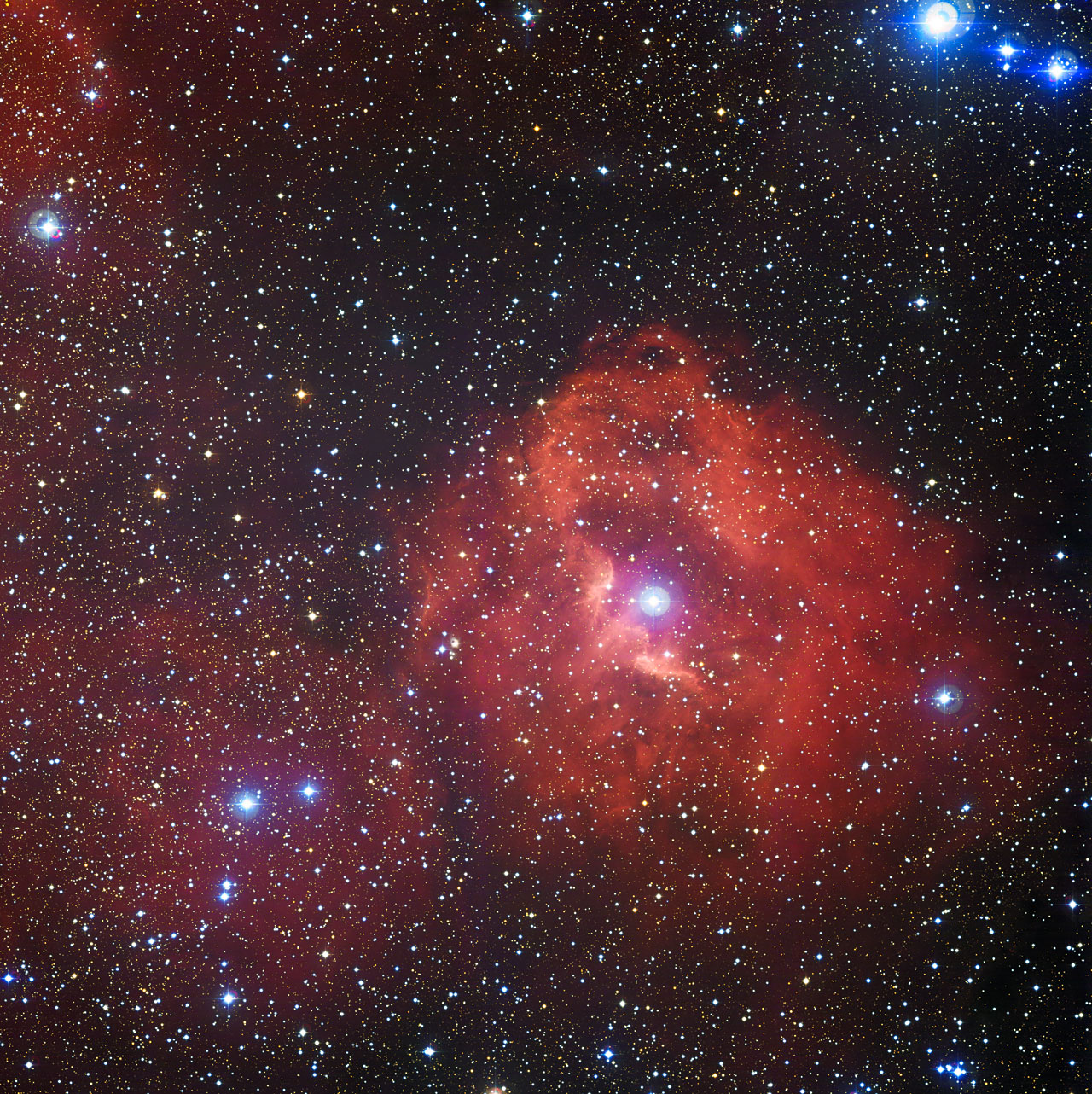
This new image from ESO’s La Silla Observatory in Chile reveals a cloud of hydrogen called Gum 41. In the middle of this little-known nebula, brilliant hot young stars are giving off energetic radiation that causes the surrounding hydrogen to glow with a characteristic red hue.
eso1413a

This area of the southern sky, in the constellation of Centaurus (The Centaur), is home to many bright nebulae, each associated with hot newborn stars that formed out of the clouds of hydrogen gas. The intense radiation from the stellar newborns excites the remaining hydrogen around them, making the gas glow in the distinctive shade of red typical of star-forming regions. Another famous example of this phenomenon is the Lagoon Nebula (eso0936), a vast cloud that glows in similar bright shades of scarlet.

The nebula in this picture is located some 7300 light-years from Earth. Australian astronomer Colin Gum discovered it on photographs taken at the Mount Stromlo Observatory near Canberra, and included it in his catalogue of 84 emission nebulae, published in 1955. Gum 41 is actually one small part of a bigger structure called the Lambda Centauri Nebula, also known by the more exotic name of the Running Chicken Nebula (another part of which was the topic of eso1135). Gum died at a tragically early age in a skiing accident in Switzerland in 1960.

In this picture of Gum 41, the clouds appear to be quite thick and bright, but this is actually misleading. If a hypothetical human space traveller could pass through this nebula, it is likely that they would not notice it as — even at close quarters — it would be too faint for the human eye to see. This helps to explain why this large object had to wait until the mid-twentieth century to be discovered — its light is spread very thinly and the red glow cannot be well seen visually.

This zoom sequence starts with a broad view of the Milky Way
and closes in on one of the more spectacular sections in the constellation
of Centaurus (The Centaur). In the final sequence we see the star formation
region known as Gum 41 in a new image from the MPG/ESO 2.2-metre telescope
at the La Silla Observatory in Chile.
Credit:ESO/N. Risinger (skysurvey.org)/Hisayoshi Kato. Music: movetwo

This new portrait of Gum 41 — likely one of the best so far of this elusive object — has been created using data from the Wide Field Imager (WFI) on the MPG/ESO 2.2-metre telescope at the La Silla Observatory in Chile. It is a combination of images taken through blue, green, and red filters, along with an image using a special filter designed to pick out the red glow from hydrogen.

More information

ESO is the foremost intergovernmental astronomy organisation in Europe and the world’s most productive ground-based astronomical observatory by far. It is supported by 15 countries: Austria, Belgium, Brazil, the Czech Republic, Denmark, France, Finland, Germany, Italy, the Netherlands, Portugal, Spain, Sweden, Switzerland and the United Kingdom. ESO carries out an ambitious programme focused on the design, construction and operation of powerful ground-based observing facilities enabling astronomers to make important scientific discoveries. ESO also plays a leading role in promoting and organising cooperation in astronomical research. ESO operates three unique world-class observing sites in Chile: La Silla, Paranal and Chajnantor. At Paranal, ESO operates the Very Large Telescope, the world’s most advanced visible-light astronomical observatory and two survey telescopes. VISTA works in the infrared and is the world’s largest survey telescope and the VLT Survey Telescope is the largest telescope designed to exclusively survey the skies in visible light. ESO is the European partner of a revolutionary astronomical telescope ALMA, the largest astronomical project in existence. ESO is currently planning the 39-metre European Extremely Large optical/near-infrared Telescope, the E-ELT, which will become “the world’s biggest eye on the sky”.
Space policy roundup – April.15.14

Another selection of space policy/politics related links:


Wobbling has its advantages for life on Earth-size exoplanets

Our Moon helps to reduce the earth’s wobbling, i.e. the variation in the tilt of the earth’s rotational axis relative to the plane of the earth’s orbit around the sun. This stabilizing effect, particularly with respect to climate, has been often presented as a necessary condition for the emergence and evolution of life on earth. However, a new paper is out that argues that an earth-like exoplanet without a big moon would benefit from the resultant wobbling because it would mean more even heating of that world and therefore less chance of freezing over. This is particularly important at greater distances from an exoplanet’s star and so the effect will expand outward the size habitable zones.

Here is a press release about the paper:

Astronomers: ‘Tilt-a-worlds’ could harbor life

A fluctuating tilt in a planet’s orbit does not preclude the possibility of life, according to new research by astronomers at the University of Washington, Utah’s Weber State University and NASA. In fact, sometimes it helps.

That’s because such “tilt-a-worlds,” as astronomers sometimes call them — turned from their orbital plane by the influence of companion planets — are less likely than fixed-spin planets to freeze over, as heat from their host star is more evenly distributed.

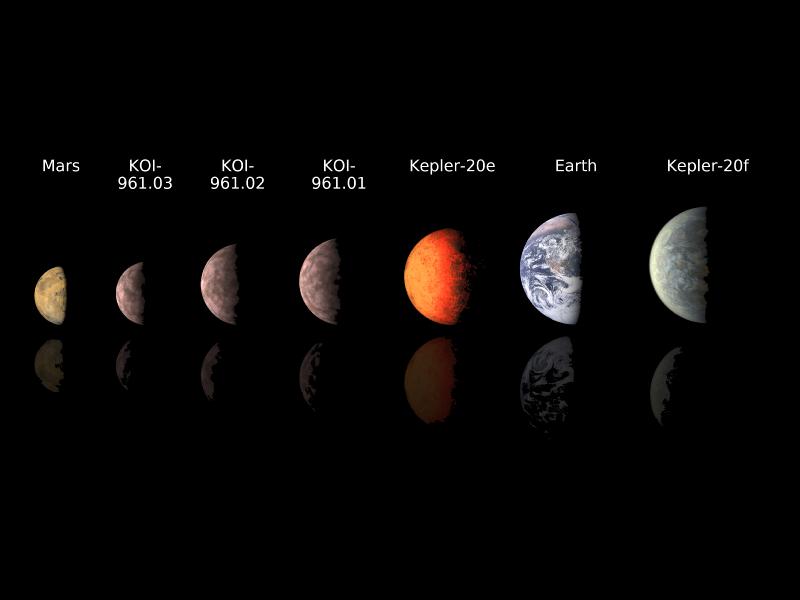
615242main_PlanetLineup_4x3_800-600A comparison to earth and Mars of small exoplanets discovered
by the Kepler Observatory 

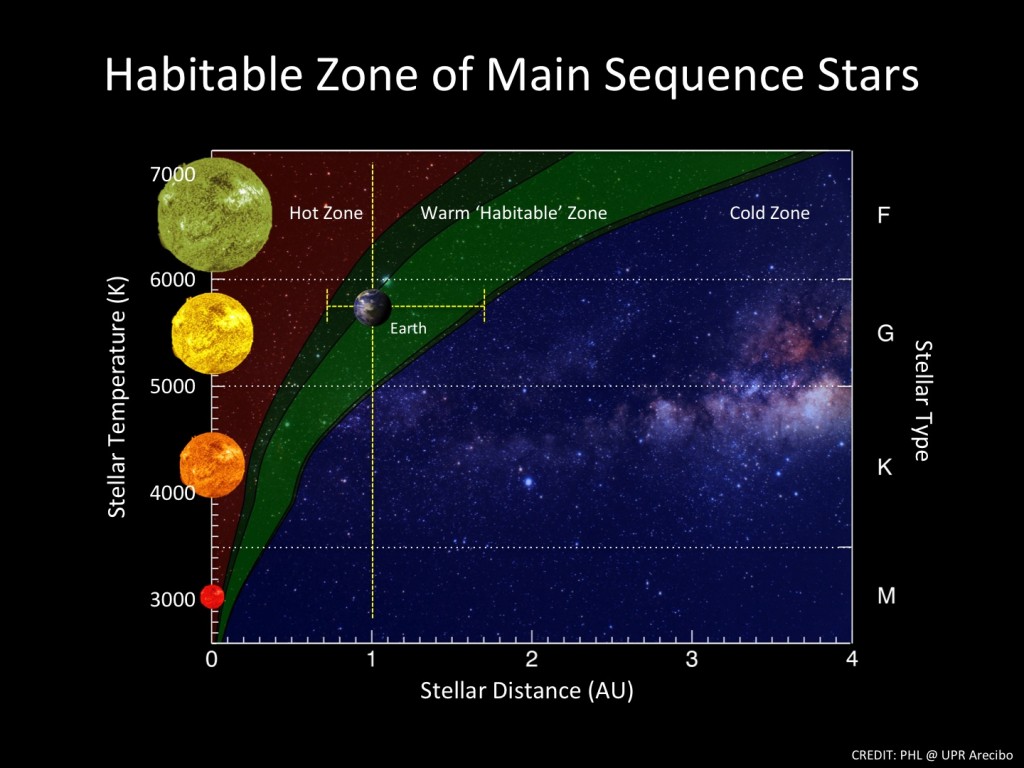
This happens only at the outer edge of a star’s habitable zone, the swath of space around it where rocky worlds could maintain liquid water at their surface, a necessary condition for life. Further out, a “snowball state” of global ice becomes inevitable, and life impossible.

The findings, which are published online and will appear in the April issue of Astrobiology, have the effect of expanding that perceived habitable zone by 10 to 20 percent.

And that in turn dramatically increases the number of worlds considered potentially right for life.

Such a tilt-a-world becomes potentially habitable because its spin would cause poles to occasionally point toward the host star, causing ice caps to quickly melt.

Habitable_ZoneA plot showing star temperatures vs distance from the star
for the habitable zone. Credit: PHL@UPR Arecibo

“Without this sort of ‘home base’ for ice, global glaciation is more difficult,” said UW astronomer Rory Barnes. “So the rapid tilting of an exoplanet actually increases the likelihood that there might be liquid water on a planet’s surface.”

Barnes is second author on the paper. First author is John Armstrong of Weber State, who earned his doctorate at the UW.

Earth and its neighbor planets occupy roughly the same plane in space. But there is evidence, Barnes said, of systems whose planets ride along at angles to each other. As such, “they can tug on each other from above or below, changing their poles’ direction compared to the host star.”

The team used computer simulations to reproduce such off-kilter planetary alignments, wondering, he said, “what an Earthlike planet might do if it had similar neighbors.”

Their findings also argue against the long-held view among astronomers and astrobiologists that a planet needs the stabilizing influence of a large moon — as Earth has — to have a chance at hosting life.

“We’re finding that planets don’t have to have a stable tilt to be habitable,” Barnes said. Minus the moon, he said, Earth’s tilt, now at a fairly stable 23.5 degrees, might increase by 10 degrees or so. Climates might fluctuate, but life would still be possible.

“This study suggests the presence of a large moon might inhibit life, at least at the edge of the habitable zone.”

The work was done through the UW’s Virtual Planetary Laboratory, an interdisciplinary research group that studies how to determine if exoplanets — those outside the solar system — might have the potential for life.

“The research involved orbital dynamics, planetary dynamics and climate studies. It’s bigger than any of those disciplines on their own,” Barnes said.

Armstrong said that expanding the habitable zone might almost double the number of potentially habitable planets in the galaxy.

Applying the research and its expanded habitable zone to our own celestial neighborhood for context, he said, “It would give the ability to put Earth, say, past the orbit of Mars and still be habitable at least some of the time — and that’s a lot of real estate.”

Barnes’ UW co-authors are Victoria Meadows, Thomas Quinn and Jonathan Breiner. Shawn Domagal-Goldman of NASA’s Goddard Space Flight Center is also a co-author. The research was funded by a grant from the NASA Astrobiology Institute.

===

Here’s a recent NASA article about an extreme case of a wobbly world: Kepler captures a weird, wildly wobbling world – NASA PlanetQuest –

The planet, designated Kepler-413b, precesses, or wobbles, wildly on its spin axis, much like a child’s top. The tilt of the planet’s spin axis can vary by as much as 30 degrees over 11 years, leading to rapid and erratic changes in seasons. In contrast, Earth’s rotational precession is 23.5 degrees over 26,000 years. Researchers are amazed that this far-off planet is precessing on a human timescale.

Cassini images hint at formation of a new Saturn moon

Saturn’s rings may be birthing a new moon:

NASA Cassini Images May Reveal Birth of New Saturn Moon 

NASA’s Cassini spacecraft has documented the formation of a small icy object within the rings of Saturn that may be a new moon, and may also provide clues to the formation of the planet’s known moons.

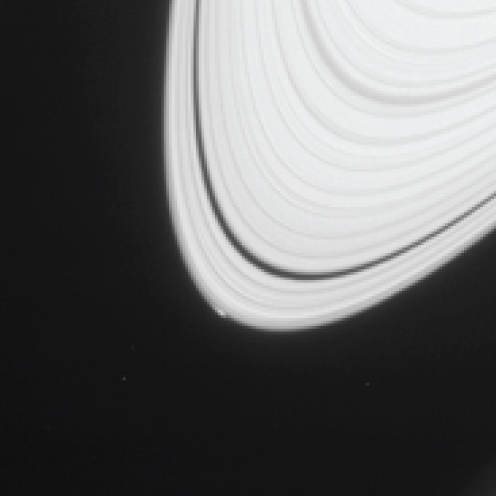
pia18078_peggy_0The disturbance visible at the outer edge of Saturn’s A ring in this image from
NASA’s Cassini spacecraft could be caused by an object replaying the birth
process of icy moons.  Full image and caption
Image Credit: NASA/JPL-Caltech/Space Science Institute

Images taken with Cassini’s narrow angle camera on April 15, 2013 show disturbances at the very edge of Saturn’s A ring — the outermost of the planet’s large, bright rings. One of these disturbances is an arc about 20 percent brighter than its surroundings, 750 miles (1,200 kilometers) long and 6 miles (10 kilometers) wide. Scientists also found unusual protuberances in the usually smooth profile at the ring’s edge. Scientists believe the arc and protuberances are caused by the gravitational effects of a nearby object. Details of the observations were published online today (April 14, 2014) by the journal Icarus.

The object is not expected to grow any larger, and may even be falling apart. But the process of its formation and outward movement aids in our understanding of how Saturn’s icy moons, including the cloud-wrapped Titan and ocean-holding Enceladus, may have formed in more massive rings long ago. It also provides insight into how Earth and other planets in our solar system may have formed and migrated away from our star, the sun.

“We have not seen anything like this before,” said Carl Murray of Queen Mary University of London, and the report’s lead author. “We may be looking at the act of birth, where this object is just leaving the rings and heading off to be a moon in its own right.”

The object, informally named Peggy, is too small to see in images so far. Scientists estimate it is probably no more than about a half mile in diameter. Saturn’s icy moons range in size depending on their proximity to the planet — the farther from the planet, the larger. And many of Saturn’s moons are comprised primarily of ice, as are the particles that form Saturn’s rings. Based on these facts, and other indicators, researchers recently proposed that the icy moons formed from ring particles and then moved outward, away from the planet, merging with other moons on the way.

“Witnessing the possible birth of a tiny moon is an exciting, unexpected event,” said Cassini Project Scientist Linda Spilker, of NASA’s Jet Propulsion Laboratory (JPL) in Pasadena, Calif. According to Spilker, Cassini’s orbit will move closer to the outer edge of the A ring in late 2016 and provide an opportunity to study Peggy in more detail and perhaps even image it.

It is possible the process of moon formation in Saturn’s rings has ended with Peggy, as Saturn’s rings now are, in all likelihood, too depleted to make more moons. Because they may not observe this process again, Murray and his colleagues are wringing from the observations all they can learn.

“The theory holds that Saturn long ago had a much more massive ring system capable of giving birth to larger moons,” Murray said. “As the moons formed near the edge, they depleted the rings and evolved, so the ones that formed earliest are the largest and the farthest out.”

The Cassini-Huygens mission is a cooperative project of NASA, the European Space Agency and the Italian Space Agency. JPL, a division of the California Institute of Technology, manages the mission for NASA’s Science Mission Directorate in Washington.

To view an image of the Saturn ring disturbance attributed to the new moon, visit: www.jpl.nasa.gov/spaceimages/details.php?id=PIA18078

For more information about Cassini, visit: www.nasa.gov/cassini

Views of the lunar eclipse

If you missed the “Blood Moon” lunar eclipse last night (see earlier post), check out the many images posted at Spaceweather.com Realtime Image Gallery.

LunarEclipse_Apr_15_2014_NASA_oA NASA image taken in San Jose, California
Image Credit: NASA Ames Research Center/Brian Day

And lots of  imagery is collected in this video: