The sun got more angry in October

Bob Zimmerman gives an update on the state of the sun, which got more active last month, though still subdued compared to recent solar maximums : The sun goes boom! – Behind The Black.

Be sure to check daily the latest solar and space weather images and data displayed on the HobbySpace Sun & Space Weather page.  Here, for example, is an updated graph of the number of sunspots per month:

ISES Solar Cycle Sunspot Number Progression - NOAA


Citizen Science: Moonometer, Moon Zoo Live, Planet Hunters and Zooniverse job ad

Some citizen science news items:

The Moonometer at the Moon Zoo project gives the latest count in the number of  LRO images classified by participants: The Moonometer -Moon Zoo

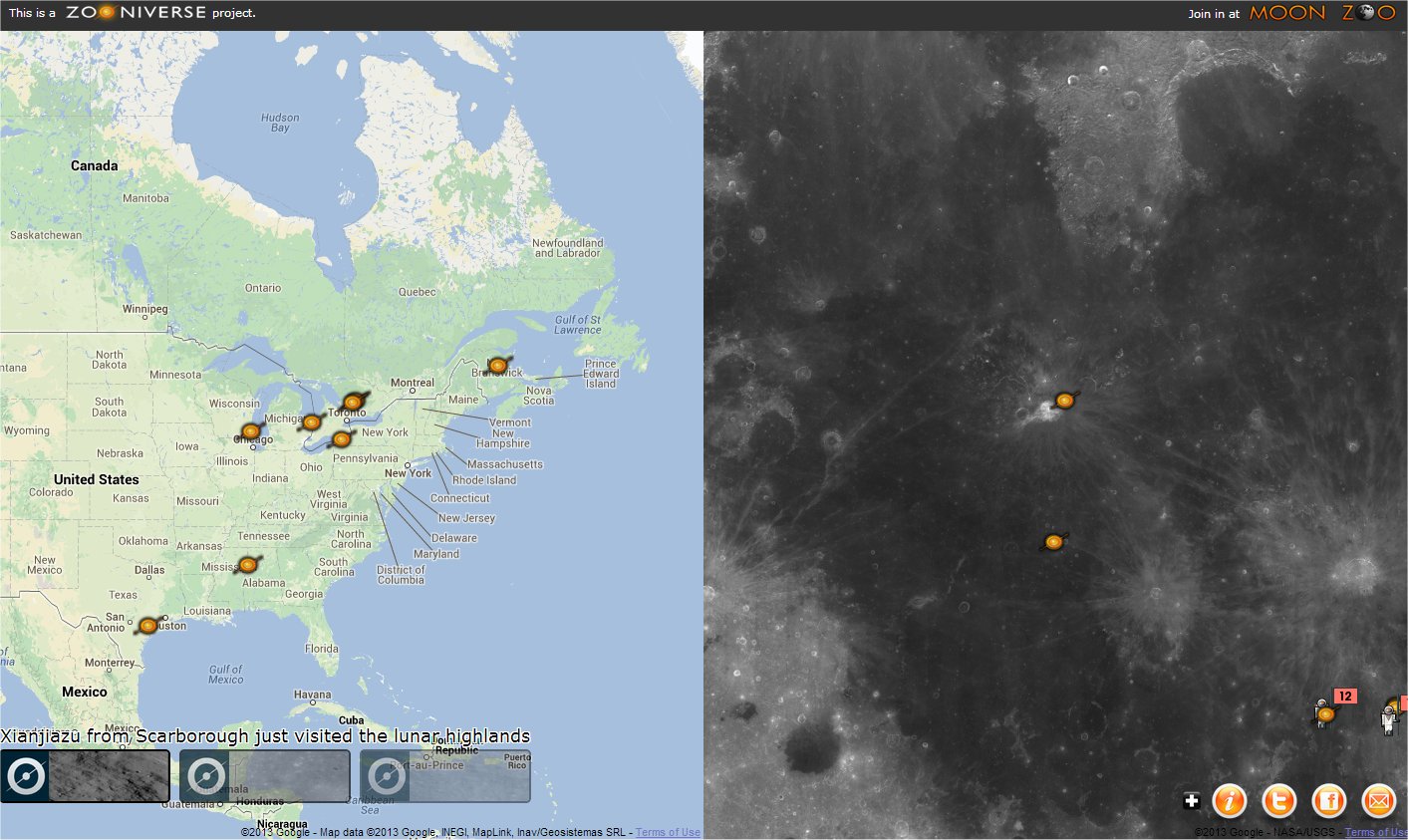
 Check out also the Moon Zoo Live page to see a real-time updated display of where the latest feature to be classified is located on the Moon and the location on earth of the classifier.

MoonZooLive_capture

===

As noted here recently, the Planet Hunters Ccitizen science project has recently announced the discovery of 14 exoplanet candidates, including the seventh in the first 7-planet system, which has the romanatic name of KOI-351. Robert Simpson, a co-author of the paper on the findings, has used the Celestia astronomy simulator to depict the KOI-351 system. Here is a video of the planets in action: Exploring the Tiny Planetary System of KOI-351 – Planet Hunters.

Tour of the Seven-Planet System Around the Star KOI-351
from Robert Simpson on Vimeo.

===

Zooniverse is an organization that runs a number of citizen science programs including Moon Zoo and Planet Hunters mentioned above. They are looking for programmers to work for them : Want to work with the Zooniverse?  Zooniverse.

10-year-old discovers a supernova

Nathan Gray, a Canadian youngster of 10, spots a supernova: 10-Year-Old Nathan Gray Discovers 600 Million-Year-Old Supernova – ibtimes.com.

His sister Kathryn had found a supernova when she was 10 as well: 10-year-old Canadian youngest ever to discover supernova: For amateur astronomers, discovering a supernova is a significant and rare feat. For a 10-year-old amateur to do it — well, that’s astronomical. – Toronto Star – Jan.4.11.


A quintet of Saturn moons

The ESA posts a great picture of a Quintet of Moons:

The image description:

Five moons pose for the international Cassini spacecraft to create this beautiful portrait with Saturn’s rings.

This view, from 29 July 2011, looks toward the northern, sunlit side of the rings from just above the ringplane.

At the far right, and obscuring Saturn itself, is the planet’s second largest moon Rhea, which spans 1528 km. Rhea is closest to Cassini in this composition, at a distance of 1.1 million kilometres. Its heavily cratered surface bears witness to a violent history, with many craters overlapping or erasing the traces of older impact events.

The nearly 400 km-wide Mimas lies just beyond, and seemingly levitates just above Saturn’s innermost rings. The outline of the moon’s large, distinguishing crater Herschel is partially covered by Rhea, but can just be made out along with numerous smaller craters.

Brightly reflective Enceladus appears above the centre of the image and lies beyond the rings, at a distance of 1.8 million kilometres from Cassini. Although not visible in this image, icy Enceladus is covered with a network of frozen ridges and troughs, with plumes of ice particles jetting from fissures in its southern hemisphere.

To the lower left, tiny Pandora, just 81 km across, appears skewered by Saturn’s outer rings – in fact, it orbits between the planet’s A and F rings.

Last but not least, the irregularly shaped Janus lies at the far left of the image, several shadowy surface markings corresponding to large impact craters.

The Cassini–Huygens mission is a cooperative project of NASA, ESA and ASI, the Italian space agency. NASA’s Jet Propulsion Laboratory, a division of the California Institute of Technology in Pasadena, manages the mission for NASA’s Science Mission Directorate, Washington DC, USA.


Kepler data analysis increases exoplanet candidate count by 833

Continued examination of the Kepler Observatory data has increased the number of candidate planets by 833 to over 3500. Though the observatory is no longer able to maintain pointing precision to the level sufficient to do the transit observations, there is a big storehouse of data yet to be analyzed and results will continue to arrive for a long time. Also, probably most “candidates” will eventually be confirmed as actual planets and not data artifacts.

Analysis of the planet data indicates that most every star in the Milky Way will probably have at least one planet orbiting it. And about a fifth of sun-like stars will have a planet similar to earth (1 to 2 times the mass of earth) orbiting within its so-called habitable zone, e.g. where the temperatures are sufficiently mild to allow liquid water to form if the atmosphere is dense enough.

Reports on the new findings:


Chart showing sizes of planet candidates as of November 2013.
Graph of the number of planet candidates in different mass categories
and the increase in each category from the latest Kepler data.
Image Credit: NASA
kepler-candidates-lined-up-4_0_2An illustration of the relative sizes of the exoplanets
candidates found by Kepler.