Sci-Tech: Updates on VTOL vehicle projects at UrbanAero and Aerofex

UrbanAero, which I’ve posted about occasionally over the years, is developing vertical takeoff and landing vehicles, both manned and unmanned, based on a design using large ducted fans. They have recently split their efforts into two subsidiaries:  Tactical Robotics will focus on military and homeland security markets while Metro Skyways will pursue civilian applications.

They recently posted an update on the testing of the large AirMule prototype:

Testing of the AirMule prototype is continuing.  As of June 2013 we have already accumulated a few hours of testing with the new six bladed rotors installed. The blade design complies with the loads specified in the FAA’s FAR 35 standard for propellers.  To verify the strength of the blades we have built a representative blade retainment section and tested it as shown in the attached photographs. The tests were run to twice the centrifugal load (which amounted to 22 tons pull on each blade retention fitting).

Most of the testing at this time is focused on improving the automatic takeoff and landing sequence in preparation for transitional flight which will commence in the next few weeks.  The first transitional tests will be carried out with the aircraft still tethered to the ground but this time with a single safety wire long enough to permit flight to the end of the runway.  The full test sequence will be a flight to the end of the runway, stopping, turning 180 degrees in hover and flying back to the point of origin with a final landing on a marker placed on the ground.  We will update on the progress of these tests in our next update.

===

A somewhat similar approach to VTOL vehicles is Aerofex‘s Tandem Duct Aerial Vehicle, i.e. a cool flying motorcycle. They occasionally post an update on their blog and here is an item from June 25th:  Flight Log: Deconstructed Vertical Flight

We believe we have hit our minimum (finally). Reliable lift on 16 moving parts – all derived from autos and motorcycles, readily serviceable just about anywhere in the world.

That includes the fans and engine (exc. bearings).
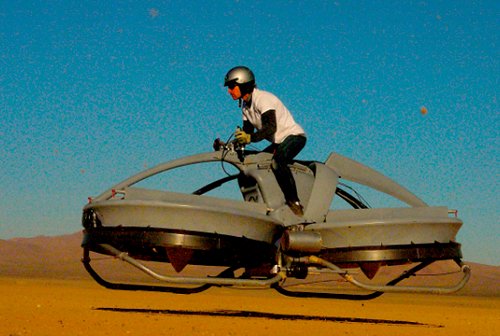
tandem_duct_aerial_vehicle_2m_500x336

A Honda commercial recently used a clip showing the Aerofex vehicle. The Aerofex – YouTube Channel offers several brief videos of a prototype vehicle in action such as this one:

Open Hardware Shuttle Project

Here is a crowd-funding campaign for an effort to develop the Exosphere space vehicle in a manner similar to that used for open software: Exosphere Open Hardware Space Shuttle – Indiegogo  –

The open hardware space shuttle project is an effort to bring the masses together to work on a spacecraft that can be owned by anyone. (Government regulations apply) The goal is to design and build a modular, reusable, and affordable space vehicle. Governments are the only ones that had access to space until recently. Privatization of space has opened the possibilities up for everyone.

The main problem we all have at this point is the means or ability. There are no shuttles we can own, yet. Private companies have a lot of capital invested in their designs and need to get a return on those investments. Because of this, the price for a ticket is higher than the annual salary of almost all Americans. By completing a design together – with Exosphere to ensure government regulations, safety standards, and testing are done properly – we could all have the ability to go to space in our lifetimes.

NASA’s KaBOOM radar could greatly improve detection and characterization of asteroids

The “Ka-BOOM” NASA project is developing a way to use an array of small high-frequency Ka-band radar dishes to map “nearby asteroids, orbital space debris, water on the Moon and even rover-trapping sand pits on Mars” : NASA Developing Prototype Asteroid-mapping Radar at KSC – SpaceNews.com.

The project was unveiled during a recent visit by NASA Associate Administrator Robert Lightfoot to KSC: NASA Associate Administrator Robert Lightfoot Visits Space Coast and Meets With Media June 3-4 – NASA.

He briefed reporters

on the agency’s new asteroid initiative and NASA’s new Ka-Band Objects Observation and Monitoring (KaBOOM) system, a three-antenna test bed radar array at Kennedy.

NASA recently announced plans to find, study, capture and relocate an asteroid for exploration by astronauts. The asteroid initiative is a strategy to leverage human and robotic activities for a first human mission while accelerating efforts to improve detection and characterization of asteroids.

The goal of KaBOOM is to prove technologies that will allow future systems to characterize near-Earth objects in terms of size, shape, rotation/tumble rate and to determine the trajectory of those objects. Radar studies can determine the trajectory 100,000 times more precisely than can optical methods.

Current NASA radar systems are limited in both resolution and the distance at which they are effective. KaBOOM is the penultimate, low-cost step before proceeding with a high-power, high-resolution radar system. NASA expects this proof of concept to be completed in about two years.

Here is a local Florida TV news report about the project: NASA to launch KaBOOM system: new way to track asteroids – ClickOrlando.com – June.5.13

Sci-Tech: Update on the SkyTug airship

Here’s an update on the big SkyTug airship that Lockheed-Martin is developing for a Canadian venture that wants to use it to transport cargo to and from remote areas: Proposed Rules Provide Peek at Lockheed’s Cargo Airship – Aviation Week

Here are some earlier articles about the system:

Here is a video showing the P-791 demonstrator that Lockheed began flying a few years ago:

http://youtu.be/isJRgEu7DQo

The Space Engine freeware simulator

The Space Engine is

a freeware space simulation software that lets you explore the universe in three dimensions, starting from planet Earth to the most distant galaxies. Areas of the known universe are represented using actual astronomical data, while regions uncharted by astronomy are generated procedurally. Millions of galaxies, trillions of stars, countless planets – all available for exploration.

Here are a couple of videos describing the program:

Find more space sim links in the HobbySpace Space Simulations section.