Morpheus Lander active today [Update 2]

Project Morpheus plans a tethered flight test today – Twitter / MorpheusLander:

Rise & shine friends! It’s a great day 4 a tether test @NASA_Johnson Follow along to be astounded. Aiming for 1-2pm CT [2-3pm ET] . #rocketengine #ALHAT

You can follow developments via the posts at Morpheus Lander (MorpheusLander) on Twitter.

Update: Watch the test on line – Twitter / MorpheusLander:

We are planning a LIVE stream of the test! Tune in & watch between 1-2pm CT! http://morpheuslander.jsc.nasa.gov/live/  We’ll stream appx 30 mins before test!

 Update 2: Here’s a video of the test:
Video: Shampooing in microgravity is a hair-raising activity

Astronaut Karen Nyberg, a member of the Expedition 36 Crew on the International Space Station, demonstrates in a new video how she washes her hair in space: Shampooing in outer space will make your hair stand on end – NBC News.com

Sizes of the major moons of the Solar System

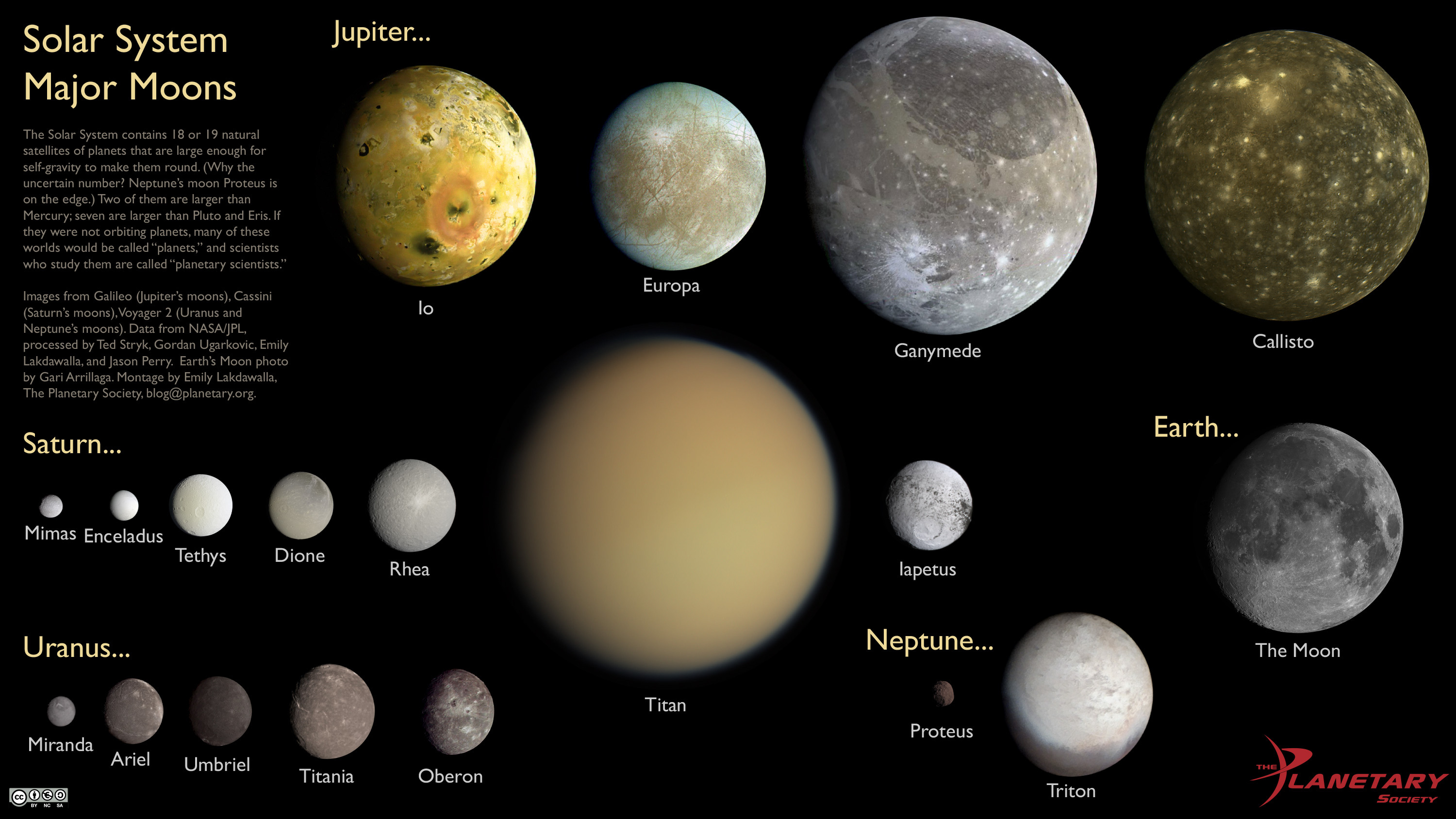
Here are some nice graphics Emily Lakdawalla of the Planetary Society displaying the relative sizes of major moons in our Solar System:

20130619_solar-system-major-moons-by-location-withtext_500x281

The Solar System contains 18 or 19 natural satellites of planets that are large enough for self-gravity to make them round. (Why the uncertain number? Neptune’s moon Proteus is on the edge.) They are shown here to scale with each other. Two of them are larger than Mercury; seven are larger than Pluto and Eris. If they were not orbiting planets, many of these worlds would be called “planets,” and scientists who study them are called “planetary scientists.” [Large image]

Montage by Emily Lakdawalla. The Moon: Gari Arrillaga. Other moons data: NASA/JPL. Processing by Ted Stryk, Gordan Ugarkovic, Emily Lakdawalla, and Jason Perry.

Space policy roundup – July.10.13 [Update]

Some space policy related items today:

Update:

“Black Beauty” – a watery meteorite from Mars

In this video from the SETI Institute‘s weekly seminar series, Carl B. Agee of the University of New Mexico talks about a special meteorite from Mars:

Caption:

Northwest Africa (NWA) 7034 is a new type of martian meteorite discovered in Morocco in 2011. NWA 7034 aka “Black Beauty”, nicknamed for its dark shiny appearance, contains ten times more water than other martian meteorites. This combined with its oxidation state which is highest among martian meteorites, its anomalous oxygen isotope values, and its early Amazonian age, make it an extraordinarily valuable specimen for understanding surface processes, aqueous alteration, and atmosphere/lithosphere exchange reactions that existed on Mars ~2 billion years ago.

Agee will show that Black Beauty appears to be the first martian meteorite to match the surface geochemistry of Mars, as seen by landers and orbiters, and as such, it has particular relevance to the current Mars Science Laboratory mission at Gale Crater.