Sci-Tech: 18th Int. Conference on Condensed Matter Nuclear Science at Univ. Missouri

The 18th International Conference on Condensed Matter Nuclear Science (ICCF-18) begins on Sunday at the University of Missouri in Columbia.

This is the first time the ICCF has been held at a major US university. The field is gradually overcoming the notoriety of the “cold fusion” label as growing numbers of  researchers find interesting phenomena that falls under the general category of low energy nuclear reactions or LENR.

The conference chair is Robert V. Duncan, Professor of Physics and Vice Chancellor for Research at MU. He had no connection to the field until he was asked a few years ago by the CBS 60 Minutes news program to take an independent outsider’s view of it . He came away very impressed and eventually started a program at MU to investigate the phenomena.

Here is Duncan’s intro to the conference:

We at the University of Missouri (MU) are delighted to team with ENEA and National Instruments to review and explore developments in condensed matter nuclear science. There have been great advances in this discipline over the last five years by research labs and private institutions around the world, and this work will be explored at ICCF-18.

The Naval Research Lab (NRL), and many other excellent laboratories have confirmed that the excess heat effects reported by Fleischmann and Pons are real, and roughly one thousand times larger than can be attributed to a chemical process. Other phenomena, such as transmutation and nuclear process of geologic origin, remain at the forefront of current inquiry.

There have also been developments and confirmations of nuclear process in other condensed matter systems, and many of these reports come from outside the traditional ICCF Community. For example, NASA, using its FERMI gamma burst satellite has confirmed antimatter ejections from major thunderstorms many hundreds of times.

In the past, we have seen the development of pyro-electric hydrogen fusion at UCLA, and the development of piezo-electric hydrogen fusion continues at MU today. Clearly, condensed matter nuclear science is undergoing a renaissance. Join us here at the University of Missouri as we review the state of our understanding of these systems, and as we apply the scientific method to understanding anomalous phenomena that are based upon reproducible empirical reports.

In this video of a panel discussion at the 2012 National Instruments NIWeek event, Duncan gives an introduction to the field. The panel also includes Dr. Andrea Aparo  (Ansaldo Energia SpA), Dr. Akito Takahashi (Osaka University), Frank Gordon (Co-chair International Conference on Cold Fusion, US Navy SPAWAR Systems Center), and Dr. Michael McKubre (SRI International).

Celebrate the Apollo 11 landing today

Today is the 44th anniversary of the first time a human walked on another world. Check out the site The First Men on the Moon: The Apollo 11 Lunar Landing

Watch, listen, and relive the excitement of the Apollo 11 lunar landing as experienced minute-by-minute by the courageous crew of Apollo 11 and Mission Control.

Here is a gallery of pictures taken by Apollo astronauts: The Best Space Images Ever Were Taken by Apollo Astronauts With Hasselblad Cameras – Wired Science.

This evening we are going to try the ceremony Evoloterra — When We First Left Planet Earth. (Two of the authors recently discussed Evoloterra on The Space Show.)

Moonandback offers an online documentary about the landing: The Journeys Of Apollo: Commemorating The Anniversary Of Apollo 11 Moon Landing – Moonandback

And here is another documentary in full:

Philip K. Dick European Science Fiction Festival announces early submissions

Here’s the latest announcement from the Philip K. Dick Film Festival:

The Philip K. Dick European Science Fiction Film Festival
Announces Early Submissions for First International Event

John Alan Simon’s Award-Winning Radio Free Albemuth To Headline Opening Night
Numerous Groundbreaking Films And Shorts Set To Be Screened

Brooklyn, N.Y. July 18, 2013 – The Philip K. Dick European Science Fiction Film Festival has announced the earliest submissions of films and shorts to be screened at its first international event which will honor one of the most respected writers within the literary world. The three-day experience will mark the first of many worldwide gatherings in the beautiful and historic Lille, France from October 25-27, 2013 at the famous L’Hybride Cinema venue. The films which are adapted or inspired from the works of Philip K. Dick will entertain and enthrall the innumerable fans who have continued to honor his enduring legacy within the genre of science-fiction.

The festival will launch with the highly anticipated screening of Radio Free Albemuth (2010) on Friday, October 25. Written and directed by John Alan Simon the film adaptation of Dick’s final novel stars Jonathan Scarfe (“Perception”), Shea Whigham (“Boardwalk Empire”), Katheryn Winnick (“Bones”) and Grammy Award-winning singer Alanis Morissette. A Q&A session with Simon is also scheduled to follow. The evening will continue its science fiction theme with the shorts Exit (2013), L’Esplanade (2012), Singularity (2013) and Meddlers (2011) which was adapted from Dick’s short story. The following night on Saturday, October 26 takes on a horror supernatural theme with Thanatomorphose (2012). Written and directed by Éric Falardeau the film stars Émile Beaudry, Eryka Cantieri and Roch-Denis Gagnon. On Sunday, October 27 the event concludes with science fiction works including Daniel Abella’s The Final Equation (2009), a highly conceived film inspired by Dick’s artistic genius and stars Robert Harriell, Cassandra Cooke and Paul Weissman. A Q&A session with Abella is also scheduled to follow. The night will commence with sci-fi shorts Dissent (2011), Un Monde Meilleur (2013) and Years in Bardo (2012).

The festival will screen all films with French subtitles and is currently accepting submissions into late September in science fiction and horror features and shorts. Admission at L’Hybride Cinema is currently by membership only and by purchasing tickets with five euros for one month or 30 euros for one year of the program. If not part of membership visitors can pay five euros on the first day of the festival to attend the three-day event and receive a pass for the next 30 days of subsequent venue events. Doors open at 7pm on Friday and Saturday and 6pm on Sunday.

As further details become available the festival anticipates a successful event in its first global outing. The first New York City festival saw record crowds of over 1,000 participants for the exclusive screening of Radio Free Albemuth which was based on Dick’s 1985 novel posthumously published three years after his death. The weekend-long festival also held numerous film screenings and panels with Simon, esteemed professors Ronald Mallet and Enrique Ricardo Miranda, distinguished writers Angela Posada-Swafford, Walter Mosley and Dennis Paoli and science fiction experts Richard Dolan and Peter Robbins. The team behind the annual festivities will also pioneer its second annual Brooklyn event in December 2013 for a record five-day gathering and a Spring 2014 cyberpunk festival in Tokyo.

The Philip K. Dick European Festival of Science Fiction, Science, The Fantastic, Horror and The Supernatural will delight its attendees with its entertaining and visually captivating themes which have made the event a favorable and continued success. The event will take place at L’Hybride Cinema at 18 Rue Gosselet 59000 in Lille, France from October 25-27, 2013.

Contact the venue at www.lhybride.org. For film submissions, deadlines and contacts please visit www.philipkdickfilmfestival-europe.com and www.withoutabox.com/login/12654 and always be sure to stay informed of all ongoing announcements on the festival’s Facebook page at www.facebook.com/ThePhilipKDickFilmFestival and Twitter page at twitter.com/ PhilipKDickFest.

About The Philip K. Dick Science Fiction Film Festival:
The Second Philip K. Dick International Film Festival of Science, Science Fiction, Fantastic Film and the Supernatural and the first of its kind to grace the screens of New York City is organized by filmmakers who understand the difficulties and challenges of telling a unique story in a corporate environment. The year 2013 marks the second year of the festival which will expand it’s genres of films, panels and venues throughout Brooklyn and Manhattan and its first international event in Lille, France. Guest speakers and writers that best represent the goals of the festival will attend the opening ceremonies. We look for original voices and visions in works submitted. Lastly, this is a festival by filmmakers for filmmakers.

About Philip K. Dick:
“Reality is whatever refuses to go away when I stop believing in it.” – Philip K. Dick Philip K. Dick (1928-1982) was one of the 20th century’s most profound novelists and writers within the science fiction community. His exploration, analysis and beliefs led to the publishings of 44 novels and 121 short stories. Dick’s enormous library of works led to several film developments including Blade Runner (1982), Total Recall (1990), Minority Report (2002), Paycheck (2003) and most recently Radio Free Albemuth (2010), The Adjustment Bureau (2011) and the successful remake of Total Recall (2012). The film industry is also awaiting the release of King of the Elves in 2014, which will surely be yet another prosperous depiction of Dick’s literary contribution to science fiction. Dick’s enormously effective views comprised of fictional universes, virtual realities and human mutation foresaw an exaggerated version of the current state of government and contemporary life. Though he is gone in the physical form his philosophies live on in the techniques applied to modern stories and films and generate large displays of appreciation and understanding.

For more information please contact:
Daniel Abella, Festival Director
Program Office: 917-362-9337
Email: info@thephilipkdickfilmfestival.com

Social Media
Facebook: https://www.facebook.com/ThePhilipKDickFilmFestival
Twitter: https://twitter.com/PhilipKDickFest
Meetup: http://www.meetup.com/The-Philip-K-Dick-science-fiction-Film-Festival/
Vimeo: http://vimeo.com/philipkdickfilmfestival
Fractured Atlas Donation Page: https://www.fracturedatlas.org/site/contribute/donate/6853

Wave at Saturn for your picture

About time to go outside and wave at Saturn. NASA’s Cassini spacecraft will be taking a picture of earth today between 2:27 and 2:42 PDT (5:27 and 5:42 p.m. EDT, or 21:27 and 21:47 UTC).

NASA’s MESSENGER spacecraft in orbit around Mercury will take images with earth in the picture at 4:49 a.m., 5:38 a.m. and 6:41 a.m. PDT (7:49 a.m., 8:38 a.m. and 9:41 a.m. EDT, or 11:49, 12:38, and 13:41 UTC) on Saturday.

NASA Interplanetary Probes to Take Pictures of Earth From Space

This simulated view from NASA's Cassini spacecraft shows the expected positions of Saturn and Earth on July 19, 2013, around the time Cassini will take Earth's picture
This simulated view from NASA’s Cassini spacecraft shows the expected positions of Saturn and Earth on July 19, 2013, around the time Cassini will take Earth’s picture. Cassini will be about 898 million miles (1.44 billion kilometers) away from Earth at the time. That distance is nearly 10 times the distance from the sun to Earth. Image credit: NASA/JPL-Caltech

PASADENA, Calif. — Two NASA spacecraft, one studying the Saturn system, the other observing Mercury, are maneuvering into place to take pictures of Earth on July 19 and 20.

The image taken from the Saturn system by NASA’s Cassini spacecraft will occur between 2:27 and 2:42 PDT (5:27 and 5:42 p.m. EDT, or 21:27 and 21:47 UTC) Friday, July 19. Cassini will be nearly 900 million miles (nearly 1.5 billion kilometers) away from Earth. NASA is encouraging the public to look and wave in the direction of Saturn at the time of the portrait and share their pictures via the Internet.

The Cassini Earth portrait is part of a more extensive mosaic — or multi-image picture — of the Saturn system as it is backlit by the sun. The viewing geometry highlights the tiniest of ring particles and will allow scientists to see patterns within Saturn’s dusty rings. Processing of the Earth images is expected to take a few days, and processing of the full Saturn system mosaic will likely take several weeks.

Inspired in part by the Cassini team’s plans to obtain a picture of Earth, scientists reexamined the planned observations of NASA’s MESSENGER spacecraft in orbit around Mercury. They realized Earth is coincidentally expected to appear in some images taken in a search for natural satellites around Mercury on July 19 and 20. Those images will be taken at 4:49 a.m., 5:38 a.m. and 6:41 a.m. PDT (7:49 a.m., 8:38 a.m. and 9:41 a.m. EDT, or 11:49, 12:38, and 13:41 UTC) on both days. Parts of Earth not illuminated in the Cassini images, including all of Europe, the Middle East and Central Asia, will appear illuminated in the MESSENGER images. MESSENGER’s images also will take a few days to process prior to release.

Details on how to find Saturn in the sky and participate in the event are available at: http://saturn.jpl.nasa.gov/waveatsaturn .

The public can share pictures by using the hashtag #waveatsaturn on Twitter, or uploading pictures to the event’s Flickr page at: http://www.flickr.com/groups/wave_at_saturn/ .

The event’s Facebook page is: http://bit.ly/waveatsaturn .

Cassini mission scientists also will be participating in a live Ustream show on Friday from 2 to 2:30 p.m. PDT (5 to 5:30 p.m. EDT): http://www.ustream.com/nasajpl2 .

For more information about the two NASA spacecraft, visit: http://www.nasa.gov/cassini , http://saturn.jpl.nasa.gov and http://www.nasa.gov/messenger .

F-1 engines recovered by Bezos venture are from Apollo 11

Bezos Expeditions, which is funded by Jeff Bezos of Amazon.com, has confirmed that the F-1 rocket engines they recovered from the Atlantic ocean floor are in fact from the Apollo 11 Saturn vehicle: F-1 Engine Recovery – Bezos Expeditions

SERIAL NUMBER 2044

When we stepped off the Seabed Worker four months ago in Port Canaveral, we had enough major components to fashion displays of two flown F-1 engines. We brought back thrust chambers, gas generators, injectors, heat exchangers, turbines, fuel manifolds and dozens of other artifacts – all simply gorgeous and a striking testament to the Apollo program. There was one secret that the ocean didn’t give up easily: mission identification. The components’ fiery end and heavy corrosion from 43 years underwater removed or covered up most of the original serial numbers. We left Florida knowing the conservation team had their work cut out for them, and we’ve kept our fingers crossed ever since.

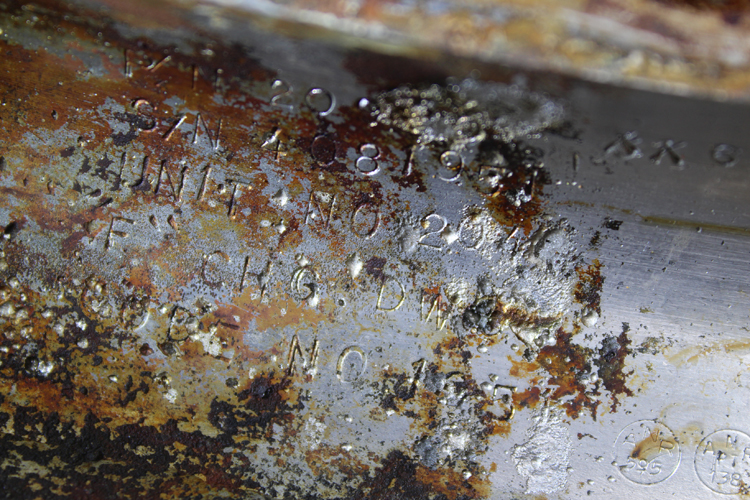
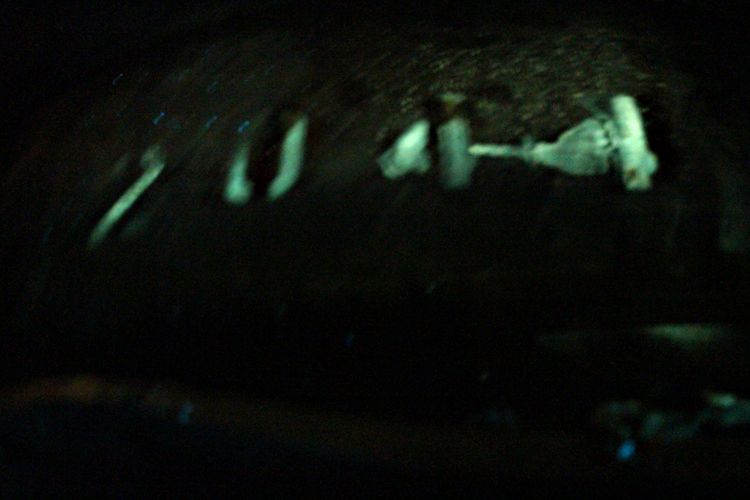
Today, I’m thrilled to share some exciting news. One of the conservators who was scanning the objects with a black light and a special lens filter has made a breakthrough discovery – “2044” – stenciled in black paint on the side of one of the massive thrust chambers. 2044 is the Rocketdyne serial number that correlates to NASA number 6044, which is the serial number for F-1 Engine #5 from Apollo 11. The intrepid conservator kept digging for more evidence, and after removing more corrosion at the base of the same thrust chamber, he found it – “Unit No 2044” – stamped into the metal surface.

Bezos Expeditions

Bezos Expeditions

44 years ago tomorrow Neil Armstrong stepped onto the moon, and now we have recovered a critical technological marvel that made it all possible. Huge kudos to the conservation team at the Kansas Cosmosphere and Space Center in Hutchinson, Kansas. Conservation is painstaking work that requires remarkable levels of patience and attention to detail, and these guys have both.

This is a big milestone for the project and the whole team couldn’t be more excited to share it with you all.

Sincerely,

Jeff

===

See also