Category Archives: Science and Technology

The sun got more angry in October

Bob Zimmerman gives an update on the state of the sun, which got more active last month, though still subdued compared to recent solar maximums : The sun goes boom! – Behind The Black.

Be sure to check daily the latest solar and space weather images and data displayed on the HobbySpace Sun & Space Weather page.  Here, for example, is an updated graph of the number of sunspots per month:

ISES Solar Cycle Sunspot Number Progression - NOAA


Sci-Tech: Nuclear fusion projects including General Fusion, Helion Energy and MSNW

Here’s an overview of several fusion power projects: The Nuclear Fusion Arms Race Is Underway –  Motherboard.

And here is info on a couple of alternative fusion approaches.

General Fusion, a Canadian based company that has raised $33M so far from Jeff Bezos and other private sources, is aiming for a reactor by the end of this decade. They have recently revamped their website and offers more info:

Their innovative acoustic driven compression technique is illustrated in this animation:

===

Prof. John Slough of the Plasma Dynamics Lab at the University of Washington is involved with a couple of spinoff companies using tech derived from his group’s work on compression of  FRC (Field Reverse Configuration) bubbles of plasma.

The company Helion Energy aims to develop a fusion power system:

The fusion propulsion project is based at the company MSNW LLC, which I recently posted about here: FISO: MSNW LLC and “the first realistic approach to fusion-based propulsion” – Space-for-All.

An updated overview was presented at the recent International Electric Propulsion Conference (IEPC2013) in Washington, D.C. : J. Slough, Electromagnetically Driven Fusion Propulsion, IEPC-2013-372

Sci-Tech: Lockheed proposing Mach 6 successor to SR-71

Aviation Week has a cover article on a proposed replacement for the Lockheed SR-71 Blackbird under study at Lockheed-Martin:  Exclusive: Skunk Works Reveals SR-71 Successor Plan – Aviation Week

After years of silence on the subject, Lockheed Martin’s Skunk Works has revealed exclusively to AW&ST details of long-running plans for what it describes as an affordable hypersonic intelligence, surveillance and reconnaissance (ISR) and strike platform that could enter development in demonstrator form as soon as 2018. Dubbed the SR-72, the twin-engine aircraft is designed for a Mach 6 cruise, around twice the speed of its forebear, and will have the optional capability to strike targets.

Guided by the U.S. Air Force’s long-term hypersonic road map, the SR-72 is designed to fill what are perceived by defense planners as growing gaps in coverage of fast-reaction intelligence by the plethora of satellites, subsonic manned and unmanned platforms meant to replace the SR-71. Potentially dangerous and increasingly mobile threats are emerging in areas of denied or contested airspace, in countries with sophisticated air defenses and detailed knowledge of satellite movements.

The vehicle’s propulsion system would integrate “an off-the-shelf turbine with a scramjet to power the aircraft from standstill to Mach 6 plus“.

[]

[]

Sci-Tech: Unbounded Robotics debuts the UBR-1 robot

Unbounded Robotics introduces the  UBR-1 automaton:  A Cheap, One-Armed Robot to Work with Humans: A mobile, one-armed robot that costs $35,000 is headed for research labs and maybe even some workplaces. – MIT Technology Review

tech_spec_callout

Introducing UBR-1 from Unbounded Robotics on Vimeo.

DOD SPHERES-RINGS to demo micro electromagnetic formation flight on ISS

Astronauts on the ISS will soon test two objects inside the station that will use steerable electromagnets to control their attitude and relative position and also to transfer power: Department of Defense Synchronized Position, Hold, Engage, Reorient, Experimental Satellites-RINGS – NASA

The Department of Defense Synchronized Position, Hold, Engage, Reorient, Experimental Satellites-RINGS (DOD SPHERES-RINGS) investigation uses the SPHERES facility and is designed to demonstrate and test, in a complex environment, enhanced technologies and techniques related to micro electromagnetic formation flight (EMFF) and wireless inductive power transfer. By advancing the knowledge base with regards to inter-satellite attitude control and wireless power transfer, future systems can expect enhanced attitude control performance between separate satellites and potentially the ability to efficiently transfer power at a distance, possibly alleviating the need for alternate or expendable (i.e., batteries) power sources.
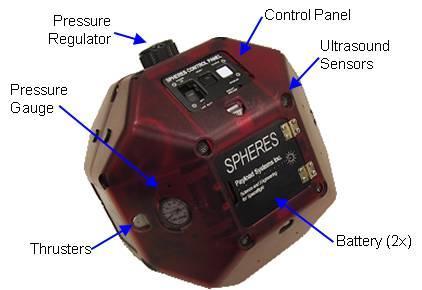
DOD_SPHERES-RINGS1

The technology could be quite useful in space:

As a test bed, the SPHERES facility serves to develop and test new technologies which, in turn, become part of future DoD and NASA missions. The DOD SPHERES-RINGS investigation hardware and algorithms were developed to enable autonomous propellant-free, plume-free satellite cluster maintenance. By advancing the knowledge base with regards to inter-satellite attitude control and wireless power transfer, future systems can expect enhanced attitude control performance between separate satellites and potentially the ability to efficiently transfer power at a distance, possibly alleviating the need for alternate or expendable (i.e., batteries) power sources. The inductive wireless power transfer experiment aids in establishing the hardware necessary for future wireless powering of space robotic, sensor and enhanced communications systems.

And on earth:

The inductive wireless power transfer experiment aids in establishing the hardware necessary for future wireless powering of urban robotics and sensor systems as well as enhanced underwater communications systems.

Find more about the project at ISS Crew To Test Electromagnetic Station-Keeping – Aviation Week