Category Archives: Science and Technology

Sci-Tech: Electronics with lossless conductors at room temperature

Not exactly room temperature superconductors but this DARPA supported theoretical research will be amazing if it works out  in real world  experiments:

Theorists Predict New State of Quantum Matter May Have Big Impact on Electronics
Experiments underway to validate topologically insulating stanene as first room temperature lossless conductor

Constantly losing energy is something we deal with in everything we do. If you stop pedaling a bike, it gradually slows; if you let off the gas, your car also slows. As these vehicles move, they also generate heat from friction. Electronics encounter a similar effect as groups of electrons carry information from one point to another. As electrons move, they dissipate heat, reducing the distance a signal can travel. DARPA-sponsored researchers under the Mesodynamic Architectures (Meso) program, however, may have found a potential way around this fundamental problem.

Meso program researchers at Stanford University recently predicted stanene will support lossless conduction at room temperature. Stanene is the name given by the researchers to 2-D sheets of tin that are only 1-atom thick. In a paper appearing in Physical Review Letters the team predicts stanene would be the first topological insulator to demonstrate zero heat dissipation properties at room temperature, conducting charges around its edges without any loss. Experiments are underway to create the material in laboratory conditions. If successful, the team will use stanene to enhance devices they are building under the Meso program.

“We recently realized there is another state of electronic matter: a topological insulator. Materials in a topologically insulating state are like paying for the gasoline to accelerate your car to highway speeds, but then cruising as far as you want on that highway without using up any more gas,” said Jeffrey Rogers, DARPA program manager. “Experiments should tell us what penalty electrons would pay for connecting to stanene in a practical application. However, the physics of stanene point to zero dissipation of heat—meaning electrons take an entropy hit once and then travel unimpeded the rest of the distance.”

Researchers at Stanford reported the first topological insulators in 2006 under a previous DARPA effort known as the Focus Center Research Program. The current Meso program developed the theory for stanene as part of research into more efficient ways to move information inside microchips. Other materials’ capabilities have come close, but only at temperatures that require extreme sub-zero temperatures created with bulky methods such as liquid helium.

“Stanene is a bold, yet compelling prediction,” said Rogers. “If the experiments underway confirm the theory, the application of a new lossless conductor becomes a very exciting prospect in the world of electronics. A host of applications—almost any time information is moved electronically from one place to another—could benefit.”
Sci-Tech: The SeaOrbiter

Here’s an update on the SeaOrbiter project, which would create an ocean vessel parallel to a space station. The SeaOrbiter would travel the world’s ocean carrying out long term marine research in a semi-submersible structure with work areas both above and deep below the surface.  Underwater vehicles that can dock with the lower section would in turn go down to depths of 6000 meters : SeaOrbiter: Help Build This Space Station of the Sea – News Watch

[]

An overview of the project:


DARPA project demonstrates imaging with lightweight membrane optics suitable for large space telescopes

Perhaps this technology will be suitable for making telescopes large enough to resolve exoplanets:

First Folding Space Telescope Aims to “Break the Glass Ceiling” of Traditional Designs

MOIRE program creates first-ever images using lightweight membrane optics,
which could help redefine how we build, launch and use orbital telescopes

The capability of orbital telescopes to see wide swaths of the earth at a time has made them indispensable for key national security responsibilities such as weather forecasting, reconnaissance and disaster response. Even as telescope design has advanced, however, one aspect has remained constant since Galileo: using glass for lenses and mirrors, also known as optics. High-resolution imagery traditionally has required large-diameter glass mirrors, which are thick, heavy, difficult to make and expensive. As the need for higher-resolution orbital imagery expands, glass mirrors are fast approaching the point where they will be too large, heavy and costly for even the largest of today’s rockets to carry to orbit.

DARPA’s Membrane Optical Imager for Real-Time Exploitation (MOIRE) program seeks to address these challenges. MOIRE aims to create technologies that would enable future high-resolution orbital telescopes to provide real-time video and images of the Earth from Geosynchronous Earth Orbit (GEO)—roughly 22,000 miles above the planet’s surface. Size and cost constraints have so far prevented placing large-scale imaging satellites in GEO, so MOIRE is developing technologies that would make orbital telescopes much lighter, more transportable and more cost-effective.

Currently in its second and final phase, the program recently successfully demonstrated a ground-based prototype that incorporated several critical technologies, including new lightweight polymer membrane optics to replace glass mirrors. Membrane optics traditionally have been too inefficient to use in telescope optics. MOIRE has achieved a technological first for membrane optics by nearly doubling their efficiency, from 30 percent to 55 percent. The improved efficiency enabled MOIRE to take the first images ever with membrane optics.

While the membrane is less efficient than glass, which is nearly 90 percent efficient, its much lighter weight enables creating larger lenses that more than make up the difference. The membrane is also substantially lighter than glass. Based on the performance of the prototype, a new system incorporating MOIRE optics would come in at roughly one-seventh the weight of a traditional system of the same resolution and mass. As a proof of concept, the MOIRE prototype validates membrane optics as a viable technology for orbital telescopes.

“Membrane optics could enable us to fit much larger, higher-resolution telescopes in smaller and lighter packages,” said Lt. Col. Larry Gunn, DARPA program manager. “In that respect, we’re ‘breaking the glass ceiling’ that traditional materials impose on optics design. We’re hoping our research could also help greatly reduce overall costs and enable more timely deployment using smaller, less expensive launch vehicles.”

Instead of reflecting light with mirrors or refracting it with lenses, MOIRE’s membrane optics diffract light. Roughly the thickness of household plastic wrap, each membrane serves as a Fresnel lens—it is etched with circular concentric grooves like microscopically thin tree rings, with the grooves hundreds of microns across at the center down to only 4 microns at the outside edge. The diffractive pattern focuses light on a sensor that the satellite translates into an image.

MOIRE technology houses the membranes in thin metal “petals” that would launch in a tightly packed configuration roughly 20 feet in diameter. Upon reaching its destination orbit, a satellite would then unfold the petals to create the full-size multi-lens optics. The envisioned diameter of 20 meters (about 68 feet) would be the largest telescope optics ever made and dwarf the glass mirrors contained in the world’s most famous telescopes.

From GEO, it is believed, a satellite using MOIRE optics could see approximately 40 percent of the earth’s surface at once. The satellite would be able to focus on a 10 km-by-10 km area at 1-meter resolution, and provide real-time video at 1 frame per second.

Ball Aerospace and Technologies Company and the U.S. Air Force Academy are the prime contractors for Phase 2 of the MOIRE program.

Sci-Tech: Electric 2-seat volocopter makes first test flights

The German e-volo company has now flown, in unmanned mode, its two seat electric volocopter.

The vehicle, inspired by the  multi-rotor scale model fliers like the popular RC quadcopters, has 18 independently powered rotors.

The maiden flight and first test flights were conducted in the dm-arena in Karlsruhe with the prototype of the 2-person VC200 on Sunday, November 17, 2013. Based on this model, it will be prepared for series production in the coming years.

With multiple flights lasting several minutes reaching the nearly 22 m high ceiling of the dm-arena, including a number of smooth takeoffs and landings, the Volocopter concept exceeded all expectations. “Rich and incredibly quiet sound, absolutely no noticeable vibrations in the flight, convincing structure with a great, new spring strut landing gear, and an extremely calm rotor plane,“ concluded the e-volo team.

SciTech: Zee.Aero developing personal VTOL

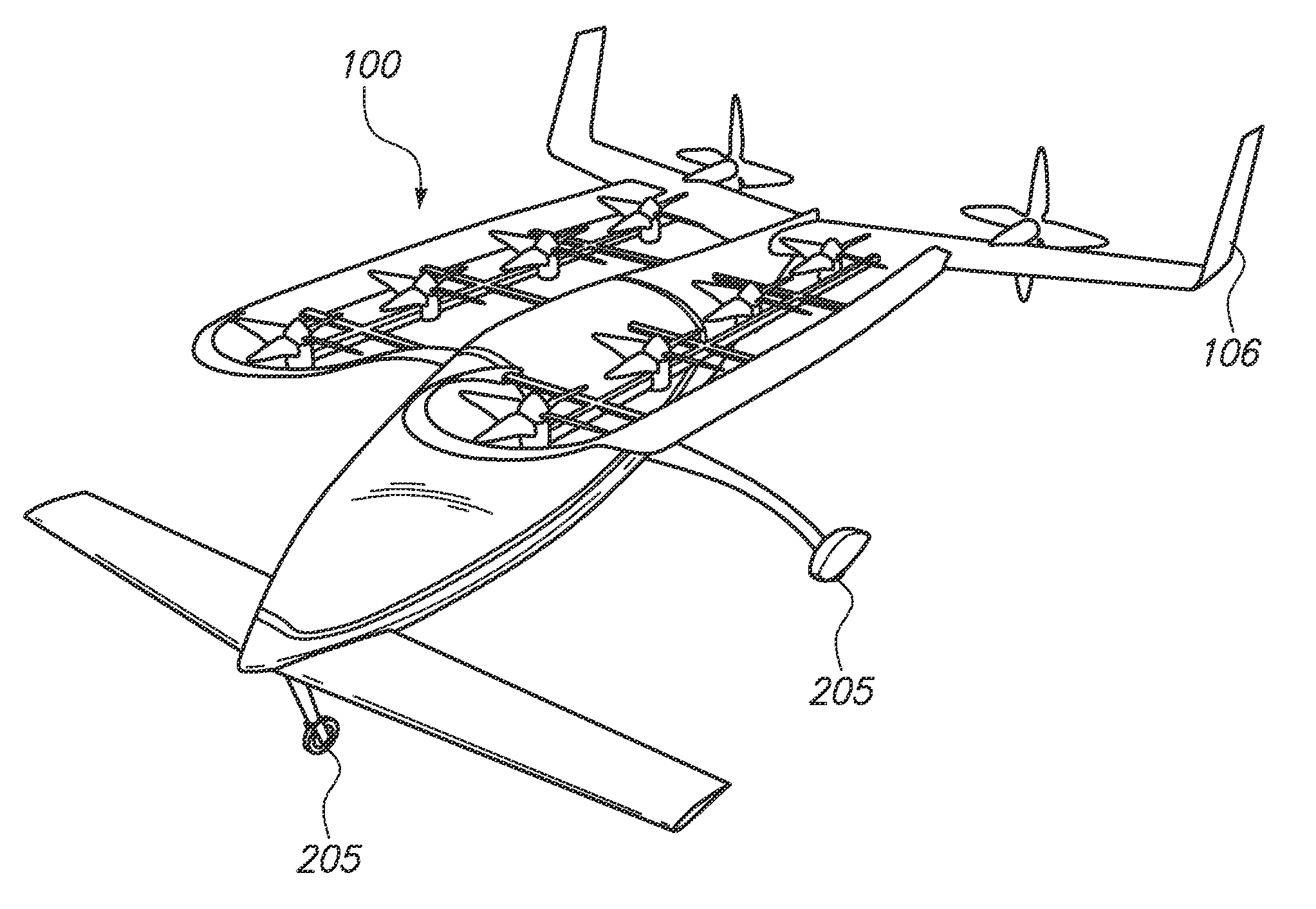
Zee.Aero is a secretive Bay Area startup that is apparently designing a vertical takeoff and landing (VTOL) vehicle with (perhaps0 some support from Google:

US20130214086A1-20130822-D00000