Category Archives: Science and Technology

FanWing wins EU award to design cargo-lifting vehicle

The FanWing project announced at the end of 2013

that, following an unexpected approach early this year from Germany, it has become joint recipient for a European Union Award. The new two-year research and development SOAR project aims to optimise the originally patented FanWing rotor and wingshape and explore feasibility of a full-size cargo-lifting FanWing (see image below).  

DLR, the German Aerospace and Space Research Centre, led the original award application. They will administer the project and provide final data documentation for the EU. Test models and oversight throughout the project will be provided by the FanWing Company in consultation with George Seyfang. The University of Saarland will provide motors and the actuation process for the rotors. The Von Karman Institute, Belgium will provide wind-tunnel tests and CFD analysis.
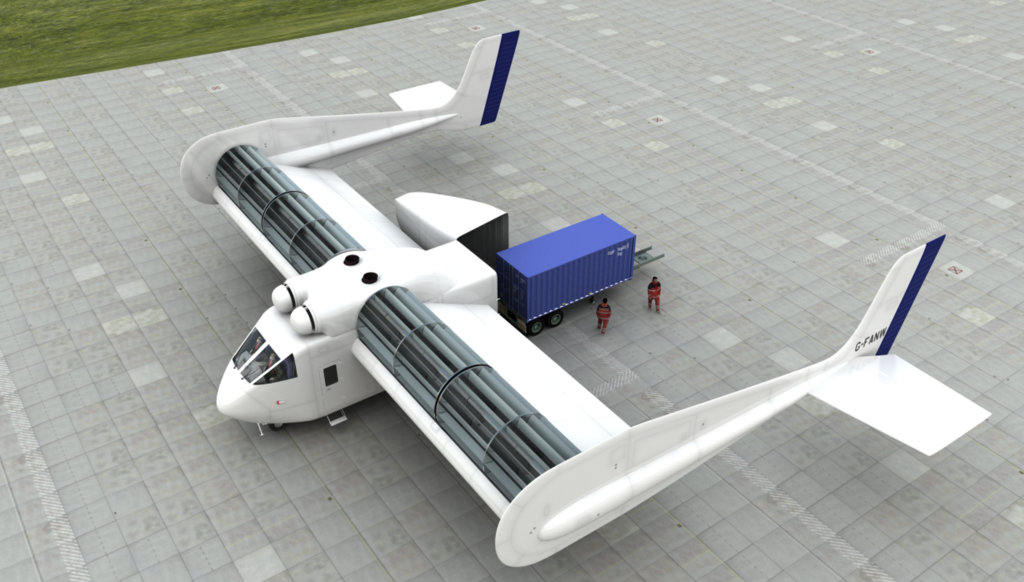
Ground 2 HR-004Simulated view of Fanwing cargo carrier.

From the entry at European Commission : CORDIS : Projects : SOAR

Objective

The SOAR open-fan wing technology at the focus of this project is a new concept that distributes the thrust and powered-lift over the entire span of the wing resulting in a model-proven lift efficiency three times that of helicopters as well as truly quiet U-STOL performance and safe autorotation landing.

Wind tunnel testing augmented by CFD simulations during the SOAR programme are expected to bring improvements in lift efficiency, flight speed and cruise economy on the order of 10% to 20% relative to those seen on small-scale wind tunnel and flight models.

The experimental data collected in this programme will be incorporated in a common aircraft design study targeting a certain mission range. The aircraft is developed in two versions – one passenger and one freight aircraft. The passenger version carries about 60-70 passenger. The freighter version is able to carry up to eight tons of freight. These two aircraft projections, based on the same wing and propulsion system, will subsequently be evaluated in terms of their direct operating cost in comparison with competing types such as conventional STOL aircraft, helicopters and Tilt-rotor aircraft.

It is believed that the SOAR open-fan wing technology, to be developed during this programme, will provide significant technical data at a much larger scale than previously; and this will eventually lead to a new class of aircraft with attractive operational and economic features.
Videos: Moonshot technologies at Solve-for-X

Here’s a sampling of talks given at a recent Google sponsored Solve for X event in which many “moonshot” ideas were presented:

Dmitriy Tseliakhovich of Escape Dynamics describes microwave powered space launch:

Julia Greer of Caltech describes 3D architected nano-metamaterials

Suchitra Sebastian discusses  A New Generation of Superconductors

Ido Bachelet talks about surgical nanorobotics

Video: Philip Lubin (UCSB) on planetary defense with beamed power

Speaking of lasers,  Philip Lubin, a professor of experimental cosmology at UC Santa Barbara, gives a SETI Institute lecture on the DE-STAR project to design a system to protect earth from comet and asteroid collisions : Is Planetary Defense Feasible – DE-STAR: A Planetary Defense and Exploration System –

Dr. Lubin will discuss how his team has proposed an orbital planetary defense system that is capable of beamed power allowing a number of directed energy (DE) possibilities including planetary defense, propulsion allowing relativistic probes and interstellar communications using existing technologies. Recent developments in photonics allow such a system whereas even a decade ago it would have been simply science fiction.


Sci-Tech: Milestone achieved in laser fusion

The National Ignition Facility at Lawrence Livermore National Laboratory has achieved scientific break-even in laser fusion tests for the first time. This is comparing the amount of laser energy impinging upon a tiny drop of tritium-deuterium to the fusion energy that takes place in the droplet due to the compression and high temperatures resulting from the blast of laser light:

The amount of fusion energy, however, is still only about 1% of the total energy needed to create those laser pulses. However, as they understand better how to shape and time the pulses and how to design the fuel droplet and the “hohlraum” capsule that holds it, the fusion output could rise very rapidly. This ignition condition occurs when the heat of the fusions starts to drive other tritium-deuterium fusions, which in turn creates more heat, etc.

To build a reactor from such a process will require an efficient way to turn the emitted energy (high energy helium nuclei and neutrons) into heat to drive electrical generators. And the rate of laser pulsing needs to be increased substantially. All tough technology challenges.

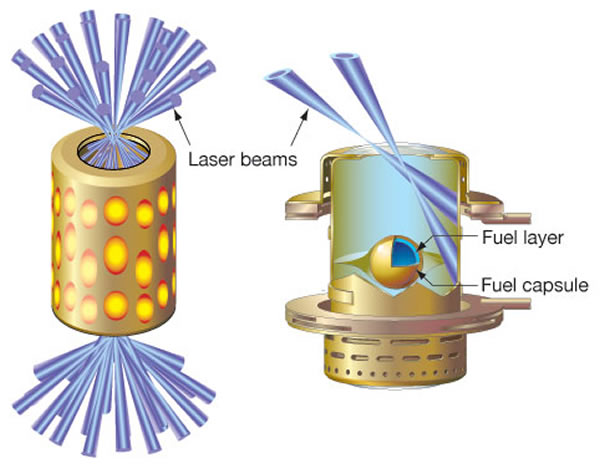
Drawings of a NIF Hohlraum

All of the energy of NIF’s 192 beams is directed inside a gold cylinder called a
hohlraum,  which is about the size of a dime. A tiny capsule inside the hohlraum
contains atoms of deuterium (hydrogen with one neutron) and tritium (hydrogen with
two neutrons) that fuel the ignition process. Credit: LLNL

Sci-Tech: DARPA ARES to develop unmanned VTOL vehicles for front-line supply services

I’m still waiting for my vertical takeoff and landing car but meanwhile DARPA is aiming for medium-scale unmanned ducted fan VTOLs that can bring supplies and other services to places hard-to-reach by helicopters or other means:

ARES Aims to Provide More Front-line Units with
Mission-tailored VTOL Capabilities

Unmanned aerial logistics system would bypass ground-based threats
and enable faster, more effective delivery of cargo and other essential
services in hard-to-reach areas

U.S. military experience has shown that rugged terrain and threats such as ambushes and Improvised Explosive Devices (IEDs) can make ground-based transportation to and from the front lines a dangerous challenge. Combat outposts require on average 100,000 pounds of material a week, and high elevation and impassable mountain roads often restrict access. Helicopters are one solution, but the supply of available helicopters can’t meet the demand for their services, which cover diverse operational needs including resupply, tactical insertion and extraction, and casualty evacuation.

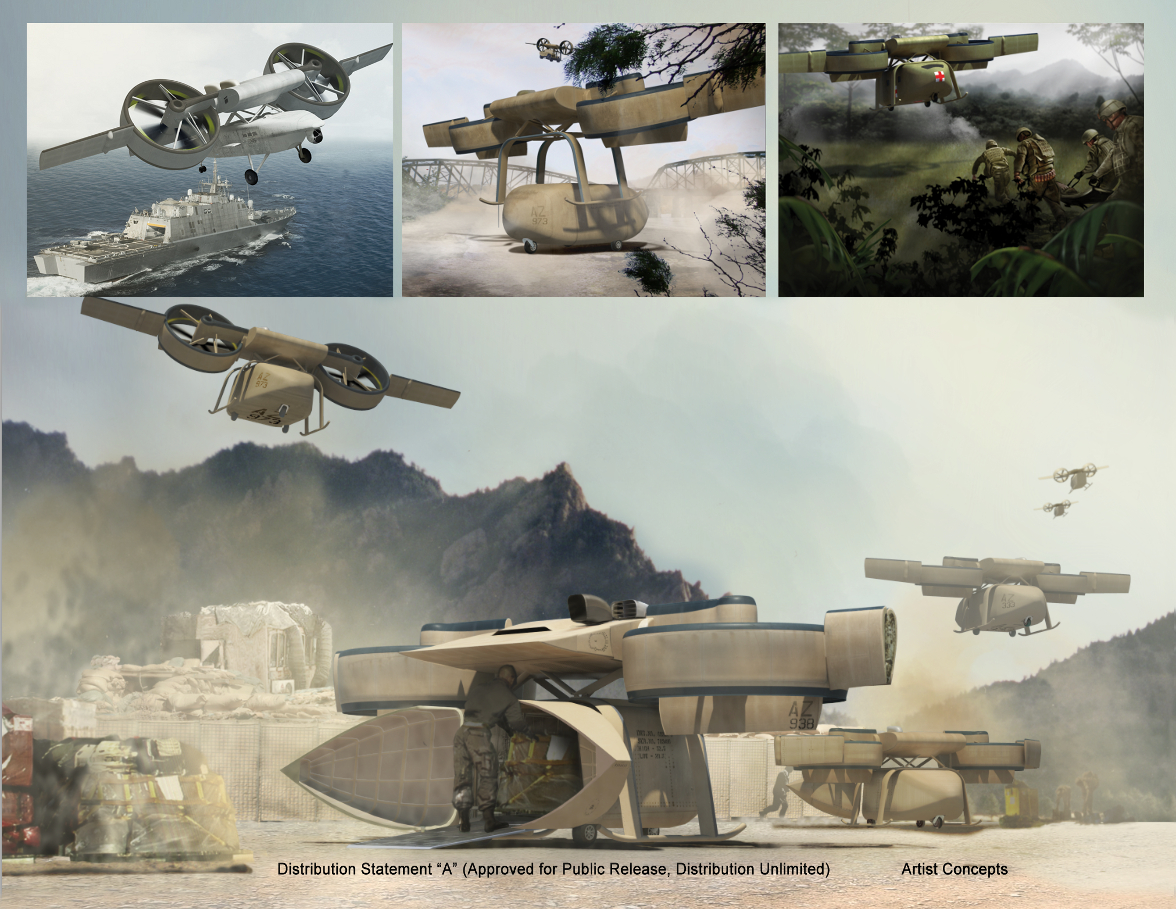
ARES Concepts v2

To help overcome these challenges, DARPA unveiled the Transformer (TX) program in 2009. Transformer aimed to develop and demonstrate a prototype system that would provide flexible, terrain-independent transportation for logistics, personnel transport and tactical support missions for small ground units. In 2013, DARPA selected the Aerial Reconfigurable Embedded System (ARES) design concept to move forward.

“Many missions require dedicated vertical take-off and landing (VTOL) assets, but most ground units don’t have their own helicopters,” said Ashish Bagai, DARPA program manager. “ARES would make organic and versatile VTOL capability available to many more individual units. Our goal is to provide flexible, terrain-independent transportation that avoids ground-based threats, in turn supporting expedited, cost-effective operations and improving the likelihood of mission success.”

ARES would center on a VTOL flight module designed to operate as an unmanned aerial vehicle (UAV) capable of transporting a variety of payloads. The flight module would have its own power system, fuel, digital flight controls and remote command-and-control interfaces. Twin tilting ducted fans would provide efficient hovering and landing capabilities in a compact configuration, with rapid conversion to high-speed cruise flight similar to small aircraft. The system could use landing zones half the size typically needed by similarly sized helicopters, enabling it to land in rugged terrain and aboard ships.

It is envisioned that the flight module would travel between its home base and field operations to deliver and retrieve several different types of detachable mission modules, each designed for a specific purpose—cargo pickup and delivery, casualty extraction or airborne intelligence, surveillance, and reconnaissance (ISR) capabilities, for instance. The flight module would have a useful load capability of up to 3,000 pounds, more than 40 percent the takeoff gross weight of the aircraft.

Units could direct the flight modules using apps on their mobile phones or ruggedized tablets. Initially, the system would be unmanned, with a future path towards semi-autonomous flight systems and user interfaces for optionally manned/controlled flight.

ARES is currently in its third and final phase. Lockheed Martin Skunk Works™ is the lead vehicle design and system integration performer for Phase 3 of the program.