Category Archives: Asteroids & Comets

Third largest NEO discovered to be a comet, not an asteroid

The near earth object 3552 Don Quixote is found to be a comet rather than an asteroid:

Professor Helps to Discover Near-Earth Asteroid Is Really a Comet
– Tennessee Today

Some things are not always what they seem—even in space. For thirty years, scientists believed a large near-Earth object was an asteroid. Now, an international team including Joshua Emery, assistant professor of earth and planetary sciences at UT, has discovered it is actually a comet.

Called 3552 Don Quixote, the body is the third largest near-Earth object—mostly rocky bodies, or asteroids, that orbit the Sun in the vicinity of Earth. About 5 percent of near-Earth objects are thought to be “dead” comets that have shed all the water and carbon dioxide in the form of ice that give them their coma—a cloud surrounding the comet nucleus—and tail.

donquixote_orbitThis image displays Don Quixote’s orbit.

The team found that Don Quixote is neither. It is, in fact, an active comet, thus likely containing water ice and not just rocks. The finding will be presented at the European Planetary Science Congress 2013 in London today, Sept. 10. The discovery could hold implications for the origin of water on Earth.

“Don Quixote has always been recognized as an oddball,” said Emery. “Its orbit brings it close to Earth, but also takes it way out past Jupiter. Such a vast orbit is similar to a comet’s, not an asteroid’s, which tend to be more circular—so people thought it was one that had shed all its ice deposits.”

Using the Spitzer Space Telescope operated by the Jet Propulsion Laboratory at the California Institute of Technology under contract with NASA, the team—led by Michael Mommert of Northern Arizona University—reexamined images of Don Quixote from 2009 when it was in the part of its orbit closest to the Sun, and found it had a coma and a faint tail.

Emery also reexamined images from 2004, when it was at its farthest distance from the sun, and determined that the surface is composed of silicate dust, which is similar to comet dust. He also determined that Don Quixote did not have a coma or tail at this distance, which is common for comets because they need the sun’s radiation to form the coma and the sun’s charged particles to form the tail. The researchers also confirmed Don Quixote’s size and the low, comet-like reflectivity of its surface.

“The power of the Spitzer telescope allowed us to spot the coma and tail, which was not possible using optical telescopes on the ground,” said Emery. “We now think this body contains a lot of ice, including carbon dioxide and/or carbon monoxide ice, rather than just being rocky.”

This discovery implies that carbon dioxide and water ice might be present within other near-Earth asteroids, as well. It also may have implications for the origins of water on Earth as comets may be the source of at least some of it, and the amount on Don Quixote represents about 100 billion tons of water—roughly the same amount that can be found in Lake Tahoe.

The project was funded by NASA’s Spitzer Space Telescope project and the German Research Foundation. Co-authors are Joseph Hora and Howard Smith, Harvard-Smithsonian Center for Astrophysics; Alan Harris, German Aerospace Center; William Reach, Universities Space Research Association; Cristina Thomas, NASA Goddard Space Flight Center; Michael Mueller, Space Research Organization Netherlands ; Dale Cruikshank, NASA Ames Research Center; David Trilling, Northern Arizona University; and Marco Delbo’, Observatoire de la Côte d’Azur.
Video: John S. Lewis talk on asteroids and mining them

Here is a video of the talk by asteroid guru John Lewis (see earlier post) given in Silicon Valley last night:

“To the Asteroids – and Beyond” – John S. Lewis talk webcast

Long time asteroid mining proponent John S Lewis will give a SETI Institute public talk this evening that will also be available online (7 pm PDT, 10 pm EDT):

Please join us tonight at 7pm for a free public talk at the SETI Institute Headquarters at 189 Bernardo Ave, Mountain View.

If you can’t be at the SETI Institute in person, the talk will be broadcast online and live at the following link: https://plus.google.com/events/cfij418phv10tocljpb2dp56630

****************************************************************

Title:        “To The Asteroids – and beyond!”
Speaker:   John Lewis (UAz)
When:      Tonight, 10 September 7pm PDT, 2013
Where:     Colloquium Room, SETI Headquarters, 189 Bernardo Ave, Mountain View
Poster:      http://www.seti.org/sites/default/files/csc-Sep-13.pdf
Live link:  https://plus.google.com/events/cfij418phv10tocljpb2dp56630
****************************************************************

Abstract:

Tsiolkovsii and Goddard dreamed of the day when we would have access to the resources  of the asteroids.  Today, with an enormous and rapidly growing body of data on meteorites,  the Near-Earth Asteroids (NEAs) and their more distant counterparts, we can envision the propulsion systems, transportation system architectures, ores, processing schemes and markets for products made from materials sourced in nearby space.  Most of these products are of greatest value and significance in space; some, such as platinum-group metals and
energy, would be worth returning to Earth.

The resources of the NEAs also provide the propellants and structural materials for a broad expansion of human presence in space.

Dr. John Lewis is the author of the 1997 book “Mining the Sky” and is an Emeritis Professor of Planetary Science at University of Arizona. This talk will survey the what, where, how and why of space resource utilization– and raise the timely question of when.

Update: Here is the talk:

“To the Asteroids – and Beyond” – John S. Lewis talk webcast

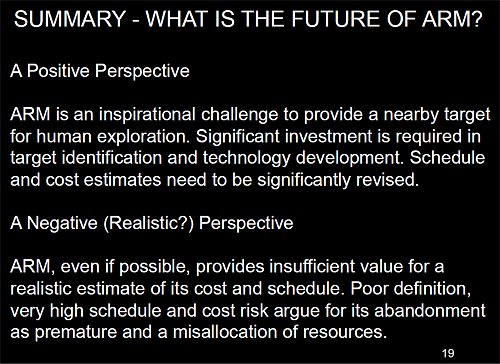
FISO: Small Bodies Assessment Group’s low assessment of the asteroid retrieval mission

The latest presentation to the Future In-Space Operations (FISO) study group is now posted in the FISO Working Group Presentations Archive. Both slides (pdf) and audio (mp3) are available for the talk, “SBAG Findings on ARM – Is There a Role for NEOs in Human Exploration?”, Mark Sykes, Planetary Science Institute – Sept.4.13

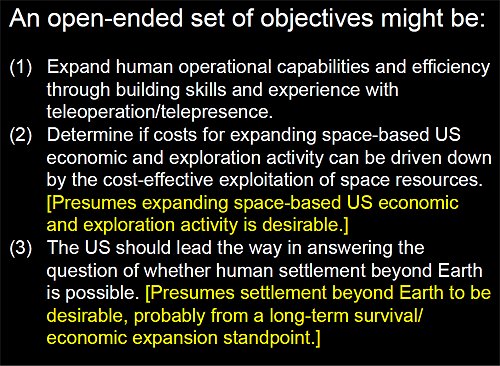
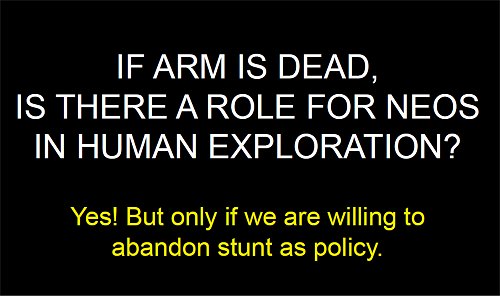
Mark V. Sykes of the Planetary Science Institute reports on the negative review of NASA’s proposed Asteroid Retrieval/Redirect Mission (ARM) by the  Small Bodies Assessment Group (SBAG).

A sampling of his slides: Sykes_Summary_500x364

Sykes_Summary_ARM_HSF_500x296

Sykes_Summary_Objectives_500x366

Video: Fireball in the sky over southeast US

A super bright meteor fireball was visible over the southeastern USA during the early hours of August 28th: Fireball outshines moon:  NASA cameras captured video of a meteor streaking past the moon. The fireball was one of the brightest observed by NASA in the past five years. – CSMonitor.com

“Recorded by all six NASA cameras in the Southeast, this fireball was one of the brightest observed by the network in 5 years of operations,” Bill Cooke, head of the Meteoroid Environment Office at NASA’s Marshall Space Flight Center in Huntsville, Ala., wrote in a blog post Tuesday (Sept. 3).

“From Chickamauga, Georgia, the meteor was 20 times brighter than the full moon; shadows were cast on the ground as far south as Cartersville.”

Here’s a brief video of the fireball talken by a NASA camera:

Caption:

Early Wednesday morning, at 3:27:20 AM Eastern Time, a piece of an asteroid, about 2 feet in diameter and weighing over 100 pounds, entered Earth’s atmosphere above the Georgia/Tennessee border, just south of Cleveland. The meteor was moving northeast at 56,000 miles per hour, and began to break apart north east of Ocoee, at an altitude of 33 miles. A second, fragmentation occurred less than half a second later, at an altitude of 29 miles. NASA cameras lost track of the fireball pieces at an altitude of 21 miles, by which time they had slowed to a speed of 19,400 mph. Sensors on the ground recorded sound waves (“sonic booms”) from this event, and there are indications on Doppler weather radar of a rain of small meteoritic particles falling to the ground east of Cleveland, Tennessee.