Category Archives: Asteroids & Comets

Rosetta spacecraft awakens

After a 31 month hibernation period, the Europe Space Agency’s Rosetta spacecraft has awakened and sent radio signals indicating that it has reactivated itself: Rosetta Mission Report | Mission Status Center – Spaceflight Now.

Rosetta was launched on an  Ariane 5G+ rocket on March 2, 2004. It flew passed asteroids 2867 Steins (in 2008) and 21 Lutetia (in 2010), and then went into hibernation in 2011. It will now pursue its main goal, comet 67P/Churyumov-Gerasimenko. It will rendezvous with the comet in August 2014 and go into orbit around it. It will also put a small lander on the comet.

Here’s a short ESA video about Rosetta waking up from its hibernation period:

Caption:

Visualisation of how the Rosetta spacecraft wakes up from deep space hibernation, 673 million kilometres from the Sun, on 20 January 2014.

Prior to entering hibernation on 8 June 2011, Rosetta was oriented so that its solar arrays faced the Sun, and it began rotating once per minute for stability. The only devices left running were its computer and several heaters.

Rosetta’s computer is programmed to carry out a sequence of events to re-establish contact with the Earth on 20 January, starting with an ‘alarm clock’ at 10:00 GMT. Immediately after, the star trackers begin to warm up. Around 6 hours later the thrusters are fired and the slow rotation stops. A slight adjustment is made to Rosetta’s orientation to ensure that the solar arrays now face the Sun. Then the star trackers switch on to determine its attitude. The spacecraft rotates towards Earth, and the transmitter is switched on. Then Rosetta’s high-gain antenna points to Earth and the signal is sent. The journey takes 45 minutes before the signal is received and mission controllers can begin to check Rosetta’s health, ready for the next phase of the mission.

Update: Here’s a cute animated depiction of the Rosetta mission:

Send your name to the Bennu asteroid

NASA offers you an opportunity to send your name to an asteroid:

NASA Invites Public to Send Names on an Asteroid Mission and Beyond

ASA is inviting people around the world to submit their names to be etched on a microchip aboard a spacecraft headed to the asteroid Bennu in 2016.

The “Messages to Bennu!” microchip will travel to the asteroid aboard the agency’s Origins-Spectral Interpretation Resource Identification Security Regolith Explorer (OSIRIS-REx) spacecraft. The robotic mission will spend more than two years at the 1,760-foot (500-meter)-wide asteroid. The spacecraft will collect a sample of Bennu’s surface and return it to Earth in a sample return capsule.

OSIRIS-REx artist concept
This is an artist’s concept of NASA’s OSIRIS-REx spacecraft preparing
to take a sample from asteroid Bennu.
Image Credit:  NASA/Goddard/Chris Meaney

“We’re thrilled to be able to share the OSIRIS-REx adventure with people across the Earth, to Bennu and back,” said Dante Lauretta, principal investigator of the OSIRIS-REx mission from the University of Arizona in Tucson. “It’s a great opportunity for people to get engaged with the mission early and join us as we prepare for launch.”

Those wishing to participate in “Messages to Bennu!” should submit their name online no later than Sept. 30 at: planetary.org/bennu

After a person submits their name, they will be able to download and print a certificate documenting their participation in the OSIRIS-REx mission.

“You’ll be part of humankind’s exploration of the solar system –How cool is that?” said Bill Nye, chief executive officer of The Planetary Society, the organization collecting and processing the entries.

Participants who “follow” or “like” the mission on Facebook will receive updates on the location of their name in space from launch time until the asteroid samples return to Earth in 2023. Facebook fans also will be kept apprised of mission progress and late-breaking news through regular status updates.

The OSIRIS-REx mission goal is to address basic questions about the composition of the very early solar system, the source of organic materials and water that made life possible on Earth, and to better predict the orbits of asteroids that represent collision threats to the Earth. It will collect a minimum of 2 ounces (60 grams) of surface material.

Once the sample return capsule deploys, the spacecraft will be placed into a long-term solar orbit around the sun, along with the microchip and every name on it.

“It is exciting to consider the possibility that some of the people who register to send their names to Bennu could one day be a part of the team that analyzes the samples from the asteroid 10 years from now,” said Jason Dworkin, mission project scientist at NASA’s Goddard Space Flight Center, Greenbelt, Md.

This mission will assist the agency in its efforts to identify the population of potentially hazardous near-Earth objects, as well as those suitable for asteroid exploration missions. The asteroid initiative brings together the best of NASA’s science, technology and human exploration efforts to achieve President Obama’s goal of sending humans to an asteroid by 2025.

NASA’s Goddard Space Flight Center in Greenbelt, Md., will provide overall mission management, systems engineering, and safety and mission assurance for OSIRIS-REx. Lockheed Martin Space Systems in Denver will build the spacecraft. OSIRIS-REx is the third mission in NASA’s New Frontiers Program. NASA’s Marshall Space Flight Center in Huntsville, Ala., manages New Frontiers for the agency’s Science Mission Directorate in Washington.

For more information about the OSIRIS-REx mission, visit: www.nasa.gov/osiris-rex and osiris-rex.lpl.arizona.edu

FISO: Exploring earth’s minimoons

The latest presentation to the Future In-Space Operations (FISO) study group is now posted in the FISO Working Group Presentations Archive. There are slides and a video in a zip file plus an  audio file  (mp3) available for the talk, Minimoons: New Prospective Targets for Human Exploration, Bill Bottke, SWRI Boulder – Jan.15.14

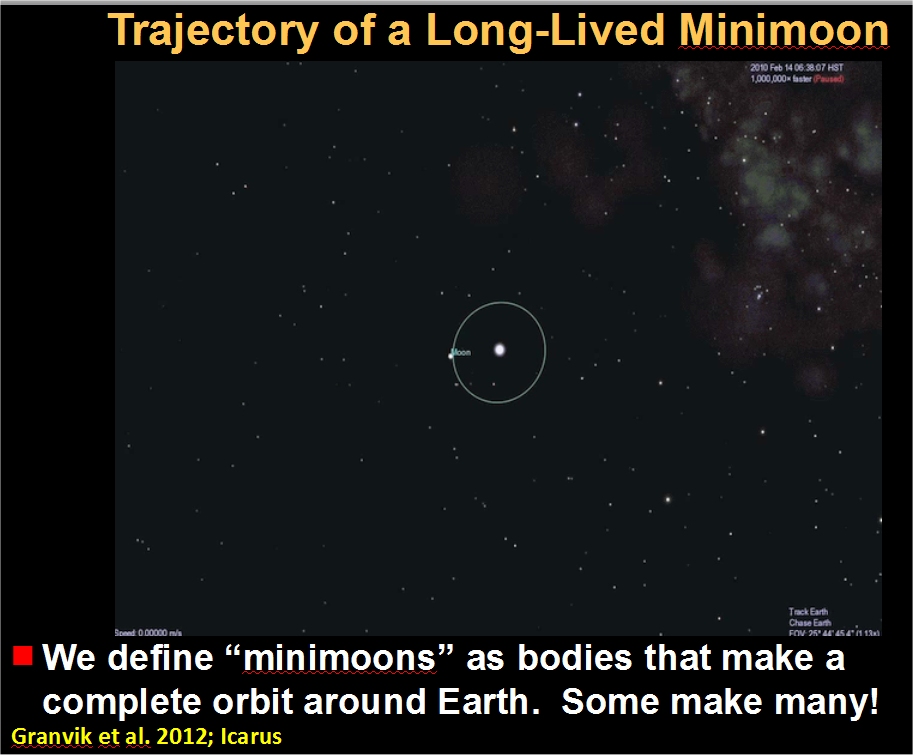
Occasionally, near earth asteroids are captured temporarily in orbits around earth. Bottke calls these Minimoons:

MinimoonDef

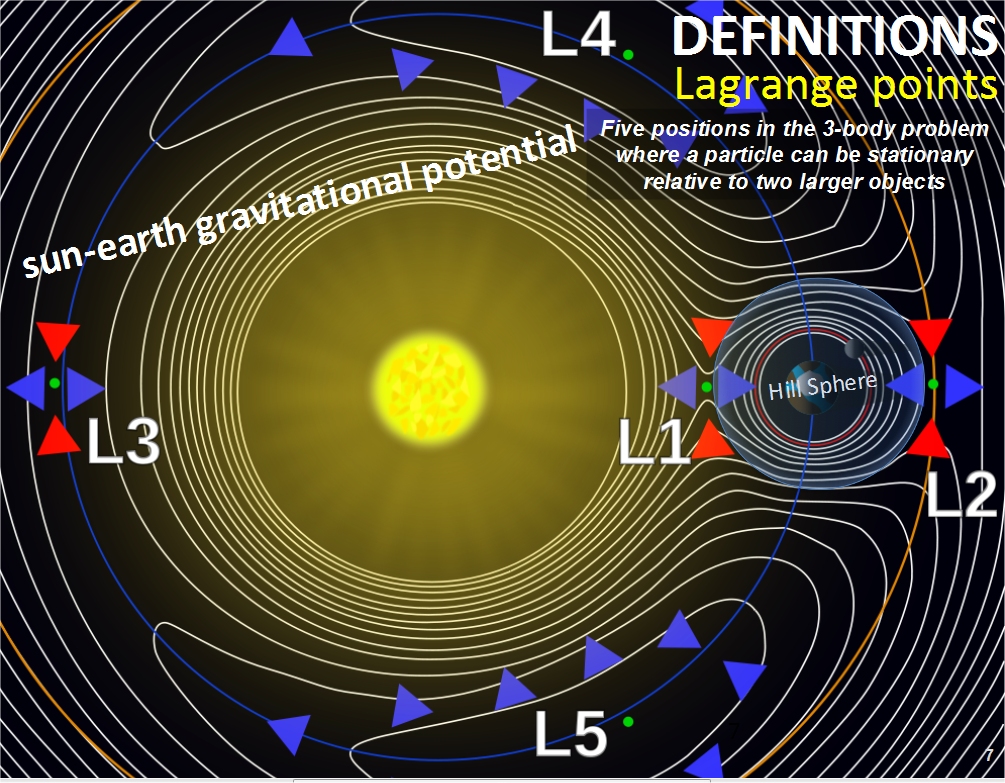
TheEarth-Sun Lagrange points minimum areas are of particular interest.

lagrangePts

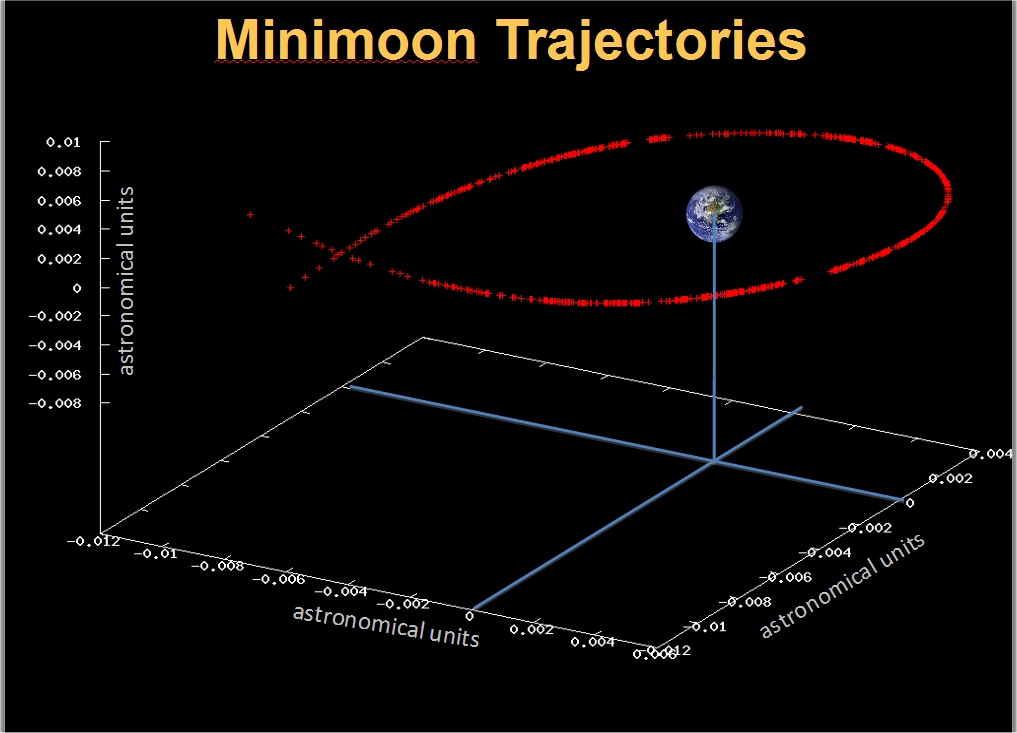
The objects can last for just one simple orbit –

MinimoonTraj1

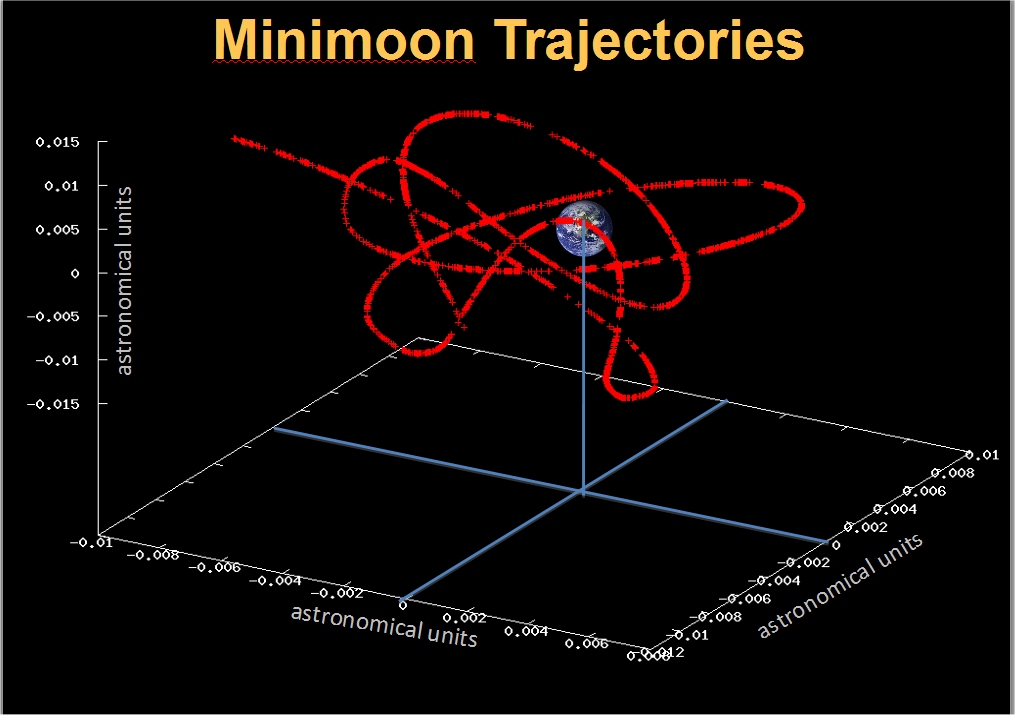
Or for many complex orbits:

MinimoonTraj2

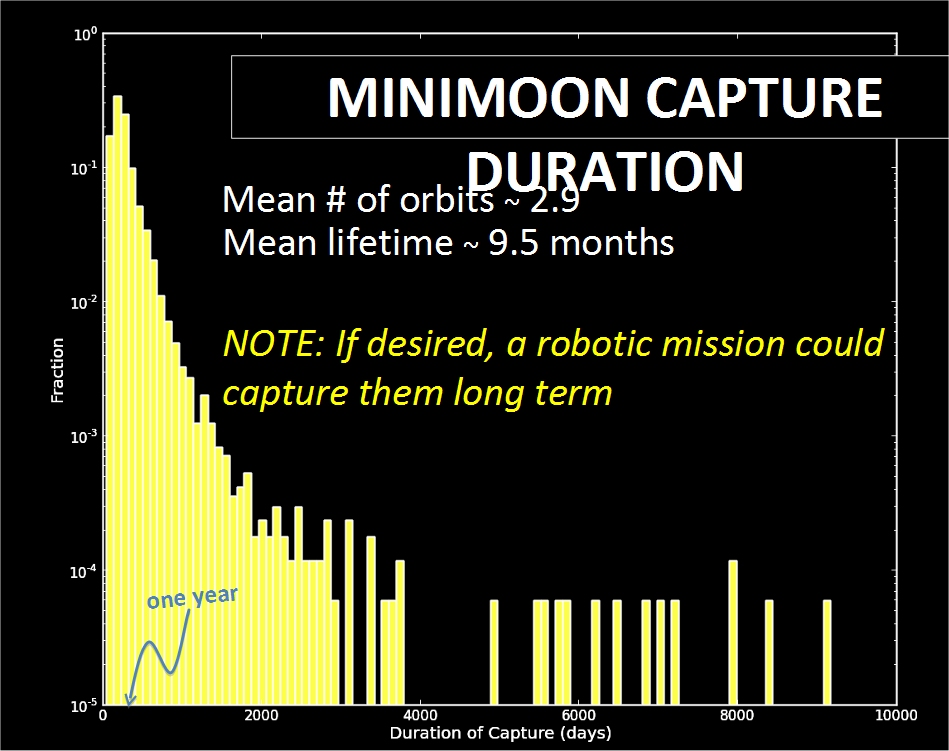
Lifetimes in the earth region can span many years:

MinimoonLifetime

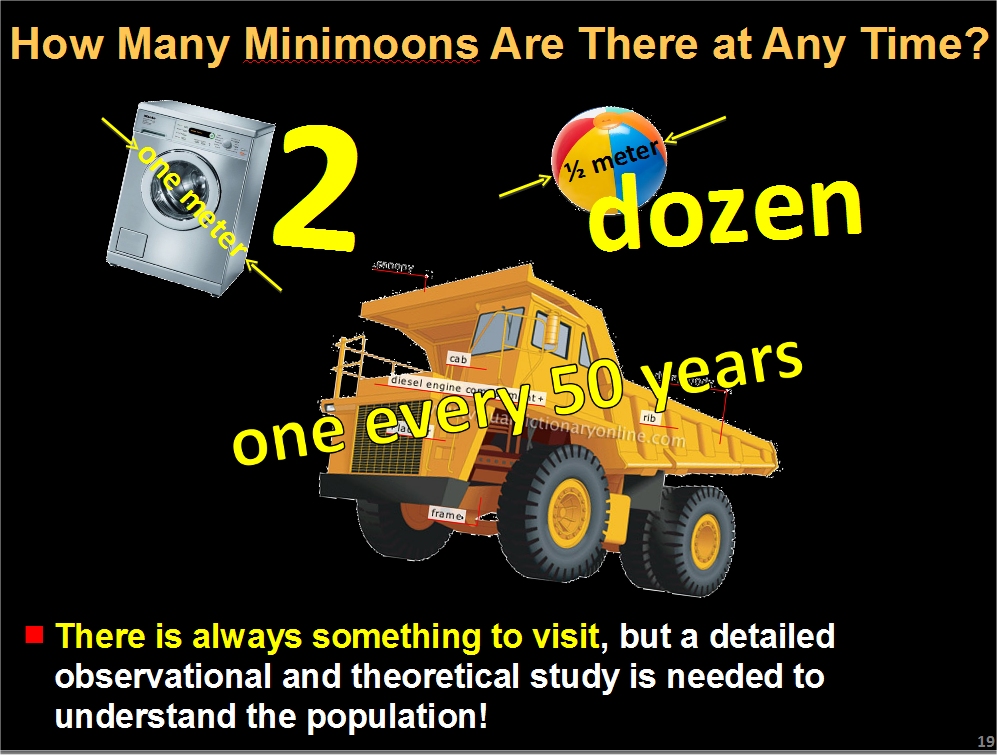
They estimate a couple of dozen such Minimoons are in orbit around earth at any given time:

MinimoonNum

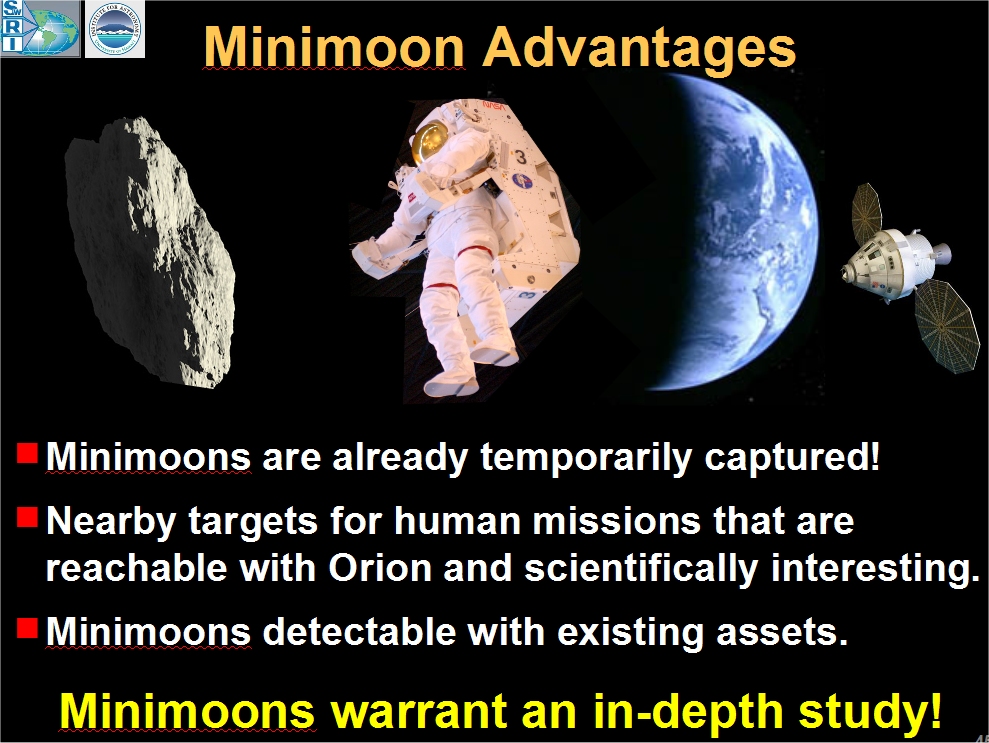
Bottke goes on to  discuss ideas for improving the detection of Minimoons and for targeting them for exploratory missions, including human missions.

MinimoonAdvantages

Retired WISE spacecraft becomes reactivated NEOWISE asteroid hunter

NASA Jet Propulsion Laboratory reports on the initial results from an old spacecraft that has been reactivated:

Recently Reactivated NASA Spacecraft Spots Its First New Asteroid

NASA’s Near-Earth Object Wide-field Infrared Survey Explorer (NEOWISE) spacecraft has spotted a never-before-seen asteroid — its first such discovery since coming out of hibernation last year.

NEOWISE originally was called the Wide-field Infrared Survey Explorer (WISE), which had made the most comprehensive survey to date of asteroids and comets. The spacecraft was shut down in 2011 after its primary mission was completed. But in September 2013, it was reactivated, renamed and given a new mission, which is to assist NASA’s efforts to identify the population of potentially hazardous near-Earth objects (NEOs). NEOWISE also can assist in characterizing previously detected asteroids that could be considered potential targets for future exploration missions.

NEOWISE's New Find
The six red dots in this composite picture indicate the location of the first new
near-Earth asteroid seen by NASA’s Near-Earth Object Wide-field Infrared
Survey Explorer (NEOWISE) since the spacecraft came out of hibernation in
December 2013. The asteroid, called 2013 YP139, is the first of hundreds of
space-rock discoveries expected during its renewed mission. The inset shows
a zoomed-in view of one of the detections of 2013 YP139.
Image credit: NASA/JPL-Caltech 

NEOWISE’s first discovery of its renewed mission came on Dec. 29 — a near-Earth asteroid designated 2013 YP139. The mission’s sophisticated software picked out the moving object against a background of stationary stars. As NEOWISE circled Earth scanning the sky, it observed the asteroid several times over half a day before the object moved beyond its view. Researchers at the University of Arizona used the Spacewatch telescope at the Kitt Peak National Observatory southwest of Tucson to confirm the discovery. Peter Birtwhistle, an amateur astronomer at the Great Shefford Observatory in West Berkshire, England, also contributed follow-up observations. NASA expects 2013 YP139 will be the first of hundreds of asteroid discoveries for NEOWISE.

“We are delighted to get back to finding and characterizing asteroids and comets, especially those that come into Earth’s neighborhood,” said Amy Mainzer, the mission’s principal investigator from NASA’s Jet Propulsion Laboratory in Pasadena, Calif. “With our infrared sensors that detect heat, we can learn about their sizes and reflectiveness.”

2013 YP139 is about 27 million miles (43 million kilometers) from Earth. Based on its infrared brightness, scientists estimate it to be roughly 0.4 miles (650 meters) in diameter and extremely dark, like a piece of coal. The asteroid circles the sun in an elliptical orbit tilted to the plane of our solar system and is classified as potentially hazardous. It is possible for its orbit to bring it as close as 300,000 miles from Earth, a little more than the distance to the moon. However, it will not come that close within the next century.

WISE discovered more than 34,000 asteroids and characterized 158,000 throughout the solar system during its prime mission in 2010 and early 2011. Its reactivation in September followed 31 months in hibernation.

NEOWISE will continue to detect asteroids and comets. The observations will be automatically sent to the clearinghouse for solar system bodies, the Minor Planet Center in Cambridge, Mass., for comparison against the known catalog of solar system objects and to determine orbit if the object is not known. A community of professional and amateur astronomers will provide follow-up observations, establishing firm orbits for the previously unseen objects.

Infrared sensors, similar to the cameras on NEOWISE, are a powerful tool for discovering, cataloging and understanding the asteroid population. Some of the objects about which NEOWISE will be collecting data could become candidates for NASA’s announced asteroid initiative, which will be the first mission to identify, capture and relocate an asteroid for astronauts to explore. The initiative represents an unprecedented technological feat that will lead to new scientific discoveries and technological capabilities that will help protect our home planet and achieve the goal of sending humans to an asteroid by 2025.

JPL manages the project for NASA’s Science Mission Directorate in Washington. The Space Dynamics Laboratory in Logan, Utah, built the science instrument. Ball Aerospace & Technologies Corp. of Boulder, Colo., built the spacecraft. Science operations and data processing take place at the Infrared Processing and Analysis Center at the California Institute of Technology in Pasadena. Caltech manages JPL for NASA.

An image of asteroid 2013 YP139, taken by NEOWISE, is available at http://go.nasa.gov/1cNF9T7 .

More information about NEOWISE is available online at http://www.nasa.gov/wise .

Beyond earth orbit space science missions in 2014

Emily Lakdawalla at the Planetary Society gives a preview of major space science missions in the coming year: What’s up in planetary missions in 2014 – The Planetary Society.

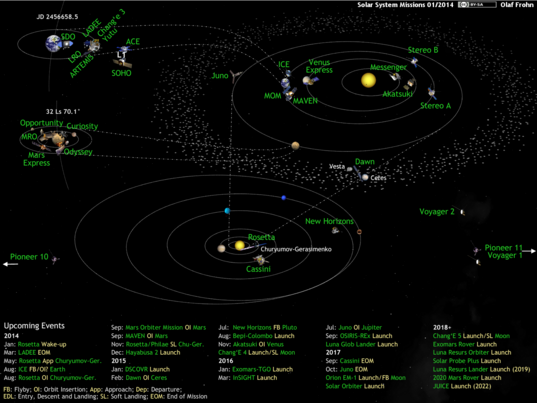
She includes a link to thisinteresting  infographic from Olaf Frohn that displays current space science missions:

What's Up in the Solar System diagram by Olaf Frohn (updated for January 2014)Credit: Olaf Frohn
What’s Up in the Solar System diagram by Olaf Frohn (updated for January 2014)

A diagram, updated once a month, of active space missions traveling beyond 
Earth orbit. Contains links to past diagrams.