Category Archives: Asteroids & Comets

Small asteroid to pass near Earth on Sunday

A message from NASA:

Small Asteroid to Safely Pass Close to Earth Sunday 

A small asteroid, designated 2014 RC, will safely pass very close to Earth on Sunday, Sept. 7, 2014.  At the time of closest approach, based on current calculations to be about 2:18 p.m. EDT (11:18 a.m. PDT / 18:18 UTC), the asteroid will be roughly over New Zealand.  From its reflected brightness, astronomers estimate that the asteroid is about 60 feet (20 meters) in size.

This graphic depicts the passage of asteroid 2014 RC past Earth on September 7, 2014This graphic depicts the passage of asteroid 2014 RC past Earth on September 7, 2014.
At time of closest approach, the space rock will be about one-tenth the distance
from Earth to the moon. Times indicated on the graphic are Universal Time.
Image Credit: NASA/JPL-Caltech

Asteroid 2014 RC was initially discovered on the night of August 31 by the Catalina Sky Survey near Tucson, Arizona, and independently detected the next night by the Pan-STARRS 1 telescope, located on the summit of Haleakalā on Maui, Hawaii.  Both reported their observations to the Minor Planet Center in Cambridge, Massachusetts.  Additional follow-up observations by the Catalina Sky Survey and the University of Hawaii 88-inch (2.2-meter) telescope on Mauna Kea confirmed the orbit of 2014 RC.

At the time of closest approach, 2014 RC will be approximately one-tenth the distance from the center of Earth to the moon, or about 25,000 miles (40,000 kilometers). The asteroid’s apparent magnitude at that time will be about 11.5, rendering it unobservable to the unaided eye.  However, amateur astronomers with small telescopes might glimpse the fast-moving appearance of this near-Earth asteroid.

The asteroid will pass below Earth and the geosynchronous ring of communications and weather satellites orbiting about 22,000 miles (36,000 kilometers) above our planet’s surface.  While this celestial object does not appear to pose any threat to Earth or satellites, its close approach creates a unique opportunity for researchers to observe and learn more about asteroids.

2014_rc[1]

This graphic depicts the orbit of asteroid 2014 RC around the sun. A house-sized
asteroid will safely fly past Earth Sunday afternoon, September 7, at a distance
equivalent to about one-tenth of the distance between Earth and the moon.
Image Credit: NASA/JPL-Caltech

While 2014 RC will not impact Earth, its orbit will bring it back to our planet’s neighborhood in the future.  The asteroid’s future motion will be closely monitored, but no future threatening Earth encounters have been identified.

For a heliocentric view of the orbit of asteroid 2014 RC with respect to Earth and other planets, visit: ssd.jpl.nasa.gov/sbdb.cgi?sstr=2014+RC&orb=1
NASA invites public to submit messages for time capsule on asteroid sampling mission

Submit a prediction about the future of spaceflight. along with an image, and it may be chosen to ride on the Bennu asteroid aboard the OSIRIS-REx probe in a TimeCapsule that will be opened after the spacecraft returns with samples of the asteroid in 2023: Submit Predictions to Fly in an Asteroid Time Capsule – The Planetary Society.

More in this NASA announcement:

NASA Invites Public to Submit Messages for Asteroid Mission Time Capsule

AsteroidTimeCapsule


NASA’s OSIRIS-REx mission launches Asteroid Time Capsule — a mission
to collect ideas from the public about space exploration 10 years
from now. Image Credit: Heather Roper/University of Arizona/OSIRIS-REx

NASA is inviting the worldwide public to submit short messages and images on social media that could be placed in a time capsule aboard a spacecraft launching to an asteroid in 2016.

Called the Origins-Spectral Interpretation-Resource Identification-Security-Regolith Explorer (OSIRIS-REx), the spacecraft will rendezvous with the asteroid Bennu in 2019, collect a sample and return the cache in a capsule to Earth in 2023 for detailed study. The robotic mission will spend more than two years at the 1,760-foot (500-meter)-wide asteroid and return a minimum of 2 ounces (60 grams) of its surface material.

Topics for submissions by the public should be about solar system exploration in 2014 and predictions for space exploration activities in 2023. The mission team will choose 50 tweets and 50 images to be placed in the capsule. Messages can be submitted Sept. 2 – 30.

OSIRIS_REX_14-235b

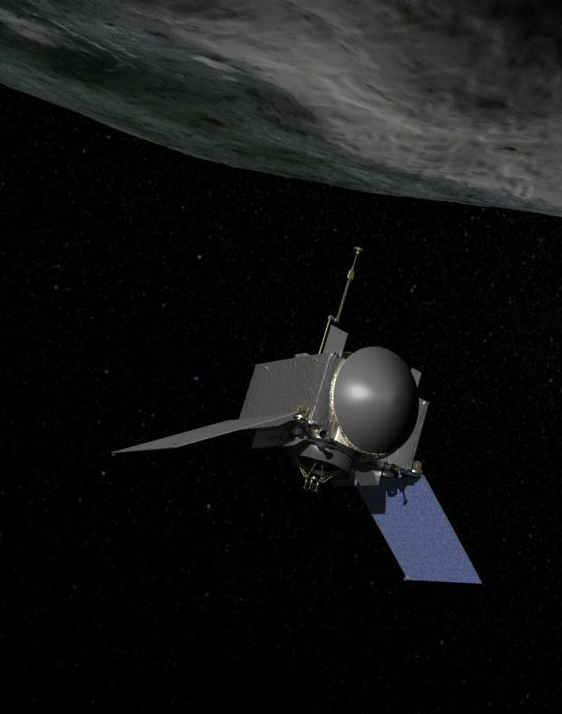
This is an artist’s concept of NASA’s OSIRIS-REx spacecraft
preparing to take a sample from asteroid Bennu.
Image Credit: NASA/Goddard

“Our progress in space exploration has been nothing short of amazing,” says Dante Lauretta, OSIRIS-REx principal investigator at the University of Arizona, Tucson. “I look forward to the public taking their best guess at what the next 10 years holds and then comparing their predictions with actual missions in development in 2023.”

This event is the second of NASA’s efforts to engage space enthusiasts around the world in the OSIRIS-REx mission, following the agency’s January invitation to participate in Messages to Bennu, which asked the public to submit their names to be etched on a microchip aboard the spacecraft.

“It is exciting to think that some people may formulate predictions then have the chance to help make their prediction a reality over the next decade,” said Jason Dworkin, OSIRIS-REx project scientist at NASA’s Goddard Space Flight Center in Greenbelt, Maryland.

When the sample return capsule returns to Earth in 2023 with the asteroid material, the mission team will open the time capsule to view the messages and images, at which time the selected submissions will be posted online at:

www.asteroidmission.org/timecapsule

“OSIRIS-REx has to take many years to perform a complex asteroid sample return,” said Bruce Betts, the director of science and technology at The Planetary Society in Pasadena, California, a public outreach partner on the asteroid mission. “A time capsule capitalizes on the long duration of the mission to engage the public in thinking about space exploration — where are we now, and where will we be.”

The OSIRIS-REx mission is focused on finding answers to basic questions about the composition of the very early solar system and the source of organic materials and water that made life possible on Earth. The mission also will contribute to NASA’s Asteroid Redirect Mission (ARM) and support the agency’s efforts to understand the population of potentially hazardous near-Earth objects and characterize those suitable for future asteroid exploration missions.

NASA’s ARM is a first-ever mission to identify, capture and redirect a near-Earth asteroid to a stable orbit around the moon, where astronauts will explore it in the 2020s, and return with samples. The mission will advance the new technologies and spaceflight experience needed for humans to explore Mars in the 2030s.

NASA’s Goddard Space Flight Center will provide overall mission management, systems engineering and safety and mission assurance. The University of Arizona, Tucson, is the principal investigator institution. Lockheed Martin Space Systems of Denver will build the spacecraft. OSIRIS-REx is the third mission in NASA’s New Frontiers Program. NASA’s Marshall Space Flight Center in Huntsville, Alabama, manages New Frontiers for NASA’s Science Mission Directorate in Washington.

For details on procedures and rules for submitting a message and image, visit: www.asteroidmission.org/timecapsule

More information is available online about Messages to Bennu, at: www.planetary.org/get-involved/messages/bennu/

For more about the OSIRIS-REx mission, visit: www.nasa.gov/osiris-rex

Comet 67P/C-G versus Los Angeles

I’ve posted several times about ESA’s Rosetta mission to the Comet 67P/Churyumov-Gerasimenko, e.g. see here and here. The Rosetta images of the bizarrely shaped object  don’t provide a sense of its size. Here is an image that gives some scale to it with a comparison to downtown L.A. :

[]


NASA’s Asteroid Grand Challenge

NASA and topcoder are sponsoring the Asteroid Grand Challenge:

The Asteroid Grand Challenge Series will be comprised of a series of topcoder challenges to get more people from around the planet involved in finding all asteroid threats to human populations and figuring out what to do about them. In an increasingly connected world, NASA recognizes the value of the public as a partner in addressing some of the country’s most pressing challenges. 

For example, there is the AsteroidDataHunter challenge, which

tasks competitors to develop significantly improved algorithms to identify asteroids in images from ground-based telescopes. The winning solution must increase the detection sensitivity, minimize the number of false positives, ignore imperfections in the data, and run effectively on all computers – 

This video explains the basics of the Asteroid Grand Challenge:

More Rosetta photos of comet 67P/C-G

Rosetta returns more great pictures of the comet t 67P/Churyumov-Gerasimenko: 

CometWatch – 12 August | Rosetta – ESA’s comet chaser

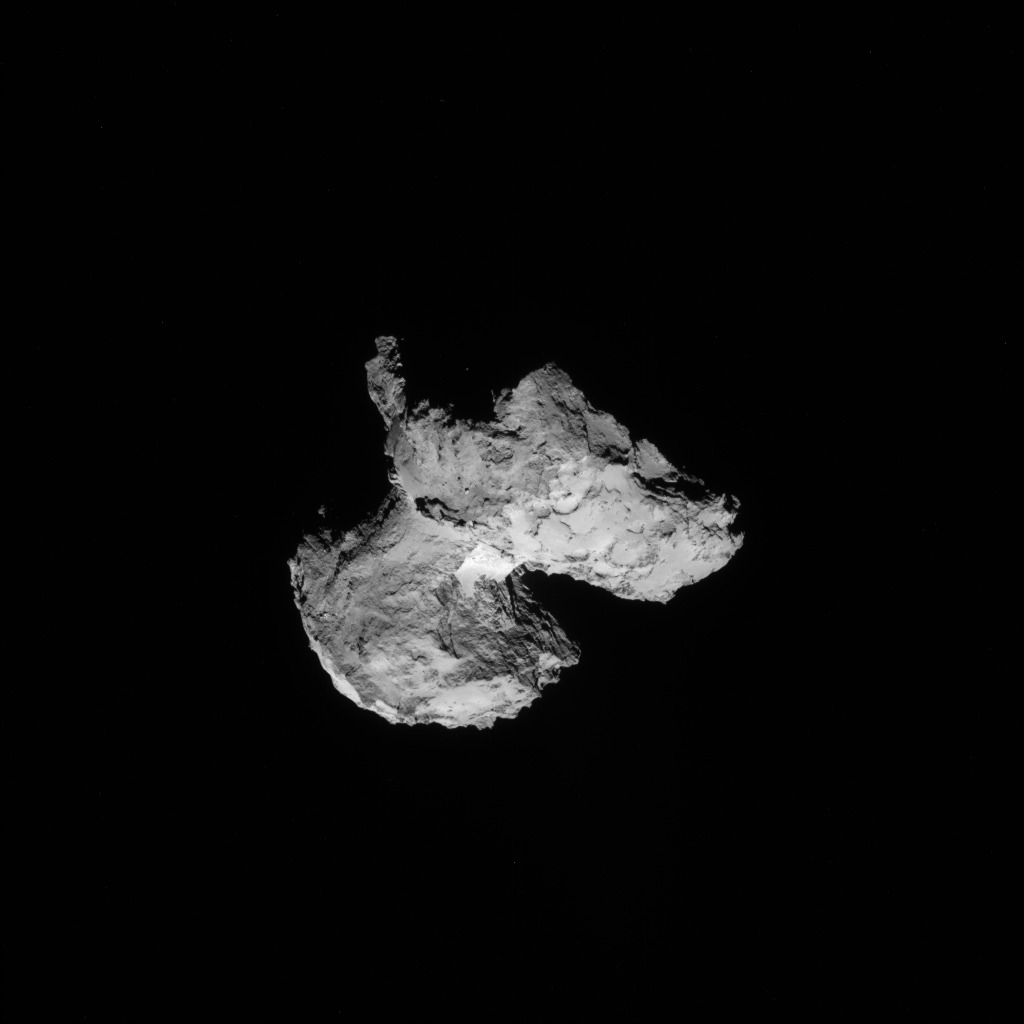
Full-frame NAVCAM image taken on 12 August 2014 from a distance of about 103 km from comet 67P/Churyumov-Gerasimenko. Credits: ESA/Rosetta/NAVCAM

Full-frame NAVCAM image taken on 12 August 2014 from a distance of about
103 km from comet 67P/Churyumov-Gerasimenko. Credits: ESA/Rosetta/NAVCAM

CometWatch – 13 August | Rosetta – ESA’s comet chaser

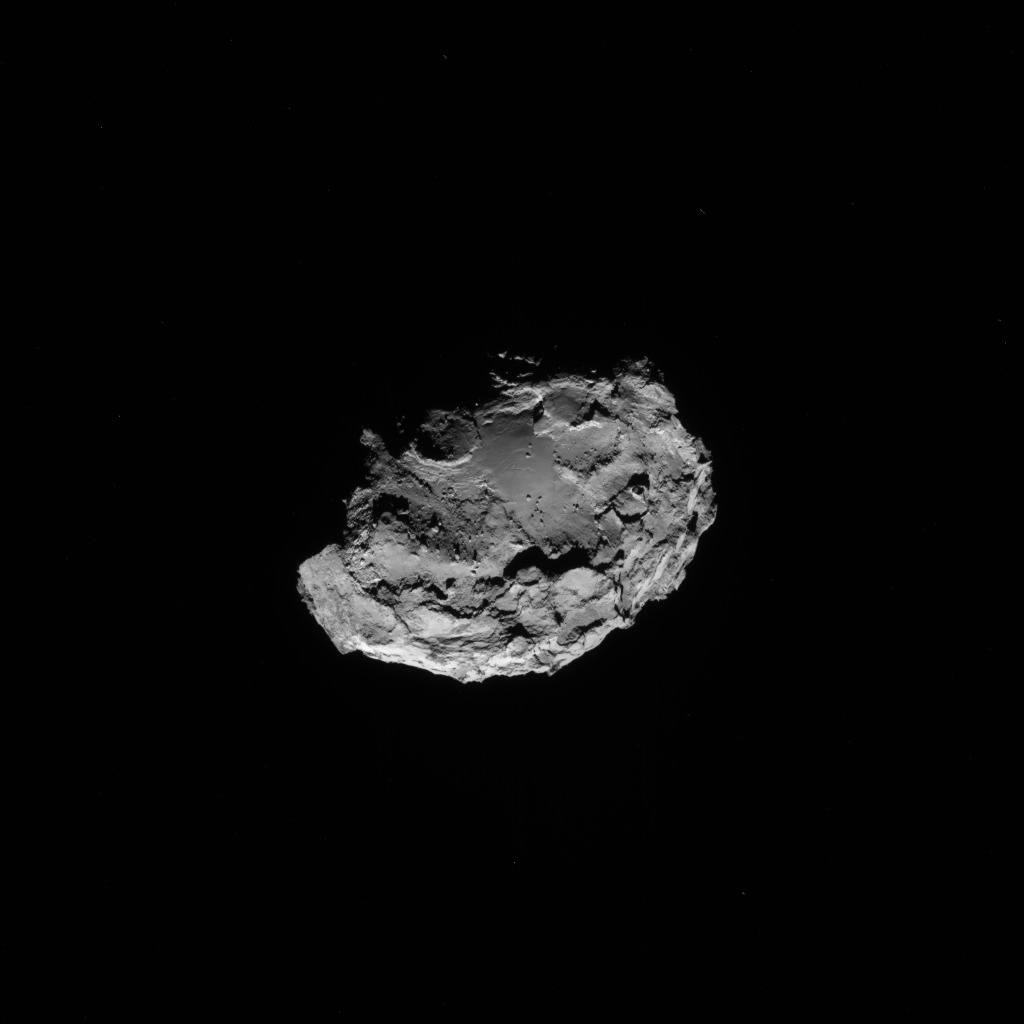
Full-frame NAVCAM image taken on 13 August 2014 from a distance of about 115 km from comet 67P/Churyumov-Gerasimenko. Credits: ESA/Rosetta/NAVCAM
Full-frame NAVCAM image taken on 13 August 2014 from a distance 
of about 115 km from comet 67P/Churyumov-Gerasimenko.
Credits: ESA/Rosetta/NAVCAM

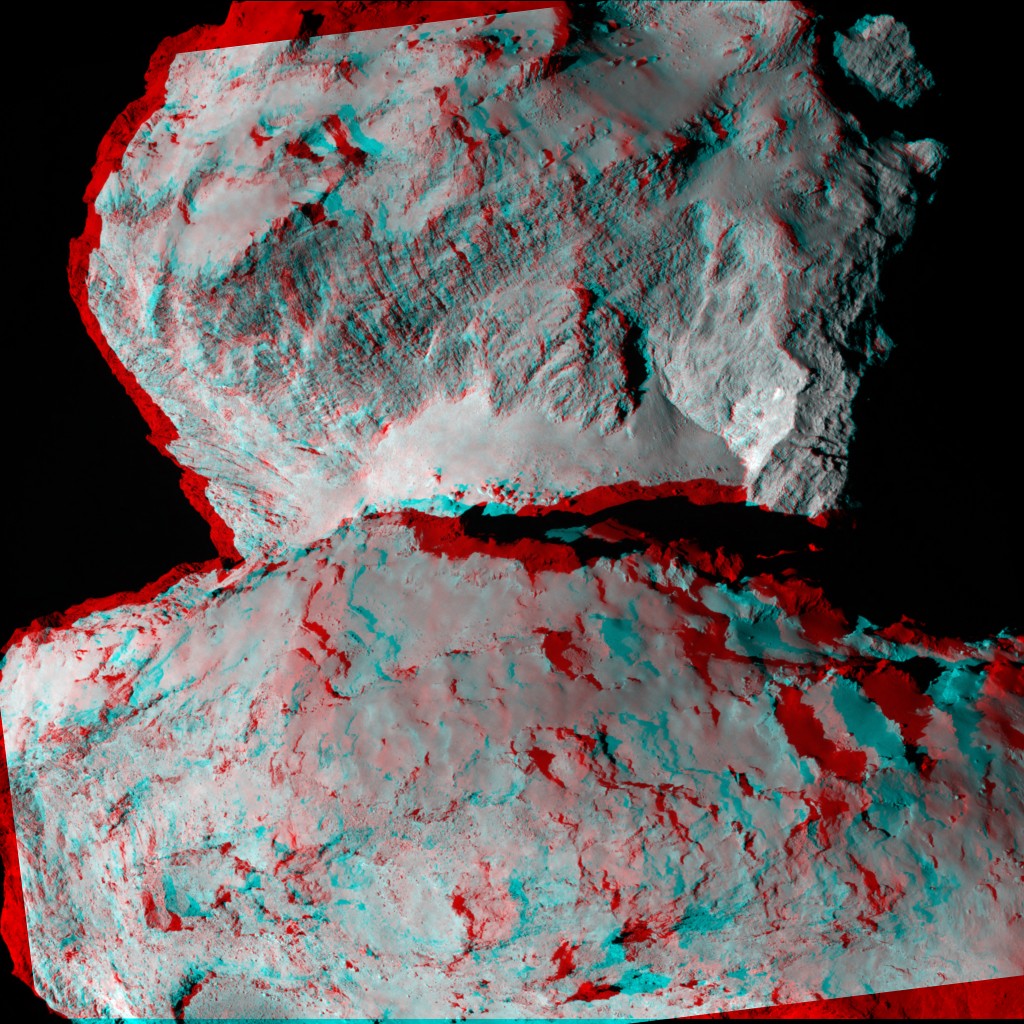
Comet 67P/C-G in 3D | Rosetta – ESA’s comet chaser

Credits: ESA/Rosetta/MPS for OSIRIS Team MPS/UPD/LAM/IAA/SSO/INTA/UPM/DASP/IDA

Credits: ESA/Rosetta/MPS for OSIRIS Team
MPS/UPD/LAM/IAA/SSO/INTA/UPM/DASP/IDA