The Sentinel Mission is their plan to fund privately a spacecraft specialized for observing and counting all the near earth asteroids.
Below is a video of a recent talk by former Apollo astronaut Rusty Schweickart on
the status of the global efforts to protect life on the planet from the devastation of large asteroid impacts and about our prospects of avoiding the same fate as the dinosaurs.
The famous nickel mine at Sudbury in Ontario, Canada was created by a huge asteroid that hit the spot over 1.8 billions ago. It left an impact crater known as the Sudbury Basin. Such asteroid impacts provided most of the heavy metals accessible to mines because most of the metals in the earth settled into the core of the planet: Rare Earth – Brian Koberlein –
… fortunately Earth was also bombarded by meteors in its early history, and this made mining practical in two ways. The first is that asteroids and meteors themselves contain vast quantities of heavy metals. By some estimates, a single mile-wide asteroid could contain twenty trillion dollars worth of precious metals. Since most of the asteroid bombardments occurred after Earth’s crust formed, these metals were deposited near Earth’s surface, making them easier to obtain. There is some evidence that most of accessible heavy metals are extraterrestrial in origin due to this process.
The second is due to large impacts such as Sudbury. With large impacts, part of the Earth’s crust are melted. As a result, deposited material then settles in layers as it re-cools. Heavier elements settle at the bottom of the crater, while lighter ones settle near the top. As a result, heavy metals are concentrated at the bottom layer of the crater, producing rich veins of ore. Impacts can also create other useful byproducts, such as impact diamonds and pockets of oil. Chicxulub crater (caused by the famous dinosaur extinction asteroid) near the Gulf of Mexico is a region with plentiful oil deposits, for example.
Here’s a nicely made video describing the formation of the Sudbury basin:
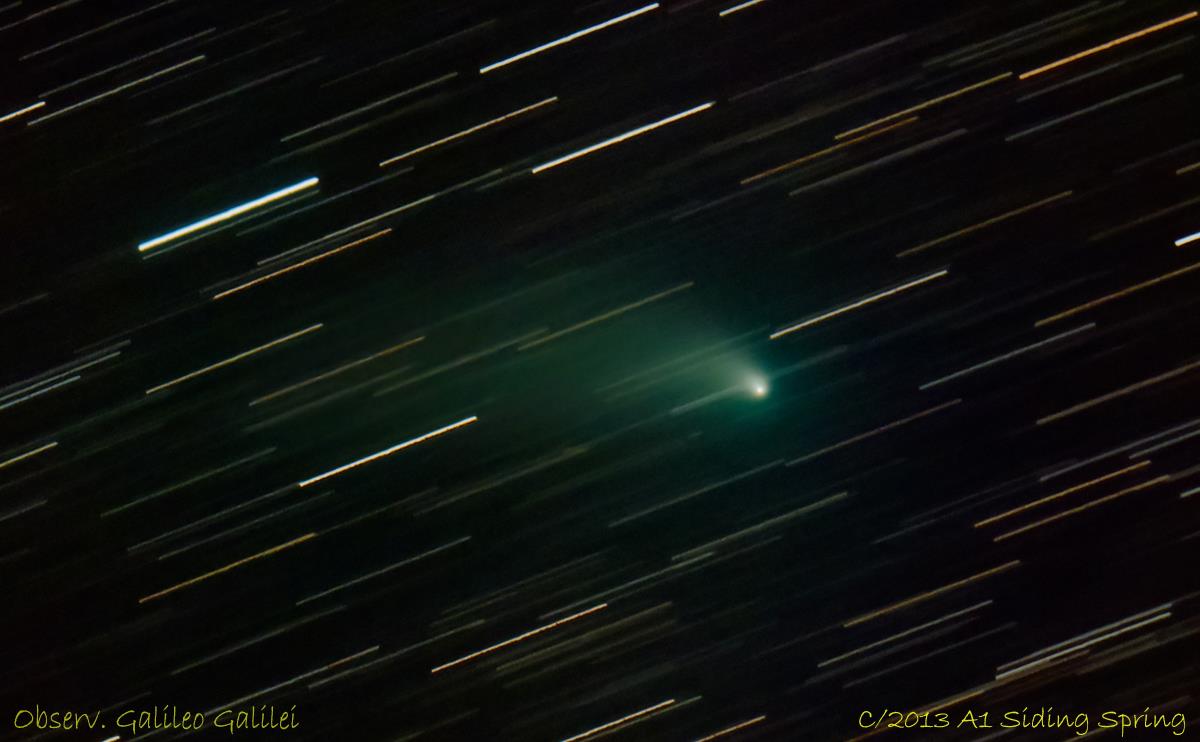
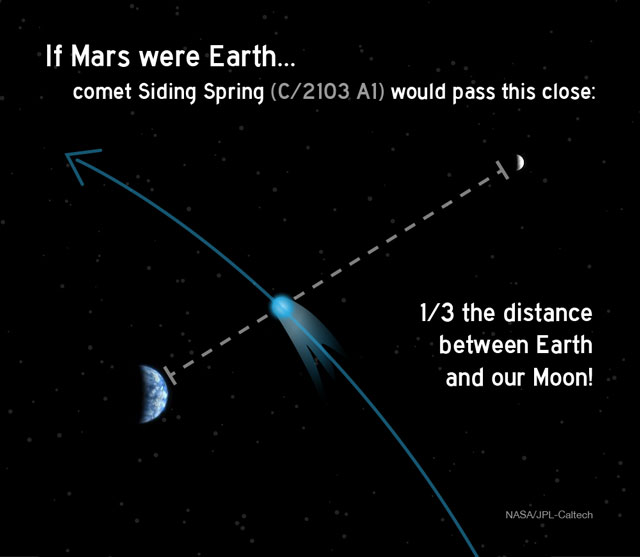
Looks like the pass of the comet Siding Spring by Mars on October 19th will not in fact bring along a dust cloud of fast moving particles thick enough to damage the spacecraft orbiting the planet:
By the middle of this summer, published estimates (based on new images and additional modelling) were indicating a flux of around 10-6 particles per m2, which, for Mars Express, very roughly equates to a 1-in-300,000 chance of being hit. It’s starting to look like our comet C/2013 A1/Siding Spring will manifest itself as a more friendly passer-by than initially thought and that it won’t be hurling clouds of large particles at unthinkable speeds towards Mars and its man-made satellites.
The European Space Agency’s Rosetta spacecraft circling Comet 67P/Churyumov-Gerasimenko is sending lots of great pictures of the odd duck-shaped object: CometWatch – 2 September – Rosetta Blog
In the two lower images shown below, you can see the faint traces of dust and water vapor emissions, signs that the comets tail is starting to form as the comet moves closer to the sun. Bob King at Universe today has combined the images and heightened the contrast in a way to enhance the “jets” : New Mosaic Reveals Jets Blasting from Rosetta’s Comet – Universe Today
Jets or sprays of vaporizing ice are what gives a comet its lively appearance. Dust released with water vapor is ultimately pushed back by the pressure of sunlight to grow 67P/C-G’s dust tail. Ultraviolet light from the sun causes volatiles within the vapor to fluoresce a pale blue, creating a second ion or gas tail. The coma or comet atmosphere is a mix of both.
—
Rosseta is also carrying a separate spacecraft called Philae that will land onto the comet. Where it will land is still not settled:
Using detailed information collected by ESA’s Rosetta spacecraft during its first two weeks at Comet 67P/Churyumov-Gerasimenko, five locations have been identified as candidate sites to set down the Philae lander in November – the first time a landing on a comet has ever been attempted.
![ESA_Rosetta_NAVCAM_20140902_montage-1024x1024[1]](http://hobbyspace.com/Blog/wp-content/uploads/2014/09/ESA_Rosetta_NAVCAM_20140902_montage-1024x10241.jpg)
![Philae_candidate_landing_sites_fullwidth[1]](http://hobbyspace.com/Blog/wp-content/uploads/2014/09/Philae_candidate_landing_sites_fullwidth1.jpg)