The orbiters circling Mars survived the fly-by of Comet Siding Spring last Sunday just fine. The NASA JPL site Comets: Siding Spring (C/2013 A1) has lots of images and reports about the event. For example,
NASA Rover Opportunity Views Comet Near Mars
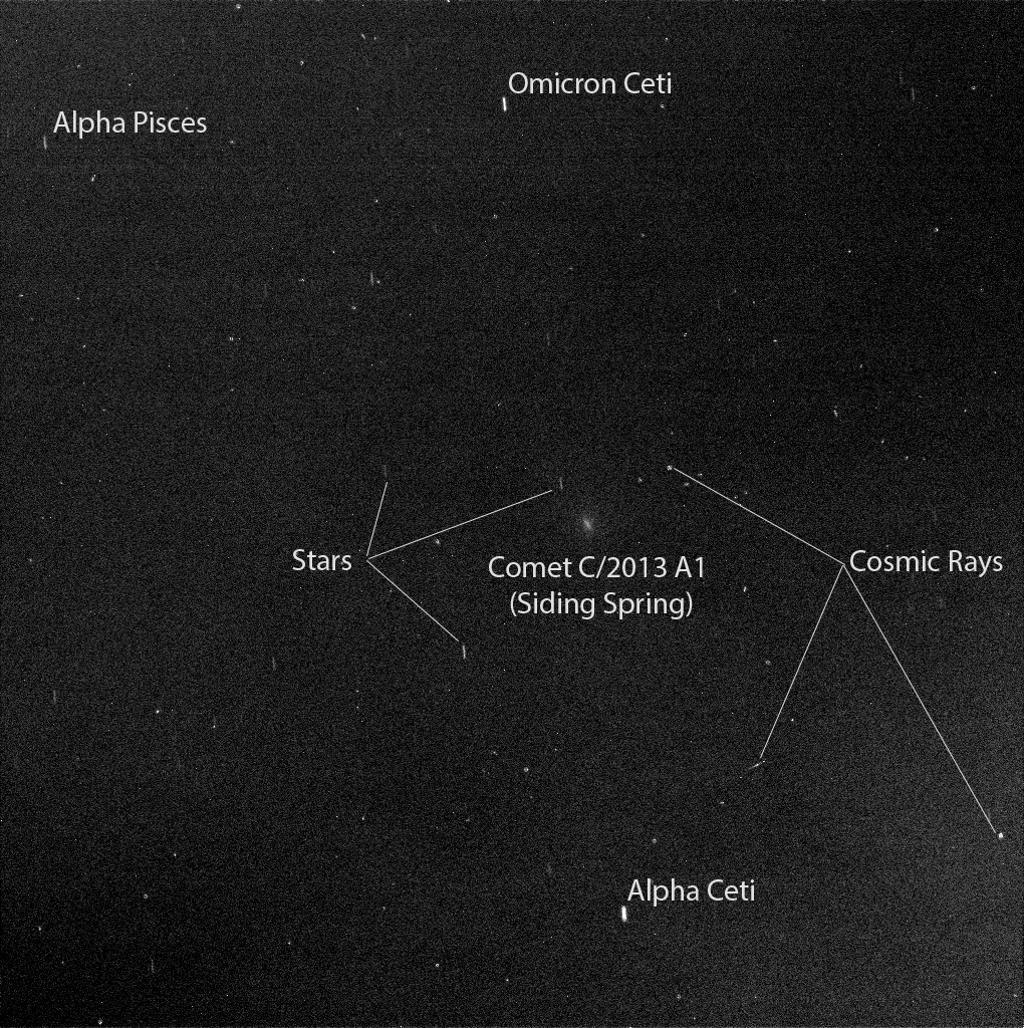 Mars Rover Opportunity’s View of Passing Comet
Researchers used the panoramic camera (Pancam) on NASA’s Mars Exploration Rover Opportunity to capture this view of comet C/2013 A1 Siding Spring as it passed near Mars on Oct. 19, 2014. Credit: NASA/JPL-Caltech/Cornell Univ./ASU/TAMU
NASA’s Mars Exploration Rover Opportunity captured images of a comet passing much closer to Mars than any previous known comet flyby of Earth or Mars. The images of comet Siding Spring were taken against a backdrop of the pre-dawn Martian sky on Sunday (Oct. 19).
Images of comet A1 Siding Spring from the rover’s panoramic camera (Pancam) are online at:
Researchers used Opportunity’s Pancam to image at a range of exposure times about two-and-one-half hours before the closest approach of the nucleus of comet Siding Spring to Mars. By the time of closest approach at about 87,000 miles (139,500 kilometers), dawn had lit the sky above Opportunity.
“It’s excitingly fortunate that this comet came so close to Mars to give us a chance to study it with the instruments we’re using to study Mars,” said Opportunity science team member Mark Lemmon of Texas A&M University, who coordinated the camera pointing. “The views from Mars rovers, in particular, give us a human perspective, because they are about as sensitive to light as our eyes would be.”
Three NASA Mars orbiters, two Mars rovers and other assets on Earth and in space are studying comet Siding Spring. This comet is making its first visit this close to the sun from the outer solar system’s Oort Cloud, so the concerted campaign of observations may yield fresh clues to our solar system’s earliest days more than 4 billion years ago.
Opportunity has been roving on Mars since January 2004 and has provided evidence about the Red Planet’s ancient wet environments.
For more about Opportunity, visit:
===
The Mars Reconnaissance Orbiter capture images of the comet as well:
Mars Orbiter Image Shows Comet Nucleus is Small
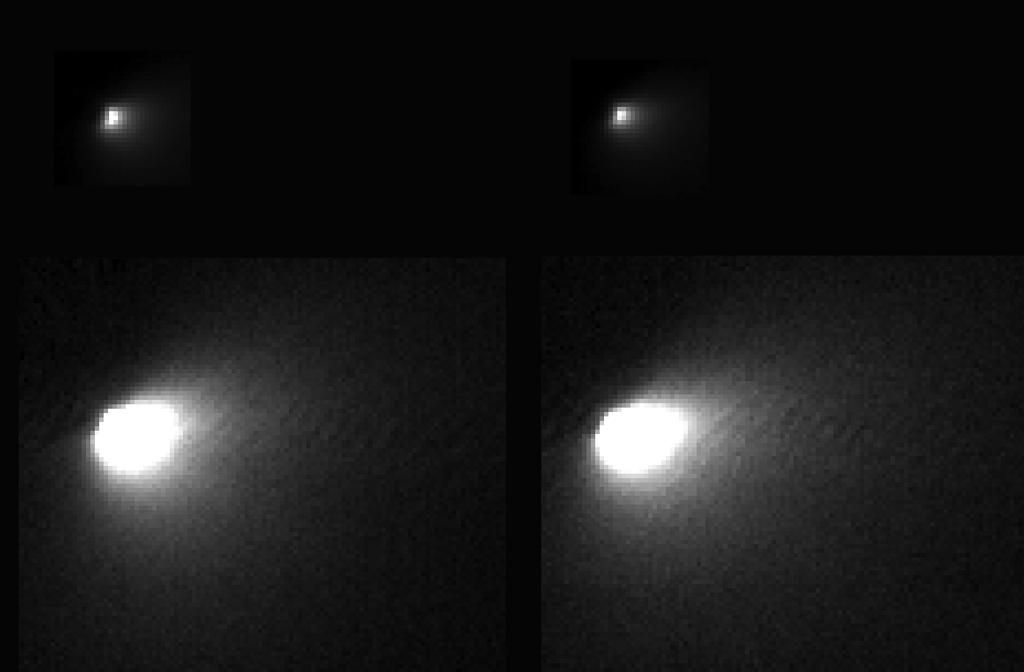
First Resolved Image of a Long-Period Comet’s Nucleus
These images were taken of comet C/2013 A1 Siding Spring by NASA’s Mars Reconnaissance Orbiter on Oct. 19, 2014, during the comet’s close flyby of Mars and the spacecraft. Credit: NASA/JPL-Caltech/University of Arizona
The High Resolution Imaging Science Experiment (HiRISE) camera on NASA’s Mars Reconnaissance Orbiter captured views of comet C/2013 A1 Siding Spring while that visitor sped past Mars on Sunday (Oct. 19), yielding information about its nucleus.
The images are the highest-resolution views ever acquired of a comet coming from the Oort Cloud at the fringes of the solar system. Other spacecraft have approached and studied comets with shorter orbits. This comet’s flyby of Mars provided spacecraft at the Red Planet an opportunity to investigate from close range.
Images of comet Siding Spring from HiRISE are online at: http://mars.nasa.gov/multimedia/images/?ImageID=6682
The highest-resolution of images of the comet’s nucleus, taken from a distance of about 86,000 miles (138,000 kilometers), have a scale of about 150 yards (138 meters) per pixel. Telescopic observers had modeled the size of the nucleus as about half a mile, or one kilometer wide. However, the best HiRISE images show only two to three pixels across the brightest feature, probably the nucleus, suggesting a size smaller than half that estimate.
For more about HiRISE, visit: http://hirise.lpl.arizona.edu
For more about Mars Reconnaissance Orbiter, visit: http://mars.nasa.gov/mro/
===
NASA released a composite image showing the comet and the Red Planet together without under or over-exposing either:
Close Encounters: Comet Siding Spring Seen Next to Mars
![comet_springs_0[1]](http://hobbyspace.com/Blog/wp-content/uploads/2014/10/comet_springs_01-1024x768.jpg)
This composite NASA Hubble Space Telescope Image captures the positions of comet Siding Spring and Mars in a never-before-seen close passage of a comet by the Red Planet, which happened at 2:28 p.m. EDT October 19, 2014. [Larger image]
This composite NASA Hubble Space Telescope Image captures the positions of comet Siding Spring and Mars in a never-before-seen close passage of a comet by the Red Planet, which happened at 2:28 p.m. EDT October 19, 2014. The comet passed by Mars at approximately 87,000 miles (about one-third of the distance between Earth and the Moon). At that time, the comet and Mars were approximately 149 million miles from Earth.
The comet image shown here is a composite of Hubble exposures taken between Oct. 18, 8:06 a.m. EDT to Oct. 19, 11:17 p.m. EDT. Hubble took a separate photograph of Mars at 10:37 p.m. EDT on Oct. 18.
The Mars and comet images have been added together to create a single picture to illustrate the angular separation, or distance, between the comet and Mars at closest approach. The separation is approximately 1.5 arc minutes, or one-twentieth of the angular diameter of the full Moon. The background starfield in this composite image is synthesized from ground-based telescope data provided by the Palomar Digital Sky Survey, which has been reprocessed to approximate Hubble’s resolution. The solid icy comet nucleus is too small to be resolved in the Hubble picture. The comet’s bright coma, a diffuse cloud of dust enshrouding the nucleus, and a dusty tail, are clearly visible.
This is a composite image because a single exposure of the stellar background, comet Siding Spring, and Mars would be problematic. Mars is actually 10,000 times brighter than the comet, and so could not be properly exposed to show detail in the Red Planet. The comet and Mars were also moving with respect to each other and so could not be imaged simultaneously in one exposure without one of the objects being motion blurred. Hubble had to be programmed to track on the comet and Mars separately in two different observations.
The images were taken with Hubble’s Wide Field Camera 3.
 Rosetta & Philae at comet 67P. Credit: ESA–C. Carreau/ATG medialab
![ESA_Rosetta_NAVCAM_141026_mosaic-922x1024[1]](http://hobbyspace.com/Blog/wp-content/uploads/2014/10/ESA_Rosetta_NAVCAM_141026_mosaic-922x10241.jpg)
![Comet_on_24_October_NavCam_node_full_image_2[1]](http://hobbyspace.com/Blog/wp-content/uploads/2014/10/Comet_on_24_October_NavCam_node_full_image_21.jpg)
![Comet_activity_10_September_2014_node_full_image_2[1]](http://hobbyspace.com/Blog/wp-content/uploads/2014/10/Comet_activity_10_September_2014_node_full_image_21.jpg)
![comet_springs_0[1]](http://www.nasa.gov/sites/default/files/comet_springs_0.jpg)