Category Archives: Rockets

Space transport roundup – Aug.7.2020

A sampling of recent articles, videos, and images dealing with space transport (find previous roundups here):

** A big week for SpaceX.  On Sunday the Crew Dragon returned safely to earth.  On Tuesday the SN5 Starship Prototype flew up and down at Boca Chica Beach, Texas. And early Friday morning, a Falcon 9 launched 57 Starlink and 2 Blacksky earth observation satellites to low earth orbit. The F9 booster landed successfully as well.

**** SN5 Starship Prototype took a short hop up to 150 meters and back down for a successful landing. Following several aborted attempts over the previous few days, the SN5 fired its Raptor engine and lifted off amid a huge cloud of smoke and debris. It rose up above the dusty turmoil and hung in the air briefly before slowly descending and disappearing into the umber cloud. Observers waited anxiously for the air to clear to see if the vehicle, which is basically just the propellant tanks section of a Starship,  was still standing. Sure enough, it had landed on six stubby legs that had folded out from inside the metal skirt.

Starship SN5 Hop

Here is a small sample of videos taken by an array of SpaceX and privately owned cameras trained on the SN5:

  • SpaceX:

Under the roar of Raptor, Starship SN5 took flight during a successful 150m test hop at Boca Chica. Mary (@BocaChicaGal) had several cameras filming this historic event, with editing by Jack Beyer (@thejackbeyer).

** NASASpaceflight – YouTube

Misc.:

**** The first Crew Dragon mission with astronauts on board ends with a splashdown in the calm waters of the Gulf of Mexico. SpaceX’s Commercial Crew Demonstration Mission 2 (DM-2) went nearly flawlessly from beginning to end.

  • DM-2 highlights from launch to landing:

  • The DM-2 astronauts give their accounts of the mission:

NASA astronauts Robert Behnken and Douglas Hurley discuss their SpaceX Demo-2 mission, 62-day stay on the International Space Station and successful return inside their Crew Dragon spacecraft Endeavour on Tuesday, Aug. 4. The duo splashed down at 2:48 p.m. EDT Aug. 2 in the Gulf of Mexico near Pensacola, Florida, following launch from Kennedy Space Center’s historic Launch Pad 39A at 3:22 p.m. May 30. They arrived at the station’s Harmony port, their spacecraft docking at 10:16 a.m. May 31. This was SpaceX’s final test flight and is providing data on performance of the Falcon 9 rocket, Crew Dragon spacecraft and ground systems, as well as in-orbit, docking, splashdown, and recovery operations.

Misc:

Find more on SpaceX activities below…

** Russian Proton rocket launches two tele-comm satellites for the Ekspress satellite network.

The Express-80 and Express-103 communications satellites have been successfully launched by the launcher Proton from the Cosmodrome of Baikonour in Kazaksthan.

The satellites are the result of the partnership between the Russian company ISS Reshetnev, providing the H1000 platforms and Thales Alenia Space, a Thales (67%) and Leonardo (33%) joint venture, providing the payloads.

** China Long March-2D rocket launches Gaofen-9 remote sensing satellite.

** Astra scrubs launch attempt from Kodiak Island, Alaska. There was no webcast of Thursday’s attempted launch but there were updates via Astra (@Astra) / Twitter.  Just before ignition was to happen, the water deluge system “lost pressure”. The water floods the pad area below the rocket to reduce the acoustic energy of the exhaust.

“We are going to stand down to fix the issue.”  They said, “Rocket is in excellent shape, we will try again tomorrow.”

Astra’s described their launch plans here: Rocket 3.1 And Astra’s Path To Orbit | Astra.

Rocket 3.1 will launch from Astra’s Kodiak Launch Site (pad LP-3B at Pacific Spaceport Complex – Alaska (PSCA) on Kodiak Island). We are proud to partner with the team at PSCA and are grateful for their support.

Our launch window is from August 2-7, 7:00 – 9:00pm Pacific Time (PT) each day. We are aiming for August 2, subject to weather constraints and final launch preparations being completed.

This is a demonstration mission, and therefore Rocket 3.1 will not have a payload. We did not feel it was appropriate to risk a customer satellite for our first orbital launch attempt. That said, if Rocket 3.1 does make it to orbit, the vehicle will send an electronic signal that simulates the deployment of a satellite.

So Friday will be their last chance in this launch window. They suffered scrubs earlier this week as well:

Astra’s mantra is rapid iteration. Build, test, learn and repeat. We’re changing the way space is done by accepting slightly more risk in order to learn more quickly. We can afford to experiment because our rockets are far less expensive than the industry average. We aren’t afraid of failure; in fact, as long as we learn from it, failure is valuable and ultimately built into the plan.

It’s rare that a new launch vehicle accomplishes all of its objectives with its first flight, and the past few months in the launch industry have once again proven just how hard getting to space can be, even for mature vehicles. That said, we believe that we can achieve orbit within 3 flights, and our goal for Rocket 3.1 is to learn enough to set us on that path.

** Rocket Lab to resume Electron launches after finding cause of the failure in July mission: Rocket Lab to Resume Electron Launches in August | Rocket Lab

Rocket Lab today announced that it has received approval from the Federal Aviation Administration (FAA) to resume launches this month after identifying an anomalous electrical connection as the cause of an in-flight failure on July 4, 2020. With corrective measures underway, the next Electron launch has been scheduled for August from Launch Complex 1.

Over the past month, Rocket Lab has collaborated on an investigation with the support of the FAA, the primary federal licensing body for commercial space launch activity. Rocket Lab’s Accident Investigation Board (AIB) worked through an extensive fault tree analysis to examine all potential causes for the anomaly that took place late into Rocket Lab’s 13th launch.

On July 4, 2020, the Electron launch vehicle successfully lifted-off from Launch Complex 1 and proceeded through a nominal first stage engine burn, Stage 1-2 separation, Stage 2 ignition, and fairing jettison as planned. Several minutes into the second stage burn, the engine performed a safe shutdown resulting in a failure to reach orbit. Due to the controlled way the engine shut down, Rocket Lab continued to receive telemetry from the vehicle, providing engineers with extensive data to conduct a robust investigation into the issue.

After reviewing more than 25,000 channels of data and carrying out extensive testing, Rocket Lab’s AIB was able to confidently narrow the issue down to a single anomalous electrical connection. This connection was intermittently secure through flight, creating increasing resistance that caused heating and thermal expansion in the electrical component. This caused the surrounding potting compounds to liquefy, leading to the disconnection of the electrical system and subsequent engine shutdown. The issue evaded pre-flight detection as the electrical connection remained secure during standard environmental acceptance testing including vibration, thermal vacuum, and thermal cycle tests.

Peter Beck, Rocket Lab’s founder and CEO, said the issue had never been observed before across the company’s previous 12 Electron launches. “The issue occurred under incredibly specific and unique circumstances, causing the connection to fail in a way that we wouldn’t detect with standard testing. Our team has now reliably replicated the issue in test and identified that it can be mitigated through additional testing and procedures.”

** More from Virgin Orbit about the LauncherOne failure on the first attempt to go to orbit: Wrapping Up Our First Launch Demo, and Looking Ahead to Launch Demo-2 | Virgin Orbit

Soon, we were able to identify the cause of the failure that ended our first Launch Demo: a breach in the high-pressure line carrying cryogenic Liquid Oxygen (LOX) to our first stage combustion chamber due to a component failure. Without a supply of oxidizer, that engine soon stopped providing thrust, ending our powered flight and ultimately the test itself.

In the business of launch vehicles, finding the direct cause of any failure of any flight is incredibly important, but certainly not sufficient. In order to truly get to the root of the issue, it is important to ask why after why after why. If the answer to the first why is “because the high-pressure LOX line failed,” then the second why must be “why did it fail?” That in turn must be followed by more whys — including “why didn’t we anticipate this failure,” “why wasn’t this failure observed in our earlier testing,” and more. To all of these, you must add in a healthy dose of “what else could have happened,” “what would this failure have looked like if it occurred at a different point in the mission,” and hundreds more questions. Creating a robust fault tree or fishbone diagram is important, especially for those visual learners.

** Autodesk makes video about Firefly and their use of their software: Firefly Aerospace: Inside the New Space Race – Autodesk

** Episode T+167: Phillip Hargrove, NASA Launch Services Program – Main Engine Cut Off

Phillip Hargrove, a Launch Vehicle Trajectory Analyst at NASA joins me to talk about NASA’s Launch Services Program. We discuss how LSP interacts with mission teams like Mars 2020 Perseverance, launch providers like United Launch Alliance and SpaceX, and what kind of work they tackle in their unique role tying it all together.

** Watch ULA Atlas V launch of Perseverance rover from onboard cameras: Video: Rocketcams show Mars-bound rover’s ride into space – Spaceflight Now

** Check out Blue Origin‘s ship for landing New Glenn boosters: Blue Origin LPV – Kyle Montgomery Photo

** Sierra Nevada Corp puts several posts on Twitter about their propulsion research:

** PLD Space of Spain gave an update at the SmallSat Conference:

** Skyrora to launch suborbital rocket from Iceland:

** Another tour of the Virgin Galactic SpaceShipTwo interior:

** The latest report from VG: Virgin Galactic earnings for Q2 2020 – CNBC.

Virgin Galactic provided a significant update to its development timeline, saying its next test spaceflight will occur “this fall,” with just two test pilots on board. Then the company will fly a second time, with four “mission specialists” inside the spacecraft’s cabin. If both test flights succeed, Virgin Galactic expects to fly Branson in early 2021, which would mark the beginning of its commercial service.

** Briefs:

==================

Check out the
The Lurio Report
for news and analysis of key developments in NewSpace

The latest issue:
Changes Here, Starliner Analysis, OneWeb – A UK View
Vol. 15, No. 5, July 24, 2020

Space Frontier Foundation Award for NewSpace Journalism

==================

** SpaceX:

**** The  Starlink launch came after several scrubs since June due to weather and technical issues.

The Falcon 9’s first stage booster was on its fifth flight. It previously launched two Starlink missions, the crew-less Crew Demo-1 mission, and the RADARSAT Constellation Mission. The fairing halves were not caught in the nets on the recovery boats. No word yet on whether they were retrieved from the water.

**** Starship

Following the SN5 hop described above,  Elon Musk made some comments on Twitter regarding what comes next:

  • V1.1 legs will be ~60% longer. V2.0 legs will be much wider & taller — like Falcon, but capable of landing on unimproved surfaces & auto-leveling.
  • Next steps?
    • We’ll do several short hops to smooth out launch process, then go high altitude with body flaps
  • When will there be a hop followed by a re-flight?
    • Soon

As seen in the videos below, there has been continuous activity in the assembly area at Boca Chica:

  • SN6 prototype has been sitting in the Mid-Bay hangar for a few weeks. A common assumption is that it is a backup for SN5 and probably won’t fly.
  • SN7 was a subscale engineering model used to pressure test structural designs and welding techniques.
  • SN8 is under construction and appears to be made of the more advanced steel alloys that will be used in the operational Starships.
  • Several nosecones have been built. Some appear to be just for testing the assembly methods but others look like they are flight capable.

**** The SN5 viewed from space:

****** Aug. 1: SpaceX Boca Chica – New Thrust Puck Delivered – Crews Work Towards 150m Hop – NASASpaceflight – YouTube

Preparations for SN5’s 150m hop attempt are in full swing, meanwhile work at the launch and build sites has resumed following SN5’s successful static fire test and a series of severe storms. Mary spots a forward dome section that could be part of the next test tank (SN7.1) and also catches delivery of a new Thrust Puck. Video and Pictures from Mary (@BocaChicaGal). Edited by Jack Beyer (@TheJackBeyer).

****** Aug 3: SpaceX Boca Chica – As SN5 prepares to hop – new fins arrive – NASASpaceflight – YouTube

Starship SN5 spent Monday preparing to conduct her 150 meter hop test (scrubbed). At the same time, hardware for future Starships included the arrival of new fins. Video and Pictures from Mary (@BocaChicaGal). Edited by Jack Beyer (@TheJackBeyer).

****** Aug.5: SpaceX Boca Chica – Starship SN8 enters Stacking Operations – NASASpaceflight – YouTube

****** Aug.6: SpaceX Boca Chica – High Bay moves to Level 3 – Test Tank SN7.1 preps – NASASpaceflight – YouTube

As the Super Heavy High Bay moved into Level 3 assembly at SpaceX Boca Chica, the Starship SN7.1 Test Tank (made from 304L Steel) is waiting for aft dome/skirt mate. Video and Pictures from Mary (@BocaChicaGal). Edited by Jack Beyer (@TheJackBeyer).

**** Other Starship and space transport reports:

**** Aug.5: SpaceX Starship 150m launch success – SN5 150 meter hop and landing – Marcus House

**** Aug.5: SpaceX’s Shiny Stainless Steel Starship Prototype Takes Flight For The First Time – Scott Manley

After many iterations, and some spectacular accidents we finally got to see a StarShip tank and thrust section take flight for a 150m hop, demonstrating flight control systems using only a single raptor engine. This is a very visible step on the long road to developing Starship and Superheavy into a fully operational, fully reusable launch vehicle.

=====

=== The Art of C. Sergent Lindsey ===

SpaceX Delivers the Goods” by C. Sergent Lindsey printed on phone cover. Available at Fine Art America.

Space transport roundup – July.31.2020

A sampling of recent articles, videos, and images dealing with space transport (find previous roundups here):

** ULA Atlas V sends Perseverance rover on course to a Mars landing on February 18th.

A United Launch Alliance Atlas V 541 rocket, carrying NASA’s Mars Perseverance rover, lifts off from Space Launch Complex 41 at Cape Canaveral Air Force Station on July 30, 2020, at 7:50 a.m. EDT.

See also:

** Long March 5 launched Tienwan-1 mission to Mars. On July 23rd, China launched the Tianwen-1 Mars mission on a Long March-5 launch vehicle  from the Wenchang Space Launch Center, Hainan Province in the southeast of the country. The LM-5 is China’s heaviest lift vehicle and this was just its fifth flight. The  big payload, included an orbiter, a lander and a rover, will reach Mars in February.

** A Long March 4B rocket carried the Earth-observation remote-sensing satellite Ziyuan 3-03 into orbit on July 25th. The rocket lifted off from the Taiyuan Satellite Launch Center in Shanxi Province in northern China. There were also two small satellites on board, one for astronomical X-ray observations and the other for data-relay.

** Russian Soyuz rocket launched Progress cargo carrier to the ISS on July 23rd. The vehicle reached the ISS about 3 hours later and managed to dock successfully despite a small misalignment as it neared the docking port under automated control.

** Arianespace returning to service following Covad-19 shutdown since March with the launch of an Ariane 5 with three satellites: Intelsat Galaxy 30 telecomm satellite built by Northrop Grumman,  Northrop Grumman MEV-2 mission extension vehicle, and BSAT-4b telecomm satellite built by Maxar for the Japanese company B-SAT. The current target date is July 31th.

** Propellant line break caused the premature end to first LauncherOne flight: Virgin Orbit identifies cause of engine shutdown on first LauncherOne flight – SpaceNews

The first flight of Virgin Orbit’s LauncherOne rocket failed to reach orbit in May when a propellant line broke seconds after the ignition of the rocket’s first stage engine, the company’s chief executive said July 22.

Speaking at a webinar organized by the SpaSpace ce Generation Advisory Council, an organization for young space industry professionals, Dan Hart said the demonstration mission for the LauncherOne rocket May 25 went well until several seconds after the ignition of the NewtonThree engine that powers the rocket’s first stage.

“We had a component break in our engine system. It was a high-pressure feed line,” he said. Liquid oxygen “stopped going into the engine and our flight was terminated.”

See also Virgin Orbit traces cause of LauncherOne engine failure to propellant line – Spaceflight Now.

** Dawn Aerospace in New Zealand debuts the Mk-II Aurora reusable suborbital spaceplane: Dawn Aerospace unveils their new spaceplane; the Dawn Mk-II Aurora — Dawn Aerospace

Dawn Aerospace, headquartered in Christchurch, unveiled its suborbital spaceplane today, the “Mk-II Aurora”, ahead of an intensive 12 month flight test campaign. 

The Mk-II Aurora is the latest development in a series of test vehicles that will one day launch satellites into space. It is the second rocket-powered aircraft or “spaceplane” produced by Dawn Aerospace. It will be capable of flights to above 100km altitude, the border to space, before returning to land at an airport. Upon landing it can be refuelled and flown again within hours. It will be the first vehicle to ever be capable of such a feat multiple times per day.

The Mk-II Aurora will demonstrate the core technology for daily access to space in a subscale vehicle. It has a modest payload capacity, enough to bring scientific experiments to space, but too little for an orbital second stage. The later generation Mk-III will be based on the Mk-II design, but with a larger payload capacity. This will allow a 50-100 kg satellite to be delivered to orbit. The Mk-III will deliver satellites into orbit using an expendable second stage. After releasing a satellite, the second stage burns up in the atmosphere and accounts for about 6 percent of the whole vehicle, making the whole system 94% reusable.

The first test flights could happen by the end of this year.  In a preliminary phase, the vehicle will use two jet engines. The operational vehicle will use a rocket engine burning hydrogen peroxide with kerosene. Operational suborbital spaceflights will cost $50k.

** Scott Manley gives his views on the Virgin Galactic SpaceShipTwo interior, which was revealed to the public on July 28th:

Virgin Galactic had a ‘virtual reveal’ of the interior design of Spaceplane Two, the passenger cabin designed to safely carry tourists over 50 miles above the Earth for rocket powered suborbital hops. It’s not as simple as picking out nice colours and fancy materials, the seats need to secure the passengers through acceleration and aerobraking, which have different orientations. They also need to provide enough room for passengers to make full use of the cabin during zero g, enough windows to observe the earth from far above, and make it easy to get back in when the deceleration starts.

** Alan Boyle takes a VR ride to space on the SS2: Virgin Galactic takes you inside SpaceShipTwo in virtual reality – Geekwire

More than a decade after Virgin Galactic unveiled a swoopy, spacey look for the passenger cabin of its SpaceShipTwo rocket plane, the company took the wraps off a more down-to-Earth design that reflects what spacefliers will actually see when they climb into their seats. And in a move befitting this era of social distancing, the big reveal was done with the aid of virtual reality. Read more:

** “Why is 304L Stainless Steel Special for Building ROCKETS?” is the focus of the latest Workshop episode from Copenhagen Suborbitals:

Copenhagen Suborbitals is the world’s only crewed, crowdfunded space program. In the future, a volunteer astronaut will fly to space on our home-built rocket. We do this on our spare time, all the donations go to paying our workshop rent and buying materials. We are forever thankful to each of our supporters!

In this video we talk about the interesting features of stainless steel for building rockets and one special trait that we can use to our advantage to make our Spica rocket’s 304L alloy propellant tanks as strong and as light as aluminum. We also cover Bianca’s DIY contra-rotating drone project for her Master thesis in Autonomous Systems, Spica propellant tank bulkhead production and more.

** An update from Launcher on engine development:

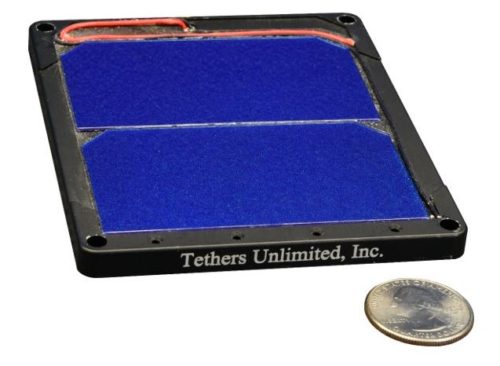
** Electrodynamic tether device from Tethers Unlimited deorbits spacecraft at the end of their missions. After several years of development and testing in space, the Terminator Tape™ Deorbit Modules is attracting more attention and customers. This arises from the growing awareness that active measures are needed to reduce orbital traffic as the number of satellites in low earth orbit rapidly expands.

From the Datasheet (pdf):

    • Terminator Tape is mounted on the face of the spacecraft
    • Solar cells are mounted to the top surface using electrical feedthroughs provided
    • Upon completion of the mission, the spacecraft commands deployment of the Terminator Tape
    • The module deploys a conducting tape, which generates neutral particle drag and passive electromagnetics drag to hasten the deorbit of the spacecraft
Terminator Tape module with solar panel. Credits: Tethers Unlimited

** Diagnosing a rocket motor nozzle failure: Jeff Smith back to the show to discuss his July 13, 2020 Space Review article, CSI: Rocket Science.

** Briefs:

==================

Check out the
The Lurio Report
for news and analysis of key developments in NewSpace

The latest issue:
Changes Here, Starliner Analysis, OneWeb-A UK View
Vol. 15, No. 5, July 24, 2020

Space Frontier Foundation Award for NewSpace Journalism

==================

** SpaceX:

** Another attempt at Starlink 9 launch upcoming on this Saturday, August 1st at 3:21 am EDT (0721 GMT) [Thursday, August 6th at 1:33 am EDT ( 0533 GMT)].  SpaceX Starlink mission nears third launch attempt after six weeks of delays – Teslarati. This mission to launch 57 Starlink satellites and two BlackSky earth imaging satellites has been repeatedly postponed since the end of June.

[ Update: Due to the threat of  tropical storm Isaias, the launch of the Starlink 9 mission has been postponed yet again. The new target liftoff date is Thursday, August 6th at 1:33 am EDT ( 0533 GMT).

** The Crew Dragon set to depart from ISS on August 1st and splash down near Florida on August 2nd. However, an approaching tropical storm may cause a postponement of the return.  Here is a schedule of coverage of the event: NASA to Provide Coverage of Astronauts’ Return from Space Station | NASA

** A briefing by NASA and SpaceX on the return of the Crew Dragon from the ISS: Expedition 63 Post Flight Readiness Review Briefing – July 29, 2020

Following the completion of a readiness review, NASA and SpaceX officials previewed the upcoming return to Earth of NASA astronauts Doug Hurley and Robert Behnken during a news conference July 29. NASA Administrator Jim Bridenstine, Commercial Crew program manager Steve Stich, International Space Station program manager Joel Montalbano and Benji Reed, the SpaceX director for crew mission management discussed splashdown and recovery options for the SpaceX Crew Dragon vehicle with Hurley and Behnken aboard. The astronauts are scheduled to undock from the space station on Aug. 1 with a planned splashdown on Aug. 2 to complete an historic nine-week mission.

** The first operational Crew Dragon mission will happen about 6 weeks after the return of the DM-2 crew: SpaceX spaceship almost ready for next NASA astronaut launch – Teslarati

Deep inside SpaceX’s Hawthorne, California rocket factory, the Crew Dragon capsule – believed to be C207 – assigned to the company’s operational astronaut launch debut (Crew-1) is in the late stages of final integration. A photo provided alongside the news confirms that the Crew Dragon is nearly complete. Aside from the installation of body panels and several other tasks that will be completed once the ship arrives in Florida, capsule C207 is already fully outfitted with a heatshield, windows, Draco maneuvering thrusters, SuperDraco abort thrusters, parachute deployment hardware, and much more.

According to Benji Reed, SpaceX Director of Crew Mission Management, SpaceX’s Crew-1 operational astronaut launch debut remains on track to launch no earlier than late September. Capsule C207 and its upgraded trunk section are also reportedly on track to head from California to SpaceX’s Florida launch facilities in time to support that schedule and could ship east just two or so weeks from now.

** Astronauts for second operational Crew Dragon mission announced: NASA Announces Astronauts to Fly on SpaceX Crew-2 Mission | NASA

NASA and its international partners have assigned crew members for Crew-2, which will be the second operational SpaceX Crew Dragon flight to the International Space Station as part of NASA’s Commercial Crew Program.

NASA astronauts Shane Kimbrough and Megan McArthur will serve as spacecraft commander and pilot, respectively, for the mission. JAXA (Japan Aerospace Exploration Agency) astronaut Akihiko Hoshide and ESA (European Space Agency) astronaut Thomas Pesquet will join as mission specialists.

Crew-2 is targeted to launch in spring 2021, following the successful completion of both NASA’s SpaceX Demo-2 test flight mission, which is expected to return to Earth Aug. 2, and the launch of NASA’s SpaceX Crew-1 mission, which is targeted for late September. The Crew-2 astronauts will remain aboard the space station for approximately six months as expedition crew members, along with three crewmates who will launch via a Russian Soyuz spacecraft. The increase of the full space station crew complement to seven members – over the previous six – will allow NASA to effectively double the amount of science that can be conducted in space.

** McGregor test facility observing:

** SpaceX raising more money to pay for Starlink deployment and Starship development: SpaceX is raising up to $1 billion at $44 billion valuation – CNBC.com

Space Exploration Technologies, Elon Musk’s reusable rocket and satellite internet venture, is in talks to raise $500 million to $1 billion in series N funding at a valuation of $44 billion, according to documents reviewed by CNBC and people familiar with the company’s fundraising activity.

The funding would help SpaceX begin commercial operations of its Starlink satellite broadband service and to conduct suborbital and orbital test flights of its Starship and SuperHeavy booster launch vehicle. Bloomberg previously reported on the fundraising plans.

See also SpaceX on track to become third most valuable private company in the world – Teslarati.

**** Starship

The SN5 prototype Starship was pressure tested last week. Subsequent efforts to test fire its single Raptor engine were hampered by various weather and technical issues. The first attempt today was scrubbed when a small fishing boat wandered into safety zone near the test site.  A second try, though, was successful. The firing occurs at about the 30:14 point in this video:

** SN5 SpaceX Stealth Cam Ultra Up Close Static Fire 3 ViewsLabPadre

The test was soon followed by this comment from Elon:

From previous tests, can expect the 150 m hop in about 2 or 3 days.

More about the Boca Chica SN5 tests:

****** Videos of recent Boca Chica activities:

****** July 23: SpaceX Boca Chica – Mk1 Fins Mounted – SN8 Common Dome Flip – NASASpaceflight – YouTube

The Mk1 Fins were hoisted into position, SN8’s Common Dome was flipped, a new nosecone (yes, another one- this one with a header tank weld) has appeared in the nosecone fabrication tent, and modifications on the old SN2 test tank continue. Video and Pictures from Mary (@BocaChicaGal). Edited by Jack Beyer (@TheJackBeyer)

****** July 24: SpaceX Boca Chica – High Bay Level 2 – Forward Dome Sheathed – NASASpaceflight – YouTube

The new High Bay continues to rise, a Forward Dome is moved out of a fabrication tent and sheathed with a ring stack, SN2 test tank mods continue, and the Mk1 Fins make an appearance. Video and Pictures from Mary (@BocaChicaGal). Edited by Jack Beyer (@TheJackBeyer)

****** July 28: SpaceX Boca Chica – SN5 Preparations – SN8 Downcomer Spotted – NASASpaceflight – YouTube

Starship SN5 is being prepared for another Static Fire attempt at the launch site while work continues on future Starships, including SN8 at the Production Facility. Video and Pictures from Mary (@BocaChicaGal). Edited by Jack Beyer (@TheJackBeyer).

****** July 29: SpaceX Boca Chica – Starship SN5 waits for Static Fire. Rebuilding Bluezilla – NASASpaceflight – YouTube

While Starship SN5 continues to prepare for a Static Fire test, Boca Chica is a hive of activity, with the dishes practicing linkups with SN5, rebuilding Bluezilla and more. Video and Pictures from Mary (@BocaChicaGal). Edited by Jack Beyer (@TheJackBeyer).

****   Other Starship and space transport reports:

**** July 25: SpaceX Starship Super heavy high bay, ANASIS-II + Hope Mars Launch and Gilmour Space 110-sec testMarcus House – July.25.2020

Another action-packed week of space news. SpaceX Starship Super heavy high bay construction continues, we had the ANASIS-II Falcon 9 launch, the Hope Mars Launch and Gilmour Space 110-sec test fire. There has been no shortage of developments with Starship construction at Boca Chica. Lots to see. We’ve had another beautiful flight of the Falcon 9 with the launch of ANASIS-II with eh booster returning just recently. The HOPE Mars Mission mission launched aboard the Japanese H-2A rocket. Gilmour Space Technologies in Queensland Australia is pioneering new single-port hybrid propulsion rocket engines that are claimed to be significantly cheaper, greener, and safer to operate than traditional liquid and solid propulsion rockets.

**** July.28: SpaceX Starship Updates – 2020 Mars Mission Frenzy! – What about it!?

In this Episode, we will take a look at SpaceX’s progress in Boca Chica Texas and the recent Hurricane Hanna. Does a Hurricane pose any danger and how real is the threat in the future for SpaceX. We will also take a look at the recent Hope mission launched by the United Arab Emirates, the Tainwen-1 mission, launched by China and the imminent Mars 2020 Perseverance rover mission to be launched very soon by NASA and ULA. Why is it, that everyone is targeting Mars right now? How does a Mars transfer orbit work?

**** July.24: SpaceX Starship Updates – Why a hop will happen this time!What about it!?

In this Episode, we will take a look at SpaceX’s progress on the Super Heavy High Bay. We will also take a look at the ongoing work at the new Super Heavy and Starship launch pad and last but not least, we will take a look at first preparations for the Starship SN5 150-meter hop!

** 2020 07 22 Fins-a-Go-GoStarshipBocaChica/Maria Pointer – YouTube

We finally see what those incredible Starship designers had in mind for Elon’s Party Central at the Starship Village Community Center. FIN Park? This will be the hub of activity for residents of the newly-renovated homes on Weems Street and those living in the Bambi Airstream executive mansions on wheels.

100 years from now, as Elon City residents look down on the planetary home of their ancestors, they will see the Sun glint off of these wings and point to their Martian children and say… “See children… That’s where your grandfather and grandmother left Earth so you could be the ‘Hope of Consciousness’ for all of humanity.” And they will rejoice.

=====

=== Space Art from C. Sergent Lindsey ===

Sweatshirt imprinted with “SpaceX Delivers the Goods” by C Sergent Lindsey. Available at Fine Art America.

Space transport roundup – July.22.2020

A sampling of recent articles, videos, and images dealing with space transport (find previous roundups here):

** SpaceX Falcon 9 launches S. Korean ANASIS-II milcomm sat with same booster used for ISS crew mission. The booster landed safely on an ocean platform. The 51 day turnaround time was the fastest so far for reusing the Falcon boosters and faster than the best Space Shuttle turnaround of 54 days.

Both of the nosecone fairings were also captured in nets on two ships for the first dual catch on the same flight. While SpaceX has re-flown fairings recovered after landing in the ocean, it’s obviously better for reuse if they can avoid dealing with the effects of seawater and impacting the surface of the sea.

A view of the rocket in super slo-mo:

See also:

Find more about other SpaceX activities below.

** Japanese H-IIA rocket launches UAE Hope mission to Mars. The H-IIA is built and operated by Mitsubishi Heavy Industries.

** Long March 5 moved to pad in preparation for launch of China’s Tianwen 1 Mars mission. The time for liftoff from the Wenchang Space Launch Center on the southern coast of Hainan province is currently given at SpaceflightNow as Thursday, July 23 at  12:45 am EDT (0445 GMT). The payload includes an orbiter, a lander, and a rover.

** The ULA Atlas V launch of the Perseverance rover to Mars is currently set for liftoff on July 30th.

Here is a discussion with ULA CEO Tory Bruno about the upcoming launch: 79 – Preparing for a Martian Launch (feat. Tory Bruno) – WeMartians Podcast

** Russian Soyuz rocket set to launch Progress cargo carrier to the ISS on Thursday: Soyuz rocket raised on Baikonur launch pad for space station resupply flight – Spaceflight Now

A Russian Soyuz rocket rolled out to a launch pad Monday at the Baikonur Cosmodrome in Kazakhstan, ready for final inspections, checkouts and fueling before liftoff Thursday with a Progress supply ship bound for the International Space Station.

The Soyuz-2.1a launcher emerged from a hangar at the Baikonur Cosmodrome just after sunrise Monday, riding a mobile railcar across the Kazakh steppe to Launch Pad No. 31. A hydraulic lift raised the launcher vertical on pad 31, and gantry arms rotated into position around the rocket to allow workers access to the vehicle for final pre-launch preparations.

Launch is scheduled for 10:26:22 a.m. EDT (1426:22 GMT; 7:26:22 p.m. Baikonur time) Thursday to kick off a three-hour pursuit of the space station. The launch time is set to occur around the time the research outpost flies over Baikonur.

The Progress will catch up with the ISS for docking in less than 3 hours after liftoff:

Russian ground teams loaded 3,351 pounds (1,520 kilograms) of dry cargo into the cargo freighter’s pressurized compartment, according to Roscosmos, the Russian space agency. Roscosmos says there’s around 1,322 pounds (600 kilograms) of propellant aboard the Progress MS-15 spacecraft for transfer into the space station’s tanks, along with 926 pounds (420 kilograms) of water and 101 pounds (46 kilograms) of compressed gas to replenish the space station’s breathing air.

**** Firefly sends mobile launch platform to Vandenberg launch facility:

** Virgin Orbit to use Japanese airport as base for some LauncherOne missions:  Virgin sets up Japan spaceport to lure Asian satellite builders – Nikkei Asian Review

Asia’s first [commercial] spaceport, located at Oita Airport on the Japanese island of Kyushu, is readying support for Virgin Orbit as the company looks to fire off its LauncherOne rocket in 2022.

Virgin Orbit — a space venture of the Virgin Group — will use a modified Boeing 747, christened “Cosmic Girl,” as the launch platform for LauncherOne, which carries small commercial satellites into either a sun-synchronous or low-Earth orbit, depending on customer requirements.

In addition to its prime Oita location, the U.S.-based company has chosen four airports in the U.S. and Europe for launching satellites, including Mojave Air and Space Port in California and the U.K.’s Spaceport Cornwall at Cornwall Airport Newquay.

** An update on the Southern Launch commercial spaceport facility on the southern coast of Australia: Southern Launch prepares for lift off In South Australia – Spacedaily.com

Historically, launch sites have been constructed closer to the equator to support large satellites launches into equatorial orbit. However, direct launch to polar orbit is achieved most efficiently from launch sites nearer the poles, which have minimal interference from aviation and maritime traffic.

Southern Launch, founded in 2017, is developing a multi-user launch complex at the tip of the Eyre Peninsula in South Australia, offering a turn-key launch service solution to polar and sun-synchronous orbit.

In addition to providing the complete launch infrastructure, Southern Launch has the ability to undertake flight and range safety, vehicle design, avionics componentry and assist with launch permitting and other support services. The year-round temperate weather coupled with the highly skilled local workforce and a robust logistics supply network enables a launch site that offers high cadence launch operations at cost competitive prices.

The growing global demand for launch services and a world class launch location has attracted several early investors, with Southern Launch running an oversubscribed seed funding round at the end of 2019 with a larger Series A round to be finalised in coming months.

The first orbital rocket launch from the facility is expected in 2021.

For more details about the project, see Frequently Asked Questions — Southern Launch.

** Astra heading to Kodiak Island, Alaska for another attempt at an orbital launch

** Study provides the latest on space elevator technologies and prospects:

From the abstract:

A new paradigm has emerged:

      • space elevators can be accomplished because we now have a material
      • space elevators enable interplanetary missions
      • fast transit to Mars (as short as 61 days, with variations out to 400+)
      • can release towards Mars EVERY day (no 26 month wait)o Can move massive amounts of cargo (180,000 MTs/year to GEO-beyond)
      • space Elevators are Earth friendly
      • space solar power replaces 100s of coal power plants
      • no rocket exhaust to contribute to global warming
      • no additional space debris
      • opens up remarkable commercial enterprises at Earth Port, GEO Region +
      • offer to all future scientists: any size science experiment, any solar system destination, releases every day towards multiple scientific destinations

** Briefs:

==================

Check out the
The Lurio Report
for news and analysis of key developments in NewSpace

The latest issue:
Riding a Dragon, Rockets Rising, Space Resource Policy
Vol. 15, No. 4, June 14, 2020

Space Frontier Foundation Award for NewSpace Journalism

==================

** SpaceX:

** NASA targets August 1st for departure of the SpaceX Crew Dragon from the ISS on August 1st. The Endeavour Dragon spacecraft will bring back astronauts Bob Behnken and Doug Hurley to a splashdown in the Atlantic off the coast of Florida on August 2nd.

** The McGregor, Texas test facility is always busy:

**** Starship

SpaceX has carried out cryogenic pressure testing the propellant tanks of the Starship SN5 prototype currently mounted on a launch fixture at Boca Chica. If the subsequent fueling and engine tests go well, then a hop of about 150 meters will come soon after:

SN5 is using a less advanced steel alloy than what is planned for operational vehicles. The SN8 prototype currently in construction is believed to be using the alloy labeled 304L –  SpaceX begins building upgraded Starship prototype – Teslarati. However, Elon says the formulation of the final alloy for the Starships may not follow the standard recipe for 304L:

**** Latest videos from Boca Chica:

****** Exclusive! Space X Launch Site Flyover 07/20!RGV Aerial Photography

****** July 15: SpaceX Boca Chica – Nosecone Progress – High Bay Grows – NASASpaceflight – YouTube

New Starship parts are lining up at the build site including new ring stacks and the completed nosecone section. The high bay continues to grow at a rapid pace, and SN5 continues to be worked on ahead of engine testing. As a special bonus: 3 entire minutes of scrapping footage at the end for your enjoyment. Video and Pictures from Mary (@BocaChicaGal). Edited by Jack Beyer (@TheJackBeyer)

****** July 16: SpaceX Boca Chica – SN5 waits, expansion continues, fin washing – NASASpaceflight – YouTube

While Starship SN5 continues to wait for its Static Fire test (still at least a few days away) and soon-to-follow Hop, the expansion of Spaceport Boca Chica continues and future Starships get in line. Video includes fin power washing! Video and Pictures from Mary (@BocaChicaGal). Edited by Jack Beyer (@TheJackBeyer).

** July 21: SpaceX Boca Chica – SN8 Common Dome Spotted – SN5 Fueling Test – NASASpaceflight – YouTube

The Common Dome for Starship SN8 has been spotted, clearly labeled as such. SN5 underwent a fueling test, the results of which are unknown, the next level of High Bay sections has started to go up, and yet another new nosecone has been spotted inside Tent 3. Video and Pictures from Mary (@BocaChicaGal). Edited by Jack Beyer (@thejackbeyer).

****** July.21: SpaceX Boca Chica – High Bay Grows as Robots and Raptor arrive – NASASpaceflight – YouTube

While Spaceship SN5 remains in preparations for a Static Fire test, numerous new arrivals were spotted, from welding robots to a new Raptor engine, all while the High Bay continues to grow. Video and Pictures from Mary (@BocaChicaGal). Edited by Jack Beyer (@thejackbeyer).

**** Webcast reports on Starship and other rockets:

**** July 19: SpaceX Boca Chica Weekly Update – Starship fabrication continues at speed as high bay takes shapeNASASpaceflight – YouTube

NSF’s second weekly update video showing the highlights of work ongoing at SpaceX Boca Chica as Starship SN5 prepares to enter a week of testing. Video and Pictures from Mary (@BocaChicaGal), Nomadd and Jack Beyer. Edited by Jack Beyer (@TheJackBeyer)

**** July 18: SpaceX Starship SN5 150m flight countdown, Starlink Beta, Minotaur IV Launch and Skylab AnniversaryMarcus House

Many topics this week including a SpaceX Starship SN5 150m flight countdown update, Starlink Beta, the Minotaur IV Launch, and the 41st Skylab Anniversary. The Starship prototype Serial Number 5 still awaits that 150-meter flight test but getting very close now. Some news on the Starlink terminals and information on the roll-out of the private beta beginning this summer with a public beta to follow. We had the super-rapid Minotaur launch just the other day, look at that go, and we’re going to talk a little about Skylab that 41 years ago made its undignified return to earth into parts of the Indian Ocean and Western Australia.

**** July 21: SpaceX Starship Updates – Solar Orbiter: Close To The InfernoWhat about it!?

The Common Dome for Starship SN8 has been spotted, clearly labeled as such. SN5 underwent a fueling test, the results of which are unknown, the next level of High Bay sections has started to go up, and yet another new nosecone has been spotted inside Tent 3. Video and Pictures from Mary (@BocaChicaGal). Edited by Jack Beyer (@thejackbeyer).

**** July 17: SpaceX Starship Updates – Boca Chica Developing Faster & Faster!What about it!?

=====

=== Space Art from C. Sergent Lindsey ===

Sweatshirt imprinted with “SpaceX Delivers the Goods” by C Sergent Lindsey. Available at Fine Art America.


Space transport roundup – July.15.2020

A sampling of recent articles, videos, and images dealing with space transport (find previous roundups here):

** Northrup Grumman Minotaur IV launches 4 NRO classified satellites from Virginia spaceport Wednesday morning. The modified Peacekeeper missile used four solid-fueled stages to put the satellites into low earth orbit.

More at:

** Launch of the UAE  Hope Mars mission on a Japanese H-2A rocket was scrubbed on Tuesday due to bad weather at the Tanegashima Space Center in southern Japan. The new target liftoff  time is Thursday, July 16, 2020 at 8:43 pm GMT (4:43 pm EDT).

** China launched a broadband Internet satellite on Long March 3B on July 9th: Long March 3B launches APStar-6D – NASASpaceFlight.com

The satellite is part of a multi-beam high-throughput broadband satellite communication system based on the Ku and Ka frequency bands that will form a space-wide Internet communication network covering the whole world, build an integrated, autonomous, controllable, efficient and safe satellite broadband communication network and service platform that provide the ability to match global communications needs to provide high-quality, efficient, and low-cost satellite broadband communications services for mobile communications, including maritime communications, aviation airborne communications, land vehicle communications and fixed satellite broadband Internet access.

** Chinese Kuaizhou-11 rocket launch failed on July 10th. Two commercial satellites were lost. First launch of Chinese Kuaizhou-11 rocket ends in failure – SpaceNews

The three-stage rocket uses solid fueled motors and has been derived from Chinese military missile technology by ExPace Technology Corp., a subsidiary of the government-run China Aerospace Science and Industry Corporation (CASIC).

SpaceNews:

The mission was China’s 19th launch of 2020, following the successful launch of the APSTAR-6D communications satellite to geosynchronous transfer orbit Thursday.

China has suffered three failures this year. These were the debut launch of the Long March 7A in March, a new launcher which may replace the aging, hypergolic Long March 3B. The latter launcher failed in April resulting in the loss of the Indonesian Palapa-N1 communications satellite.

** More about the recent Israeli Shavit rocket launch from Scott Manley:

The Shavit first launched in 1988 carrying Israeli designed and built surveillance satellites, since then it’s launched more than 10 time, with the latest being the first weekend of July 2020 carrying the Ofeq 16 satellite. Shavit is unique among launch vehicles in that it’s designed to launch retrograde to avoid dropping spend stages on Israels neighbours.

** Skyrora opens new engine test facility in Scotland: Skyrora opens rocket engine test complex expected to create over 170 jobs – Skyrora

Skyrora has established an engine test complex in Scotland, where it already has successfully tested its 3.5kN engine and three-tonne engine for its sub-orbital and orbital rockets. Skyrora expects the newly established Engine Test Complex to help the company create over 170 new jobs in the area by 2030. 

Skyrora’s engine test complex layout is fairly minimal, mainly consisting of a fuel and oxidiser loading system to put fuel into both tanks and a pressure supply system to feed the fuel to the engine in the test stand.  Skyrora also built the actual test stand, the road to access the test site and the concrete slab for the test site to sit on. It took the team only a few weeks to build it, at a fraction of the estimated time and cost while making sure all measures followed health and safety guidelines.

Skyrora’s vision is to test all three engines used on its rocket suite in the one location: the seven-tonne engine for the first and second stage of the orbital Skyrora XL launch vehicle, the 3.5Kn engine for the third stage, and the three-tonne engine for the sub-orbital Skylark L launch vehicle. 

The test site is estimated to help Skyrora create over 170 mainly technical jobs in manufacturing and operations ranging from mechanical engineering to electronics for avionics systems. 

** Taiwanese TiSpace develops mobile launch system for Hapath V rocket:

** Startup iRocket signs contract with USAF: Fully Reusable, Autonomous, Small Rockets, Flight-Ready in Under 24 Hours – iRocket

On July 7, 2020 iRocket announced that the company signed a Phase II RAPID Other Transaction Agreement contract with the U.S. Air Force. The award was created just three months after the phase I contract when iRocket partnered with Space and Missile Systems Center (SMC) in Albuquerque, N.M., and Air Force Research Lab at Wright-Patterson Air Force Base, Ohio.

iRocket is a privately funded New York startup building autonomous small reusable rockets to cargo micro, nano, cube, and constellations to LEO on its Shockwave launch vehicle. The company develops cost-effective small launch vehicles that can support 300kg and 1500 kg payloads for space research and exploration. After the recent successful launch of two American astronauts into orbit by the SpaceX/NASA partnership, there has been tremendous media interest in private companies innovating, reducing costs, and increasing access to space exploration – all of which are iRocket’s specialties. iRocket plans to disrupt the small satellite market and will offer on-orbit satellite servicing capabilities by 2025.

iRocket’s Shockwave will be a fully autonomous launch vehicle and the only fully reusable small launcher in the market. It will consist of two stages to orbit, the first and second stage landing back on the launch site. iRocket will prove inland launch capabilities to the Department of Defense and be mission capable of launching within 24 hrs. iRocket plans to launch its rockets from Launch Complex 48 at Kennedy Space Center in Cape Canaveral, Fl.

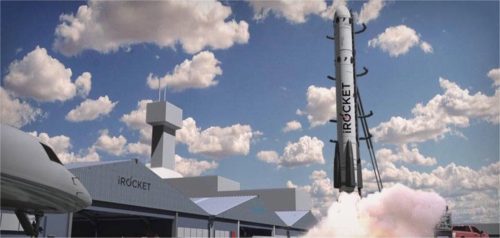
Rendering of an iRocket Shockwave rocket lifting off.

** Vert Aerospace aims to develop a smallsat launch system with a low carbon footprint. The fully reusable vehicle will accomplish this by

using additive manufacturing, Vert Aerospace will drastically REDUCE part count and material needs.

and

The Gaia Launch Vehicle (GLV) will be fueled using recycled RP-1. Vert Aerospace will use a proprietary CO2 conversion process powered by solar. 

** Germany’s DLR sponsoring microlauncher competition (Google Translation):

The microlauncher competition of the DLR Space Administration started on May 15, 2020. The competition supports German start-ups with a total amount of 25 million euros, which Mikrolauncher wants to develop and operate commercially. A maximum of five companies can participate, of which two winners will be selected by an expert jury during the two-year term….

The Mikrolauncher competition is divided into three phases: In the preliminary round (2020), the maximum of five participating start-ups are selected, each receiving 500,000 euros in funding. In the course of the main round (2021) the winner of the competition will be determined, who will receive funding of eleven million euros. In the third phase (2022), the second place is awarded, which is also endowed with eleven million euros.

Funding is provided through the European Space Agency’s C-STS program . Technical, economic and operational evaluation criteria are decisive for the selection of the teams in all three competition phases.

Three teams –  HyImpulseIsar Aerospace Technologies and Rocket Factory Augsburg  – have now been selected from the preliminary round to continue to the next phase of the competition: DLR microlauncher competition: These three teams are one round further – DLR Portal (Google Translate)

The core task of the competition was a proposal for transport services from earth to orbit (“Earth to Orbit”) based on a micro launcher developed by the company itself. A prerequisite was also the willingness to allow free flight of selected non-commercial payloads from universities or research institutions with a maximum total mass of 150 kilograms each on the qualification flights. In the last two rounds of the competition, the winners receive funding for the final qualification phase of their carrier system, including the implementation of two demonstration flights in the period 2022-2023. After the preliminary round has now ended, the first winner of the competition will be determined in the course of the main round (2021), who will receive funding of eleven million euros. In the third phase (2022), the second prize is awarded, which is also endowed with eleven million euros.

The microlaunchers are loosely defined as those launchers that can take a payload of a few hundred kilograms to low earth orbit.

** Spaceflight to fly new Sherpa-FX space tug on a SpaceX Rideshare mission later this year to take multiple smallsats to desired orbits: Spaceflight Inc. Unveils Next-Gen Orbital Transfer Vehicle To Fly Aboard Next SpaceX Rideshare Mission – Spaceflight

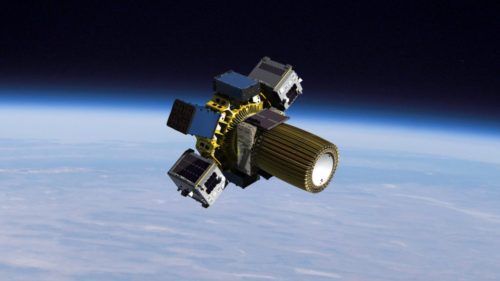
“Spaceflight’s Sherpa-FX is the first innovative orbital transfer vehicle to debut in the company’s Sherpa-NG (next generation) program. The vehicle is capable of executing multiple deployments, providing independent and detailed deployment telemetry, and flexible interface, all at a low cost. Graphic represents the SXRS-3 mission, carrying customer spacecraft and hosted payloads.” Credits: Spaceflight

Some hosted payloads will remain attached to the transfer vehicle:

In addition to the customer spacecraft, Sherpa-FX will transport multiple hosted payloads including one for Celestis Inc., as well as several that will demonstrate technologies designed to identify and track spacecraft once deployed. By demonstrating these tracking systems on orbit, Spaceflight customers will have access to flight-proven technologies that can mitigate space congestion and provide the foundation of effective and responsible space traffic management. Technologies onboard Sherpa-FX include payloads by NearSpace Launch, Keplerian Technologies and their hardware partner Tiger Innovations, and Space Domain Awareness Inc. These innovative payloads will provide spacecraft developers an independent capability to identify and track their spacecraft without drawing on the host spacecraft resources. 

** First Launch of Europe’s next-gen Ariane 6 rocket slips till late 2021. The all expendable vehicle is intended to replace the Ariane 5 and to offer launch prices competitive with SpaceX Falcon 9. ESA confirms Ariane 6 delay to 2021 – SpaceNews

Europe’s Ariane 6 rocket won’t launch until the second half of 2021 at the earliest, a delay of at least six months, the European Space Agency confirmed July 9.

“While we know that the maiden flight will not take place before the second semester of 2021, we cannot at this moment precisely quantify the delay, and we cannot provide an exact launch date,” Daniel Neuenschwander, ESA’s director of space transportation, said according to an ESA translation of remarks at a July 9 press event provided to SpaceNews. The French Association of Professional Journalists in Aeronautics, organized the event at ArianeGroup’s headquarters in Paris.

** Status of development of seven heavy lift launch systems: Sadly, none of the big rockets we hoped to see fly in 2020 actually will | Ars Technica

  • H3 – Mitsubishi Heavy Industries – Likely first launch 2Q 2021
  • Omega – Northrop-Grumman – 3Q-4Q 2021
  • Ariane 6 – Airbus/Safran/ESA – 4Q 2021
  • Vulcan-Centaur – United Launch Alliance – 4Q 2021
  • Super Heavy reusable 1st stage – SpaceX – 4Q 2021
  • SLS – Boeing/NASA – 1Q-2Q 2022
  • New Glenn – Blue Origin – 3Q-4Q 2022

** Briefs:

==================

Check out the
The Lurio Report
for news and analysis of key developments in NewSpace

The latest issue:
Riding a Dragon, Rockets Rising, Space Resource Policy
Vol. 15, No. 4, June 14, 2020

Space Frontier Foundation Award for NewSpace Journalism

==================

** SpaceX:

** Two SpaceX Falcons struggling to fly. The third go at launching the Starlink 9 payload with 57 Starlink satellites and 2 BlackSky satellites on Saturday July 11th was scrubbed due to unspecified technical problems. This followed two previous attempts to lift off since late June. A launch of another Falcon 9 set for Tuesday July 14th of the South Korean Anasis 2 military communications satellite was postponed due to an issue with the upper stage. The first stage booster had been successfully test fired last Saturday. The Anasis launch is now set for Sunday, July 19th at 5 pm EDT (2100 GMT).

** SpaceX – Lift, Load and Go – GPS IIIwww.USLaunchReport.com

From the sea to the highway. Incredible how SpaceX has shortened the Port processing time. With the new Octagrabber, they are able to load directly from JRTI to the transporter. Pushing for that 24hr turnaround. All in 4K.

**** Starship

It appears that the Raptor engine on the Starship prototype SN5 will be test fired in the next few days. If that goes well, a brief hop flight up to 150 meters could take place soon after: Starship SN5 set for a static fire followed shortly by a 150-meter hop attempt – NASASpaceFlight.com

Starship SN5 is finally set to begin Raptor engine testing this weekend after a successful cryogenic proof test on July 1. If the static fire test is successful, it will clear the way for a 150-meter hop test as early as next week. The 150-meter hop will be the first test flight of a full-scale Starship tank section.

A successful cryogenic proof test on July 1 verified that Starship SN5 can withstand the forces associated with engine testing. These forces include the pressure created by the cryogenic propellants and the thrust from the Raptor engine.

Ahead of the static fire test, the hydraulic thrust simulator – used for the proof testing – was removed to make way for a Raptor engine. Raptor SN27 is the engine chosen for use on SN5.

….

Whatever the case, SpaceX teams are understood to be eager to get Starship SN8 completed. The vehicle will feature major upgrades over previous Starship prototypes. SN8 will be built out of 304L stainless steel versus 301, receive a fairing, aerosurfaces, and three Raptor engines to allow for a higher altitude test flight.

****** Boca Chica Beach facilities have developed and expanded rapidly has seen in the before and after imagery provided in this article from RGVAerialPhotography and other sources: New images show SpaceX’s Starship factory, launch site grow over time – Business Insider

A new fly over video from RGV:

******More videos of Boca Chica:

****** July 11: SpaceX Boca Chica – Additional facility expansion – NASASpaceflight – YouTube

SpaceX Boca Chica continues to grow as a spaceport with the impressive High Bay continuing assembly while extra land is cleared for further expansion. Video and Pictures from Mary (@BocaChicaGal). Edited by Brady Kenniston (@TheFavoritist)

****** July 12:  SpaceX Boca Chica – Gearing up for Starship SN5’s Static Fire testing – NASASpaceflight – YouTube

While there is activity all across SpaceX Boca Chica, the focus of attention will be on Starship SN5 this coming week ahead of her Static Fire test campaign. Footage includes Production Facility section preps and the drive past of the facilities that have new additions each week. Video and Pictures from Mary (@BocaChicaGal). Edited by Jack Beyer (@thejackbeyer).

****** July 14: SpaceX Boca Chica – Nosecone Ready To Stack – Work On New Lot – NASASpaceflight – YouTube

In today’s Boca Chica update, Nosecone stacking appears imminent (but doesn’t happen), another new nosecone (yes another one) is spotted in the fabrication tents, Earth work begins at a new lot that SpaceX has apparently purchased, future starship parts line up and SN5 test campaign preparations continue. Video and Pictures from Mary (@BocaChicaGal). Edited by Jack Beyer (@TheJackBeyer)

****** July 15: SpaceX Boca Chica – A New Nosecone Is Born – New Lots Readied For Expansion – NASASpaceflight – YouTube

In this Starship update; a new Nosecone is born in Boca Chica, a scrap ring stack is moved out of the fabrication area, earth work on both sides of the build site continued, and work at the launch site and on SN5 continued ahead of engine testing. Video and Pictures from Mary (@BocaChicaGal). Edited by Jack Beyer (@TheJackBeyer)

****** Webcast Starship reports:

**** SpaceX Starship news as SN5 heads towards 150m flight, OneWeb, RocketLab & Starliner updatesMarcus House

****** What’s Missing In SpaceX’s Boca Chica?What about it!?

****** Will the Starship Facility Survive Hurricanes?What about it!?

****** SpaceX Boca Chica – Weekly Update – First Week of July, 2020 – NASASpaceflight – YouTube

NSF’s first weekly update video showing the highlights of work ongoing at SpaceX Boca Chica. Featuring videos and photos from Mary (@bocachicagal) for NSF. Edited and hosted by Jack Beyer (@thejackbeyer).

=====

=== The Art of C. Sergent Lindsey ===
SpaceX Delivers the Goods” by C. Sergent Lindsey printed on phone cover. Available at Fine Art America.

Space transport roundup – July.7.2020

A sampling of recent articles, videos, and images dealing with space transport (find previous roundups here):

[ Update: The launch was scrubbed due to thunderstorms in the area around the Cape. Another attempt will be made this Saturday, July 11th  during a window between 10:49 am to 11:00 am EDT.  Currently, the forecast shows a 60% chance of acceptable conditions for liftoff during the window.

]

** Delayed Starlink-9 mission now set for liftoff on Wednesday at 11:59 am EDT (1559 GMT) from Pad 39A at Cape Kennedy Space Center. The Falcon 9’s launch date was postponed several times in June and then moved till after the launch of a USAF GPS satellite. The rocket will carry 57 Starlink broadband Internet satellites and 2 BlackSky earth imaging satellites into polar orbit.

Four Falcon 9 launches could happen this month. Here are the three other missions with their no-earlier-than dates:

Find more about other SpaceX activities below.

** Rocket Lab Electron mission fails due to upper stage issue. This was the 13th launch of the Electron rocket, which also failed on its first test launch due to a communications problem in a ground system. Rocket Lab Mission Fails to Reach Orbit | Rocket Lab.

The payload consisted of seven satellites including a Canon Electronics CE-SAT-IB imaging satellite, five Planet SuperDove imaging smallsats, and the Faraday-1 6U CubeSat from In-Space Missions.

Scott Manley gives his view on the failure:

See also:

** China launches two rockets within three days. The first rocket was a Long March 4B rocket launched from the Taiyuan Satellite Lunch Center in northern China on July 2nd with a Gaofen remote sensing satellite as the primary payload. Also on board was the Xibaipo (BY 70-2) CubeSat, intended for science and education related tasks.

The second rocket was a Long March 2D that lifted off from the Jiuquan Satellite Launch Center in the Gobi desert carrying the Shiyan-6 satellite on July 5th. The Shiyan-6 is described as a remote sensing technology development system but is believed by analysts outside of China as a military reconnaissance satellite.

See also:

** Israel launched a reconnaissance satellite into orbit with a Shavit rocket. As with previous Israeli satellites, the rocket launched the Ofek 16 satellite towards the west over the Mediterranean Sea and into a retrograde orbit.

** Virgin Galactic to show SpaceShipTwo interior design on July 28th: Virgin Galactic Announces Date for World’s First Virtual Reveal of Spaceship Cabin Design – Virgin Galactic

Virgin Galactic today [July.2.2020] announced that SpaceShipTwo’s cabin interior design reveal will take place on July 28, 2020. The virtual event will be streamed live on YouTube. In celebration of this milestone, the Company will also be announcing plans to bring immersive experiences of Virgin Galactic’s spaceflight and cabin interior to aspiring astronauts around the world.

The unveiling of the spaceship cabin design marks the latest milestone towards Virgin Galactic’s operational readiness and will accentuate the Company’s focus on using inspired and bold design to transform the entire customer journey. While the cabin interior has been created to integrate seamlessly with every step of that journey, it is also the design centerpiece, providing safety without distraction, quietly absorbing periods of sensory intensity and offering each astronaut a level of intimacy required for personal discovery and transformation.

The live-streamed unveiling will feature a virtual walkthrough of the cabin, curated by the multi-disciplinary team which has striven to ensure that every detail of its design works to provide an unparalleled and safe consumer experience.

** NASA and Boeing give update on Starliner crew vehicle and uncrewed test flight: NASA and Boeing Complete Orbital Flight Test Reviews | NASA

NASA and Boeing have completed major reviews of the company’s uncrewed Orbital Flight Test in December 2019 and are continuing with preparations to refly the test, designated Orbital Flight Test-2 (OFT-2), to the International Space Station as part of NASA’s Commercial Crew Program.

“NASA and Boeing have completed a tremendous amount of work reviewing the issues experienced during the uncrewed flight test of Starliner,” said Steve Jurczyk, associate administrator at NASA. “Ultimately, everything we’ve found will help us improve as we move forward in the development and testing of Starliner, and in our future work with commercial industry as a whole.”

The joint NASA-Boeing Independent Review team completed the final assessment into the intermittent space-to-ground communication issue detected during the first uncrewed Orbital Flight Test of Boeing’s Starliner spacecraft. The review team previously completed its investigation into the two other primary anomalies experienced during the test.

No date has been set yet for liftoff of the OFT-2 mission.

** Briefs:

==================

Check out the
The Lurio Report
for news and analysis of key developments in NewSpace

The latest issue:
Riding a Dragon, Rockets Rising, Space Resource Policy
Vol. 15, No. 4, June 14, 2020

Space Frontier Foundation Award for NewSpace Journalism

==================

** SpaceX:

** The Falcon 9 booster for the recent USAF GPS III satellite launch has returned to Cape Canaveral : SpaceX adds fresh Falcon 9 booster to the fleet after drone ship recovery – Teslarati

SpaceX has added a second new Falcon 9 booster to its rocket fleet in just one month after B1060 safely returned to shore aboard drone ship Just Read The Instructions (JRTI) on July 4th.

Exactly 31 days prior, Falcon 9 booster B1058 sailed into Port Canaveral aboard drone ship Of Course I Still Love You (OCISLY) on June 3rd after becoming the first private rocket in history to launch astronauts into orbit. Prior to B1058’s successful May 30th launch and landing debut, SpaceX’s fleet of available flightworthy boosters appeared to be just three strong, comprised of B1049, B1051, and B1059. Supposedly (relatively) easy to reconfigure into regular Falcon 9 boosters, twice-flown Falcon Heavy side boosters B1052 and B1053 remain wildcards that seem unlikely to re-enter circulation anytime soon.

In other words, SpaceX has grown its fleet of flight-proven Falcon 9 boosters by almost 70% in a single month, undoubtedly bringing with it some welcome sighs of relief for the second half of the company’s 2020 launch manifest. Given just how ambitious SpaceX’s plans are for the next six months, both boosters are set to be invaluable assets in the near term.

A view of the landing of this booster:

**** Starship

After the SN5 Starship prototype passed its cryogenic pressure tests last week, work continued this week on the launch platform and on installation of a Raptor engine. It had once been expected that SN5 would get 3 engines. However, it appears that SN5 will do the one engine powered test hop that was previously planned for the SN4 prototype. Before it had a chance to fly, SN4 was destroyed by a huge explosion from the ignition of methane that poured out when a quick-release attachment at the base of the vehicle failed following an engine test firing.

According to the current road closure schedule, the earliest we’ll see engine test firings for the SN5 is Friday July 10th.

A huge “high bay” building is now under construction. It will be used for assembly of Super Heavy Booster prototypes. An awesome “Bluezilla” crane was assembled over the last week and it has begun lifting structural sections into place.: SpaceX Super Heavy ‘high bay’ construction begins in South Texas – Teslarati.

Before SpaceX can launch a massive and super noisy Super Heavy, it will need to update the company’s FAA environmental review and license for the Boca Chica facility: SpaceX facility under FAA review after changing rocket tests in South Texas – BorderReport.com

Border Report was told the FAA had not approved significant plans that SpaceX has for the facility since the company told the agency it had switched projects and is now using this facility to develop a new, massive spacecraft to travel to Mars, called the Starship. The FAA also said it has begun a new environmental review of the company’s new plans.

“The current testing falls within the current EIS. However, a full-scale Starship launch site falls outside the scope of the 2014 EIS. The FAA is in the early stages of an environmental review. Any proposal must meet the requirements of the National Environmental Policy Act (NEPA) and the FAA’s policies and procedures for conducting a NEPA review,” an FAA official wrote in an email to Border Report on Friday.

****** Boca Chica flyovers posted today by RGV Aerial Photography:

****** July 2: SpaceX Boca Chica – Bluezilla Rises! Super Heavy High Bay Builder – NASASpaceflight – YouTube

The biggest crane to arrive at Boca Chica – which is some achievement based on previous big cranes – came to life on Thursday. “Bluezilla” will help build the new Super Heavy High Bay. Video and Pictures from Mary (@BocaChicaGal). Edited by Jack Beyer (@TheJackBeyer)

****** July 3: SpaceX Boca Chica – Raptor SN27 set for Starship SN5 Installation – NASASpaceflight – YouTube

Raptor engine SN27 has arrived for installation into Starship SN5 for the latest test campaign. Meanwhile, work continues on the Super Heavy pad and the Nosecones are multiplying. Video and Pictures from Mary (@BocaChicaGal). Edited by Brady Kenniston (@TheFavoritis

****** July 4: SpaceX Boca Chica – SN27 Raptor Installed – Mystery Dome in work – NASASpaceflight – YouTube

Starship SN5 now has her SN27 Raptor installed while work goes on around SpaceX Boca Chica, include the sighting of a mystery dome for a test tank or future Starship. Video and Pictures from Mary (@BocaChicaGal). Edited by Brady Kenniston (@TheFavoritist)

****** July 5: SpaceX Boca Chica – Bluezilla Stretches Its Limbs – Boca Drive Past – NASASpaceflight – YouTube

In today’s Starship update: the Manitowoc Model 18000 Crane (AKA Bluezilla) stretches its limbs, the Mystery Dome sees some progress, work on SN5 with Raptor 27 installed continues ahead of engine testing, and Mary treats us all to a Sunday drive past Boca Chica for a checkup on the entire site. Video and Pictures from Mary (@BocaChicaGal). Edited by Jack Beyer (@TheJackBeyer)

****** July 6: SpaceX Boca Chica – Build Site Bonanza – SN5 Nearly Ready – NASASpaceflight – YouTube

It’s a Build Site bonanza in today’s Boca Chica Update. A new ring was moved into the fabrication tents, the Manitowoc 18000 crane started off its work on the site with some light lifting, some interesting parts were delivered and work on SN5 and Raptor SN27 continued. Video and Pictures from Mary (@BocaChicaGal). Edited by Jack Beyer (@TheJackBeyer)

** Webcast rocket reports:

**** Starship updates with SN5 Pressure Test, SpaceX GPS III, Mars Perseverance Rover Launch Date SlipsMarcus House

Yet again, another huge week of space news. We have some Starship updates with the SN5 Pressure Test, SpaceX GPS III mission went off perfectly, but the Mars Perseverance Rover Launch Date Slips close to the end of the Mars launch window. The starship SN5 has been pressured up this week with liquid nitrogen getting ready for a static fire test quite soon we hope. We’ve got a bunch of news and updates around the development of the Space Launch System, SpaceX had another incredible launch with the GPS III mission during the week. Flawless yet again. A few updates on the Crew Dragon Demo 2 mission to share and also we have our fingers crossed that the Mars 2020 Perseverance Rover mission will get across the line before the end of the launch window to Mars after yet another delay in the schedule.

**** What’s hiding in SpaceX’s Starship? + SpaceX Starship – Why are they building it in a scrap yard?What about it!?

**  Mars Mission Update: June 2020Martian Colonist

The successful Commercial Crew launch by SpaceX and NASA has forever changed spaceflight. Now, for the first time, there is a clear path to sending humans to Mars. Aspiring Martian Colonist Dr. Ryan MacDonald charts the course towards the first human missions to the Red Planet.

=====

=== The Art of C. Sergent Lindsey ===

SpaceX Delivers the Goods” by C. Sergent Lindsey printed on a phone cover. Available at Fine Art America.