Category Archives: Amateur/Student Satellite

Student and amateur CubeSat news roundup – Sept.9.2020

A sampling of recent articles, press releases, etc. related to student and amateur CubeSat / SmallSat projects and programs (find previous smallsat roundups here):

** USC student team comes out on top in AIAA smallsat competition: USC Wins First Place in the AIAA Small Satellite Student Competition – USC Viterbi School of Engineering

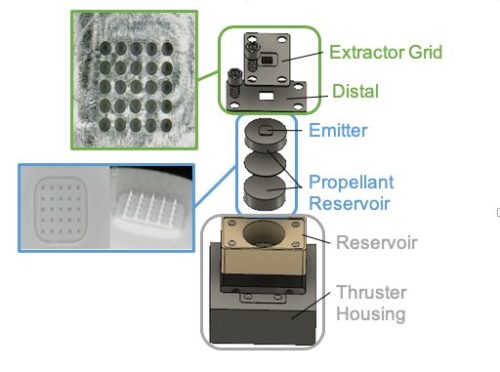
A team of students from the USC Laboratory for Exploration and Astronautical Physics (LEAP), including Robert Antypas and Jeffrey Asher, doctoral students in the Viterbi Department of Astronautical Engineering. The students are working to optimize the design of ionic electrospray thrusters, in-space propulsion devices, in collaboration with the Air Force Research Laboratory (AFRL). These thrusters are small, light and powerful, easy to construct and customizable. These unique aspects contributed to the team winning first place in the AIAA Small Satellite Poster Competition. The students were supervised by Joseph Wang, professor of astronautics and aerospace and mechanical engineering at the USC Viterbi School of Engineering.

Said Asher: “Unlike traditional electric or chemical propulsion technologies, these thrusters are able to scale linearly with the area by increasing the number of emission sites.” In other words, you can increase the level of thrust outputted by increasing the number of emitter tips on the device, a feature not currently possible on other types of propulsion technologies.

Major components of the USC electrospray testbed thruster. Image Credits: Jeffrey Asher.

“The ionic electrospray thruster the team created is an electrostatic propulsion device that operates by extracting and accelerating ions from the propellant using an electric field. The ion extraction is aided by the thruster’s use of a novel liquid propellant, called an ionic liquid. This liquid is highly conductive and freely “gives up” its charge when exposed to an electric field. It also has extremely low vapor pressure, so that it can withstand being directly exposed to the vacuum conditions of space without evaporating.” – USC

** AMSAT news on student and amateur CubeSat/smallsat projects:

ANS-243 AMSAT News Service Special Bulletin

  • AMSAT Member David Minster, NA2AA, Elected ARRL CEO
  • Jeanette Epps, KF5QNU, Joins Starliner Mission To ISS
  • ANS Editors Wanted
  • CubeSat Challenge Seeks To Inspire, Prepare Students
  • Amateur License Fee Proposal From FCC
  • AO-92 (FOX-1D) Reverting to Safe Mode
  • GRBAlpha Frequency Coordination Completed
  • ARISS News
  • Upcoming Satellite Operations
  • Hamfests, Conventions, Maker Faires, and Other Events
  • Satellite Shorts From All Over

ANS-250 AMSAT News Service Special Bulletin

  • ARISS First Element of the Interoperable Radio System is Operational
  • FCC Notice of Proposed Rulemaking: Proposal open for comment
  • Successful Vega Mission Launches the Amicalsat Project Satellite
  • TEVEL Mission Nears Projected Launch Date
  • Changes to the AMSAT-NA TLE Distribution for September 3, 2020
  • VUCC Satellite Awards and Endorsements
  • ARISS News
  • Upcoming Satellite Operations
  • Hamfests, Conventions, Maker Faires, and Other Events
  • Satellite Shorts From All Over

General CubeSat/SmallSat info:

** Autonomous deep-space CubeSat: where we are and where we are going – GVWI (The Global Virtual Workshop I – Stardust-R)

** Educational webinars – Session A – Build a Cubesat from scratchSatRevolution

SatRevolution is happy to invite you to a series of informational sessions (only 30 minutes long!), organized by our team and the team of our partners. This webinars has been recorded during Small Sat Conference 2020 this is way session is different in title and during webinars record. For more infromation please visit our website: https://satrevolution.com/

** Ask NMD Episode 1 – Guest, Prof. Jordi Puig-SuariNanosatellite Missions Design

Prof Jordi Puig-Suari is a professor and an aerospace technology developer. He is the co-inventor of the CubeSat standard, and co-founder of Tyvak Nano-Satellite Systems. Prof. Jordi answered 2 questions from the many questions you asked us. The questions were “How did Cubesats begin” and “What is the relationship and collaboration between robotics, AI, software and space exploration”.

** SmallSat Mesh Networking – SmallSat 2020 Webinar – TethersUnlimited – YouTube

** Leveraging the Success of the CubeSat Standard to Create a SmallSat Standard for ESPA SpacecraftEnrico Congiu – YouTube

=== Amazon Ad ===

Introduction to CubeSat Technology and Subsystem:
Orbit Design, Debris Impact, and Orbital Decay Prediction

Student and amateur CubeSat news roundup – Aug.25.2020

A sampling of recent articles, press releases, etc. related to student and amateur CubeSat / SmallSat projects and programs (find previous smallsat roundups here):

** University of Cádiz (UCA) student team developing the UCAnFly cubesat to test space-based gravitational wave detection technologies.

UCAnFly is an educational nanosatellite to test emerging technologies for space-based gravitational wave detectors, such as LISA. The main motivation is to complement academic education at the University of Cádiz (UCA) and transfer knowledge to students in the field of advanced instrumentation and data analysis for Space Sciences. 

The emerging line of research that the UCAnFly project has recently started to conduct at UCA requires engaging and training young researchers with the purpose of creating a group specialized in high precision measurement systems for space missions. This project will open a unique opportunity of novel and valuable experience for the students involved.

UCAnFly is led by a multidisciplinary team at the University of Cádiz, with the support of the Education Office of the European Space Agency, under the educational Fly Your Satellite! programme.

Rendering of the design of the UCAnFly cubesat. Credits: UCA

A video overview:

…The UCAnFly project involves the introduction of a new line of research at the University of Cádiz, which requires engaging and training young researchers with the aim of creating a group specialized in high precision measurement systems for space missions. For this reason, in addition to the mission objectives, one of the main motivations of the project is to complement academic education and transfer knowledge in the field of advanced instrumentation and data analysis for space applications to undergraduate and doctoral students…

** Virginia high school team building TJ REVERB cubesat to compare smallsat radio communications systems. The project won a ride to space via NASA’s CubeSat Launch Initiative.

The TJ REVERB project is creating a best practice document for building a Nanosatellite while building a 2U CubeSat that compares multiple radio systems in Lower Earth Orbit. Additionally, TJ REVERB serves as an educational vehicle for teaching students the principles of systems engineering. Beyond the rich learning experience designing and constructing a satellite provides the students at Thomas Jefferson HSST, the team is committed to a robust local, national, and international outreach program.

There is a GoFundMe to raise funds to expand the smallsat program and their outreach activities to other high schools: Fundraiser for US STEM FOUNDATION by TJ REVERB : TJREVERB Cubesat for TJHSST

Latest updates at Cool Cube (@CoolCube10) / Twitter. Find videos posted by the students at Cool Cube – YouTube, e.g.

** AMSAT news on student and amateur CubeSat/smallsat projects: ANS-236 AMSAT News Service Special Bulletin

  • Ballot Return Date is September 15
  • Two-Minute Engineering Video Update Available
  • New Distance Records
  • ORI’s Digital Microwave Broadband Communication System Determined to be Free of ITAR
  • SmallSat 2020 Virtual Conference Proceedings Available Online
  • Upcoming Satellite Operations
  • ARISS News
  • Satellite Shorts from All Over

General CubeSat/SmallSat info:

** Students Use Ham Radio to Call an Astronaut in Space – NASA Johnson

On May 15, 2020, Canadian students used ham radio to talk with NASA astronaut Chris Cassidy, currently aboard the International Space Station. Thanks to ham radio operators and the International Space Station program, the students were able to participate from their homes. Learn more about ham radio aboard the space station: https://go.nasa.gov/2DRPAeK Learn more about the research being conducted on station: https://www.nasa.gov/iss-science

** What is a CubeSat?Cool Cube

CubeSats are driving space exploration! In this video, by students for students, we go over what they are and some major components that are typically on board! Please stick along for the rest of this series, where we’ll go over the ins and outs of satellite development!

=== Amazon Ad ===

Introduction to CubeSat Technology and Subsystem:
Orbit Design, Debris Impact, and Orbital Decay Prediction

Student and amateur CubeSat news roundup – Aug.19.2020

A sampling of recent articles, press releases, etc. related to student and amateur CubeSat / SmallSat projects and programs (find previous smallsat roundups here):

** US Dept. of Education opens CubeSat mission competition for high school students: U.S. Department of Education Launches Space Mission Challenge for High School Students: CTE Mission: CubeSat Challenge seeks to inspire, prepare students for a future in aerospace | U.S. Department of Education

Building on the Administration-wide commitment to expand student interest in the booming science, technology, engineering and math (STEM) fields, the U.S. Department of Education today launched CTE Mission: CubeSat, a national challenge to inspire students to build technical skills for careers in space and beyond. High school students from across the country are invited to design and build CubeSat (cube satellite) prototypes, or satellites that aid in space research, bringing space missions out of the clouds and into the classroom.

“This is such an exciting way to rethink education and get students engaged in hands-on learning in the growing aerospace and technology fields,” said U.S. Secretary of Education Betsy DeVos. “I look forward to seeing the innovative prototypes students develop and hope this challenge inspires our next generation of American space explorers.”

Investors predict that space will be the next trillion-dollar industry, and as missions in space continue to expand, so do the career opportunities. This multi-phase challenge offers high school students across the United States the chance to build CubeSat prototypes while learning creative, collaborative, and technical skills for 21st century careers.

Schools interested in entering CTE Mission: CubeSat should form a team and submit a mission proposal by 5:59 p.m. ET, on Oct. 16, 2020 — no in-person collaboration or prior experience with CubeSats is required. The online submission form asks for school information, a team profile, a project proposal, and anticipated learning outcomes. Curated educational resources are available to students and teachers online in the CTE Mission: CubeSat resource hub. To learn more, schools can join a virtual information session on Sept. 1.

Up to five finalists will be selected to receive prizes and participate in Phase 2, which runs from January to May 2021. Finalists will have access to expert mentorship and additional virtual resources as they build CubeSat prototypes and plan flight events to launch their prototypes. The Department understands that due to current conditions, schools will need flexibility to safely collaborate when designing and building prototypes during the challenge. The Department looks forward to the creative solutions in the mission proposals it receives as challenge entries.

Each finalist will receive an equal share of the $25,000 cash prize pool, as well as satellite development, hardware, and software kits. Challenge sponsors include Arduino, Blue Origin, Chevron, EnduroSat, LEGO Education, Magnitude.io, MIT Media Lab, and XinaBox.

Find more about the competition at the CTE Mission: CubeSat blog. See, for example, Small yet mighty: CubeSats are transforming the future of space discovery — and education – CTE Mission: CubeSat

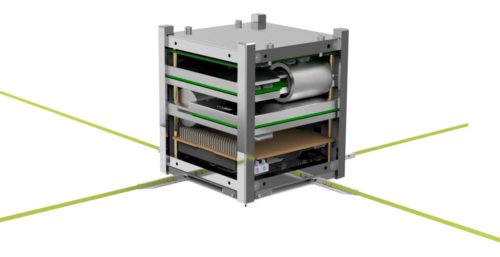
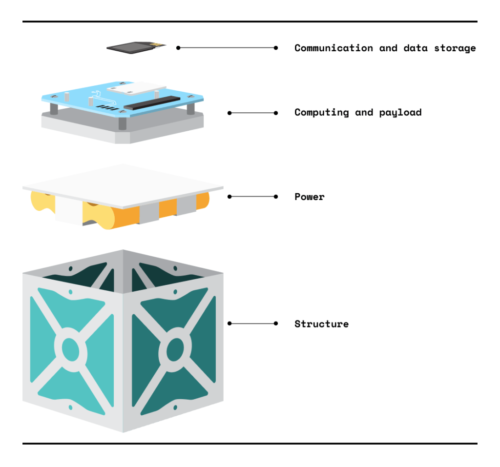
Diagram of the primary components of a CubeSat.

** Norwegian university team building HYPSO-1 CubeSat to study ocean algae blooms.The NTNU SmallSat Lab at the Norwegian University of Science & Technology is developing a miniature hyper-spectral camera system for the mission. The 6U CubeSat is to be launched later this year.

The HYPer-Spectral smallsat for Ocean observation (HYPSO) will observe oceanographic phenomena via a small satellite with a hyperspectral camera, intelligent on-board processing and robots

Why?

The Ocean is of great interest to understand the effects of climate change and human impact on the world.

Traditional EO satellites are very expensive and take several years to develop and launch.

Dedicated SmallSats can be used to provide images of small areas of interest with short revisit times.

The information can be downloaded, and communicated to unmanned vehicles which can investigate the areas of interest further.

The Norwegian company KSAT ( Kongsberg  Satellite Services ) will provide ground support for the mission: KSAT will support Norway’s first hyperspectral Smallsat mission – KSAT

At NTNU Small Satellite Lab, a multi-disciplinary team of master students, PhD-students and professors are currently working on a small satellite with a miniaturized hyperspectral camera for detection of toxic algae blooms along the Norwegian coast. KSAT will as part of this contract, provide commercial ground station services from the Svalbard Ground Station for this mission, called HYPSO-1. KSAT is well known for providing fast and reliable space to ground services. By using the unique ground station at Svalbard, KSAT ensures fast access to the time-critical data.

In combination with drones and autonomous vehicles both on surface and subsea, the goal is to be able to detect and alert the fish-farms about toxic algae blooms in the area. In 2019 a sudden upwelling of toxic algae killed close to 8 million salmon in Norwegian fish farms, wiping out more than half of the annual sales growth in just over a week. The hope is that with the contribution of this mission, one can avoid this in the future.

As a significant provider of maritime monitoring services KSAT had an active role during the algae bloom last year and together with partners in Tromsø they are currently exploring how to discriminate between different types of algae by combining different sensors and applying advanced algorithms.

** The Orbit student smallsat group at NTNU is developing SelfieSat as their first mission.

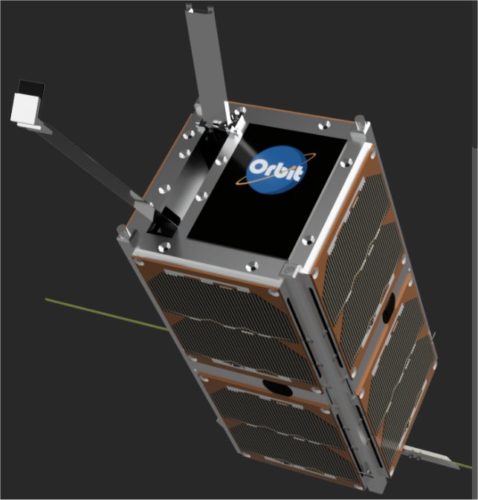
The SelfieSat, our first project, started out as a simple satellite project; we wanted to make an operational satellite that is able to communicate while it is orbiting earth. However, we wanted to make things a bit more interesting. While SelfieSat is in orbit it will be able to display a selfie of any person on earth, which will be uploaded from our ground station at NTNU. A robotic arm with a camera attached will photograph the screen with the earth in its background. Finally this picture will be sent back to the selfie-taking individual!

A rendering of the SelfieSat CubeSat in development by the Orbit student group at NTNU.

Launch is targeted for the 2020/2021 time frame.

** Univ. of Georgia‘s Small Satellite Research Laboratory (SSRL) building 2 CubeSats for ocean studies: Smallsat Lab @ University of Georgia Building Two For Orbit – SatNews

The primary scientific goals of these cubesat missions are to develop and operate the first moderate resolution coastal ecosystem and ocean color CubeSats in Georgia.

The AFRL mission, the Mapping and Ocean Color Imager (MOCI) will use an onboard RGB camera to take images from multiple perspectives to create a 3D point cloud of land features.

The NASA mission, the SPectral and Ocean Color Satellite (SPOC Sat), will generate hyperspectral moderate resolution imaging products to monitor coastal wetlands status, estuarine water quality, and near-coastal ocean productivity in compliance with some of the NASA’s strategic objectives. The designing and building of the hyperspectral imager for SPOC is being done in house and will have 60 bands to acquire image data between 400 and 850 nm. In addition, the SPOC mission has been chosen as a candidate of NASA’s eight CubeSat Launch Initiative, meaning that SPOC will be launched to the International Space Station for deployment between 2018 and 2020.

Undergraduate students are deeply involved in the two projects:

The two missions and the establishment of the lab have the primary goals of teaching and developing students for STEM careers by training undergraduates in a broad range of fields through hands-on, experiential learning and creating a pipeline for high school students to attend UGA through the Physics and Astronomy Department. While the majority of members in the lab are undergraduates, there are graduate students that serve as mentors. The team currently consists of 45 students from around campus.

Checkout the SSRL poster (pdf) created for the recent Smallsat 2020 conference.

** AMSAT news on student and amateur CubeSat/smallsat projects: ANS-229 AMSAT News Service Special Bulletin

  • Two-Minute Engineering Video Update Available [See the video below]
  • CubeSat.org Announced CubeSat Design Specification Rev.14
  • US Department of Defense to Share 3450 – 3550 MHz with 5G Commercial Operations
  • QSO Today Virtual Expo Satellite Presentations Still Available
  • Chinese Mars probe Tianwen-1 successfully received by AMSAT-DL
  • SmallSat 2020 Virtual Conference Proceedings Available Online
  • Upcoming Satellite Operations
  • ARISS News
  • Satellite Shorts from All Over

General CubeSat/SmallSat info:

** AMSAT Engineering Two Minute Update

A light-hearted presentation of the latest status update from AMSAT Engineering.

** Bhutan-1 CubeSat. Bhutan’s first satellite

** SmallSat 2020- Achieving compact and effective thermal solutions for small satellitesAdvanced Cooling Technologies Inc. – YouTube

ACT’s Bryan Muzyka hosts a side meeting for Small Satellite 2020 in a virtual platform. He walks through some of options available for small satellite thermal control. Q&A finishes up the presentation with questions related to CTE mismatch, custom tubing for 3U cards, electric propulsion systems and if heat pipes are suitable for RF environments.

** Hypergiant Galactic Systems SEOPs: Affordable Access to Low Earth OrbitGalactic – Hypergiant

With the advent of mobile phones and mass-produced miniaturized electrical components, satellite construction has become much more affordable. Hypergiant Galactic Systems SEOPs has built a foundation to provide access to space utilizing the International Space Station infrastructure with two launch systems servicing the CubeSat and MicroSat markets. The organization has also built several launch vehicle agnostic products such as dispensers and separation systems with five successful missions.

** The Space Show – Fri. Aug.14.2020Charles Miller discussed “his new company, Lynk Global, connecting mobile phones to [small] satellites for global coverage. We discussed other topics as well, including some of the commercial space history made by our guest.”

=== Amazon Ad ===

Introduction to CubeSat Technology and Subsystem:
Orbit Design, Debris Impact, and Orbital Decay Prediction

Student and amateur CubeSat news roundup – Aug.11.2020

A sampling of recent articles, press releases, etc. related to student and amateur CubeSat / SmallSat projects and programs (find previous smallsat roundups here):

** Univ. Southern California students to build CubeSats in partnership with Lockheed Martin and Momentus. For the La Jument project, students in  USC’s SERC (Space Engineering Research Center) nanosatellite program will assemble four spacecraft using payloads with the LM’s  SmartSat technology.  This technology uses a

software-defined satellite architecture on both their payload and bus. SmartSat lets satellite operators quickly change missions while in orbit with the simplicity of starting, stopping or uploading new applications.

The system is powered by the NVIDIA® Jetson™ platform built on the CUDA-X™ capable software stack and supported by the NVIDIA JetPack™ software development kit (SDK), delivering powerful AI at the edge computing capabilities to unlock advanced image and digital signal processing.

The spacecraft will launch over the next two years:

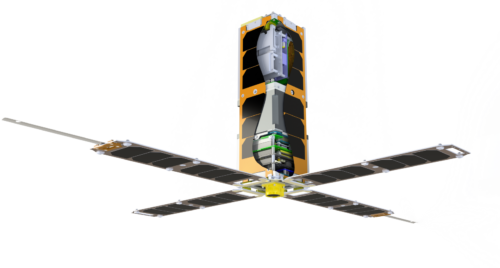
The first of the four La Jument nanosatellites is a student-designed and built 1.5U CubeSat that will be launched with a SmartSat payload to test the complete system from ground to space, including ground station communications links and commanding SmartSat infrastructure while in-orbit. The second is a 3U nanosat, the size of three small milk cartons stacked on top of each other, with optical payloads connected to SmartSat that will allow AI/ML in-orbit testing. Finally, two 6U CubeSats are being designed jointly with USC that will be launched mid-2022. The pair will launch together and incorporate future research from USC and Lockheed Martin, including new SmartSat apps, sensors and bus technologies.

Momentus has arranged for the first CubeSat to launch on a SpaceX Falcon 9 rideshare mission scheduled for Feb. 2021. A Momentus space tug will take it to a 550 km high sun synchronous orbit.

More about the project:

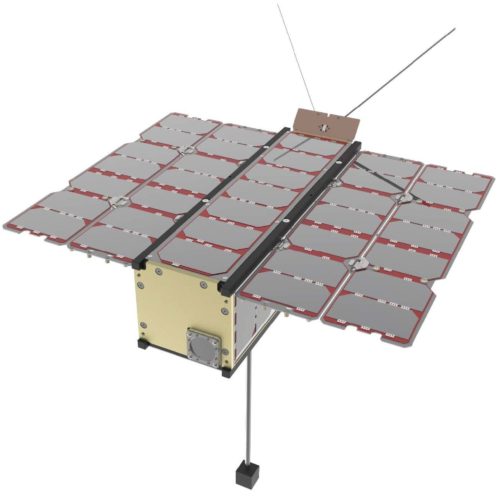
La Jument nanosatellite rendering. Courtesy: University of Southern California & LM

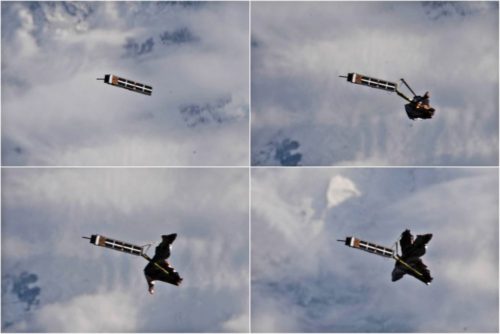
** TechEdSat-10 deployed “exo-brake” de-orbit sail: TechEdSat-10 Deploys from the Space Station | NASA. Discussed here earlier, the TechEdSat-10 cubesat was developed by NASA Ames in collaboration with student teams at San Jose State University and the University of Idaho. The 10th in a series of technology demo spacecraft, the 6U CubeSat tested several devices including the Exo-Brake,

a tension-based, flexible braking device resembling a cross-parachute that deploys from the rear of a satellite to increase the drag. It is a de-orbit device that replaces the more complicated rocket-based systems that would normally be employed during the de-orbit phase of re-entry.

Here are four photos showing the deployment of the chute:

“TechEdSat-10’s exo-brake precision de-orbit technology demonstration deploying in orbit around Earth.” Credits: NASA

** Successful demonstration of HARP earth imaging on a CubeSat. Cubesat demonstrates Earth science instrument – SpaceNews.  The HyperAngular Rainbow Polarimeter (HARP) device,  discussed here last year, was developed by Utah State and Univ. Maryland at Baltimore County teams. The goal was to measure the microphysical properties of cloud water and ice particles. Since its deployment from the ISS last February, the HARP has proven this capability.

The three-unit cubesat is managed by the Space Dynamics Lab (SDL) of Utah State University, which built the spacecraft, while the payload was developed and is operated by the University of Maryland Baltimore County (UMBC). The payload achieved “first light” in April and took its first images in May.

Tim Neilsen, program manager for HARP at SDL, said the spacecraft demonstrates that cubesats can provide useful data in the Earth sciences. “The application of space-based Earth observation technology has historically been the domain of large satellites,” he said in a statement. “HARP helps to confirm that miniaturized sensors on small satellites can provide a high degree of fidelity at a fraction of the cost and time it takes to build larger satellites.”

The instrument’s utility comes from its ability to measure the size distribution of cloud droplets, which can provide information on the properties of ice and water clouds. That can, in turn, improve modeling of aerosol processes and help reduce uncertainties in climate modeling.

A larger system called HARP2 is to be mounted on NASA’s Plankton, Aerosol, Cloud, ocean Ecosystems (PACE) spacecraft to launch in 2022.

** AMSAT news on student and amateur CubeSat/smallsat projects: ANS-222 AMSAT News Service Special Bulletin

  • German Satellite Demonstrates Orbit Control on 1U CubeSat
  • AMSAT CubeSat Simulator Now Transmits SSTV
  • AMSAT-UK OSCAR Satellite QSO Party Ongoing
  • Hamfests, Conventions, Maker Faires, and Other Events
  • Upcoming Satellite Operations
  • Satellite Shorts from All Over

See also: Radio Amateur Takes Part in Successful Commercial Spaceflight to ISS – ARRL

General CubeSat/SmallSat info:

** Launch industry panel + SmallSat preview – Space News

SpaceNews Senior Staff Writer Jeff Foust talks with executives of several launch companies about the state of the smallsat launch sector. Panelists include:

Peter Beck, CEO of Rocket Lab
Brad Schneider, chief revenue officer of Firefly Aerospace
Dan Hart, CEO of Virgin Orbit

The webinar begins with a brief interview with SmallSat conference organizer Marianne Sidwell about how to get the most out of this year’s virtual Small Satellite Conference.

The session concludes with a SpaceNews reporter roundtable about what to expect in the week ahead.

** SN @ SmallSat: Smallsat builders panel + show wrap-up – Space News

SpaceNews Staff Writer Caleb Henry and Silicon Valley correspondent Debra Werner lead a panel discussion with a cross section of smallsat builders. Panelists include:

– Marco Villa, Tyvak Nano-Satellite Systems COO
– Brian Rider, LeoStella CTO
– F. Brent Abbott, NanoAvionics US CEO
– Craig Clark, AAC Clyde Space founder and chief strategy officer
– Tim Lynch, L3Harris Technologies Space and Airborne Systems Multi-Domain Architecture Group executive director
– Chester Gillmore, Planet vice president of spacecraft development and manufacturing

The webinar concludes with a 15-minute SpaceNews reporters roundtable on key takeaways from this year’s Small Satellite Conference.

** Preparing CySat 1: A Look at Iowa State University’s First CubeSat

** A Methodology for Successful University Graduate CubeSat Programs

=== Amazon Ad ===

Introduction to CubeSat Technology and Subsystem:
Orbit Design, Debris Impact, and Orbital Decay Prediction

Student and amateur CubeSat news roundup – Aug.2.2020

A sampling of recent articles, press releases, etc. related to student and amateur CubeSat / SmallSat projects and programs (find previous smallsat roundups here):

** The annual Smallsat Conference hosted at Utah State University is on line this year due to the Covid-19 virus situation. Registration is free. Though the event is nominally August 1-6, there are dozens of videos of workshop and technical session presentations already on line.

Dr. Pat Patterson of Utah State University talked about the Conference for 2020 on The Space Show on July 21, 2020 :

** Villanova University has a new student  CubeSat Club. The group is starting out by running a locally developed CubeSat simulator, receiving signals from CubeSats in orbit, designing a test project for a high-altitude balloon flight, and more.

The club’s long-term goal involves a bigger leap: to design, build and launch an actual CubeSat—a 10-by-10-by-10-centimeter, lightweight nanosatellite that can be launched from a rocket, or put into orbit by astronauts on the ISS. But with design, equipment, programming, testing, and launch, CubeSat development can take several years and cost up to $100,000.

For now, club members are taking smaller steps towards their ultimate mission as they gain hands-on experience with satellite technology through a CubeSat simulator developed by faculty adviser Alan Johnston, PhD, associate teaching professor of Electrical and Computer Engineering. The low-cost simulator functions like a real CubeSat, with working solar panels and the capability to send telemetry to an antenna, making it an ideal learning tool.

Monitoring its Lindenblad antenna will keep Villanova’s CubeSat Club busy. First, they will design a payload to be launched into the stratosphere via a high-altitude balloon. If all goes well, the balloon’s telemetry will be detectable from the roof of Tolentine as it sails above Villanova. Also on tap is working with a project called AmbaSat-1: to program, launch and track a credit card-sized “sprite” satellite into low earth orbit.

The CubeSat simulator involves both software and a hardware CubeSat bench emulator. Here is a description of the simulator: A Year with the AMSAT CubeSat Simulator: 12 Months in the Classroom and Lab – A. Johnston, P. Kilroy (pdf). More information on CubeSat Simulator Project Page.

CubeSat model simulators.

** Student CubeSat project at the MIT Beaver Works Summer Institute. There are several CubeSat project videos available online. Here is a brief overview of the project that involved designing an system for imaging and tracking ocean plastic debris:

And here is an overview of the design that the students developed:

** AMSAT news on student and amateur CubeSat/smallsat projects:

ANS-208 AMSAT News Service Special Bulletin

  • AMSAT Partners with UMaine’s WiSe-Net Lab to Develop Maine’s First Small Satellite
  • AMSAT-UK Announces OSCAR Satellite QSO Party
  • JARL Announces FO-29 Operation Schedule for August
  • Christopher Brault, KD8YVJ, Named 2020 Newsline Young Ham of the Year
  • Hamfests, Conventions, Maker Faires, and Other Events
  • Upcoming Satellite Operations
  • Upcoming ARISS Contacts
  • Satellite Shorts from All Over

ANS-215 AMSAT News Service Weekly Bulletins

  • ISS MAI-75 SSTV Activity Planned For Aug 4-5
  • AMSAT Awards Update
  • How Many Satellite Awards Have Been Issued?
  • VUCC Awards-Endorsements for August 2020
  • First Demonstration Of Orbit Control On A 1U CubeSat
  • Burns Fisher, WB1JF, Featured Speaker at AMSAT SA Symposium
  • NASA to Provide Coverage of Astronauts’ Return from ISS on SpaceX
  • ARISS News
  • Upcoming Satellite Operations
  • Hamfests, Conventions, Maker Faires, and Other Events
  • Satellite Shorts From All Over

General CubeSat/SmallSat info:

** Cubesat MissionsMakua Lani Christian Academy – Designing a CubeSat for a particular mission goal.

** PLIX CubeSats Online: Week 2 Wrap-up Stream

Welcome to Week 2 of PLIX CubeSats Online! 🛰️ For the second session, we’ll be covering the Satellite Testing & Payload Integration workshop, which covers both satellite testing strategies and the incorporation of a data-collecting tool. Read more about the CubeSats activity on our PLIX Activity Repository: http://bit.ly/PLIX-CubeSats

=== Amazon Ad ===

Introduction to CubeSat Technology and Subsystem:
Orbit Design, Debris Impact, and Orbital Decay Prediction