Category Archives: Satellite Watching

Russian student satellite will shine bright in the night sky

A Russian student satellite was recently launched (along with 72 other satellites) into low earth orbit (LEO). Mayak is Russia’s first crowdfunded satellite project. The primary goal is to demonstrate that a small satellite can be de-orbited passively by deploying a large form that greatly increases the drag of the spacecraft as it passes through the extremely thin upper atmosphere in LEO.

Mayak, which is about the size of a loaf of bread (10cm x 10cm x 34 cm),  will inflate a tetrahedron-shaped form covered in reflective sheets. This will not only increase its drag but will also make it very bright in the night sky: Almost as Bright as the Moon? New Satellite Might Light Up the Sky – Sky & Telescope.

Each surface is four square meters on a side and should be readily visible from the ground on a twilight pass. In fact, the team claims, Mayak will be the “brightest shooting star” once unfurled, almost as bright as the full Moon at magnitude –10. Mayak could be visible in bright twilight and perhaps even during daytime passes as well.

The satellite tracking website Heavens-Above has created a Mayak tracking tool that will tell you when Mayak will pass over your location.

The plan is to fly Mayak in a stabilized mode for the first four weeks, then set it tumbling on all three axes, setting off a brilliant twinkling pattern. The team’s site mentions using brightness estimations from Mayak to gather information about air density at high altitude and to calibrate brightness estimations for future satellites.

The reflector will also speed up reentry once deployed, utilizing both solar wind pressure and atmospheric drag. Such devices may become a standard feature on future satellites, enabling them to de-orbit shortly after their mission ends rather than adding to the growing tally of space junk in low-Earth orbit. Nanosail-D2 tested a similar technology in 2011, and another mission recently dispatched from the International Space Station, InflateSail, is currently testing the same method.

The University of Toronto’s CanX-7  satellite, launched last September, deployed a drag sail in May and it quickly demonstrated its de-orbiting effect.

Here is a video of the launch of the Soyuz rocket that  put the 73 satellites into orbit:


====
Amateur satellite observers can spot a spysat

Spysats can’t hide from determined amateur spacecraft trackers: Backyard Detectives Out-Spy the Spies Orbiting Above – WIRED 

Even spy satellites can’t hide from a civilian with a pair of binoculars and a lot of free time. “It’s hard to hide something that you can see in the sky,” says John Magliacane, an amateur radio operator and satellite tracker in New Jersey. Just like the moon, satellites reflect sunlight back to Earth. Magliacane is a satellite tracker, but not one of the smaller sub-group that tracks spy satellites. However, he did end up doing some similar stuff during the era of space shuttle launches, upon which the military would occasionally piggyback payloads. “Some people would try to figure out the orbital parameters based on the time of launch and information from previous missions,” he says.

The orbital characteristics tell you more than just where a satellite is: It can tell you what it does. For most satellites, this data is public, and published (among other places) on a website called CelesTrak. The goods for each probe is a set of numbers called the two-line element. These are coordinates and time codes noting important things like the satellite’s apogee, perigee, time it passed certain latitudes and longitude, how many times it orbits Earth in a day, and so on and so forth.

More about satellite observations in the HobbySpace Satellite Watching section.

Images: ISS and Mercury captured crossing the face of the Sun

An image of both the planet Mercury and the Int. Space Station transiting the face of the Sun simultaneously:

Space in Images – 2016 – 05 – Space Station Mercury

[]
“Space Station Mercury” –  Thierry Legault

On 9 May Mercury passed in front of the Sun as seen from Earth. These transits of Mercury occur only around 13 times every century, so astronomers all over Earth were eager to capture the event.

For astrophotographer Thierry Legault, capturing Mercury and the Sun alone was not enough, however – he wanted the International Space Station in the frame as well.

To catch the Station passing across the Sun, you need to set up your equipment within a ground track less than 3 km wide. For Thierry, this meant flying to the USA from his home near Paris, France.

On 9 May there were three possible areas to capture the Station and Mercury at the same time against the solar disc: Quebec, Canada, the Great Lakes and Florida, USA.

Choosing the right spot took considerable effort, says Thierry:

“Canada had bad weather predicted and around Florida I couldn’t find a suitably quiet but public place, so I went to the suburbs of Philadelphia.”

With 45 kg of equipment, Thierry flew to New York and drove two hours to Philadelphia to scout the best spot. Even then, all the preparations and intercontinental travel could have been for nothing because the Station crosses the Sun in less than a second and any clouds could have ruined the shot.

“I was very lucky: 10 minutes after I took the photos, clouds covered the sky,” says a relieved Thierry.

“Adrenaline flows in the moments before the Station flies by – it is a one-shot chance. I cannot ask the space agencies to turn around so I can try again. Anything can happen.”

The hard work and luck paid off. The image here includes frames superimposed on each other to show the Station’s path. Mercury appears as a black dot at bottom-centre of the Sun.

For Thierry, the preparation and the hunt for the perfect shot is the best part.

“Astrophotography is my hobby that I spend many hours on, but even without a camera I encourage everybody to look up at the night sky. The International Space Station can be seen quite often and there are many more things to see. It is just a case of looking up at the right time.”

Watch a video of the pass, including another moment with an aircraft flying by. 

Visit Thierry’s homepage here: http://www.astrophoto.fr/

BINARY SPACE Satellite Tracking Tool available as free Win 10 app

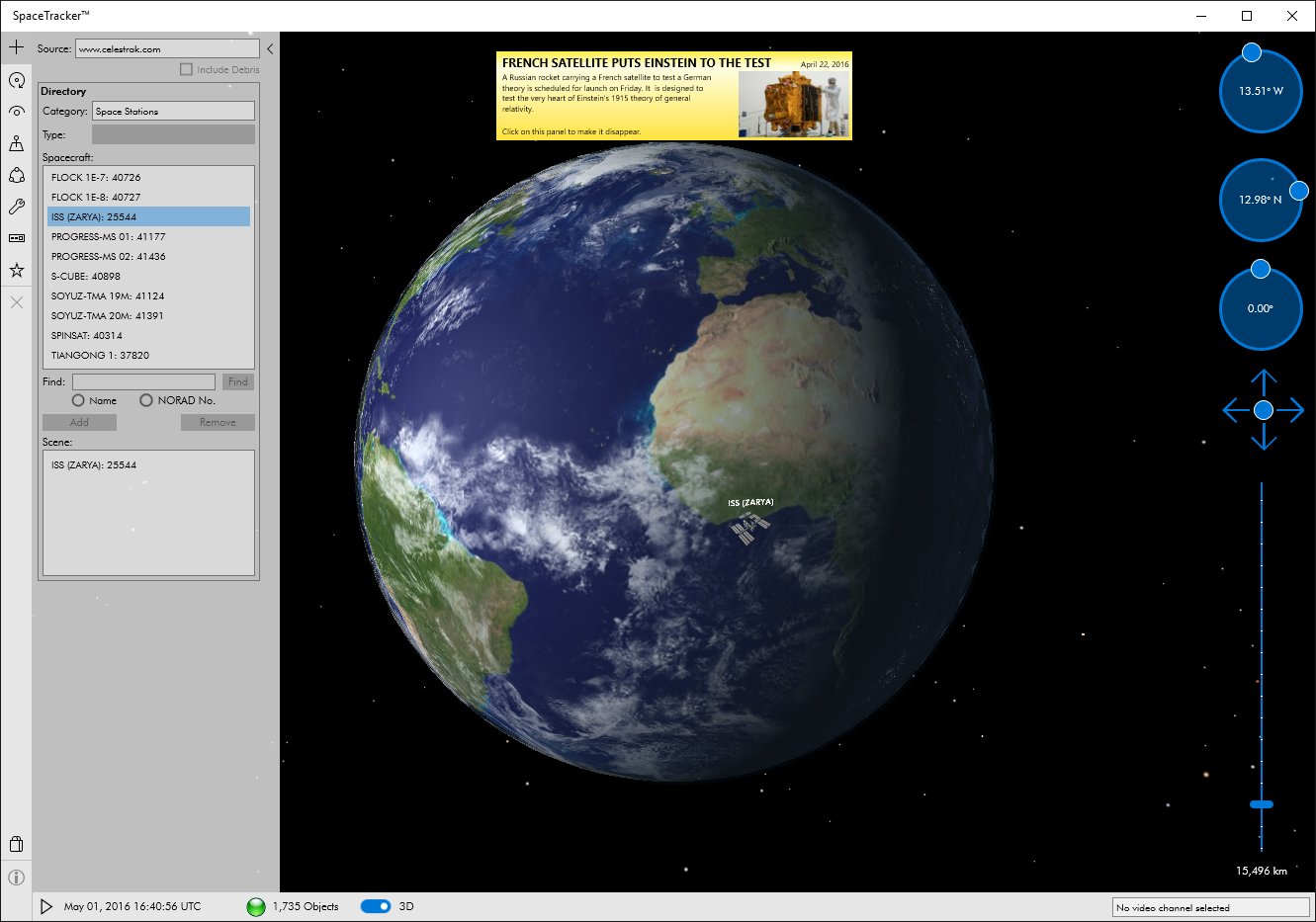
BINARY SPACE’s Satellite Tracking Tool is now available as a free app for Windows 10: SpaceTracker™ – Windows Games on Microsoft Store

The SpaceTracker™ is a 2D/3D real-time satellite tracking application. It allows you to determine the current position of most Earth-centric satellites currently in orbit and also features location pass & interlink predictions. It can even help you to setup your TV antenna dish.

Windows 10 users should run this new version. The previous version used Microsoft’s Silverlight graphics system.

Win10AppVersion-2016-05

Update: BINARY SPACE chief Adrian Wenz tells me that a nice new feature of the SpaceTracker™ is its support for live tiles:

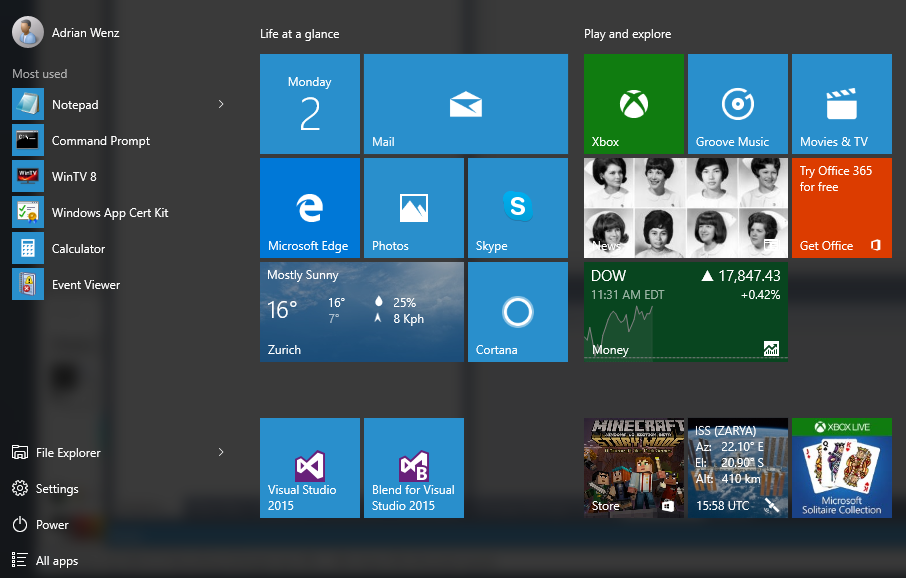
If you pin the app to the start menu (see lower right corner [of the screen capture below], right to ‘Minecraft’) it will periodically show you the position of any desired satellite. By default, it comes-up with positional information about the ISS, but you can choose any satellite via the ‘Favorites’ panel (-> ‘Star’ symbol). For large/wide tiles you can specify up to 4 satellites to be monitored. These tiles are updated even if the app is not open (via background tasks).

To pin the app to the start menu: Open the ‘All apps’ group, scroll to the letter ‘S’ and right-click on the ‘SpaceTracker™’ icon.

PinningToWin10StartMenu

A marvelous view of the Space Station in front of the Moon

A great picture of the International Space Station transiting across the face of the Moon: Space Station Lunar Transit – NASA

The International Space Station, with a crew of six onboard, is seen in silhouette as it transits the moon at roughly five miles per second, Sunday, Aug. 2, 2015, Woodford, VA.  Onboard are; NASA astronauts Scott Kelly and Kjell Lindgren: Russian Cosmonauts Gennady Padalka, Mikhail Kornienko, Oleg Kononenko, and Japanese astronaut Kimiya Yui. Photo Credit: (NASA/Bill Ingalls)
The International Space Station, with a crew of six onboard, is seen in silhouette as it transits the moon at roughly five miles per second, Sunday, Aug. 2, 2015, Woodford, VA. Onboard are; NASA astronauts Scott Kelly and Kjell Lindgren: Russian Cosmonauts Gennady Padalka, Mikhail Kornienko, Oleg Kononenko, and Japanese astronaut Kimiya Yui. Photo Credit: (NASA/Bill Ingalls)

Click here for a larger image.

Find more about tracking and imaging spacecraft in the HobbySpace Satellite Observing section.