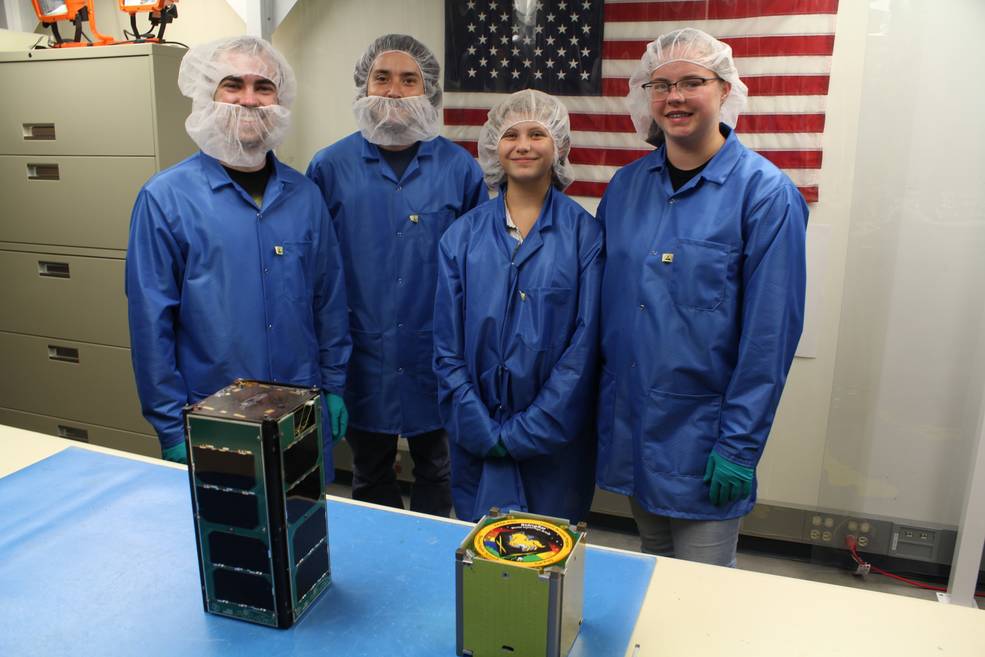
“Merritt Island High School students are photographed at the Kennedy Space Center with StangSat – a cube satellite (CubeSat) that was built and developed by students at the school. StangSat [launched] on a SpaceX Falcon Heavy rocket as part of the Department of Defense Space Test Program-2 mission, managed by the U.S. Air Force Space and Missile Systems Center… Credits: NASA/Shaun Daly”** Georgia Tech’s Prox-1 with LightSail-2 was successfully put into orbit by the Falcon Heavy as well. Prox-1 was built by Georgia Tech students with funding from the University Nanosat Program (UNP) and LightSail-2 was built by a team led by Ecliptic Enterprises and funded by the Planetary Society.
The sail’s cubesat will be ejected from Prox-1 this week:
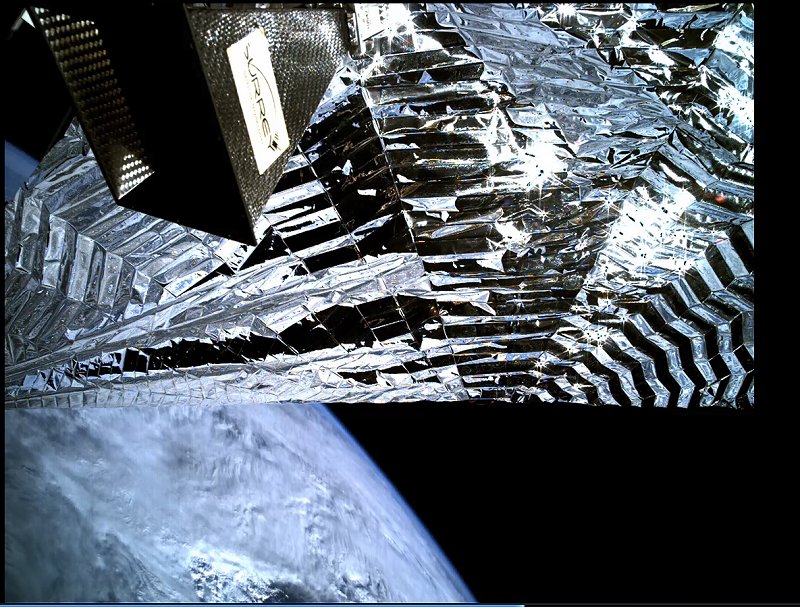
LightSail 2 team members will soon converge at Cal Poly San Luis Obispo in California, where the spacecraft’s mission control is located. Once LightSail 2 is released from Prox-1 on 2 July, the team will spend several days checking out the CubeSat’s systems before commanding its dual-sided solar panels to deploy. Following that, the spacecraft’s solar sails will be deployed, roughly 2 weeks in total from launch day.
** Students at Cal State Poly at San Luis Obispo were involved closely with LightSail-2 and with LEO (Launch Environment Observer) cubesat also on board the FH:
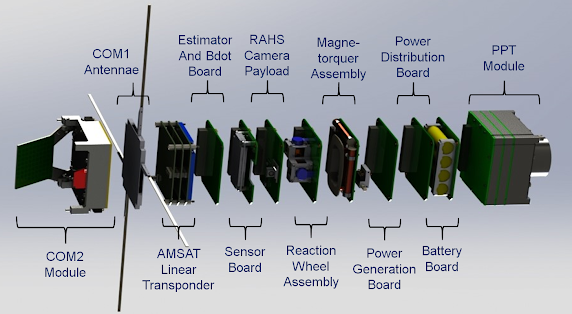
Designed and built by a team of nine students pursuing a Master’s degree with Space Systems and Technology Concentration, MYSAT-2 features significant upgrades from MYSAT-1. Its primary mission is to enable students to design, implement, and test new Attitude Determination and Control (ADC) Algorithms, developed by the Khalifa University students. The algorithms help determine a CubeSat’s orientation in space, and are estimated to be 15 to 20 percent more power-efficient, in comparison with similar algorithms implemented on other spacecrafts. If successful, the new algorithms will establish the UAE as a contributor to the global space industry.
TechDemoSat-1, a 150 kg in-orbit technology demonstration small satellite mission, validated 8 innovative UK spacecraft instruments and software payloads and also acquired ocean wind speed datasets using GNSS reflectometry.
The deployed sail measures approximately 6.7 m2 and is designed to significantly increase the spacecraft’s rate of orbital decay, in compliance with current Space Debris Mitigation best practice and guidelines.
Stephen Hobbs, Head of Cranfield University’s Space Group, commented “At Cranfield we are delighted to see our Icarus de-orbit technology demonstrated successfully in orbit – again. With the Icarus sails now deployed on both TechDemoSat-1 and Carbonite-1, SSTL and Cranfield have demonstrated clear leadership in this technology. We hope to see many more satellites following TechDemoSat-1’s example to keep space clear of debris. It’s been great to work with SSTL on this mission.”
The Icarus-1 drag sail consists of a thin aluminium frame fitted around one of the external panels of the spacecraft in which four trapezoidal Kapton sails and booms are stowed and restrained by a cord. Deployment is achieved by activating cord-cutter actuators, allowing the stored energy in the spring hinges to unfold the booms and the sail.
TechDemoSat-1 built by Surrey Satellite Systems, Ltd.
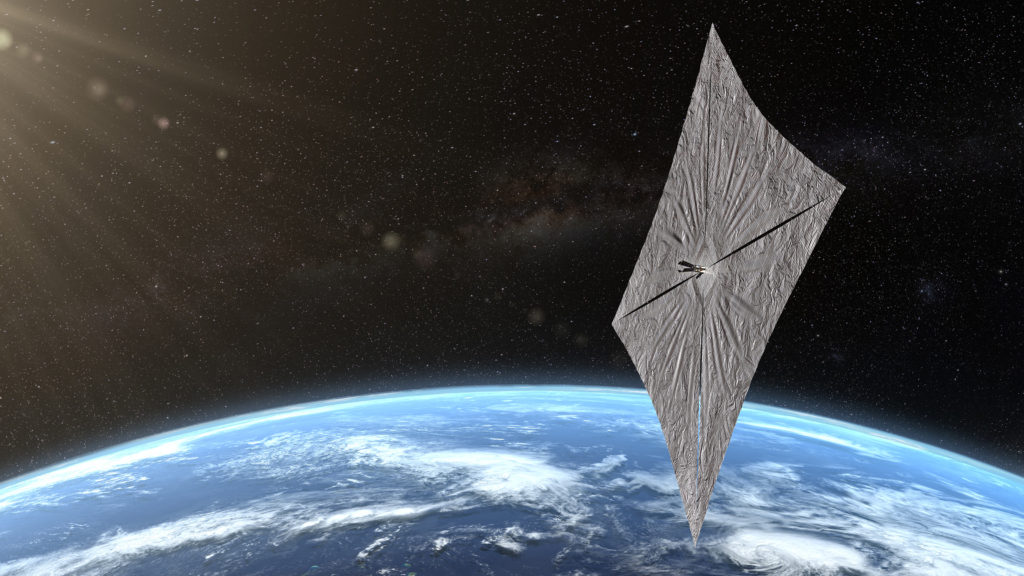
** The Planetary Society’s LightSail-2 to launch on the SpaceX Falcon Heavy STP-2 mission. The sail follows several previous solar sail projects (Japan’s IKAROS 2010 was the first to demonstrate sunlight driven propulsion) and aims to be the first of the Society’s sails to demonstrate net thrust. The sail will be released from the Georgia Tech Prox-1 carrier satellite (see below) about a week after the launch.
** Georgia Tech’s Prox-1 smallsat was built by students and will be student-operated as well. The goal of the mission is to
… demonstrate proximity operations for space situational awareness, through the use of a low thrust propulsion system for orbital maneuvering, and visible and infrared imaging for reconnaissance. The Prox-1 mission is directly applicable to Air Force Space Command’s priority to develop and maintain complete knowledge of assets in the on-orbit environment.
Prox-1 will conduct rendezvous and proximity operations with an on-orbit “objective”: the expended launch vehicle that delivers Prox-1 to orbit. Through multiple circumnavigations of the objective while acquiring visible and infrared images, a three-dimensional model of the objective will be developed and material properties will be established. The orbit of the objective will be determined, and a time-history of the objective attitude will be acquired. As an extended mission goal, Prox-1 will conduct proximity operations with additional objects in the near-space environment. The primary mission duration is three months.
This animation is somewhat dated but shows the primary operational tasks of the mission:
** Northwestern Univ. & Univ. of Illinois students work to get SpaceICE CubeSat ready for space after the project missed the first launch opportunity.
we are sending freeze-casting to Low Earth Orbit! At Northwestern, we are designing the experiment and payload, while UIUC (CubeSat Project) is building the satellite. This project is funded by NASA’s Office of Education through the Undergraduate Student Instrument Project. Our anticipated launch date is late 2018.
Once in orbit, we’ll collect image and temperature data while freezing aqueous suspensions of silver coated glass beads and salt water solutions. Whereas we were limited to freezing very quickly during our parabolic flight work, the CubeSat platform will allow us to test a range of freezing velocities.
Young scientists are racing to deliver by October a satellite payload of instruments to test freeze-casting — technology that could free space explorers from expensive, time-consuming deliveries of supplies from Earth.
The team of Northwestern University undergraduates building the innards for a small satellite called a “CubeSat” missed the launch window last year but are getting ready for another try.
“The sample container failed,” explains Kristen Scotti, a graduate student and mentor for SpaceICE, the initiative creating the CubeSat instrumentation to test freeze-casting for eventual manufacturing needs in space. Essentially, the glass containers for three sample suspensions were cracking, and anything less than airtight would jeopardize the freeze-casting process, dependent upon controlled temperatures and accurate readings.
MagQuest is designed to attract new ideas to increase the efficiency, reliability, and sustainability of geomagnetic data collection. With this open innovation challenge, NGA is inspiring solvers to apply their expertise to a wide range of potential solution areas. “From seafloor observatories to satellites, the breadth of ideas that emerged from Phase 1 of MagQuest is impressive and energizing,” said Richard Salman, Director of NGA’s Office of Geomatics. “We look forward to seeing the novel thinking and new technologies solvers will bring to Phase 2 of the challenge.”
** Nepal and Sri Lanka now have their first satellites in orbit. The BIRDS 3 CubeSats were built in collaboration with Japan’s Kyushu Institute of Technology, whose BIRDS project is intended to help non-spacefaring developing countries get into orbit. (See posting here.) The Birds-3 satellites were deployed from the ISS into orbit last week. ISS crew member Nick Hague posted images of the deployments:
Yesterday I monitored the deployment of 4 small satellites (CubeSats), as they were ejected outside of the JEM laboratory on @Space_Station. The first set of CubeSats deployed were from Nepal, Sri Lanka & Japan, & the last CubeSat was from Singapore. https://t.co/3YIvo0P40B pic.twitter.com/DAKvl2mskj
— Nick Hague (@AstroHague) June 18, 2019
This video shows the Birds-3 deployment at around the 15:15 point:
A swarm of 105 tiny satellites the size of computer chips, costing under $100 each, recently launched into Earth’s orbit. Stanford scientist Zac Manchester, who dreamed up the ChipSats, said they pave the way for cheaper and easier space exploration.
…
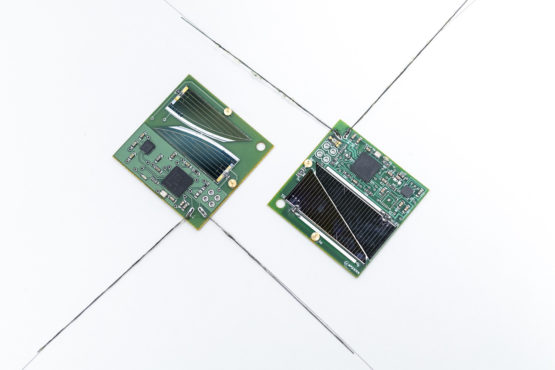
Each ChipSat is a circuit board slightly larger than a postage stamp. Built for under $100 apiece, each ChipSat uses solar cells to power its essential systems: the radio, microcontroller and sensors that enable each device to locate and communicate with its peers. In the future, ChipSats could contain electronics tailored to specific missions, Manchester said. For instance, they could be used to study weather patterns, animal migrations or other terrestrial phenomena. Spacefaring applications might include mapping the surface features or internal composition of asteroids or moons orbiting other planets.
…
In 2009, while studying with Cornell professor Mason Peck, Manchester envisioned how to engineer the electronic essence of a satellite into a device even cheaper and easier to build than a CubeSat. In 2011, he crowdfunded his project by putting it on Kickstarter.com, quickly raising about $75,000 from 315 contributors, and what he initially called the KickSat project was born. “I want to make it easy and affordable enough for anyone to explore space” is how Manchester put it at the time.
Prof. Zac Manchester sent a swarm of postage-stamp sized satellites into orbit. (Image credit: L.A. Cicero)
The first attempt in 2014 failed when the CubeSat containing the ChipSats did not open before de-orbiting. The re-designed KickSat-2 was attached along with other smallsats to a Northrop-Grumman Cygnus cargo vehicle launched to the ISS last November. After the Cygnus departed from the ISS, the small satellites were deployed into orbit. Then on March 18th, the 105 ChipSats were released from their CubeSat mothership.
That moment finally came, when the deployment commands were transmitted from the 60-foot dish behind the Stanford campus. Another anxious day passed before Manchester learned that the sensitive dish antenna had detected the faint signals from the ChipSats, which meant they were operational. Manchester worked with collaborators around the world to track the ChipSats as they transmitted data until reentering the atmosphere and burning up on March 21.
** HuskySat-1 is a student project at the University of Washington. The CubeSat is booked for launch aboard a Cygnus cargo vehicle (NG-12) on an Antares rocket that is currently set to lift off from Wallops Flight Facility, Virginia on October 19, 2019.
The Husky Satellite Lab is a student-run aerospace research club working on establishing a space presence for the University of Washington. We are currently working on our first mission, HuskySat-1. The HS1 is currently undergoing flight model integration testing.
Our Mission is to foster interdisciplinary student participation in space systems research, to inspire and train future space scientists and engineers, and to advance spacecraft capabilities at the University of Washington.
Our Team is composed primarily of UW undergraduate and graduate students, as well as mentors from the local aerospace industry. Our lead principal investigator is Professor Robert Winglee.
“Almost all of HuskySat-1 is being developed at the UW. The satellite is broken up into different subsystems. Each component is designed to be modular so that they can be most easily developed independently from each other and reused for future missions.” – Husky Satellite Lab
A sampling of recent articles, press releases, etc. related to student and amateur CubeSat / SmallSat projects and programs:
[ Update: A satellite developed by China’s AMSAT group and the Beijing Institute of Technology ( BIT ) is set to launch this month on a Chinese commercial rocket:
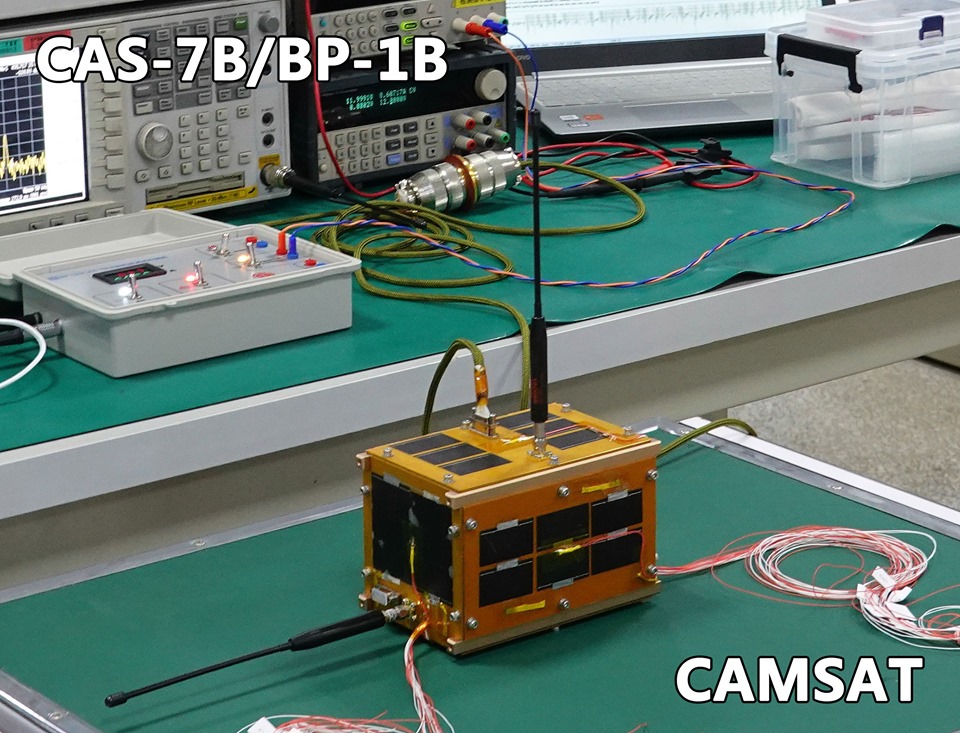
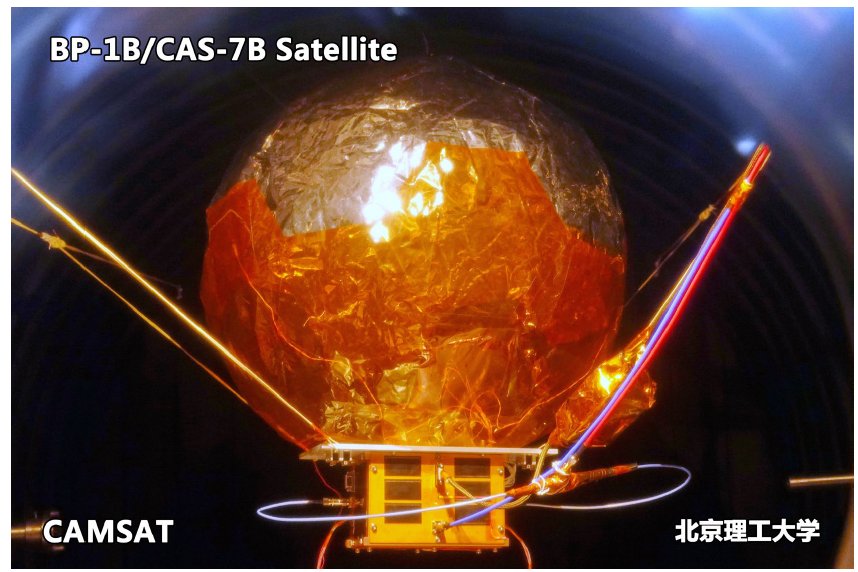
… the CAS-7B satellite, also designated as BP-1B, a short-lived spacecraft that will carry an Amateur Radio payload. An unusual feature of the spacecraft is its “sail ball” passive stabilization system. The 1.5-U CubeSat is attached to a 500-millimeter flexible film ball — or sail — that will offer passive “pneumatic resistance” stabilization. CAS-7B is expected to remain in orbit for up to 1 month.
The spacecraft will carry an Amateur Radio transponder and educational mission. CAMSAT is working with Beijing Institute of Technology (BIT), a top aerospace school, which is providing launch support in launch of the satellite. BIT faculty and students are participating in the development and testing of the satellite, and, with CAMSAT’s help, the university has established an Amateur Radio club (call sign BI1LG). CAMSAT said many students are now members, “learning Amateur Radio satellite communication and experience[ing] endless fun.”
The CAMSAT BP-1B/CAS-7B cubesat duringa thermal vacuum test with the “sail ball” deployed.
The next phase of this project involves the construction of a 4U (40 cm3) CubeSat in accordance with the UAE’s Environment Vision 2030.
Amity University, Dubai has launched a satellite ground station on their campus, which will allow students to track satellites, predict weather patterns and pollution levels, as reported by Khaleej Times.
The station at Amity University is aimed at garnering the participation of students studying aerospace, electrical, electronics, computer science or nanotechnology engineering.
Commenting on the initiative, Dr Vajhat Hussain, CEO of Amity University Dubai, as quoted by the English daily, said: “The main goal of the ground station is to give students the opportunity to perform the following operations – telemetry data visualisation and storage, antenna control and positioning system, radio communication using very high frequency (VHF) and satellite data analysis. Through this initiative, students will not only learn how to read and analyse such data but also get the support they need for research projects.”
Creating satellites to explore space is no longer just for adults.
At Grace Brethren High School, a group of about 20 students have made it their mission to launch a small satellite into orbit by 2020.
Known as CubeSat, the device contains a payload that can be monitored from the ground and is equipped with small yet strong LED lights that will send satellite-operating information to the mission operations center at the Grace Brethren Space Lab, said Annabelle Hynes, an 18-year-old graduate who worked on the project.
“Being the only girl involved in the spacecraft class and working on CubeSat has been an interesting experience, and we’ve gotten to do a lot of really exciting, hands-on things with this project,” Annabelle said.
“We’re still figuring out the basics, but . . . the plan is to track the satellite from the school and communicate with it. It will be open to other organizations so they can use the data we collect.”
EIRSAT-1 will be fully designed, assembled, tested and operated in Ireland by staff and students at UCD. This is primarily a technology demonstration and science mission with three payloads, a gamma-ray detector, a materials science experiment and a novel spacecraft control algorithm. It will also demonstrate a low-profile UHF/VHF Antenna Deployment Mechanism. Clyde Space are providing UCD with its full set of CubeSat avionics, including a flight proven onboard computer, an attitude determination and control system and its high-performance power system products.
Led by Professor Karu Esselle of the School of Engineering, the team has developed an antenna system with a steerable beam which will enable scientific data downloading from spacecrafts to labs on earth 24 hours a day.
As the first move towards rapidly growing space systems, the low-profile antenna system was designed for US company Audacy who launched the world’s first entirely Ka-band CubeSat (a type of miniaturised satellite that can be used for a variety of space applications including earth imaging, astronomy, science experiments, climate monitoring and surveillance) called Audacy Zero into space via a SpaceX Falcon 9 Rocket in December 2018.
Audacy, a company spun off Stanford University and based in California, is developing the world’s first commercial inter-satellite data relay network. Audacy Zero was the first iteration of a radio that will enable Audacy customers’ spacecraft to connect to this network.
“Data from your CubeSat will travel through the relay system down to earth to the internet and cloud,” explains Prof Esselle.
“Without such a space relay network, a CubeSat can be seen from a fixed ground station only for a few minutes per day and that is often not enough to download all the data collected by the CubeSat.
What’s up in the June sky? Jupiter is at its biggest and brightest, Mercury and Mars appear ultra-close and how you can observe the Moon’s tilted orbit.