Dr. Courtney Dressing of the University of California at Berkeley gives a public lecture on exoplanets:
The NASA Kepler mission revealed that our Galaxy is teeming with planetary systems and that Earth-sized planets are common. However, most of the planets detected by Kepler orbit stars too faint to permit detailed study. The NASA Transiting Exoplanet Survey Satellite (TESS,) launched in 2018, is now finding hundreds of small planets orbiting stars that are much closer and brighter. Dr. Dressing discusses how we find exoplanets, describes the TESS mission, and explains how it (and future projects) will help our understanding of what planets are out there and how they form.
The lecture is one in the Silicon Valley Astronomy Lectures series organized and moderated by Foothill’s astronomy instructor Andrew Fraknoi and jointly sponsored by the Foothill College Astronomy Department, NASA’s Ames Research Center, the SETI Institute, and the Astronomical Society of the Pacific.
A sampling of recent articles, press releases, etc. related to student and amateur CubeSat / SmallSat projects and programs (find previous smallsat roundups here):
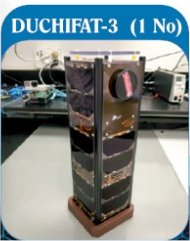
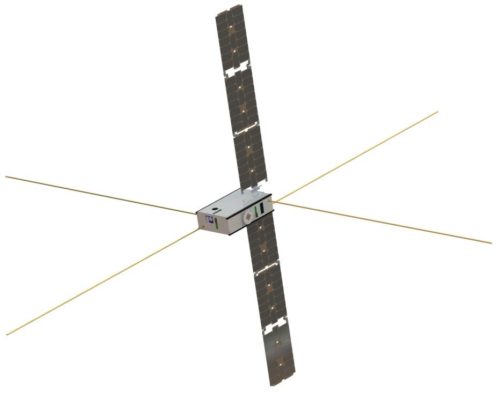
** Indian rocket orbits Duchifat-3 CubeSat built by Israeli high school students:
Duchifat 3 is the third in the series of Israeli student-made satellites.
Jointly built by Herzliya Science Center and Sha’ar HaNegev High School students, the satellite is designed to serve children from across the country to “observe the Earth”.
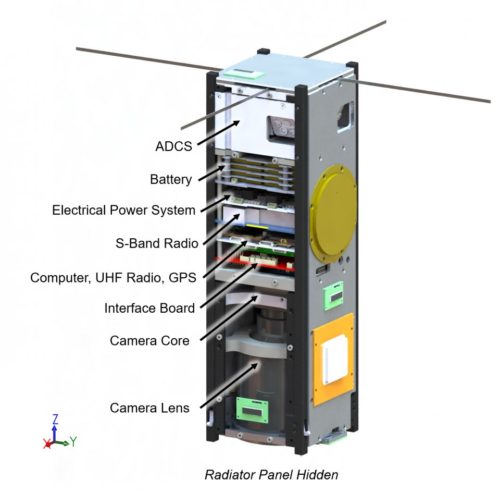
“It is a photo satellite used for ecological research of Earth from space. The size of the satellite is 10x10x30 cm (3U) and it weighs 2.3 kg. The students worked for almost two and a half years to build it. The satellite will be of good help to agriculturists,” one of the donors for the project and head of ICA Foundation Zeev Miller told PTI.
Bolsonaro also said in his tweet that besides the CBERS-4A, nano-satellite Floripast (cubeSat) would also be launched, a project developed by students of bachelor, master and doctorate courses in Electrical Engineering, Automation and Mechanical Engineering of the Federal University of Santa Catarina, in partnership with the Uniespaço programme of the Brazilian Space Agency.
In 2013, Alfeeli moved to the Kuwait Foundation for the Advancement of Science, where he has worked ever since. Orbital Space takes up his evenings and weekends, as he manages several initiatives in parallel. He has set up a basic ground station called Um Alaish 4, after its predecessor, to receive signals from CubeSats. Orbital Space is also involved in building the country’s first CubeSat, with a group of around 15 Kuwaiti volunteers. The Kuwaiti engineer initiated the CubeSat project as a tool to attract space enthusiasts.
“The idea is to create a platform to bring together a community of space enthusiasts in Kuwait. There is interest from the young generation, but there is no project that engages them to create that critical mass. I figured we needed a hub where people can come together and do that. So Orbital Space has now created that opportunity and is open to anyone who wants to join us to promote space in Kuwait,” Alfeeli says.
By creating greater awareness through public talks on the history of the ground station in Kuwait and hands-on workshops on CubeSats for kids, he hopes to plant the seeds of a space programme in Kuwait. In addition to all the other initiatives, Orbital Space has also launched a competition for high-school students and undergraduate students in partnership with US-headquartered space commercialisation company Nanoracks, with the winning experiment to be sent to the International Space Station (ISS).
A sampling of recent articles, press releases, etc. related to student and amateur CubeSat / SmallSat projects and programs (find previous smallsat roundups here):
The first satellite built by students in Mexico for launch from the International Space Station is smaller than a shoebox but represents a big step for its builders.
The project is part of NASA’s CubeSat Launch Initiative, which offers universities, high schools and non-profit organizations the opportunity to fly small satellites. Innovative technology partnerships keep down the cost, providing students a way to obtain hands-on experience developing flight hardware.
A multidisciplinary team of students at Universidad Popular Autónoma del Estado de Puebla (UPAEP), in Puebla, Mexico, built the CubeSat for AzTechSat-1. The investigation demonstrates communication within a satellite network in low-Earth orbit. Such Intra-satellite communication could reduce the need for ground stations, lowering the cost and increasing the number of data downloads possible for satellite applications.
“Jose Cortez of NASA Ames (left) and Joel Contreras of UPAEP (right), conduct final integration of AzTechSat-1 into the Nanoracks CubeSat Deployer (NRCSD) in preparation for launch to the International Space Station. Credits: NASA”
After a series of tests and screening, Wee and seven others from different science backgrounds and regions were accepted into UP’s graduate program for electrical engineering and into the Space Technology and Applications Mastery, Innovation and Advancement (STAMINA4Space) program of the DOST.
For Dr. Joel Joseph Marciano, who heads the STAMINA4Space program and the DOST-ASTI, said making cube satellites locally is an important step for the Philippines.
“Building satellites is one way you can be in space,” he said. “These smaller satellites are becoming more powerful, can take meaningful missions, experiments in space.”
A sampling of recent articles, press releases, etc. related to student and amateur CubeSat / SmallSat projects and programs (find previous smallsat roundups here):
The Community Satellite Project is an online group of international space professionals and students, collaborating to launch BATSAT, a crowd-developed cubesat. The group was initially founded in early November 2019 via r/space, following a reputable space company’s offer of a free launch.
Our goals are not only to develop and use BATSAT to conduct cutting edge aerospace research, but to facilitate mentorship between space experts and students.
We are currently in the recruiting and mission defining stages of this process.
If you are interested in becoming part of the team, please get in touch via our Join Us page.
More than 740 people have joined the online group, including aerospace engineers, avionics and payload experts, cloud engineers, satellite ground station engineers and university students from all over the world.
Of this, 260 supporters with specialist skills have been assigned to various teams to confirm the parameters of the project, with regular conversations held using an online meeting app.
The collective decision is to build two small satellites, each about the size of a Rubik’s Cube, to test a theory about whether electro-magnetic tether straps can be used to de-orbit a satellite once it has come to the end of its life.
The students have broken their project into phases, and are now in the construction phase. Once Strong and Johnson finish building the satellite, they will conduct environmental tests to expose it to vibration, vacuum and temperature conditions closely identical to space.
Then the students will work with NASA to prepare to launch it into space. After the launch, the seniors will perform satellite operations and conduct space experiments. Once the space mission is complete, the nanosatellite will fall to Earth, possibly burning up in the atmosphere.
ESA’s Hera asteroid mission is go – ESA – “Hera will carry two CubeSats on board, which will be able to fly much closer to the asteroid’s surface, carrying out crucial scientific studies, before touching down. Hera’s up-close observations will turn asteroid deflection into a well-understood planetary defence technique.”
A sampling of recent articles, press releases, etc. related to student and amateur CubeSat / SmallSat projects and programs (find previous smallsat roundups here):
“Concrete and asphalt tend to retain the heat of the sun and heat the place. We want to know exactly why, where, and when the cities are heating up,” De La Vega stated.
Once the satellite gets deployed by astronauts onboard the International Space Station in January, the team will be testing, calibrating, and hopefully, receiving data from the satellite for further research.
[SOCRATES} is the first-ever made by the university in a joint venture featuring university professors and students from a variety of space-related fields and engineering. The project is under NASA’s Undergraduate Student Instrument Project, which was started three years ago to give students opportunities to build and launch satellites into space.
More than 30 students from the university were interested in the program, led by Kyle Houser, the chief engineer and Burgett, the project manager. The SOCRATES was developed in the university’s Small Satellite Project Lab, founded by Demoz Gebre and physics professor Lindsay Glesener for a small satellite study.
The SOCRATES is fitted with state-of-the-art X-ray detection sensors to provide navigation when GPS is inaccessible. The satellite will also be able to capture information on electronic acceleration from solar flares to aid in the study of the solar phenomenon. The SOCRATES will be released to orbit the Earth in January 2020 from the International Space Station, where it is held at the moment.