Category Archives: Education

Student and amateur CubeSat news roundup – Feb.11.2020

A sampling of recent articles, press releases, etc. related to student and amateur CubeSat / SmallSat projects and programs (find previous smallsat roundups here):

** Arizona State Univ. Phoenix CubeSat set to deploy from ISS on Feb.12th. The first ASU undergraduate student built satellite, Phoenix will study Urban Heat Islands with observations of the earth using an infrared camera. The team welcomes help in visual tracking and amateur radio contacts.

After deployment, it will take some trial and error before we are able to confirm our spacecraft’s TLEs before we can comfortably predict its orbit. The more people who can help us spot our spacecraft, the sooner our operations phase can officially begin! If you would like to help listen for Phoenix, you can do so with the information below. 

If you think you’ve heard from Phoenix and you are a member of the SatNOGS network, please publish your observation on the Libre Space community page, and tag @sarah_srogers in the post.
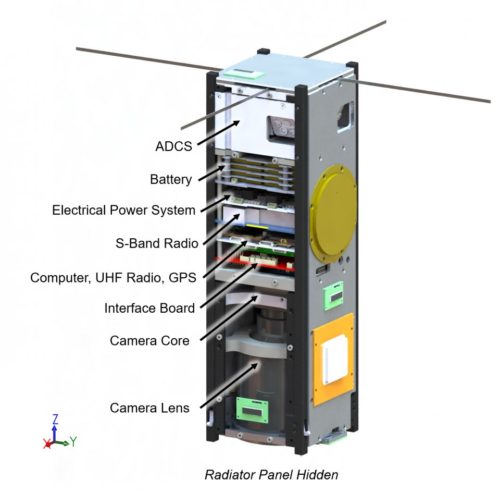
ASU Phoenix Cubesat Diagram
Component diagram of the ASU Phoenix Cubesat.

See also Phoenix CubeSat upcoming deployment – Southgate Amateur Radio News

** Orbital Factory-2 communicates with the Univ. Texas at El Paso team that built the CubeSat in collaboration with Lockheed-Martin. The spacecraft was released into orbit via a Nanoracks deployment system on February 3rd  from the Northrop-Grumman Cygnus cargo vehicle after it departed from the ISS. UTEP Successfully Communicates With Satellite to Cap Monumental Project – Univ. Texas at El Paso

Joel Quintana, Ph.D., research assistant professor of mechanical engineering and a UTEP alumnus, said 25 students from various engineering disciplines worked on the OF-2 project throughout the course of two years. He was with a group of those students at a cSETR research space provided by the City of El Paso near the UTEP campus as they waited on notification from OF-2.

“Seeing their excitement when the first ping came in when they were able to communicate with the satellite as it orbited over El Paso was priceless,” Quintana said. “They leave this program knowing how to design, build and test spacecraft, making them really high in demand and industry experts.”

With this milestone reached, cSETR will now set off on a set of new initiatives including the development of spacecraft capabilities for on-orbit manufacturing, and planetary and lunar exploration. The center will conduct this work concurrently with its primary mission of training El Paso talent and cultivating a space technology workforce.

** AMSAT news on student and amateur CubeSat/smallsat projects: ANS-040 AMSAT News Service Special Bulletin

  • Clayton Coleman, W5PFG, Elected AMSAT President
  • Phoenix CubeSat Upcoming Deployment
  • New ISS Tour Video Goes Inside Cygnus NG-12
  • Changes to AMSAT-NA TLE Distribution
  • HuskySat-1 Gains Enthusiastic Following
  • Robert Bankston, KE4AL, Proposes amsatLink Project
  • 10 US Schools Moved Forward in ARISS Selection Process
  • AMSAT at Yuma (Arizona) Hamfest, 14-15 February 2020
  • Hamfests, Conventions, Maker Faires, and Other Events
  • Upcoming Satellite Operations
  • Satellite Shorts From All Over

General CubeSat/SmallSat info:

** Jeff Dillon – Cubesat to Mars22nd Annual International Mars Society Convention [October 17-20, 2019]

** NASA’s Cube Quest Challenge Crowdsources Ideas for Deep Space CubeSats

Pushing the boundaries of space technology, NASA’s first in-space competition invites the public to design, build and launch small satellites capable of advanced operations near and beyond the Moon. Three winners from the ground competition, completed in 2017, are readying their CubeSats for launch on Artemis I, the first uncrewed flight of NASA’s Space Launch System (SLS) rocket and the Orion spacecraft. Want to get in on the action? Additional teams can compete in the Deep Space Derby and Lunar Derby by securing their own launch opportunity. Explore more about NASA’s Cube Quest Centennial Challenge: http://www.nasa.gov/cubequest

== Amazon Ad ==

Introduction to CubeSat Technology and Subsystem:
Orbit Design, Debris Impact, and Orbital Decay Prediction

Student and amateur CubeSat news roundup – Feb.4.2020

A sampling of recent articles, press releases, etc. related to student and amateur CubeSat / SmallSat projects and programs (find previous smallsat roundups here):

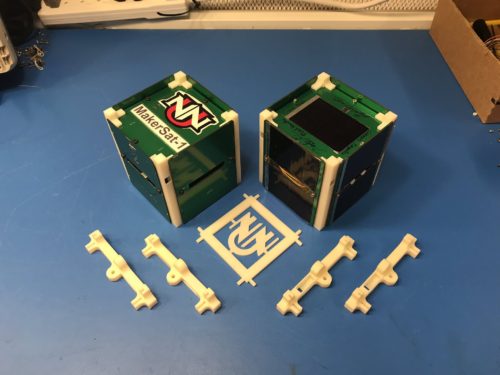
MakerSat-1 components for easy assembly. Credits: and NanoSats.eu

** After ISS departure, Cygnus resupply vehicle releases 14 CubeSats including several built by university groups:

The university satellites include:

A demo of the MakerSat 1 quick assembly:

** AMSAT news on student and amateur CubeSat/smallsat projects: ANS-033 AMSAT News Service Special Bulletin

  • HuskySat-1 Deployed, Telemetry Beacon Active
  • Free Digital Copy of “Getting Started with Amateur Satellites” Now Available for New or Renewing Members
  • Joe Spier, K6WAO, Resigns as AMSAT President
  • Melissa Pore To Be Honored at Hamcation February 2020
  • W1ANT Pro Satellite Tracker Announced
  • AMSAT Argentina Drifting APRS Buoy on 145.825 MHz
  • VUCC Awards-Endorsements for February 2020
  • Upcoming Satellite Operations
  • Upcoming AMSAT Events
  • ARISS News
  • Satellite Shorts from All Over

General CubeSat/SmallSat info:

** Judi Sandrock – Modular Smallsat Teaching Tools with Xinabox – Cold Star Project S02E17

Xinabox co-founder Judi Sandrock from South Africa is on the Cold Star Project with host Jason Kanigan, and we’re talking about their modular smallsat teaching tools.

== Amazon Ad ==

Introduction to CubeSat Technology and Subsystem:
Orbit Design, Debris Impact, and Orbital Decay Prediction

Videos: Night Sky for February 2020

[ Update:  What’s Up: February 2020 Skywatching Tips from NASA

Looking for astronomy highlights for February 2020? This month is the best time of the year to try to view Mercury, soon after sunset; Mars disappears behind the Moon on Feb. 18; and the bright red star on Orion’s shoulder, Betelgeuse, has been acting weird. (Or has it?) Additional information about topics covered in this episode of What’s Up, along with still images from the video, and the video transcript, are available at https://solarsystem.nasa.gov/whats-up….

]

Tonight’s Sky: FebruarySpace Telescope Science Institute – YouTube

In February, the Winter Triangle is your guide to the night sky: The northern hemisphere is treated to views of the stars Procyon, Sirius, and Betelgeuse. Keep watching for the awe-inspiring space-based views of the Orion Nebula, which is sculpted by the stellar winds of central bright stars.

** What’s in the Night Sky February 2020Alyn Wallace

** The Virtual Planetarium: what to see in the night sky, February 2020BBC Sky at Night Magazine – YouTube

The Sky at Night presenters Pete Lawrence and Paul Abel reveal what they will be observing in the night sky throughout February

** Eyes on The Sky: February 2020Hudson Valley Community College – YouTube

Hudson Valley Community College astronomy instructor Richard Monda gives a detailed update of what will be happening in the night sky from Jan. 27, 2020 – Feb. 29, 2020 in the Northeastern US. Eyes on the Sky is a series of informational videos relating to Astronomy in the Capital Region of New York State and the Northeastern United States. The videos are hosted by Richard J. Monda, an astronomy instructor in the college’s Biology, Chemistry and Physics Department.

** Astronomy Events In February 2020The Secrets of the Universe – YouTube

=== Amazon Ad ===

The Planet Factory: Exoplanets and the Search for a Second Earth

Student and amateur CubeSat news roundup – Feb.1.2020

A sampling of recent articles, press releases, etc. related to student and amateur CubeSat / SmallSat projects and programs (find previous smallsat roundups here):

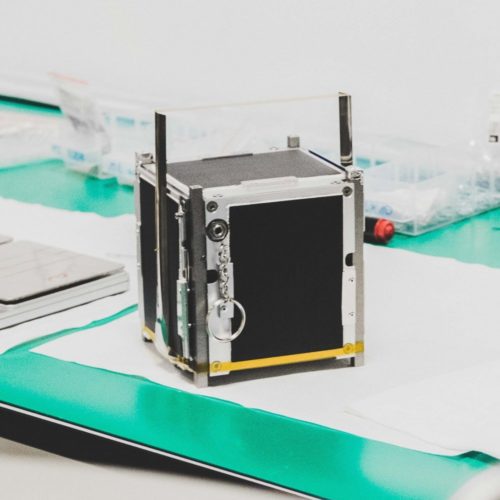
The KRAKsat CubeSat.

** A review of KRAKsat performance after its deployment from the ISS in June 2019. The satellite was developed by students at the AGH University of Science and Technology  and Jagiellonian University in Kraków, Poland. It was “one of the first Cubesat type satellites in Poland but also the first satellite in the world which uses magnetic liquid, called ferrofluid, for orientation control”. KRAKsat was active in orbit for about two weeks before a cascade of problems led it into an unstoppable reboot cycle.

This slow energy drain continued until the voltage dropped to the point that the power supply shut down, and that’s were things really started going south. Once the satellite shut down the batteries were able to start charging back up, which normally would have been a good thing. But unfortunately the KRAKsat had no mechanism to remain powered down once the voltage climbed back above the shutoff threshold. This caused the satellite to enter into and loop where it would reboot itself as many as 150 times per orbit (approximately 90 minutes).

The paper then goes into a laundry list of other problems that contributed to KRAKsat’s failure. For example, the satellite had redundant radios onboard, but the software on them wasn’t identical. When they needed to switch over to the secondary radio, they found that a glitch in its software meant it was unable to access some portions of the onboard flash storage. The team also identified the lack of a filesystem on the flash storage as another stumbling block; having to pull things out using a pointer and the specific memory address was a cumbersome and time consuming task made all the more difficult by the spacecraft’s deteriorating condition.

** Recognition for the CubeSat projects of the students at The Weiss School (preK-8) in Palm Beach Garderns, Florida:

More about the two Weiss School CubeSats

** AMSAT news on student and amateur CubeSat/smallsat projects: ANS-026 AMSAT News Service Special Bulletin

  • HuskySat-1 With AMSAT VHF/UHF Linear Transponder Planned for Deployment Soon
  • Celebration of 50th Anniversary of Australis-OSCAR 5
  • ARRL to Argue for Continued Access to 3-GHz Spectrum as FCC Sets Comment Deadlines
  • FO-99 (NEXUS) 1st Anniversary Report
  • Amateurs in the News: “96-year-old Amateur Radio operator at Ontario Science Centre speaks with astronaut”
  • Upcoming ARISS Contacts
  • Upcoming AMSAT Events
  • Upcoming Satellite Operations
  • Satellite Shorts From All Over

General CubeSat/SmallSat info:

  • Resources:
    • PolySat – “PolySat is a student run, multidisciplinary independent research lab. We are the CubeSat development team of Cal Poly, an originator and leader for launches in the CubeSat community.”
    • Pauline Faure – Inside the CubeSat Lab at Cal Poly – Cold Star Project

Dr. Pauline Faure, Assistant Professor at California Polytechnic State University’s Aerospace Engineering Department, is on the Cold Star Project with host Jason Kanigan. We’re talking about what it’s like to be a student in Cal Poly’s CubeSat Lab. Dr. Faure has international experience in Europe, Japan and the USA. The lab has completed eight missions in the past year including the bus for Lightsail 2. This is a great interview for space students.

== Amazon Ad ==

Introduction to CubeSat Technology and Subsystem:
Orbit Design, Debris Impact, and Orbital Decay Prediction

Student and amateur CubeSat news roundup – Jan.23.2020

A sampling of recent articles, press releases, etc. related to student and amateur CubeSat / SmallSat projects and programs (find previous smallsat roundups here):

** “What Smallsat Projects Are Like For University Students” – Cold Star interview with Dr. Amelia Greig of Univ. of Texas at El Paso:

Dr. Amelia Greig of the University of Texas at El Paso’s Center for Space Exploration and Technology Research is on the Cold Star Project to talk about her experience. We’re looking into both her own experience as a student and professor, and that of her graduate students in today’s programs.

Dr. Greig earned an Australian National University doctorate in plasma physics & electrical propulsion, a Postdoctorate in Plasma Physics at CalTech, and taught aerospace propulsion, space environment and spacecraft thermal control at California Polytechnic State University before moving to the University of Texas.

I wanted to hear from “boots on the ground” about what’s going on in academia regarding smallsats. So we cover what kind of courses students are interested in, the hands-on opportunities they’re being given in addition to classroom theory, and Dr. Greig’s vision for the future.

In addition, she shares her thoughts on what graduate students can and should be doing before and as graduation approaches so they can maximize their job opportunities. Networking done well during this time can pay off strongly into their career. You can connect with Dr. Greig at adgreig@utep.edu

** Latest from the all-girl Kyrgyz Space Program in  Kyrgyzstan:

See also:

** AMSAT news on student and amateur CubeSat/smallsat projects: ANS-019 AMSAT News Service Special Bulletin

  • GOLF-TEE Reaches Major Milestones
  • ARISS Contact Opportunity Call for Proposals February 1, 2020 to March 31, 2020
  • Satellite Status and Tracking API’s Added to AMSAT Website
  • Qarman Beacon Telemetry Information Released
  • China Telecoms Regulator Proposing to Delete Some Current Amateur Allocations
  • Memorial Service for Brian Kantor, WB6CYT
  • Upcoming Satellite Operations
  • ARISS News
  • Satellite Shorts from All Over

General CubeSat/SmallSat info:

** Rick Fleeter – A Personal History of Smallsats – The Cold Star Project S02E04

Dr. Rick Fleeter, associate adjunct professor at Brown University and visiting lecturer at La Sapienza (Rome), has decades of personal history with small satellites.

“I got started in microspace through amateur radio and AMSAT. In the early 1980s I had the unusual experience of spending evenings building small satellites in a garage in Redondo Beach, CA, paid for essentially with small contributions by the team that was building them, while during the day working at the Jet Propulsion Laboratory and then TRW, where it was insisted that without something close to $1 billion there wasn’t much you could do other than paper studies.”

Rick Fleeter was launching smallsats in the 1970s, when they were considered merely a hobby or toys. Since then he has helped change the perception of cubesats to useful tools by leading well designed, cost-minimized projects. As an example, Brown’s Space Engineering department built a satellite for just $5000. He has written books, founded the company AeroAstro and the Space Horizons annual conference at Brown.

In this interview, Cold Star Project host Jason Kanigan asks Dr. Rick Fleeter about the smallsat and cubesat field, new developments, frustrations with space, and even company development.

** Isaac Arthur – The Future of Smallsats – The Cold Star Project S02E03

Host of the top space educator YouTube channel, Science and Futurism with Isaac Arthur, is on the Cold Star Project and we’re talking about the future of smallsats. Isaac Arthur shares his views with host Jason Kanigan on:
* the potential impact of economies of scale and the sheer number of cubesats about to be put into orbit
* tracking problems and space debris cleanup possibly resulting from mission failure, end of life, and collisions
* connectivity improvements leading to SAR (search and rescue) & lifesaving operations
* the next two or three decades of industry & commercial development of continuous launches to place and replace satellite constellations
* the future of smallsat technology and “space jobs.”
Check out Science and Futurism with Isaac Arthur here:
https://www.youtube.com/channel/UCZFi…

** Riccardo Albertoni – Electric Propulsion for Smallsats – Cold Star Project S02E06

Dr. Riccardo Albertoni, a member of the Airbus team in charge of developing electric propulsion systems including the one used on the OneWeb constellation, is our guest on the Cold Star Project. His team was the 2017 & 2019 Winner of the Airbus Defence and Space Award for Excellence, and he lectures on electric propulsion at the Airbus Space Academy. Dr. Albertoni explains how electric propulsion for satellites works, as well as its role in the market. While electric propulsion has several advantages, it is not a fit for every type of mission. He explains to host Jason Kanigan that there will continue to be room for conventional combustion propulsion systems. Dr. Albertoni concludes by sharing his views on what new developments are upcoming in the electric propulsion field.

== Amazon Ad ==

Introduction to CubeSat Technology and Subsystem:
Orbit Design, Debris Impact, and Orbital Decay Prediction