Category Archives: Education

Student and amateur CubeSat news roundup – April.29.2020

A sampling of recent articles, press releases, etc. related to student and amateur CubeSat / SmallSat projects and programs (find previous smallsat roundups here):

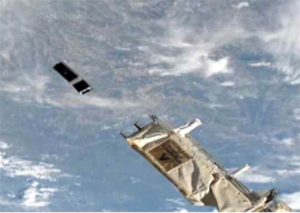
** Quetzal-1 CubeSat, developed at the University del Valle de Guatemala, was deployed into orbit from the ISS yesterday.  The project was sponsored by  KiboCUBE, a collaboration of the Japanese space program JAXA and United Nations Office for Outer Space Affairs (UNOOSA). Guatemala launches Quetzal-1 cube satellite through UNOOSA and JAXA KiboCUBE programme – Univ. Vienna .
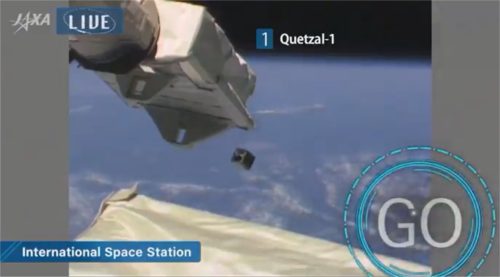
Deployement of Guatemala’s Quetzal-1 cubesat from the Japanese Kibo module on the ISS. Credits: JAXA

The satellite – Quetzal-1 – is Guatemala’s first and will unlock new possibilities for the country and help achieve the United Nations Sustainable Development Goals (SDGs). The primary objective of the mission is to test a multispectral sensor to acquire remote sensing data for natural resource management. The sensor could be used to monitor water quality in inland water bodies, helping to achieve SDG Goal 6 – clean water and sanitation.

The project supports SDG Goal 9 – industry, innovation and infrastructure – helping Guatemala develop its capacities in aerospace engineering and sparking innovations, such as the sensor created for the satellite. Women were an integral part of the winning team that engineered the satellite, contributing to SDG Goal 5 – gender equality.

The project has been made possible thanks to the strong collaboration of several entities: UNOOSA, JAXA, UVG, the UK Space Agency, the University of Colorado, the University of Chile, TEC Costa Rica, and the University of Würzburg among others. This is in line with SDG 17, partnership for the goals: international collaboration can unlock new frontiers in leveraging space for development.

The KiboCUBE programme offers the opportunity for institutions from developing countries to develop a cube satellite to be deployed from the ISS Japanese Experiment Module (Kibo). The programme, which recently completed its fifth round, enabled Kenya to deploy their first satellite in 2018, 1KUNS-PF, developed by a team from the University of Nairobi.

Views of the deployment:

Updates and further info about the project:

** Berkeley student-built QubeSat to test quantum gyroscope in orbit. The CubeSat project was selected by NASA’s CubeSat Launch Initiative for launch in 2021: Students’ shoebox-sized satellite gets green light for launch | Berkeley News

“The NASA grant is just for the launch, so we have still got to supply and manufacture the satellite ourselves,” said [Paul] Kӧttering, a junior majoring in applied mathematics and physics. “Luckily, the cost of CubeSats has dropped significantly over the past three to four years. The communications systems, power systems, control systems — a lot of those are just off-the-shelf, commercial parts, so they are quite cheap. The payload itself is the more expensive item, but again, a lot of that comes from in-kind donations from companies.”

Called QubeSat, or quantum CubeSat, the group’s satellite will test a new type of gyroscope based on quantum mechanical interactions in imperfect diamonds. The diamond gyroscope was invented in the UC Berkeley laboratory of physicist Dmitry Budker, a Professor of the Graduate School who is now also at the Helmholtz Institute at Johannes Gutenberg University in Mainz, Germany.

The student team is part of an undergraduate aerospace club called Space Technologies at Cal (STAC) that has already flown experiments aboard balloons and the International Space Station — an impressive record for a group that started only four years ago. Some of the group’s graduates have gone on to work for SpaceX, Boeing and other aerospace companies.

Boasting about 65 members from a range of majors, including physics, math, engineering, chemistry and environmental sciences, they’re currently working on four projects they hope will push innovative new space technologies.
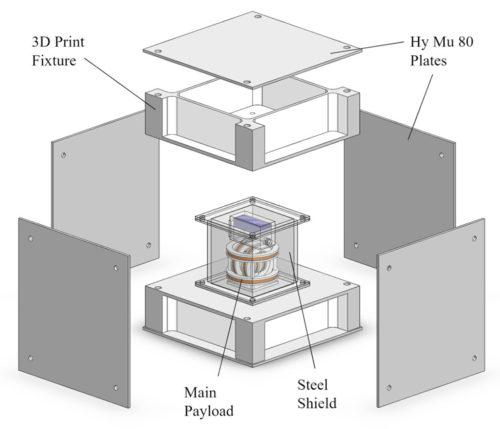
“The NV-diamond, a quantum gyroscope, will sit in the middle of the magnetic coils, which will be encased in a box that blocks outside magnetic fields, which would interfere with the measurements. (Diagram by STAC team)”. Credits: STAC & Berkeley News

** Washington State University student-built CougSat-1 will study plant germination in microgravity. The Cougs in Space student organization is developing the CubeSat, the first for WSU to go to space. Cougs in Space prepare satellite – The Daily Evergreen

Teams from Cougs in Space are working together to build a satellite that will be launched from the International Space Station by this October. 

Mathew Bauer, junior computer science major and president of Cougs in Space, said the satellite is a 10-centimeter cube, or “CubeSat.” It will contain cameras to monitor conditions and pea seeds germinating, which means growing in an internal chamber. 

“The germination of pea seeds, the germination of seeds in general, is something that has never really been done outside of the International Space Station,” Bauer said. “They’ve never seen how seeds react in space.”

Bauer said Cougs in Space has been building the satellite for about one and a half to two years.

There are many teams responsible for different parts of the satellite, he said. The structure team builds the body of the satellite, the payload team is responsible for the pea seeds and the germination chamber and the communication team will receive data from the satellite when it is in space. Other teams are responsible for electrical systems, computing and controls, among other functions.
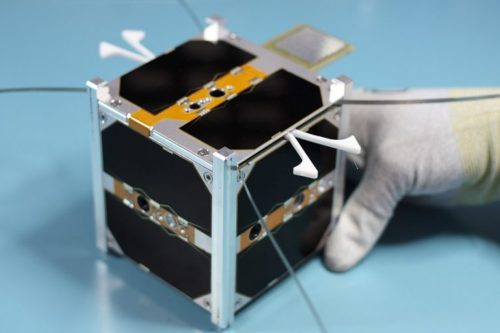
CougSat-1 CubeSat. Credits: Cougs in Space.

CougSat-1 will got to the ISS aboard a Cargo Dragon this fall and be deployed into orbit via Nanoracks.

Find updates at Cougs in Space (@cougsinspace) / Twitter

** AMSAT news on student and amateur CubeSat/smallsat projects: ANS-117 AMSAT News Service Special Bulletin

  • March/April 2020 Edition of Apogee View Posted
  • Long-Lost U.S. Military Satellite Found By Amateur Radio Operator
  • Let’s Take Some Pictures
  • Changes to AMSAT-NA TLE Distribution
  • The W4AMI Award and How to Obtain One
  • New OSCAR T-Shirt Available from AMSAT Zazzle Store
  • Upcoming Satellite Operations
  • ARISS News
  • Hamfests, Conventions, Maker Faires, and Other Events
  • Satellite Shorts From All Over

General CubeSat/SmallSat info:

** Terran Space Technologies presentation at NewSpace Pitch in Singapore last year: Singapore’s Infinite Orbits wins NewSpace Pitch at APSCC2019 | SpaceTech Asia

** Polaris: Machine Learning for Satellites:

A presentation on Polaris (https://polarisml.space), an open source Python project to apply machine learning to satellite telemetry. This presentation was supposed to be given at the 2020 Cubesat Developer’s Workshop (https://www.cubesat.org/workshop-info… the workshop was cancelled because of COVID-19, but the organizers have allowed us to record our presentations for the archive. Links: – The Polaris project can be found here: https://polarisml.space – The slides for this presentation can be found here: https://drive.google.com/file/d/1H4UF… – The demo shown in this video can be found here: https://deepchaos.spac

== Amazon Ad ==

Introduction to CubeSat Technology and Subsystem:
Orbit Design, Debris Impact, and Orbital Decay Prediction

Student and amateur CubeSat news roundup -April.24.2020

A sampling of recent articles, press releases, etc. related to student and amateur CubeSat / SmallSat projects and programs (find previous smallsat roundups here):

** Mexico university students to build CubeSat in collaboration with NanoAvionics and the Mexian Space Agency: NanoAvionics and Mexican Space Agency Introduce a Nanosatellite Pilot Project for Future Space Missions | NanoAvionics

Nanosatellite manufacturer and mission integrator NanoAvionics, together with the Mexican Space Agency (AEM) and students from the Polytechnic University of Atlacomulco will develop the first nanosatellite for the State of Mexico, (one of most important states of the country), the AtlaCom-1. Building the nanosatellite is part of a pilot project to establish a nanosatellite infrastructure for future space missions designed and built by Mexico’s youth.

The project, starting in September 2020, is a testimony to the importance of space applications enabled by nanosatellites, which are rapidly becoming essential to national economies. Together, the Mexican Space Agency, led by Dr. Salvador Landeros, appointed director general of AEM in 2019, and NanoAvionics are fostering the advanced skills that Mexican youth will need to bring the country’s space industry forward.

NanoAvionics’ engineers will share their space mission experience and help the students and faculty at the Polytechnic University of Atlacomulco to develop the ATLA-1. The company’s multi-purpose nanosatellite buses are pre-configured and pre-qualified, allowing mission teams to focus on their payloads. As a result, technology development missions can produce results quicker and satellite constellations can enter commercial service much faster. The project is further supported by the Mayor of Atlacomulco, Roberto Téllez-Monroy, an engineer with a passion for space technology.

** AzTechSat-1 was the first Mexican university student built CubeSat to reach orbit. See the posting here from last December about the project and a February post about the deployment of the satellite from the ISS.

The AzTechSat-1 mission is led by the Universidad Popular Autónoma del Estado de Puebla, or UPAEP, in Puebla, Mexico. It is providing students and professors an opportunity to lead and participate in their first spaceflight mission. The multidisciplinary team of students at UPAEP was mentored by engineers and project managers at NASA’s Ames Research Center in California’s Silicon Valley. They learned to use NASA methodologies for spaceflight project management and systems engineering. The students designed, built, tested and delivered a flight-certified CubeSat.

Communications were establish with AzTechSat-1 after its deployment. The primary mission for the satellite is to demonstrate satellite-to-satellite communications by contacting a GlobalStar satellite.

“Jose Cortez of NASA Ames (left) and Joel Contreras of UPAEP (right), conduct final integration of AzTechSat-1 into the Nanoracks CubeSat Deployer (NRCSD) in preparation for launch to the International Space Station. Credits: NASA”

** AMSAT news on student and amateur CubeSat/smallsat projects: ANS-110AMSAT News Service Special Bulletin

  • ARRL, AMSAT Seek Changes in FCC Orbital Debris Mitigation Proposals
  • House Committee Leaders Request FCC Delay Rulemaking on Space Debris
  • 3D Printed Cubesat Simulator Frame Design Posted
  • New OSCAR T-Shirt Available from AMSAT Zazzle Store
  • Receiving SMOG-P and ATL-1 Nano Satellites With an RTL-SDR
  • Commercial Blogs Feature Introductions to Satellite Operations
  • Upcoming Satellite Operations
  • ARISS News
  • Hamfests, Conventions, Maker Faires, and Other Events
  • Satellite Shorts From All Over

General CubeSat/SmallSat info:

** Low cost CubeSat design:

Why are CubeSats / Cube Satellites so expensive? Entry level 1U satellites for basic science missions often cost at least $10 or $20K, and I figure that they shouldn’t, given how cheap consumer electronics are. 2U / 3U and above satellites are even more expensive, not to mention the much much larger launch cost. Is the high cost justified by the unique operating environment and market demand for CubeSats?

== Amazon Ad ==

Introduction to CubeSat Technology and Subsystem:
Orbit Design, Debris Impact, and Orbital Decay Prediction

Student and amateur CubeSat news roundup – Apr.18.2020

A sampling of recent articles, press releases, etc. related to student and amateur CubeSat / SmallSat projects and programs (find previous smallsat roundups here):

** A review of the Virginia Cubesat Constellation program in which a consortium of universities in the state built three cubesats:  Virginia Cubesat Constellation, Mike McPherson, KQ9P

A report about the launch of the cubesats to the ISS: UVA-Built Nano-Spacecraft is Launched Into Space | UVA Today

The three spacecraft were deployed into orbit from the ISS on July 3, 2019.

Virginia CubeSat ConstellationDeployment
Three Virginia CubeSat Constellation spacecraft deployed from the ISS on July 9,2019.
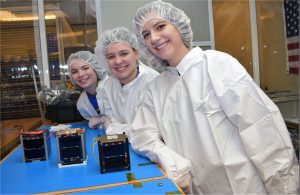
Three student members of the Virginia CubeSat Consortium show off the three program’s 3 CubeSats

Unfortunately,  communications were only established with one of the three spacecraft. In the above video, McPherson discusses the communications problems.

** Staten Longo – I Am NASA Virginia Space Grant – Participation in the Virginia CubeSat program led to a career in aerospace

Staten Longo, graduate of the University of Virginia, participated in the Virginia Aerospace Science and Technology Scholars (VASTS) program as a high school student and then served as a program manager for the Virginia Cubesat Constellation project. This ‘I am NASA Space Grant’ video

** A CubeSat overview from Fiske Planetarium:

** AMSAT news on student and amateur CubeSat/smallsat projects: ANS-082 AMSAT News Service Special Bulletin

  • ARISS Responds to the COVID-19 Pandemic
  • New TQSL Version Provides Better LoTW Rover Support
  • AMSAT-EA Registering SanoSat-1 for AMSAT Nepal
  • ESA and LibreSpace Report: SDR’s for Small Satellites
  • Brazil Holds 430 and 1240 MHz Hearing
  • Upcoming Satellite Operations
  • ARISS News
  • Hamfests, Conventions, Maker Faires, and Other Events
  • Satellite Shorts from All Over

General CubeSat/SmallSat info:

  • Exolaunch signs agreement with SpaceX for launch of small satellites on a Falcon 9 rideshare mission – Exolaunch – “Exolaunch, a German rideshare launch and deployment solutions provider, signed a Launch Services Agreement with SpaceX to launch small satellites on a Falcon 9 as part of SpaceX’s SmallSat Rideshare Program. Under the launch contract, Exolaunch accommodates multiple microsatellites and cubesats on the first Falcon 9 smallsat-dedicated rideshare mission to sun-synchronous orbit, targeted for launch in December 2020.

    Exolaunch will provide comprehensive rideshare mission management, deployment and integration services for its customers participating in this launch. Core customers who signed up for this launch through Exolaunch’s services will be announced in the coming weeks.”

  • In Response to Covid-19, Space Dynamics Lab Satellite Operators “Fly” Small Satellites from Home – Space Dynamics Laboratory (SDL)/ Utah State Univ.  – “NASA’s Hyper-Angular Rainbow Polarimeter CubeSat and the Compact Infrared Radiometer in Space instrument small satellite, known as HARP and CIRiS respectively, are two science satellites that are now being commanded by SDL satellite operators outside of SDL facilities.”

** Cubesats, Hubble and Apollo 13 Trouble | Podcasts | Naked Scientists

Space Boffins Richard Hollingham and Sue Nelson celebrate Hubble’s 30th birthday with Shuttle astronaut Kathy Sullivan, whose mission deployed the space telescope, and hear from NASA engineer Jerry Woodfill about his warning alarm system for Apollo 13, celebrating its 50th lucky escape anniversary. The Space Boffins also meet Craig Clark, founder of AAC Clyde Space, and are shown around the cubesat pioneer’s HQ in Glasgow. All this with bonus space-themed added music….

== Amazon Ad ==

Introduction to CubeSat Technology and Subsystem:
Orbit Design, Debris Impact, and Orbital Decay Prediction

Make your own LEctenna like that used on the ISS to demo power-beaming

The Naval Research Lab (NRL) sent a simple device to the International Space Station (ISS) to demonstrate the reception of a Wi-FI signal and converting it to enough power to light up a LED: NRL power-beaming demonstrated on International Space Station – Naval Research Laboratory (NRL)

International Space Station astronaut Jessica Meir completed the first U.S. Naval Research Laboratory power-beaming demonstration [see video below] in orbit February 12, 2020, using relatively simple components suitable for STEM activities.

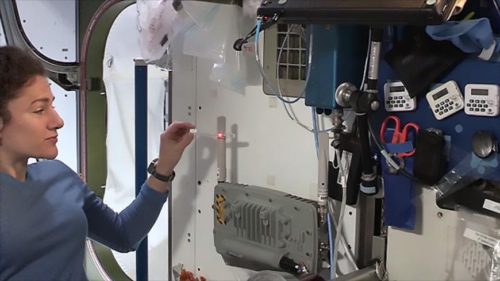
Meir showed how NRL’s LEctenna™, a light-emitting rectifying antenna, converted a wireless network signal, similar to home networks, into electric power. While the current generated and light emitted was a small amount, the setup proved the concept in space.

“While this is a cool device on its own, our collaborators [at NRL] have begun investigating the wide range of possible applications for this technology in the real world,” Meir said. “We could find ways to wirelessly charge our mobile devices or remotely power drones. But one of the most interesting applications that they’re looking into is space-based solar panel arrays.”

Led by electronics engineer Paul Jaffe, researchers at NRL are investigating space solar and power beaming as a potential source of clean energy for a variety of military and civilian applications.

Space solar is simply using solar panels in space to harvest the sun’s energy, where collecting rays would be unaffected by clouds or other interference. Power beaming would send the collected energy down to Earth, where it would be converted back – just like LEctenna™ did – to usable energy.

“Some people might know about power beaming, such as for their toothbrush, or putting their phones on a charging pad,” Jaffe said. “What’s really exciting about it though, is that power can be sent wirelessly over much larger distances.”

“NASA astronaut Jessica Meir demonstrates how the LEctenna™, a light-emitting rectifying antenna constructed by the U.S. Naval Research Laboratory, converts electromagnetic waves into electric current on the International Space Station. Similar technology could be used on the Earth’s surface to convert electromagnetic waves beamed from space-based solar arrays.” Credits NASA via NRL

The LEctenna™ demonstration proved the concept of power beaming in space, but was primarily a STEM project to inspire the next generation of innovators launched by the Department of Defense Space Test Program mission. Its simple, relatively low-cost design to convert electromagnetic waves to electric power can be replicated by students.

“LEctenna™ was a cool demonstration to raise awareness,” said Elias Wilcoski, an NRL research physicist. “We want to show students that this is technology that they can do themselves. If we can get them excited about it and space solar and power beaming, we can help bring more scientists and engineers into the fields to ensure the viability of our future.”

Here is a brief tutorial on making your own LEctenna:

Want to be able to see invisible electromagnetic waves? It’s easy to make your own LEctenna in just a few minutes to allow you to do just that! NRL’s Elias Wilcoski shows you how.

Parts used in this video:
An RF through-hole Schottky Diode (1N5711)
A through-hole LED
A plastic test tube

== Amazon Ad ==

The High Frontier: An Easier Way

Student and amateur CubeSat news roundup – Apr.8.2020

A sampling of recent articles, press releases, etc. related to student and amateur CubeSat / SmallSat projects and programs (find previous smallsat roundups here):

** Cubesat program at Cal Poly, San Luis Obispo, wins grants from NASA lunar exploration technology program: NASA Small Satellite Program Selects Cal Poly to Help Develop New Technology for Lunar Exploration Missions – Cal Poly News

Cal Poly will participate in a pair of two-year projects, both in collaboration with NASA’s Jet Propulsion Laboratory in Pasadena, California. The grants are valued at $200,000. The first, under the SmallSat Propulsion for Lunar Missions area, will team Cal Poly with UC Irvine for a project titled “Variable Specific Impulse Electrospray Thrusters for SmallSat Propulsion.”

The project will build on existing propulsion technology that uses electrostatic charges to propel liquid droplets to generate thrust. It will further develop and test a more-versatile system capable of operating in either a high-thrust mode when needed, or more efficient low-thrust mode to conserve fuel and save weight. This technology will add mission flexibility to electrospray propulsion systems while keeping within the size suited constraints of small spacecraft.

“Cal Poly will be providing a design for a CubeSat to test the thrusters, including an electrical subsystem that is capable of powering the thrusters,” Bellardo said. “UCI will be focusing more on the thruster side. Cal Poly will be focused on the spacecraft side.”

The second proposal, under NASA’s Advanced Electrical Power Subsystem and Thermal Management Technology area, pairs Cal Poly with Cal State Los Angeles for a project titled “An Additively Manufactured Deployable Radiator with Oscillating Heat Pipes to Enable High Power Lunar CubeSats.”

Compact CubeSats do not efficiently dissipate heat, yet lunar missions will demand even more electrical power, which produces heat as a byproduct that could damage core components of a small satellite. The equipment needed for longer duration missions far from Earth orbit includes more powerful radio transmitters while simultaneously dealing with the harsh cislunar thermal environment. The grant will fund the development of a deployable radiator with flexible oscillating heat pipes to provide more efficient heat transfer than traditional thermal straps.

“The more power a spacecraft needs, the more heat gets generated — both during power generation and consumption,” Bellardo said. “Radiators are part of the solution to keeping the spacecraft cooler. The technology is applicable to other small spacecraft as well.”

More about the Cal Poly projects and about lunar technology projects at other universities selected by NASA: NASA Selects Universities for Collaborative Development | NASA.

** AMSAT news on student and amateur CubeSat/smallsat projects: ANS-096 AMSAT News Service Special Bulletin

  • Ham Radio Book Featured in “Story Time From Space” on ISS
  • NO-104 / PSAT2 Status
  • VUCC Standings for April 2020
  • AMSAT Awards During Stay-at-Home Orders
  • Radio Amateurs of Canada Offers New Online Amateur Radio Course
  • AMSAT South Africa Reports Good Progress with AfriCUBE
  • ARISS News
  • Hamfests, Conventions, Maker Faires, and Other Events
  • Upcoming Satellite Operations
  • Satellite Shorts from All Over

General CubeSat/SmallSat info:

** Exploring CubeSats!MIT Full STEAM Ahead

** SunRISE – NASA’s new mission to study giant space weather stormsYour Space Journey

NASA has just selected a new mission to study how the Sun generates and releases giant space weather storms into space. The new mission is called SunRISE, which stands for Sun Radio Interferometer Space Experiment. This mission will ultimately help protect astronauts traveling to the Moon and Mars by providing better information on how the Sun’s radiation affects the space environment they must travel through. The principal investigator of SunRISE, Dr. Justin Kasper, joins us to discuss this incredible mission. Justin is also a professor of Space Science & Engineering for the University of Michigan, where he designs sensors for spacecraft that explore extreme environments in space from the surface of the Sun to the outer edges of the solar system. SunRISE is an array of six CubeSats operating as one very large radio telescope. NASA has awarded $62.6 million to design, build and launch SunRISE by no earlier than July 1, 2023.

** 2019 IAF Global Technical Symposium – Small Satellite MissionsIAF Young Professionals

The Small Satellite Missions Global Technical Session (GTS) is collaboration between the International Academy of Astronautics (IAA) Small Satellite Missions Symposium and the International Astronautical Federation (IAF) Workforce Development/Young Professionals Programme Committee. This session is unique in that it allows for sharing of information on a global scale with presenters and audience both at the IAC venue and online at their home/work/university locations.

== Amazon Ad ==

Introduction to CubeSat Technology and Subsystem:
Orbit Design, Debris Impact, and Orbital Decay Prediction