Category Archives: In Space Infrastructure

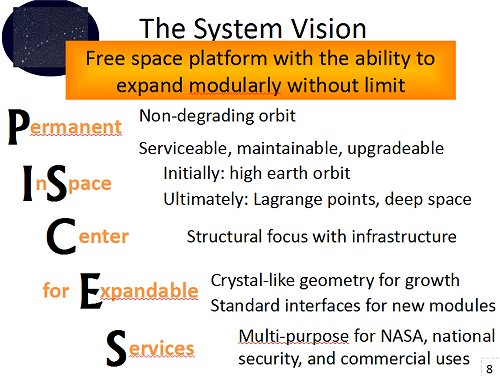
FISO presentation: PISCES: Settling the near space frontier – Doris Hamill, NASA LaRC

The latest presentation to the Future In-Space Operations (FISO) study group is now posted in the FISO Working Group Presentations Archive. Both slides (pptx) and audio (mp3) are available for the talk, PISCES: Settling the Near Space Frontier, Doris Hamill, NASA LaRC – June 5, 2013.
Hamill_PISCES_Vision

FISO: METERON and its related robotics Technologies at ESA Telerobotics & Haptics Lab

The latest presentation to the Future In-Space Operations (FISO) study group is now posted in the FISO Working Group Presentations Archive. The  slides and videos (zip) and audio (mp3) are available for the talk, METERON and its Related Robotics Technologies at ESA Telerobotics & Haptics Lab – Part 2,  André Schiele , Delft Univ of Technology & ESA/ESTEC – May 29, 2013.

A zip file is used this time since the

presentation by André Schiele includes a pdf, and a set of 8 short mp4 videos. When you open the pdf, you will be pointed to these videos (by number, as in “Video1 – EXARM / PA10 Telerobotics Workcell”) which you can open by clicking on the mp4 file by that name, OR by calling them up by clicking on the YouTube link on the page, if you happen to be internet-connected. These videos will NOT automatically launch in the pdf document.

Here are a couple of the videos from the TeleroboticsLab YouTube channel:

FISO: Environmental Control & Life Support Systems, Status & Future Development

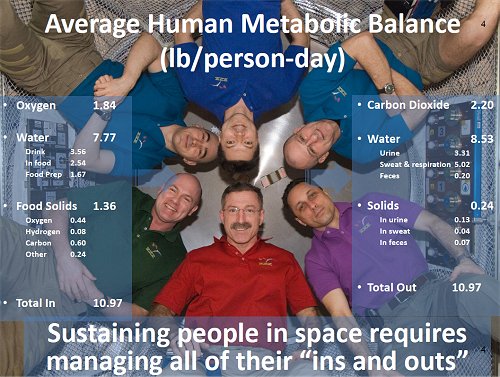
The latest presentation to the Future In-Space Operations (FISO) study group is now posted in the FISO Working Group Presentations Archive. Both slides (pdf) and audio (mp3) are available for the talk, Environmental Control and Life Support Systems: Current Status and Future Development, Robert Bagdigian & Robyn Carrasquillo – NASA MSFC – May.22.2013.
ELCSS_500x377

Video: NASA Lunabotics Mining Competition at KSC

NASA is holding the Lunabotics Mining Competition at the Kennedy Space Center Visitor Complex this week.

The Lunabotics Mining Competition is a university-level competition designed to engage and retain students in science, technology, engineering and mathematics (STEM). There is particular relevance to NASA’s recently announced mission to find an asteroid by 2016 and then bring it to Cis-Lunar space, the technology concepts developed by the university teams for this competition conceivably could be used to mine resources on Asteroids as well as Mars. Robotic miners, just like these, will allow us to take samples at the returned Asteroid and give us valuable information to prepare for other deep space missions.

The challenge is for students to design and build a remote controlled or autonomous excavator that can collect and deposit a minimum of 10 kilograms of regolith simulant (aggregate) within 10 minutes. Regolith exists not only on Earth’s moon, but also on most planetary bodies such as Asteroids, Moons of Mars and Mars itself.

The complexities of the challenge include the abrasive characteristics of the simulant, the weight and size limitations of the robot, and the ability to control it from a remote control center. The scoring for the mining category will require teams to consider a number of design operation factors such as dust tolerance and projection, communications, vehicle mass, energy/power required, and full autonomy.

Here is a video in which the camera for the first half wanders around the event hall showing the student teams preparing their lunar mining robots for the contest. The second half shows the robots in the lunar simulant arena:

ESA conference on space debris finds consensus on need to act

An ESA sponsored conference on space debris finds a consensus on the need to act on the problem:

Global experts agree action needed on space debris

25 April 2013 There is an urgent need to remove orbiting space debris and to fly satellites in the future without creating new fragments, Europe’s largest-ever space-debris conference announced today.

The findings from the 6th European Conference on Space Debris were released during the concluding press briefing at ESA’s European Space Operations Centre in Darmstadt, Germany.

Future space missions must be sustainable, including safe disposal when they are completed. The current levels mean that we must soon begin removing debris from orbit, with research and development urgently needed for pilot ‘cleaning’ missions.

Watch media briefing: Findings of the 6th European Conference on Space Debris, 25 April 2013, ESA/ESOC

The removal of space debris is an environmental problem of global dimensions that must be assessed in an international context, including the UN.

These results were presented to over 350 worldwide participants representing almost all the major national space agencies, industry, governments, academia and research institutes.

“There is a wide and strong expert consensus on the pressing need to act now to begin debris removal activities,” says Heiner Klinkrad, Head of ESA’s Space Debris Office.

Loading…


Expert consensus on the need to act

“There is a wide and strong expert consensus on the pressing need to act now to begin debris removal activities,” says Heiner Klinkrad, Head of ESA’s Space Debris Office.

Future debris density at poles with and without active debris removal

Future debris density at poles with and without active debris removal

“Our understanding of the growing space debris problem can be compared with our understanding of the need to address Earth’s changing climate some 20 years ago.”

There was wide agreement that the continuing growth in space debris poses an increasing threat to economically and scientifically vital orbital regions.

In addition to providing daily benefits to citizens and economies, today’s satellite infrastructure has immense value. The replacement cost for the approximately 1000 active satellites in orbit today is estimated to be around €100 billion. The impact on the overall economy of losing these satellites would be several orders of magnitude higher. Society would be severely damaged.

“While measures against further debris creation and actively deorbiting defunct satellites are technically demanding and potentially costly, there is no alternative to protect space as a valuable resource for our critical satellite infrastructure,” he notes.

“Their direct costs and the costs of losing them will by far exceed the cost of remedial activities.”

The findings were delivered by senior researchers and specialists from the DLR German Aerospace Center, France’s CNES space agency, Italy’s ASI space agency, the UK Space Agency, the Committee on Space Research, the International Academy of Astronautics and ESA.

ESA accelerates space debris research and development

Satellite operators worldwide, including those flying telecom, weather, navigation, broadcast and climate-monitoring missions, are now focusing their efforts on controlling space debris.

The ultimate goal is to prevent a cascade of self-sustaining collisions from setting in over the next few decades.

ESA, as a space technology and operations agency, has identified the development of active removal technologies as a strategic goal.

A number of long-standing space debris-related research activities are being reinforced by the Agency. This includes improving our understanding of the debris environment and its evolution using novel, sensitive measurements and improved modelling of debris sources.

The new Clean Space initiative includes maturing technology to approach, capture and deorbit targets – a mission is already under study.

Clean Space will also develop techniques to mitigate the problem, such as passive and active deorbiting devices and the means to ‘passivate’ retiring satellites.

====

Here’s a EuroNews report on the space debris issue: