Category Archives: Astronomy

Space sciences roundup – April.24.2019

A sampling of recent articles, videos, and images from space-related science news items:

** The InSight Mars Lander detects its first Marsquake using the seismometer set on the ground next to the spacecraft:

From NASA:

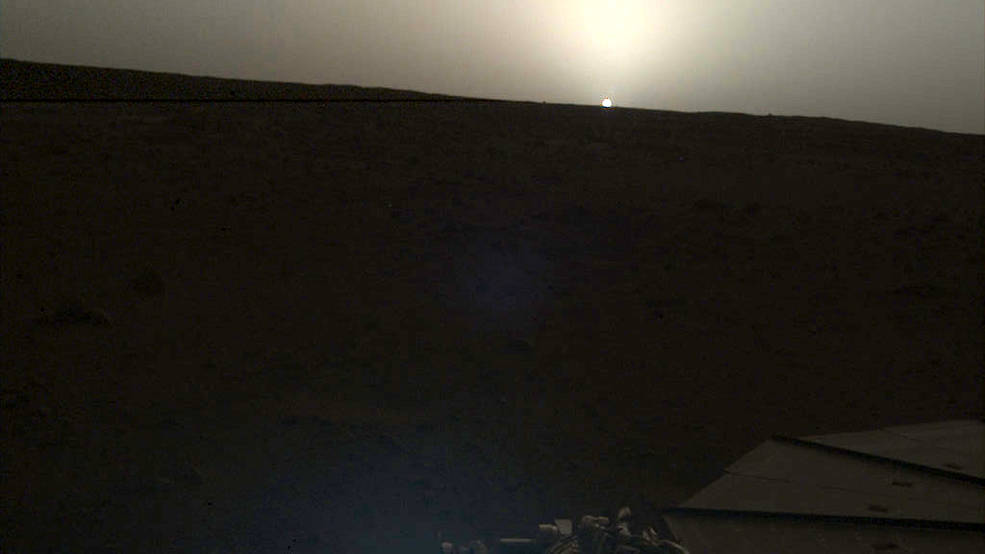
NASA’s Mars InSight lander has measured and recorded for the first time ever a likely “marsquake.”

The faint seismic signal, detected by the lander’s Seismic Experiment for Interior Structure (SEIS) instrument, was recorded on April 6, the lander’s 128th Martian day, or sol. This is the first recorded trembling that appears to have come from inside the planet, as opposed to being caused by forces above the surface, such as wind. Scientists still are examining the data to determine the exact cause of the signal.

This image, taken March 19, 2019 by a camera on NASA’s Mars InSight lander, shows the rover’s domed Wind and Thermal Shield, which covers its seismometer, the Seismic Experiment for Interior Structure, and the Martian surface in the background. Credits: NASA/JPL-Caltech

The seismometer signals can be converted to audio:

This video and audio illustrates a seismic event detected by NASA’s Mars InSight rover on April 6, 2019, the 128th Martian day, or sol, of the mission. Three distinct kinds of sounds can be heard, all of them detected as ground vibrations by the spacecraft’s seismometer, called the Seismic Experiment for Interior Structure (SEIS): noise from Martian wind, the seismic event itself, and the spacecraft’s robotic arm as it moves to take pictures. Credits: NASA/JPL-Caltech/CNES/IPGP/Imperial College London.

The new seismic event was too small to provide solid data on the Martian interior, which is one of InSight’s main objectives. The Martian surface is extremely quiet, allowing SEIS, InSight’s specially designed seismometer, to pick up faint rumbles. In contrast, Earth’s surface is quivering constantly from seismic noise created by oceans and weather. An event of this size in Southern California would be lost among dozens of tiny crackles that occur every day.

“The Martian Sol 128 event is exciting because its size and longer duration fit the profile of moonquakes detected on the lunar surface during the Apollo missions,” said Lori Glaze, Planetary Science Division director at NASA Headquarters.

Note that the signals’ frequencies “have been sped up by a factor of 60” since otherwise the vibrations would not be audible to the human ear.

** More quakes in the Cosmos are being detected more quickly with newly upgraded gravity wave observatories in the US and Italy. The sensitivities of the detectors have been increased to a level such that signals picked up at the LIGO (Laser Interferometer Gravitational-Wave Observatory) installations in Louisiana, and Washington plus the European Virgo detector in Italy will result in roughly one gravity wave detection per week. A new public alert system will let everyone know when a detection occurs:

From PSU:

Two new probable gravitational waves — ripples in the fabric of spacetime caused by cataclysmic cosmic events and first predicted by Albert Einstein over 100 years ago — have been detected by the Laser Interferometer Gravitational-Wave Observatory (LIGO) and the Virgo observatory in Italy in the first weeks after the detectors were updated. The source of both waves is believed to be the merging of a pair of black holes.

LIGO announced the discovery of the first new gravitational wave in its first-ever open public alert on April 8, and quickly followed up with a second announcement on April 12. LIGO detected the first-ever gravitational wave in September 2015, and announced the discovery in February 2016. Ten more gravitational waves were detected over the following three years, but with updates to LIGO and Virgo, scientists expect to see as many as one per week, which so far has proven true.

Updates to LIGO and Virgo have combined to increase its sensitivity by about 40 percent over its last run. Additionally, with this third observing run, LIGO and Virgo transitioned to a system whereby they alert the astronomy community almost immediately of a potential gravitational wave detection. This allows electromagnetic telescopes (X-ray, UV, optical, radio) to search for and hopefully find an electromagnetic signal from the same source, which can be key to understanding the dynamics of the event.

“The region of sky believed to contain the source of the gravitational wave detected on April 8, 2019. The area spans 387 square degrees, equivalent to nearly 2000 full-Moons, roughly meandering through the constellations Cassiopeia, Lacerta, Andromeda, and Cepheus in the northern hemisphere. IMAGE: LIGO/Caltech/MIT”

… The source of both gravitational waves is suspected to be compact binary mergers — the collision of two massive and incredibly dense cosmic objects into one another. Compact binary mergers can occur between two neutron stars, two black holes, or a neutron star and a black hole. Each of these different types of mergers create gravitational waves with strikingly different signals, so the LIGO team can identify the type of event that created the gravitational waves.

** Huge gallery of Rosetta mission images of comet 67P/Churyumov-Gerasimenko is now available on line at the OSIRIS Image Archive:

The ESA release says the image shown below

… was taken on 6 October 2014 from a distance of 18.6 km to the comet. This is just one of almost 70 000 images taken with Rosetta’s high-resolution imaging system OSIRIS that are now available via a new online and mobile-friendly ‘comet viewer’ created in a joint project with the Department of Information and Communication at Flensburg University of Applied Sciences, and the Max Planck Institute for Solar System Research, who lead the OSIRIS team.

A feature of  Comet 67P/Churyumov-Gerasimenko: “Seen from afar, the comet is usually likened to a duck in shape, but in this enchanting close-up view its profile resembles that of a cat’s face seen side-on. The two ‘ears’ of the cat make up the twin peaks either side of the ‘C. Alexander Gate’ – named for US Rosetta Project Scientist Claudia Alexander who passed away in July 2015. These impressive cliffs lie at the border between the Serqet and Anuket regions on the comet’s head.”

The image viewer hosts the full archive, but also has subsections organising image sets into themes: for example, images showing towering cliffs and bizarre cracks on the comet surface, or those focusing on spectacular dust fountains as the comet launched gas and dust jets into space as its surface ices were warmed as it came closer to the Sun on its orbit.

The collection of OSIRIS images captured the farewell of lander Philae as it dropped towards the surface of the comet, and later, towards the end of the mission, the feverish search for the hidden robot.

Within the new comet viewer, each of the nearly 70 000 images is supplemented with the date on which it was taken, the distance to the comet, and a short accompanying text briefly describing what is seen in the image. The images can be downloaded in full resolution and can also be directly shared to Twitter and Facebook.

** The Southern Crab Nebula shines in a new Hubble image marking 29 years in orbit for the space telescope: Hubble Celebrates its 29th Birthday with Unrivaled View of the Southern Crab Nebula | ESA/Hubble

This incredible image of the hourglass-shaped Southern Crab Nebula was taken to mark the NASA/ESA Hubble Space Telescope’s 29th anniversary in space. The nebula, created by a binary star system, is one of the many objects that Hubble has demystified throughout its productive life. This new image adds to our understanding of the nebula and demonstrates the telescope’s continued capabilities.

The Southern Crab Nebula — Hubble’s 29th anniversary image.

On 24 April 1990, the NASA/ESA Hubble Space Telescope was launched on the space shuttle Discovery. It has since revolutionised how astronomers and the general public see the Universe. The images it provides are spectacular from both a scientific and a purely aesthetic point of view.

Each year the telescope dedicates a small portion of its precious observing time to take a special anniversary image, focused on capturing particularly beautiful and meaningful objects. This year’s image is the Southern Crab Nebula, and it is no exception [1].

This peculiar nebula, which exhibits nested hourglass-shaped structures, has been created by the interaction between a pair of stars at its centre. The unequal pair consists of a red giant and a white dwarf. The red giant is shedding its outer layers in the last phase of its life before it too lives out its final years as a white dwarf. Some of the red giant’s ejected material is attracted by the gravity of its companion.

More highlights from Hubble’s 29 years in orbit:

** Latest Mars updates from Bob Zimmerman:

Comparison of an area near Olympus Mars before (left) and after (right) the global dust storm of 2018. Credits: Bob Zimmerman & HiRISE camera on NASA Mars Reconnaissance Orbiter (MRO)
White streaks atop avalanche debris on this Mars slope appear to be water frost. Credits: Bob Zimmerman + HiRISE camera on NASA Mars Reconnaissance Orbiter (MRO)

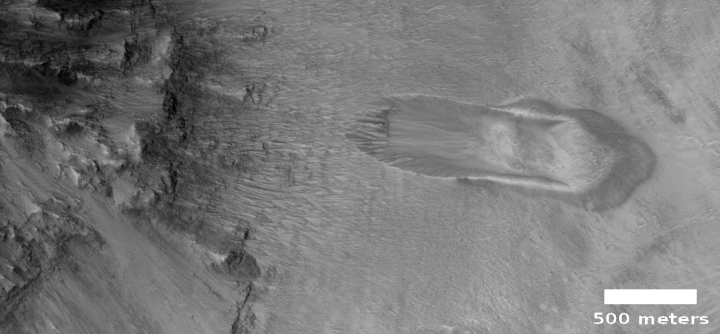
Check out a new MRO avalanche image released today by NASA: Landslides in Mars’ Cerberus Fossae | NASA.

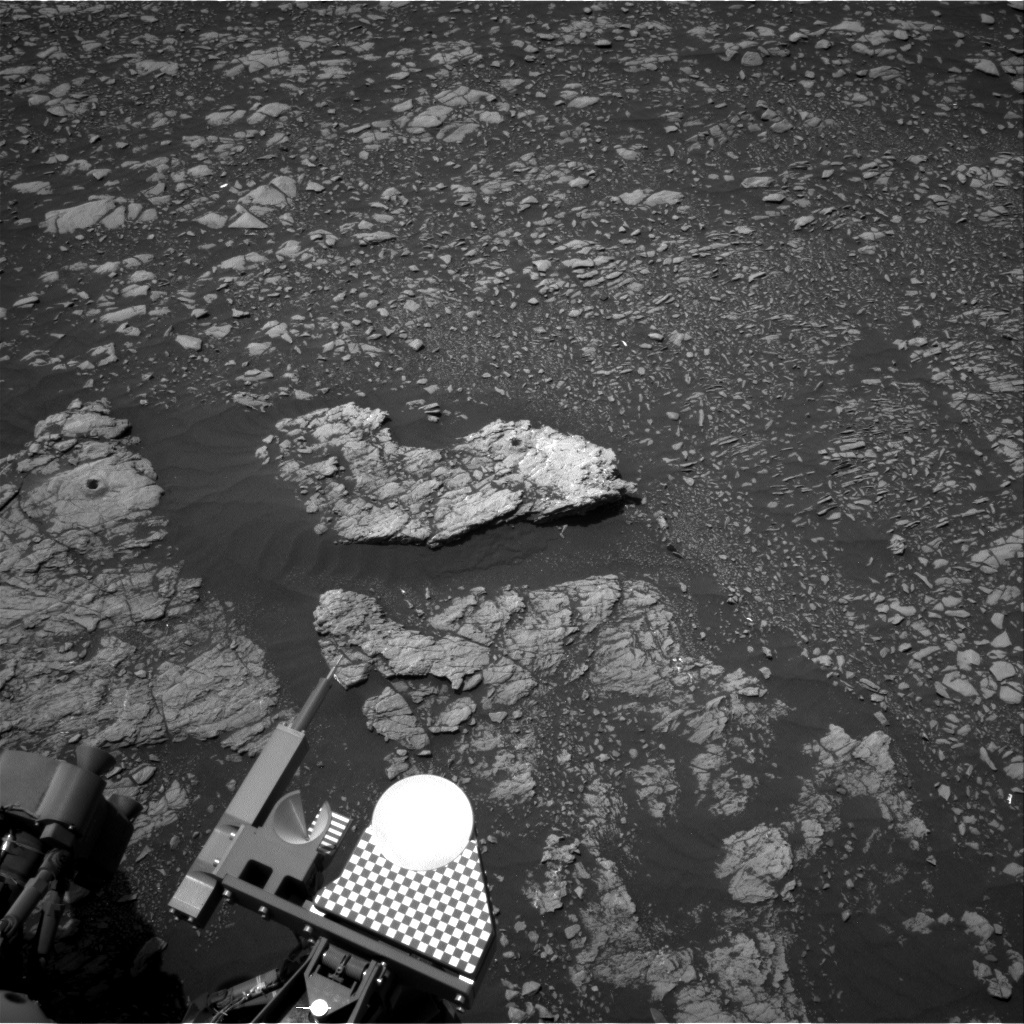
The Mast Camera, or Mastcam, on NASA’s Curiosity Mars rover captured this image after “it drilled a rock nicknamed “Aberlady,” on Saturday, April 6, 2019 (the 2,370th Martian day, or sol, of the mission). The rock and others nearby appear to have moved when the drill was retracted. This was the first time Curiosity has drilled in the long-awaited “clay-bearing unit.” See also a GIF animation showing before and after the drilling. Credits: NASA JPL
  • How fast do things change on Mars? – A comparison of Mars Reconnaissance Orbiter images of a dune-like feature on Mars taken 12 years apart show some differences. “Overall, however, not much is different. Though dunes definitely change on Mars, they do so much more slowly than on Earth. And in some cases what look like dunes are not really dunes at all, but a form of cemented sandstone, exhibiting even fewer changes over long time spans.”

** Some space sciences webcasts:

>> Weekly Space Hangout: Apr 17, 2019 – Dr. Dorothy Oehler Talks “Is there Methane on Mars?”

>> SETI Institute: Tiny Neptune Moon Spotted by Hubble May Have Broken from Larger Moon

>> SETI Institute: Mars Exploration Rovers: Spirit and Opportunity with Nathalie Cabrol

>> SETI Institute: Turkish Meteorite Traced to Impact Crater on Asteroid Vesta

====

Archaeology from Space: How the Future Shapes Our Past

Videos: TMRO Orbit 12.11 & 12.12 – James Webb Space Telescope’s first images & APL’s Interstellar Probe

A recent episode of the TMRO.tv Space show: Why JWST’s first images will just be 18 fuzzy blobs

This week we are joined by NASA’s James Webb Space Telescope Program Scientist Dr. Eric Smith. We talk about the most ambitious space telescope project humans have ever undertaken, and why when we get the first images back it will likely just be 18 fuzzy blobs.

** And here is another: APL’s Interstellar Probe

The always energetic and information powerhouse Dr. Kirby Runyon joins us to talk about New Horizons, Yuris Night and announces the Johns Hopkins University Applied Physics Lab Interstellar Probe. It’s a really fun and exciting interview, and we had a bit of stuff we missed in After Dark so we left a bit of that in there at the end as well.

** A space news report: RocketLab announces Photon, ISS Spacewalks and the weight of the galaxy!

This week in Space News from TMRO we have: Rocket Lab announces their Photon satellite system US Spacewalk 53, Space Suit Mixup Milky Way Weight There were 2 Soyuz launches in Space Traffic and of course the Space Weather Woman Dr. Tamitha Skov brings is our Space Weather.

====

The Space Barons: Elon Musk, Jeff Bezos, and the Quest to Colonize the Cosmos

Space sciences roundup – April.10.2019

A sampling of recent articles, videos, and images from space related science news:

** Radio telescope array images a black hole for the first time. This is the big news not just of the week but for 2019: First Image of a Black Hole | ESO

The Event Horizon Telescope (EHT) — a planet-scale array of eight ground-based radio telescopes forged through international collaboration — was designed to capture images of a black hole. In coordinated press conferences across the globe, EHT researchers revealed that they succeeded, unveiling the first direct visual evidence of the supermassive black hole in the centre of Messier 87 and its shadow.

The shadow of a black hole seen here is the closest we can come to an image of the black hole itself, a completely dark object from which light cannot escape. The black hole’s boundary — the event horizon from which the EHT takes its name — is around 2.5 times smaller than the shadow it casts and measures just under 40 billion km across. While this may sound large, this ring is only about 40 microarcseconds across — equivalent to measuring the length of a credit card on the surface of the Moon.

Although the telescopes making up the EHT are not physically connected, they are able to synchronize their recorded data with atomic clocks — hydrogen masers — which precisely time their observations. These observations were collected at a wavelength of 1.3 mm during a 2017 global campaign. Each telescope of the EHT produced enormous amounts of data – roughly 350 terabytes per day – which was stored on high-performance helium-filled hard drives. These data were flown to highly specialised supercomputers — known as correlators — at the Max Planck Institute for Radio Astronomy and MIT Haystack Observatory to be combined. They were then painstakingly converted into an image using novel computational tools developed by the collaboration.

Chandra X-ray Observatory close-up of the core of the M87 galaxy. Credits: NASA/CXC/Villanova University/J. Neilsen

More at:

** SpaceIL Beresheet spacecraft will land on the Moon tomorrow April 11th, hopefully softly. The Israeli privately developed vehicle made orbit corrections this past week that brought the vehicle into the final close lunar orbit in preparation for the landing firing: Find updates at Israel To The Moon (@TeamSpaceIL) | Twitter.

Resources for the mission:

There will be a webcast of the landing. The estimated landing times:

  • 22:00 – 23:00 Israel
  • 19:00 – 20:00 UTC
  • 15:00 – 16:00 EDT
  • 12:00 – 13:00 PDT

Some info on the landing site: Beresheet lunar landing site revealed 3 April 2019 – Weizmann Institute of Science.

** Launch of the Indian Chandrayaan 2 lunar lander/rover mission will be delayed somewhat due to some minor damage during a test: Chandrayaan 2: Vikram hurt during practice, puts Chandrayaan-2 on bench – Times of India

Vikram, the Lander on India’s ambitious mission that envisages to land a probe on Moon, has suffered minor injuries in two of its legs during a test late February, putting Chandrayaan-2 on the bench at least until May. But the need to find the most suitable launch window could see the mission take off only in the second half of the year.

A source in the know, said: “The rover and orbiter are in good health and tests met all the parameters. However, after the ‘Lander Drop Test’, we found that Vikram (the lander) needed to be strengthened in its legs. Prima facie, it appears that not all parameters were set correctly before the test, it could also be that the additional mass—a result of the new configuration—caused the problem.”

** Curiosity captures Demos and Phobos eclipses of the Sun: Curiosity Captured Two Solar Eclipses on Mars | NASA

When NASA’s Curiosity Mars rover landed in 2012, it brought along eclipse glasses. The solar filters on its Mast Camera (Mastcam) allow it to stare directly at the Sun. Over the past few weeks, Curiosity has been putting them to good use by sending back some spectacular imagery of solar eclipses caused by Phobos and Deimos, Mars’ two moons.

Phobos, which is as wide as 16 miles (26 kilometers) across, was imaged on March 26, 2019 (the 2,359th sol, or Martian day, of Curiosity’s mission); Deimos, which is as wide as 10 miles (16 kilometers) across, was photographed on March 17, 2019 (Sol 2350). Phobos doesn’t completely cover the Sun, so it would be considered an annular eclipse. Because Deimos is so small compared to the disk of the Sun, scientists would say it’s transiting the Sun.

** More Martian image commentaries from Bob Zimmerman:

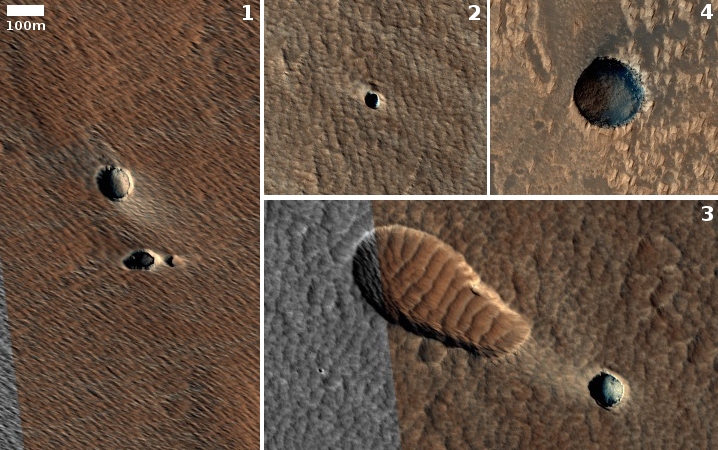
  • A dance of dust devils – “Many of my image posts about Mars have emphasized how slowly things change there. This post will highlight the exact opposite. When it comes to dust devils, it appears they can leave their trace frequently and often, and for some reason they seem to also favor specific locations.
  • Monitoring the ice scarps on Mars for changes – “Monitoring these scraps will be crucial for future exploration. The ice here is very readily available, as it is exposed and should be relatively easy to access. Moreover, tracking might tell us whether it will be easier to get at this ice from the top of the cliff by drilling down, or approach it from the bottom. Some of the ice bands in these scarps was very close to the surface at the top of the cliff.
  • A decade of changes at the Martian south pole – “The mystery here is that these images were both taken at almost the same moment in the late southern summer, though about five Martian years apart. Why should the white areas have shrunk? We would expect a reduction from winter to summer, but these were both taken in summer. While it would make sense to see changes, with some areas growing and others shrinking, we should expect to see about the same amount of white area.
Dust devil trails in southern highlands of Mars. Credits: Mars Reconnaissance Orbiter HiRISE camera.

** Martian soil studies may bring medical spinoff benefits: Martian soil detox could lead to new medicines – ESA

“During their experiments they noticed that when bacteria grew in partial gravity, they became stressed as they accumulated waste around them that they couldn’t get rid of. This holds great potential because when microbes belonging to the Streptomyces family become stressed, they usually start making antibiotics,” adds Prof. Claessen.

“Seventy percent of all the antibiotics humans use are derived from Streptomyces bacteria and we know they have the potential to produce even more. Using the RPM to stress them in new ways may help us to find ones we’ve never seen before.”

** Hayabusa2 successfully fired a projectile into Ryuga to investigate the asteorid’s surface structure:

Debris from the impact of the projectile shot from Hayabusa2 can be seen in this cropped section of an image taken by the DCAM3 free-flying imager. Hayabusa2 went to the far side of Ryuga to wait for the debris to settle back to the surface.


Here is the full image:

** Parker Solar Probe makes another close pass of the Sun

From the Parker Solar Probe mission:

Parker Solar Probe has successfully completed its second close approach to the Sun, called perihelion, and is now entering the outbound phase of its second solar orbit. At 6:40 p.m. EDT on April 4, 2019, the spacecraft passed within 15 million miles of our star, tying its distance record as the closest spacecraft ever to the Sun; Parker Solar Probe was traveling at 213,200 miles per hour during this perihelion.

The Parker Solar Probe mission team at the Johns Hopkins Applied Physics Laboratory in Laurel, Maryland scheduled a contact with the spacecraft via the Deep Space Network for four hours around the perihelion and monitored the health of the spacecraft throughout this critical part of the encounter. Parker Solar Probe sent back beacon status “A” throughout its second perihelion, indicating that the spacecraft is operating well and all instruments are collecting science data.

“The spacecraft is performing as designed, and it was great to be able to track it during this entire perihelion,” said APL’s Nickalaus Pinkine, Parker Solar Probe mission operations manager. “We’re looking forward to getting the science data down from this encounter in the coming weeks so the science teams can continue to explore the mysteries of the corona and the Sun.”

Parker Solar Probe montage. Credit: NASA/Johns Hopkins APL/Steve Gribben

** Will the Sun remain quiet or not? Bob Zimmerman reports on the latest sunspot activity and on predictions for the next phase of the solar cycle: Sunspot update March 2019: An upcoming Grand Minimum? | Behind The Black

Even though we are now deep into the beginning of what might become the first grand minimum in sunspot activity since the invention of the telescope, that does not mean the Sun has as yet stopped producing sunspots. Yesterday NOAA released its the monthly update of its tracking of the solar cycle, adding sunspot activity for March 2019 to its graph. Below is that graph, annotated by me to give it some context.

It shows the Sun with a slight burst in activity in March, suggesting that though we are now in the solar minimum that minimum still has the ability to produce sunspots.

** Sounding rockets produced a  spectacular sky show after releasing tracer gases. The goal of the NASA project is to help better understand the flow of charged particles in the earths magnetic fields at the poles: Two rockets dropped tracers into the northern lights and the result was glorious | Ars Technica

Late Friday night, two sounding rockets launched from a small spaceport in northern Norway. The two skinny rockets soared to an altitude of 320km, and along the way each released a visible gas intended to disperse through and illuminate conditions inside the aurora borealis. Some of the resulting images were stunning.

This NASA-funded AZURE mission, which stands for Auroral Zone Upwelling Rocket Experiment, is one of a series of sounding rocket missions launching over the next two years as part of an international collaboration known as “The Grand Challenge Initiative – Cusp.” The goal of these flights is to study the region where Earth’s magnetic field lines bend down into the atmosphere, and particles from space mix with those from the planet.

See also Sounding Rocket Mission Will Trace Auroral Winds | NASA.

April 8, 2019: The Auroral Zone Upwelling Rocket Experiment or AZURE mission was successfully conducted April 5 from the Andøya Space Center in Norway. The first Black Brant XI sounding rocket was launched at 6:14 p.m. EDT and flew to an altitude of 200 miles, followed by the launch of the second Black Brant XI at 6:16 p.m. EDT flying to an altitude of 202 miles. The initial assessment from the field showed that the rockets were launched into a good science event and ground based photos/data of the vapor releases were obtained from at least two locations.  Preliminary reports state that the scientist for the mission were very pleased with the results.

** The next Northrop-Grumman Cygnus cargo mission to the ISS will carry an array of experiments: Cygnus Carries Tech and Science Investigations to Space Station | NASA

A Northrop Grumman Cygnus spacecraft scheduled to liftoff on April 17 carries supplies and scientific experiments to the International Space Station. It uses a new late load capability that allows time-sensitive experiments to be loaded just 24 hours before liftoff. Previously, all cargo had to be loaded about four days prior to launch, creating challenges for some types of experiments.

The launch on the company’s Antares rocket departs from Pad-0A of the Mid-Atlantic Regional Spaceport (MARS) at NASA’s Wallops Flight Facility on Wallops Island, Virginia. This Cygnus mission is the 11th and final under Northrop’s Commercial Resupply Services (CRS)-1 contract with NASA; a CRS-2 contract begins with a cargo launch in the fall. Resupply missions from U.S. companies ensure NASA’s capability to deliver critical science research to the space station and significantly increase its ability to conduct new investigations in the only laboratory in space.

Continue to the article to see a list of the experiments.

====

Brief Answers to the Big Questions – Stephen Hawking

Video: “What’s Up: April 2019 – Skywatching Tips from NASA”

NASA JPL presents a preview of highlights in the night sky in the coming month: What’s Up: April 2019 Skywatching from NASA | Solar System Exploration: NASA Science

====

Brief Answers to the Big Questions – Stephen Hawking

ESO: Optical interferometry reveals details of the atmosphere of an exoplanet

The latest report from ESO (European Southern Observatory):

GRAVITY instrument breaks new ground in exoplanet imaging
Cutting-edge VLTI instrument reveals details of a storm-wracked exoplanet
using optical interferometry

The GRAVITY instrument on ESO’s Very Large Telescope Interferometer (VLTI) has made the first direct observation of an exoplanet using optical interferometry. This method revealed a complex exoplanetary atmosphere with clouds of iron and silicates swirling in a planet-wide storm. The technique presents unique possibilities for characterising many of the exoplanets known today. This artist’s impression shows the observed exoplanet, which goes by the name HR8799e. Credit: ESO/L. Calçada

The GRAVITY instrument on ESO’s Very Large Telescope Interferometer (VLTI) has made the first direct observation of an exoplanet using optical interferometry. This method revealed a complex exoplanetary atmosphere with clouds of iron and silicates swirling in a planet-wide storm. The technique presents unique possibilities for characterising many of the exoplanets known today.

Aerial view of the observing platform on the top of Paranal mountain (from late 1999), with the four enclosures for the 8.2-m Unit Telescopes (UTs) and various installations for the VLT Interferometer (VLTI). Three 1.8-m VLTI Auxiliary Telescopes (ATs) and paths of the light beams have been superimposed on the photo. Also seen are some of the 30 “stations” where the ATs will be positioned for observations and from where the light beams from the telescopes can enter the Interferometric Tunnel below. The straight structures are supports for the rails on which the telescopes can move from one station to another. The Interferometric Laboratory (partly subterranean) is at the centre of the platform.

This result was announced today in a letter in the journal Astronomy and Astrophysics by the GRAVITY Collaboration [1], in which they present observations of the exoplanet HR8799e using optical interferometry. The exoplanet was discovered in 2010 orbiting the young main-sequence star HR8799, which lies around 129 light-years from Earth in the constellation of Pegasus.


Today’s result, which reveals new characteristics of HR8799e, required an instrument with very high resolution and sensitivity. GRAVITY can use ESO’s VLT’s four unit telescopes to work together to mimic a single larger telescope using a technique known as interferometry [2]. This creates a super-telescope — the VLTI  — that collects and precisely disentangles the light from HR8799e’s atmosphere and the light from its parent star [3].

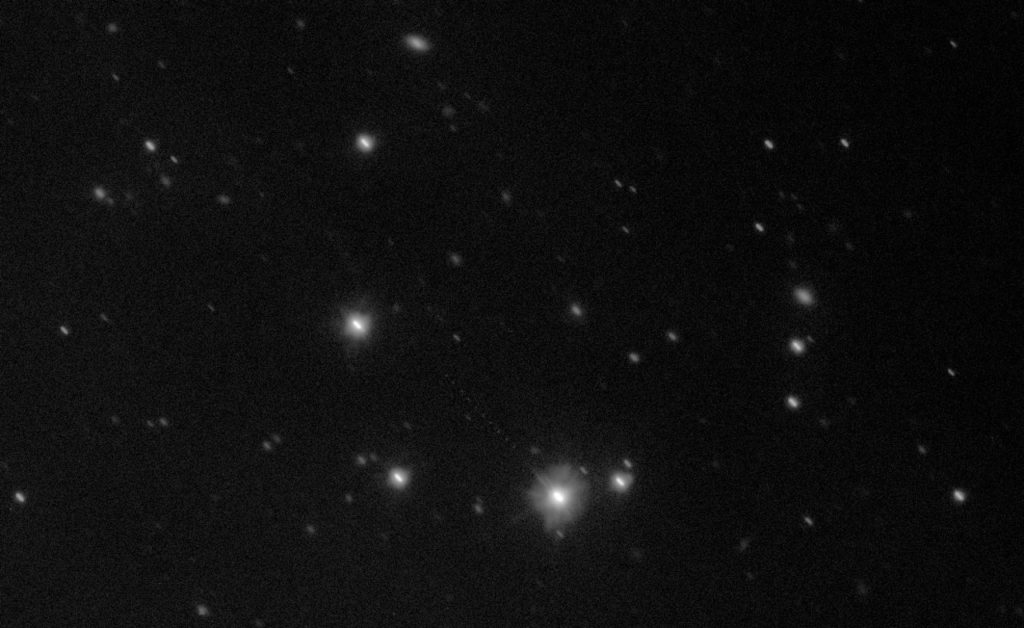
The HR 8799 system harbors four super-Jupiters orbiting with periods that range from decades to centuries. HR 8799e is the innermost planet in this video. This footage consists of 7 images of HR 8799 taken with the Keck Telescope over 7 years. The video was made by Jason Wang, data was reduced by Christian Marois, and the orbits were fit by Quinn Konopacky. Bruce Macintosh, Travis Barman, and Ben Zuckerman assisted in the observations.

HR8799e is a ‘super-Jupiter’, a world unlike any found in our Solar System, that is both more massive and much younger than any planet orbiting the Sun. At only 30 million years old, this baby exoplanet is young enough to give scientists a window onto the formation of planets and planetary systems. The exoplanet is thoroughly inhospitable — leftover energy from its formation and a powerful greenhouse effect heat HR8799e to a hostile temperature of roughly 1000 °C.

This is the first time that optical interferometry has been used to reveal details of an exoplanet, and the new technique furnished an exquisitely detailed spectrum of unprecedented quality — ten times more detailed than earlier observations. The team’s measurements were able to reveal the composition of HR8799e’s atmosphere  — which contained some surprises.

“Our analysis showed that HR8799e has an atmosphere containing far more carbon monoxide than methane — something not expected from equilibrium chemistry,” explains team leader Sylvestre Lacour researcher CNRS at the Observatoire de Paris – PSL and the Max Planck Institute for Extraterrestrial Physics. “We can best explain this surprising result with high vertical winds within the atmosphere preventing the carbon monoxide from reacting with hydrogen to form methane.”

The team found that the atmosphere also contains clouds of iron and silicate dust. When combined with the excess of carbon monoxide, this suggests that HR8799e’s atmosphere is engaged in an enormous and violent storm.

“Our observations suggest a ball of gas illuminated from the interior, with rays of warm light swirling through stormy patches of dark clouds,” elaborates Lacour. “Convection moves around the clouds of silicate and iron particles, which disaggregate and rain down into the interior. This paints a picture of a dynamic atmosphere of a giant exoplanet at birth, undergoing complex physical and chemical processes.”

This result builds on GRAVITY’s string of impressive discoveries, which have included breakthroughs such as last year’s observation of gas swirling at 30% of the speed of light just outside the event horizon of the massive Black Hole in the Galactic Centre. It also adds a new way of observing exoplanets to the already extensive arsenal of methods available to ESO’s telescopes and instruments — paving the way to many more impressive discoveries [4].

Schematic lay-out of the VLT Interferometer. The light from a distant celestial objects enters two of the VLT telescopes and is reflected by the various mirrors into the Interferometric Tunnel, below the observing platform on the top of Paranal. Two Delay Lines with moveable carriages continuously adjust the length of the paths so that the two beams interfere constructively and produce fringes at the interferometric focus in the laboratory.

Notes

[1] GRAVITY was developed by a collaboration consisting of the Max Planck Institute for Extraterrestrial Physics (Germany), LESIA of Paris Observatory–PSL / CNRS / Sorbonne Université / Univ. Paris Diderot and IPAG of Université Grenoble Alpes / CNRS (France), the Max Planck Institute for Astronomy (Germany), the University of Cologne (Germany), the CENTRA–Centro de Astrofisica e Gravitação (Portugal) and ESO.

[2] Interferometry is a technique that allows astronomers to create a super-telescope by combining several smaller telescopes. ESO’s VLTI is an interferometric telescope created by combining two or more of the Unit Telescopes (UTs) of the Very Large Telescope or all four of the smaller Auxiliary Telescopes. While each UT has an impressive 8.2-m primary mirror, combining them creates a telescope with 25 times more resolving power than a single UT observing in isolation.

[3] Exoplanets can be observed using many different methods. Some are indirect, such as the radial velocity method used by ESO’s exoplanet-hunting HARPS instrument, which measures the pull a planet’s gravity has on its parent star. Direct methods, like the technique pioneered for this result, involve observing the planet itself instead of its effect on its parent star.

[4] Recent exoplanet discoveries made using ESO telescopes include last year’s successful detection of a super-Earth orbiting Barnard’s Star, the closest single star to our Sun, and ALMA’s discovery of young planets orbiting an infant star, which used another novel technique for planet detection.

This wide-field image shows the surroundings of the young star HR8799 in the constellation of Pegasus. This picture was created from material forming part of the Digitized Sky Survey 2. The location of HR 8799 is shown.

Links

====

Brief Answers to the Big Questions – Stephen Hawking