** What’s Up: January 2022 Skywatching Tips from NASA – NASA JPL
What are some skywatching highlights in January 2022? Stargazing is at its best on the nights around the new moon, Jan. 2. Later that night, catch the peak of the Quadrantid meteor shower. Then look for the Moon with Jupiter on Jan. 5, and with Mars and Venus on Jan. 29.
0:00 Intro 0:10 New Moon 0:30 Quadrantid meteors 1:28 Dusk / Dawn Highlights 2:28 Moon Phases
Additional information about topics covered in this episode of What’s Up, along with still images from the video, and the video transcript, are available at https://solarsystem.nasa.gov/skywatch….
In January, the northern hemisphere features beautiful views of Capella, a pair of giant yellow stars; Aldebaran, a red giant star; and two star clusters—the Hyades and the Pleiades. Keep watching for the awe-inspiring space-based views of the Crab Nebula, the remains of a star that exploded as a supernova. About this Series “Tonight’s Sky” is a monthly video of constellations you can observe in the night sky. The series is produced by the Space Telescope Science Institute, home of science operations for the Hubble Space Telescope, in partnership with NASA’s Universe of Learning. This is a recurring show, and you can find more episodes—and other astronomy videos—at https://hubblesite.org/resource-galle....
What can you see in the night sky tonight? Astronomers Pete Lawrence and Paul Abel reveal the best night-sky highlights to observe throughout January 2022.
** What’s in the Night Sky June 2021 #WITNS | Comet Leonard | Quadrantid Meteor Shower – Alyn Wallace
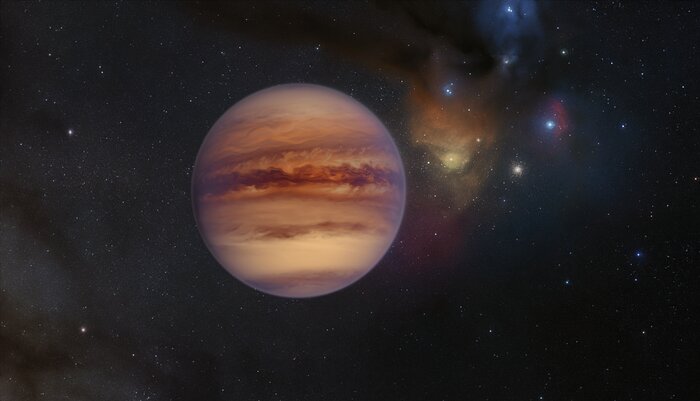
This artist’s impression shows an example of a rogue planet with the Rho Ophiuchi cloud complex visible in the background. Rogue planets have masses comparable to those of the planets in our Solar System but do not orbit a star, instead roaming freely on their own.
Rogue planets are elusive cosmic objects that have masses comparable to those of the planets in our Solar System but do not orbit a star, instead roaming freely on their own. Not many were known until now, but a team of astronomers, using data from several European Southern Observatory (ESO) telescopes and other facilities, have just discovered at least 70 new rogue planets in our galaxy. This is the largest group of rogue planets ever discovered, an important step towards understanding the origins and features of these mysterious galactic nomads.
“We did not know how many to expect and are excited to have found so many,”
says Núria Miret-Roig, an astronomer at the Laboratoire d’Astrophysique de Bordeaux, France and the University of Vienna, Austria, and the first author of the new study published today in Nature Astronomy.
Rogue planets, lurking far away from any star illuminating them, would normally be impossible to image. However, Miret-Roig and her team took advantage of the fact that, in the few million years after their formation, these planets are still hot enough to glow, making them directly detectable by sensitive cameras on large telescopes. They found at least 70 new rogue planets with masses comparable to Jupiter’s in a star-forming region close to our Sun, located within the Scorpius and Ophiuchus constellations [1].
To spot so many rogue planets, the team used data spanning about 20 years from a number of telescopes on the ground and in space.
“We measured the tiny motions, the colours and luminosities of tens of millions of sources in a large area of the sky,” explains Miret-Roig. “These measurements allowed us to securely identify the faintest objects in this region, the rogue planets.”
“The vast majority of our data come from ESO observatories, which were absolutely critical for this study. Their wide field of view and unique sensitivity were keys to our success,” explains Hervé Bouy, an astronomer at the Laboratoire d’Astrophysique de Bordeaux, France, and project leader of the new research. “We used tens of thousands of wide-field images from ESO facilities, corresponding to hundreds of hours of observations, and literally tens of terabytes of data.”
The team also used data from the European Space Agency’s Gaia satellite, marking a huge success for the collaboration of ground- and space-based telescopes in the exploration and understanding of our Universe.
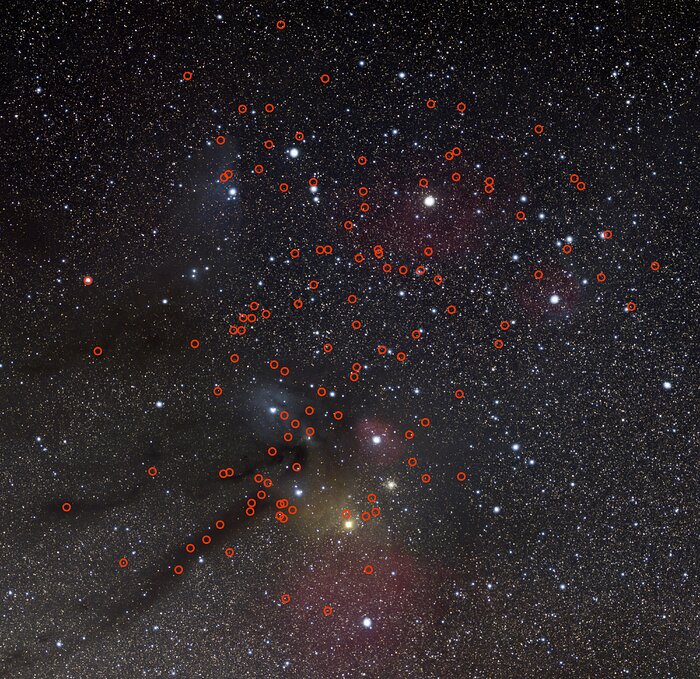
This image shows the locations of 115 potential rogue planets, highlighted with red circles, recently discovered by a team of astronomers in a region of the sky occupied by Upper Scorpius and Ophiucus. Rogue planets have masses comparable to those of the planets in our Solar System, but do not orbit a star and instead roam freely on their own. The exact number of rogue planets found by the team is between 70 and 170, depending on the age assumed for the study region. This image was created assuming an intermediate age, resulting in a number of planet candidates in between the two extremes of the study.
The study suggests there could be many more of these elusive, starless planets that we have yet to discover.
“There could be several billions of these free-floating giant planets roaming freely in the Milky Way without a host star,” Bouy explains.
By studying the newly found rogue planets, astronomers may find clues to how these mysterious objects form. Some scientists believe rogue planets can form from the collapse of a gas cloud that is too small to lead to the formation of a star, or that they could have been kicked out from their parent system. But which mechanism is more likely remains unknown.
Further advances in technology will be key to unlocking the mystery of these nomadic planets. The team hopes to continue to study them in greater detail with ESO’s forthcoming Extremely Large Telescope (ELT), currently under construction in the Chilean Atacama Desert and due to start observations later this decade.
“These objects are extremely faint and little can be done to study them with current facilities,” says Bouy. “The ELT will be absolutely crucial to gathering more information about most of the rogue planets we have found.”
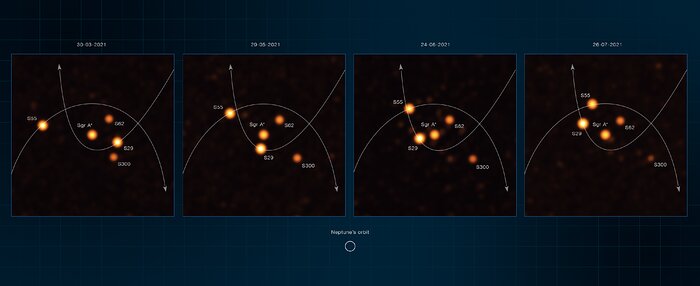
These annotated images, obtained with the GRAVITY instrument on ESO’s Very Large Telescope Interferometer (VLTI) between March and July 2021, show stars orbiting very close to Sgr A*, the supermassive black hole at the heart of the Milky Way. One of these stars, named S29, was observed as it was making its closest approach to the black hole at 13 billion kilometres, just 90 times the distance between the Sun and Earth. Another star, named S300, was detected for the first time in the new VLTI observations. To obtain the new images, the astronomers used a machine-learning technique, called Information Field Theory. They made a model of how the real sources may look, simulated how GRAVITY would see them, and compared this simulation with GRAVITY observations. This allowed them to find and track stars around Sagittarius A* with unparalleled depth and accuracy.
The European Southern Observatory’s Very Large Telescope Interferometer (ESO’s VLTI) has obtained the deepest and sharpest images to date of the region around the supermassive black hole at the centre of our galaxy. The new images zoom in 20 times more than what was possible before the VLTI and have helped astronomers find a never-before-seen star close to the black hole. By tracking the orbits of stars at the centre of our Milky Way, the team has made the most precise measurement yet of the black hole’s mass.
“We want to learn more about the black hole at the centre of the Milky Way, Sagittarius A*: How massive is it exactly? Does it rotate? Do stars around it behave exactly as we expect from Einstein’s general theory of relativity? The best way to answer these questions is to follow stars on orbits close to the supermassive black hole. And here we demonstrate that we can do that to a higher precision than ever before,”
explains Reinhard Genzel, a director at the Max Planck Institute for Extraterrestrial Physics (MPE) in Garching, Germany who was awarded a Nobel Prize in 2020 for Sagittarius A* research. Genzel and his team’s latest results, which expand on their three-decade-long study of stars orbiting the Milky Way’s supermassive black hole, are published today in two papers in Astronomy & Astrophysics.
On a quest to find even more stars close to the black hole, the team, known as the GRAVITY collaboration, developed a new analysis technique that has allowed them to obtain the deepest and sharpest images yet of our Galactic Centre.
“The VLTI gives us this incredible spatial resolution and with the new images we reach deeper than ever before. We are stunned by their amount of detail, and by the action and number of stars they reveal around the black hole,”
explains Julia Stadler, a researcher at the Max Planck Institute for Astrophysics in Garching who led the team’s imaging efforts during her time at MPE. Remarkably, they found a star, called S300, which had not been seen previously, showing how powerful this method is when it comes to spotting very faint objects close to Sagittarius A*.
With their latest observations, conducted between March and July 2021, the team focused on making precise measurements of stars as they approached the black hole. This includes the record-holder star S29, which made its nearest approach to the black hole in late May 2021. It passed it at a distance of just 13 billion kilometres, about 90 times the Sun-Earth distance, at the stunning speed of 8740 kilometres per second. No other star has ever been observed to pass that close to, or travel that fast around, the black hole.
The team’s measurements and images were made possible thanks to GRAVITY, a unique instrument that the collaboration developed for ESO’s VLTI, located in Chile. GRAVITY combines the light of all four 8.2-metre telescopes of ESO’s Very Large Telescope (VLT) using a technique called interferometry. This technique is complex,
“but in the end you arrive at images 20 times sharper than those from the individual VLT telescopes alone, revealing the secrets of the Galactic Centre,”
says Frank Eisenhauer from MPE, principal investigator of GRAVITY.
“Following stars on close orbits around Sagittarius A* allows us to precisely probe the gravitational field around the closest massive black hole to Earth, to test General Relativity, and to determine the properties of the black hole,”
explains Genzel. The new observations, combined with the team’s previous data, confirm that the stars follow paths exactly as predicted by General Relativity for objects moving around a black hole of mass 4.30 million times that of the Sun. This is the most precise estimate of the mass of the Milky Way’s central black hole to date. The researchers also managed to fine-tune the distance to Sagittarius A*, finding it to be 27 000 light-years away.
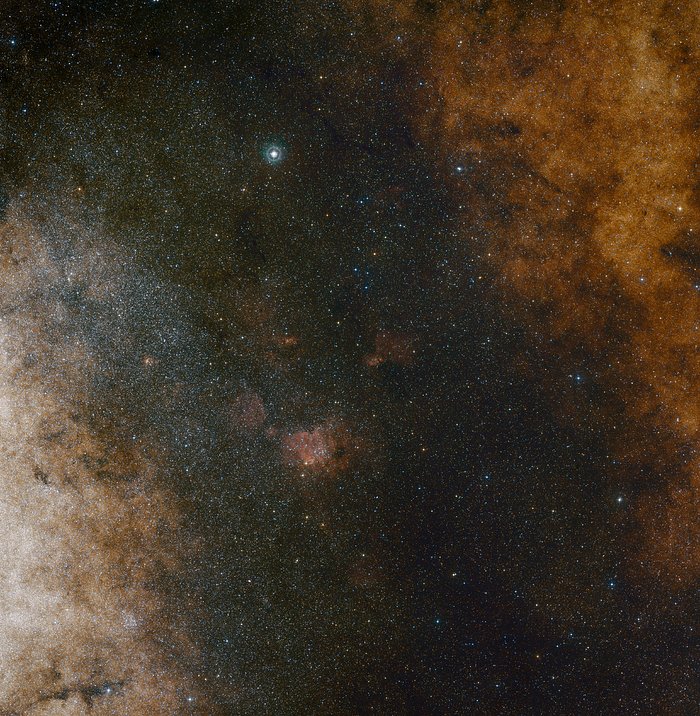
This visible light wide-field view shows the rich star clouds in the constellation of Sagittarius (the Archer) in the direction of the centre of our Milky Way galaxy. The entire image is filled with vast numbers of stars — but far more remain hidden behind clouds of dust and are only revealed in infrared images. This view was created from photographs in red and blue light and forming part of the Digitized Sky Survey 2. The field of view is approximately 3.5 degrees x 3.6 degrees.
To obtain the new images, the astronomers used a machine-learning technique, called Information Field Theory. They made a model of how the real sources may look, simulated how GRAVITY would see them, and compared this simulation with GRAVITY observations. This allowed them to find and track stars around Sagittarius A* with unparalleled depth and accuracy. In addition to the GRAVITY observations, the team also used data from NACO and SINFONI, two former VLT instruments, as well as measurements from the Keck Observatory and NOIRLab’s Gemini Observatory in the US.
GRAVITY will be updated later this decade to GRAVITY+, which will also be installed on ESO’s VLTI and will push the sensitivity further to reveal fainter stars even closer to the black hole. The team aims to eventually find stars so close that their orbits would feel the gravitational effects caused by the black hole’s rotation. ESO’s upcoming Extremely Large Telescope (ELT), under construction in the Chilean Atacama Desert, will further allow the team to measure the velocity of these stars with very high precision.
“With GRAVITY+’s and the ELT’s powers combined, we will be able to find out how fast the black hole spins,” says Eisenhauer. “Nobody has been able to do that so far.”
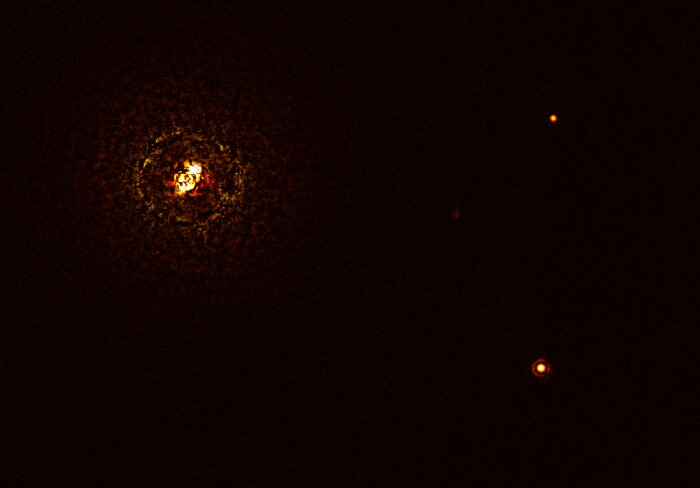
This image shows the most massive planet-hosting star pair to date, b Centauri, and its giant planet b Centauri b. This is the first time astronomers have directly observed a planet orbiting a star pair this massive and hot. The star pair, which has a total mass of at least six times that of the Sun, is the bright object in the top left corner of the image, the bright and dark rings around it being optical artefacts. The planet, visible as a bright dot in the lower right of the frame, is ten times as massive as Jupiter and orbits the pair at 100 times the distance Jupiter orbits the Sun. The other bright dot in the image (top right) is a background star. By taking different images at different times, astronomers were able to distinguish the planet from the background stars. The image was captured by the SPHERE instrument on ESO’s Very Large Telescope and using a coronagraph, which blocked the light from the massive star system and allowed astronomers to detect the faint planet.
The European Southern Observatory’s Very Large Telescope (ESO’s VLT) has captured an image of a planet orbiting b Centauri, a two-star system that can be seen with the naked eye. This is the hottest and most massive planet-hosting star system found to date, and the planet was spotted orbiting it at 100 times the distance Jupiter orbits the Sun. Some astronomers believed planets could not exist around stars this massive and this hot — until now.
“Finding a planet around b Centauri was very exciting since it completely changes the picture about massive stars as planet hosts,”
explains Markus Janson, an astronomer at Stockholm University, Sweden and first author of the new study published online today in Nature.
Located approximately 325 light-years away in the constellation Centaurus, the b Centauri two-star system (also known as HIP 71865) has at least six times the mass of the Sun, making it by far the most massive system around which a planet has been confirmed. Until now, no planets had been spotted around a star more than three times as massive as the Sun.
Most massive stars are also very hot, and this system is no exception: its main star is a so-called B-type star that is over three times as hot as the Sun. Owing to its intense temperature, it emits large amounts of ultraviolet and X-ray radiation.
The large mass and the heat from this type of star have a strong impact on the surrounding gas, that should work against planet formation. In particular, the hotter a star is, the more high-energy radiation it produces, which causes the surrounding material to evaporate faster.
“B-type stars are generally considered as quite destructive and dangerous environments, so it was believed that it should be exceedingly difficult to form large planets around them,”
Janson says.
But the new discovery shows planets can in fact form in such severe star systems.
“The planet in b Centauri is an alien world in an environment that is completely different from what we experience here on Earth and in our Solar System,”
explains co-author Gayathri Viswanath, a PhD student at Stockholm University.
“It’s a harsh environment, dominated by extreme radiation, where everything is on a gigantic scale: the stars are bigger, the planet is bigger, the distances are bigger.”
Indeed, the planet discovered, named b Centauri (AB)b or b Centauri b, is also extreme. It is 10 times as massive as Jupiter, making it one of the most massive planets ever found. Moreover, it moves around the star system in one of the widest orbits yet discovered, at a distance a staggering 100 times greater than the distance of Jupiter from the Sun. This large distance from the central pair of stars could be key to the planet’s survival.
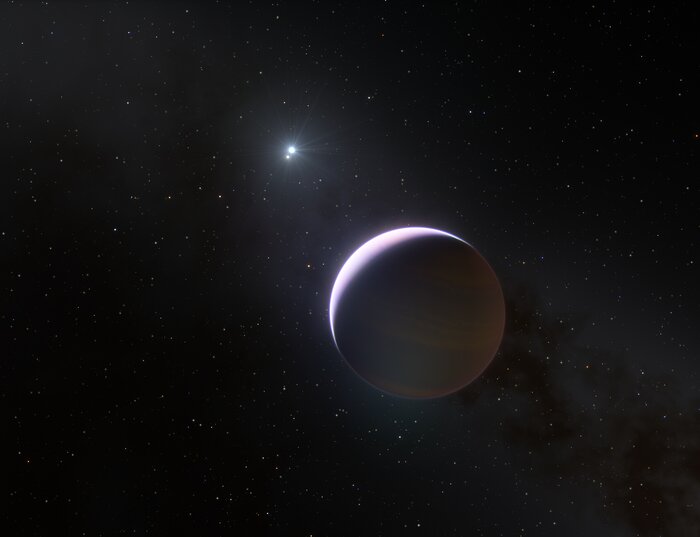
This artist’s impression shows a close up of the planet b Centauri b, which orbits a binary system with mass at least six times that of the Sun. This is the most massive and hottest planet-hosting star system found to date. The planet is ten times as massive as Jupiter and orbits the two-star system at 100 times the distance Jupiter orbits the Sun.
These results were made possible thanks to the sophisticated Spectro-Polarimetric High-contrast Exoplanet REsearch instrument (SPHERE) mounted on ESO’s VLT in Chile. SPHERE has successfully imaged several planets orbiting stars other than the Sun before, including taking the first ever-image of two planets orbiting a Sun-like star.
However, SPHERE was not the first instrument to image this planet. As part of their study, the team looked into archival data on the b Centauri system and discovered that the planet had actually been imaged more than 20 years ago by the ESO 3.6-m telescope, though it was not recognised as a planet at the time.
With ESO’s Extremely Large Telescope (ELT), due to start observations later this decade, and with upgrades to the VLT, astronomers may be able to unveil more about this planet’s formation and features.
“It will be an intriguing task to try to figure out how it might have formed, which is a mystery at the moment,”
** What’s Up: December 2021 Skywatching Tips from NASA – NASA JPL
What are some skywatching highlights in December 2021? See three planets after sunset, but say goodbye to Venus as the “Evening Star” at the end of the month. Then have a hunt for newly discovered Comet Leonard in the early morning through mid-month. Finally, get up early on Dec. 14 to watch for Geminid meteors after local moonset, around 2 a.m. Additional information about topics covered in this episode of What’s Up, along with still images from the video, and the video transcript, are available at https://solarsystem.nasa.gov/whats-up….
Step outside on a cold December night when the stars shine bright to find the Big Dipper, Cassiopeia, and Cepheus. They will help you locate a binary star system, a fan-shaped open star cluster, and a variable star. Stay tuned for space-based views of a ragged spiral galaxy, an open star cluster, and an edge-on galaxy.